



The simulation theory is one of the most shocking and mind-bending scientific hypotheses of the modern era. Have you ever stared up at the night sky or looked closely at the digital pixels on your smartphone screen, only to be struck by an eerie, existential thought: “What if this entire universe is an ultra-advanced computer simulation?”
While it sounds like a plot straight out of The Matrix, some of the world’s most brilliant physicists, cosmologists, and tech innovators—including Elon Musk and astrophysicist Neil deGrasse Tyson—openly entertain the mathematical probability that physical reality is a synthetic creation. What makes this idea so terrifying is not philosophical speculation, but hard quantum physics.
When scientists peer deep into the subatomic building blocks of matter, they encounter bizarre physical laws that behave exactly like the optimization code of a video game engine. Here is the mind-blowing science behind the simulation theory and seven real quantum physics experiments that challenge our understanding of reality.
1. What Exactly Is the Simulation Theory?
The simulation theory, popularized by Oxford philosopher Nick Bostrom in 2003, posits a mathematical trilemma: if advanced civilizations survive long enough to develop immense computing power, they will inevitably run hyper-realistic ancestral simulations. Statistically, simulated minds would quickly outnumber biological ones, meaning we are almost certainly living inside a simulated reality right now.
One of the most compelling arguments for the simulation hypothesis comes from physicist Silas Beane and colleagues at the University of Washington. In a 2012 paper, they demonstrated that the structure of space-time, as described by quantum mechanics, is consistent with the structure that would emerge from a computational lattice—essentially a massive grid of processors. While this does not prove we live in a simulation, it shows that the physical universe has properties that are remarkably similar to what we would expect from a simulated environment.

Physicist Jim Baggott, writing in Scientific American, has noted that many of the seemingly arbitrary constants of physics—the speed of light, the gravitational constant, the charge of an electron—could potentially be seen as “parameters” in a simulation. While this interpretation is speculative, it raises genuine philosophical questions about the nature of physical reality that scientists continue to debate.
Critics of the simulation hypothesis point out that even if the universe has computational properties, this does not necessarily mean it was deliberately created by a programmer. Natural processes can produce computational structures without intentional design. The hypothesis also faces a logical problem: if we are in a simulation, how would we ever know? Any evidence we gather is, by definition, part of the simulation and therefore cannot prove or disprove its existence.
In quantum mechanics, physical matter does not exist in a solid, fixed state until it is measured. Subatomic particles exist purely as diffuse “probability waves” until an observer measures them. The moment an observation occurs, the probability wave instantly collapses into a solid physical particle. In computer graphics programming, this identical technique is called “Occlusion Culling”—a rendering engine only renders the 3D environment that the player is actively looking at to conserve processing power.

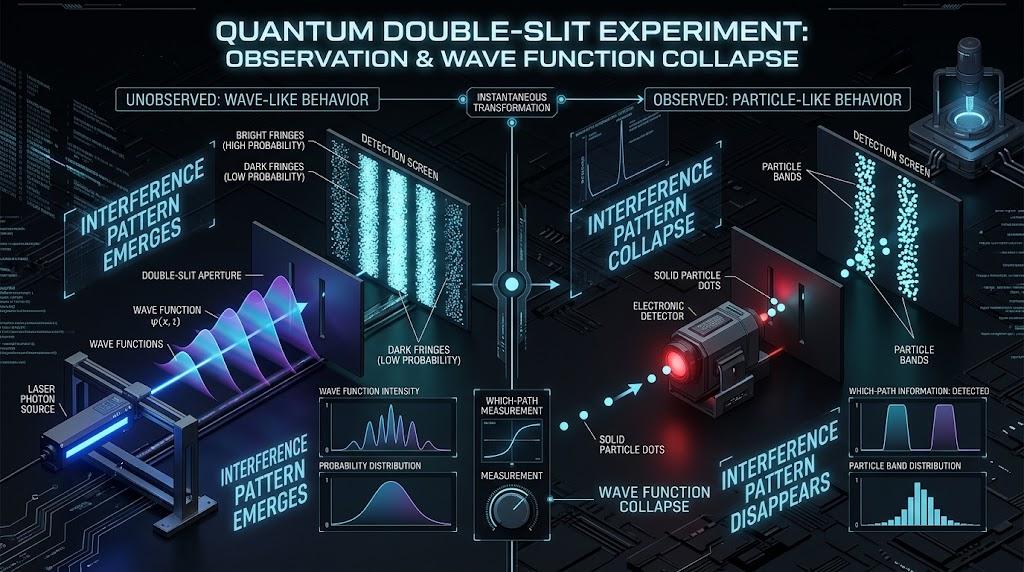
⚛️ THE DOUBLE-SLIT EXPERIMENT: The Observer Effect
The cornerstone experiment supporting the simulation theory and digital physics is the famous Double-Slit Experiment:
- Unobserved Particles: When photons or electrons are fired through two slits without a detector watching, they act like waves, creating a wave interference pattern on the back wall.
- Observed Particles: The second scientists place a detector at the slits to watch which slit the particle passes through, the particles instantly stop acting like waves and behave like solid billiard balls.
- The Conclusion: The universe refuses to calculate a particle’s exact location until an observer requests the data, functioning identically to an on-demand software rendering engine.
2. Simulation Theory and the Speed of Light: A Hard Processing Limit
Why does the universe have an absolute speed limit? According to Einstein’s theory of relativity, nothing in the universe—no object, signal, or ray of light—can travel faster than 299,792,458 meters per second. This speed, denoted as $c$, is not merely a physical boundary. It is a hard mathematical wall that governs every interaction in the cosmos.
Theoretical physicists exploring the simulation theory suggest a provocative explanation for why this limit exists:
- Every computer processor has a hardware clock rate (measured in Gigahertz) limiting how many calculations it can process per second.
- If an object in a simulated universe moved at infinite speed, the underlying processing engine would collapse due to infinite computational load.
- The speed of light represents the maximum clock speed of our universe’s computational hardware—the maximum rate at which information can transfer across spatial pixels (Planck lengths).
Think about it this way: in a video game, no character can move faster than the engine can render their position. If a character attempted to teleport across the map faster than the frame rate could update, the game would crash or produce visual glitches. The speed of light may serve the exact same function in our reality—a failsafe to prevent the simulation from overloading.
This processing speed limit is closely related to how digital processing limits shape synthetic environments under the dead internet theory.
The Substrate Reality Paradox: Red Pill vs Blue Pill
Physicists present incontrovertible mathematical proof that our universe is a computational simulation run by ancestor researchers. You are given a one-time choice to view the raw host code:
3. Quantum Entanglement: Instantaneous Data Transfer Across the Simulation
Albert Einstein famously derided Quantum Entanglement as “spooky action at a distance.” Entanglement occurs when two subatomic particles become deeply linked; if you measure the spin of one particle on Earth, its entangled partner instantly adjusts its spin on the far side of the universe—faster than the speed of light.
This phenomenon has been confirmed in countless experiments since the 1980s, most notably by physicist Alain Aspect in 1982 and later by a team at Delft University in 2015. The results are undeniable: entangled particles communicate instantaneously regardless of distance. But how can information travel across billions of light-years instantaneously without violating relativity?

The simulation theory offers a surprisingly elegant answer:
- In physical 3D space, the particles are separated by vast distances.
- However, in a computer simulation, two objects located on opposite sides of the screen share the exact same memory address in the underlying RAM.
- Changing the value in the RAM updates both screen pixels simultaneously, regardless of their visual distance on the screen display.
Quantum entanglement demonstrates that physical distance is an illusion created by the rendering interface, while the underlying data remains instantly connected at the root code level. This is one of the strongest pieces of evidence cited by simulation theory proponents, because no known law of classical physics can explain how two particles separated by light-years can share information without any signal traveling between them.
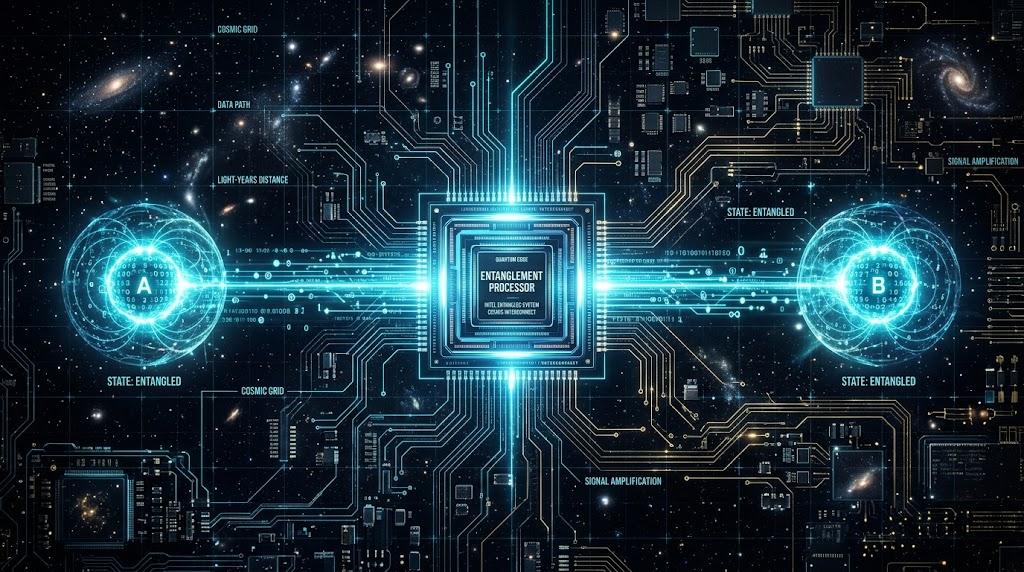
“If physical reality were fundamental, instantaneous communication across space would be impossible. Quantum entanglement proves that 3D space is merely a projected user interface.”
4. Pixelated Space: The Planck Length and Discrete Reality
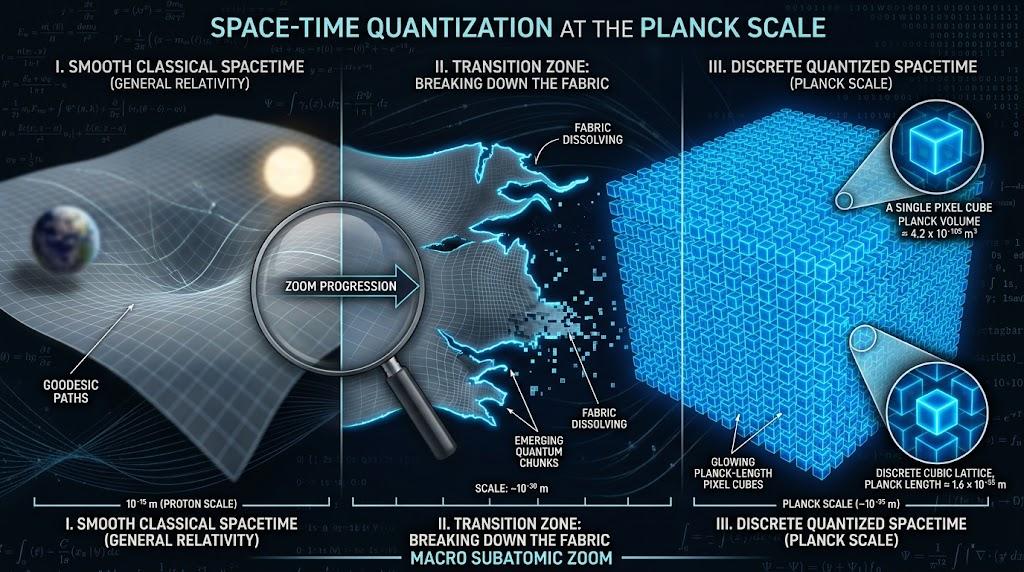
In digital video games, if you zoom in close enough on a high-definition monitor, you eventually hit the smallest indivisible unit of visual graphics: the pixel. Continuous curves disappear, revealing a grid of discrete square blocks. This is the fundamental architecture of every digital display ever created.
Physics encounters this exact same barrier at the subatomic scale—a key argument in the simulation theory:
- Space is not continuous; it is quantized into discrete units called the Planck Length ($1.6 imes 10^{-35}$ meters). Below this threshold, the very concept of “distance” loses all meaning.
- Time is also quantized into discrete units called Planck Time ($5.39 imes 10^{-44}$ seconds). You cannot experience a time interval smaller than this.
- You cannot move a distance smaller than a Planck length, meaning space itself has a finite resolution—just like a digital screen.
Discovering that space and time are broken into discrete, indivisible units suggests that our universe operates on a spatial grid resolution—the exact architecture of a digital simulation. If reality were truly continuous and infinite, there would be no reason for nature to impose a minimum possible distance. The existence of Planck units is exactly what we would expect if the universe were running on finite computational hardware.
This structural grid architecture is deeply connected to how the human brain constructs perceptual boundaries from sensory noise.
5. Error-Correcting Code Hidden in the Equations of Physics
In 2011, theoretical physicist Sylvester James Gates Jr. made a startling discovery while working on supersymmetry and string theory equations at the University of Maryland. While simplifying complex mathematical formulas describing the fundamental forces of nature, Gates found something that should not exist in pure physics.
Inside these equations were embedded sequences of binary code—specifically, block linear error-correcting codes. These are the exact same self-correcting algorithms developed by Claude Shannon that modern internet browsers use to detect and correct data transmission errors. When you load a webpage and the data arrives corrupted, these error-correcting codes silently fix the damage before you ever notice.
The question that shook the physics community was simple: why would pure, unguided natural physics contain digital error-correcting algorithms designed to protect data integrity?
Proponents of the simulation theory argue that these codes prevent computational glitches or memory corruption within the universe’s simulation runtime. Just as software engineers build error correction into their programs to prevent crashes, the underlying code of reality may include the same safeguards. Gates himself has acknowledged that while he does not claim this proves we live in a simulation, the presence of these codes is “suspicious” and demands explanation.
This computational strain on human perception is similar to how perceptual glitches trigger revulsion under the uncanny valley effect, as our brains detect subtle synthetic anomalies in the world around us.
6. The Cosmic Ray Cut-Off: A Rendering Boundary in the Sky
High-energy cosmic rays—subatomic particles traveling through space at nearly the speed of light—have a hard energy ceiling known as the GZK limit (named after Greisen, Zatsepin, and Kuzmin). No cosmic ray has ever been detected above this energy threshold, despite the fact that there is no known physical reason why particles could not be accelerated beyond it.
Computer simulations modeling early universe physics generate this exact same cut-off due to spatial grid resolution limits. When a simulation’s grid cannot resolve movements smaller than a single pixel, particles exceeding a certain energy level simply cannot be represented. The GZK limit in our universe mirrors this computational constraint with eerie precision.
If the universe were truly infinite and continuous, there would be no reason for cosmic rays to hit a sudden energy wall. But if reality is rendered on a finite grid with a maximum resolution, this cut-off is not just expected—it is inevitable. This observation adds another layer of evidence to the simulation theory, suggesting that the fabric of space-time itself has a maximum processing capacity.
7. The Conscious Observer: Why Awareness Shapes Reality
Perhaps the most philosophically disturbing aspect of quantum physics is the role of consciousness in determining physical reality. The measurement problem in quantum mechanics asks a deceptively simple question: what counts as an “observation”?
In the famous Schrödinger’s Cat thought experiment, a cat in a sealed box exists in a superposition of both alive and dead simultaneously—until someone opens the box and looks. The act of conscious observation forces the quantum system to “choose” a definite state. This is not philosophy; it is experimental physics confirmed by decades of research.
Quantum physics consistently reveals that consciousness is not a passive bystander in the universe. The act of conscious observation actively forces physical matter to manifest into concrete reality. This is deeply strange. In a purely physical universe, the act of a human looking at something should have no effect on subatomic particles. But it does—every single time.
The simulation theory explains this phenomenon elegantly: consciousness is not inside the simulation. Conscious observers exist at a higher level of reality—the level of the user. When a conscious observer “looks” at a quantum system, they are essentially requesting the simulation to render that specific data. Until the request is made, the data does not need to exist. This is resource optimization 101: never compute what nobody is watching.
Simulation Theory: Summary and Frequently Asked Questions
The simulation theory is a compelling intersection of quantum physics, mathematics, and philosophy. Whether reality is physical or digital, exploring these boundaries deepens our appreciation for the profound mysteries of consciousness. From the observer effect to Planck-length pixels, seven real physics experiments continue to challenge our assumptions about what is “real.”
Is there definitive proof that we live in a simulation?
No. While quantum phenomena like the observer effect and Planck quantization mirror computer code mechanics, they remain subject to multiple theoretical physics interpretations. The simulation theory remains a hypothesis, not a proven fact. However, the mathematical similarities between quantum behavior and computational processes are difficult to dismiss entirely.
Why would an advanced civilization run a simulation of us?
Philosophers suggest advanced civilizations run ancestral simulations to study history, model climate futures, explore social dynamics, or experience biological consciousness. If such simulations are possible, they would be infinitely cheaper to run than conducting real-world experiments across millions of years.
What is the strongest evidence for the simulation theory?
The combination of quantum observer effects, Planck-length discretization, quantum entanglement, and error-correcting codes in physics equations together form a compelling circumstantial case. No single experiment proves the theory, but the pattern of computational-like behavior across multiple domains of physics is striking.
Where can I read more scientific research on digital physics?
To explore technical papers on digital physics and quantum mechanics, consult the Bostrom, N. (2003) – Are You Living in a Computer Simulation? as well as theoretical physics research in Scientific American on quantum reality experiments.
References
- Beane, M. et al. (2012). The lattice simulation hypothesis. European Physical Journal A, 48, 92. DOI: 10.1140/epja/i2012-12092-y
- Bostrom, N. (2003). Are you living in a computer simulation? Philosophical Quarterly, 53(211), 243-255. DOI: 10.1111/1468-0068.00414
- Tegmark, M. (2014). Our Mathematical Universe: My Quest for the Ultimate Nature of Reality. Knopf.
- Kurzweil, R. (2005). The Singularity Is Near: When Humans Transcend Biology. Viking.
📚 You Might Also Like
Hand-picked articles for you


