


In 2002, an Israeli psychologist named Eli Somer described six adult patients at the University of Haifa who did not fit any textbook. They were not psychotic; they knew their rich internal worlds were self-generated. They were not merely absent-minded. Each had spent years absorbed for hours daily in intricate, ongoing internal sagas — complete with recurring characters, plot arcs, and emotional stakes — so consuming that the fantasy life had begun to replace their actual one. Somer named the phenomenon maladaptive daydreaming: extensive fantasy activity that replaces human interaction and interferes with academic, interpersonal, or vocational function. Two decades later, the syndrome has a validated measurement instrument, thousands of self-identified sufferers, and a research literature — but still no official diagnostic code.
The distinction that defines the field is not the dreaming itself but its relationship to the dreamer. Mundane mind wandering is spontaneous stimulus-independent thought: a fragment of rehearsal, a mental grocery list, a stray resentment that drifts through while you drive. It is brief, unstructured, and cheap. Maladaptive daydreaming is something categorically different — immersive, emotionally charged, narratively structured virtual reality, entered voluntarily yet abandoned with difficulty, the way an addict relates to a substance. The difference between the two is roughly the difference between a daydream of a beach and an ocean you can drown in.
An internally generated world with the emotional resolution of a film — and the grip of a substance.
The Tri-Network Failure: A Brain Talking Only to Itself

The default mode network — anchored in the medial prefrontal cortex, the posterior cingulate cortex, and the angular gyrus — is the brain’s story-generating system. It renders autobiographical memory, social simulation, and imagined futures; it is most active precisely when attention turns inward. We have examined why your brain repeats the same thoughts — the same narrative machinery, stuck in gear. This network is the engine of all daydreaming, healthy or otherwise. The default mode network is not the problem. The problem is who else is talking.
In healthy cognition, two partner networks keep the story-generating system in check. The central executive network — the dorsolateral prefrontal cortex and posterior parietal cortex — exerts top-down control, mobilizing attention toward tasks and dampening internal narrative when the world demands action. The salience network — the anterior insula and dorsal anterior cingulate cortex — acts as the switchboard, detecting which signals, internal or external, deserve attention.

Maladaptive daydreaming can be described as a tri-network failure, in the language of Vinod Menon’s influential model of psychopathology: the default mode network renders narrative worlds without interruption; the central executive network fails to assert inhibitory control over the rendering; and the salience network tags self-generated fantasy as more salient and biologically urgent than the physical world. The brain ends up talking mostly to itself — with feeling. As our article on why focus is so fragile explains, attention is a contested resource — and the contest has been forfeited from the start.
No neuroimaging study has yet confirmed this architecture directly in maladaptive daydreamers, and honesty requires saying so. But the model explains the phenomenology with unusual precision: absorption that persists despite attempted interruption, and a reality that grows progressively thinner than the simulation.
The Dopaminergic Trap: Why the Dream World Is Addictive

Ask people with maladaptive daydreaming why they return, and the answers describe a drug. The fantasies are engineered — by no one, yet precisely — around maximum reward: heroism, romantic validation, dramatic stakes, competence, rescue. The neurochemistry of motivation suggests why maladaptive daydreaming behaves like an internally generated drug. Anticipated reward triggers phasic dopamine release from the ventral tegmental area into the nucleus accumbens, the striatal circuitry that stamps experiences with “do this again” — the same loop engaged by games, gambling, and substances.

The crucial difference is supply. A behavioral addiction to slot machines still requires a casino; the maladaptive daydreamer carries the casino in their head. The trigger is instantly accessible, costs nothing, and cannot be confiscated — which is precisely what makes the loop so hard to interrupt. Researchers have documented the full addictive signature: tolerance, as scenarios must escalate in drama to deliver the same emotional payload; compulsive escalation of hours spent; distress and irritability when interrupted; and continued use despite mounting damage to work, relationships, and sleep. One qualitative study interviewing self-diagnosed daydreamers concluded that the syndrome behaves, functionally, like a new form of behavioral addiction — a drug laboratory manufacturing its own supply.
The daydreams work, at first. That is the trap’s genius and its cruelty: the loop provides genuine emotional regulation — comfort, excitement, self-esteem repair — delivered faster than the world can deliver it. Nothing external competes.
Do Your Daydreams Involve Kinesthetic Triggers?
Many individuals who engage in vivid, immersive fantasy report that narratives are involuntarily triggered by repetitive physical pacing, rocking, or looping emotional music tracks.
The Body in the Loop: Kinesthetic Stereotypies and the Motor Induction
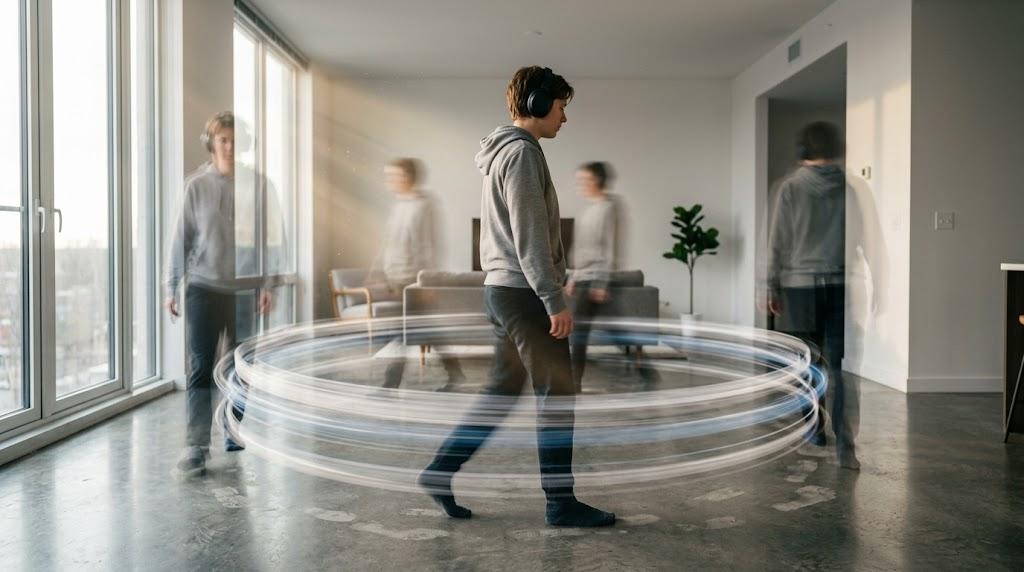
Ask the second question, and the phenomenology turns physical: nearly everyone with maladaptive daydreaming describes movement. Pacing in fixed loops, rocking, spinning, hand-flapping or weaving motions, rhythmic jumping — accompanied, very often, by music played on repeat, the same track or track-sequence cued like a needle on a record.
These kinesthetic motor stereotypies are not incidental quirks; they are part of the machinery. The research literature describes them as facilitators: proprioceptive rhythm appears to stabilize the cognitive trance, giving the wandering mind a repetitive, automatic anchor in the body while the default mode network renders its parallel world. The acoustic scaffolding works in parallel: a looping track cues narrative moods — each song mapped to a storyline — and insulates the brain from competing ambient signals.
The resulting system is a sensorimotor induction loop: body feeds rhythm, rhythm feeds trance, trance deepens, and the body’s motion continues its loop. Maladaptive daydreaming in this state is not a thought but a choreography — mind and motor loop locked together until the music stops or someone walks into the room.
What It Is Not: The Differential Diagnosis
Because maladaptive daydreaming lives near several better-known conditions, the differential diagnosis is where rigor matters most. In the differential matrix below, six dimensions separate maladaptive daydreaming from the conditions it most resembles — the six warning signs clinicians most need.

| Dimension | Mundane mind-wandering | ADHD inattention | Obsessive-compulsive disorder | Psychosis spectrum | Maladaptive daydreaming |
|---|---|---|---|---|---|
| Volition | Spontaneous drift; easily shed | Involuntary attention lapses | Intrusions resisted | Not voluntary | Entered willingly, exited with difficulty |
| Narrative cohesion | Fragmentary | Fragmentary | Repetitive single themes | Disorganized | Multi-year structured sagas |
| Reality testing | Intact | Intact | Intact | Impaired | Intact — always known to be imagined |
| Motor stereotypies | Absent | Fidgeting, not narrative-linked | Usually absent | Variable | Pacing, rocking, looping music |
| Reward value | Neutral or mild | None | None — experienced as aversive | Variable | Intensely pleasurable |
| Functional impact | Minimal | Broad impairment | Driven by rituals or avoidance | Often severe | Hours daily lost to fantasy |
The critical diagnostic divergence rests on volitional agency and functional impairment. Reality testing — the intact, moment-by-moment knowledge that the world is self-generated — separates the syndrome categorically from psychosis, where imagined content is experienced as external perceptual reality. And reward value separates it from obsessive-compulsive disorder: the obsessions of OCD are endured, not enjoyed, while the maladaptive daydreamer’s fantasy is the best thing in their day. The disorder is compulsive in structure but hedonic in texture.
From Sanctuary to Prison: The Trauma-Attachment Genesis

Why does a healthy capacity become maladaptive daydreaming? The developmental literature points consistently toward childhood. Surveys of self-identified daydreamers repeatedly find histories of loneliness, emotional neglect, and adversity, and clinical studies find elevated rates of childhood trauma alongside high dissociative absorption — the trait of becoming fully immersed in internal experience to the point of losing awareness of surroundings.
The mechanism rhymes with what we described in how emotional memories are stored differently than facts: emotionally charged experience consolidates with a potency ordinary facts never receive — and for the daydreamer, every potent memory is self-generated.
The account that fits the evidence is tragic in structure. For a child lacking warmth, safety, or peers, imagination becomes an analgesic: dissociative absorption deploys the brain’s own simulation engine as a shelter, a place where attachment needs are met, control is absolute, and humiliation can be rewritten as triumph.
The sanctuary is adaptive. It regulates distress no adult is regulating. But the nervous system learns the wrong lesson — that the internal world is where life is lived — and the sanctuary built in childhood compounds interest for decades. By adulthood, the maladaptive daydreamer’s hours have a second, parallel economy: real relationships foregone for phantom ones, real competence undeveloped because the simulation already supplies the feeling of it. Phantom achievements, in the end, are the most expensive kind — purchased with the years the real world required.
Measuring Maladaptive Daydreaming: The MDS-16 and the Threshold of Disorder
The 16-Item Maladaptive Daydreaming Scale, developed by Somer and Nirit Soffer-Dudek with colleagues and validated across cultures, converted maladaptive daydreaming from anecdote into measurable construct. Its items interrogate the dimensions this article has traced: hours consumed, the pull of music and movement as triggers, distress when interrupted, and functional impairment across real obligations.
The scale also encodes the field’s most important distinction: the line between immersive daydreaming and maladaptive daydreaming. Immersive daydreaming is a high-trait capacity — elaborate, vivid fantasy that coexists with a functioning life and often feeds it; writers, artists, and scientists build careers on it. Maladaptive daydreaming is the same capacity after capture: absorption so compulsive that psychological distress and life paralysis follow. The difference is not the vividness of the inner world but its cost — one enriches the dreamer’s life; the other replaces it. A person can sit at either point on that gradient, and the same imagination can migrate from asset to parasite as circumstances and stress shift the balance.
What Actually Helps: Clinical Frontiers
No treatment has yet been validated in a large randomized trial, and any honest article must say so before it says anything else. But the emerging clinical literature offers three converging strategies.
Mindfulness-based approaches train the skill the tri-network failure loses: metacognitive awareness — the ability to notice a narrative spark as a mental event rather than an invitation. The therapeutic target is early; interrupt the associative spark before the trance compiles, and the loop never gains momentum.
Stimulus control attacks the sensorimotor induction loop directly: remove the pacing runways, the looping tracks, the cues that choreograph the trance. Behavioral experiments — standing still while daydreaming, or playing silence — reliably expose how much of the absorption’s grip was scaffolding rather than self.
Pharmacological observations remain preliminary. Case literature and self-report surveys note benefit from fluvoxamine — a selective serotonin reuptake inhibitor with sigma-1 receptor activity — and from agents modulating serotonin and dopamine, particularly in sufferers with comorbid obsessive-compulsive traits. One patient treated with fluvoxamine for over a decade reported her daydreaming controlled throughout. No medication has been tested in a controlled trial for this indication; the observations are hypotheses, not prescriptions.
Protocols built on these principles — recognizing triggers, decoupling movement from fantasy, scheduling deliberate immersive time instead of forbidding it — define the field’s current clinical frontier, and early pilot work reports encouraging results.
The Simulation Engine: An Evolutionary Synthesis
Zoom out, and the syndrome becomes a comment on what human imagination is for. Our species’ defining trick is offline simulation — running futures, rehearsing conversations, composing symphonies and spacecraft in the same default mode network that renders a daydreamer’s saga. Mind wandering is not the brain malfunctioning; it is the simulation engine idling, and from that idling comes most of what civilization calls creativity.
Maladaptive daydreaming is the simulation engine devouring the simulator. The system that lets us rehearse possible lives becomes a place to hide from the actual one; the same prediction machinery that writes novels writes a fugue state. The clinical task, in this light, is not to lobotomize the engine but to re-anchor it — to return the simulation to its role as servant of a life rather than substitute for one. The inner world that once offered refuge can become again what it was always meant to be: a workshop, not a residence.
The experience of the sufferers themselves may say it best. One person’s description of the condition has become the field’s unofficial epigraph: the daydreams are a black hole — “it sucks you in and it’s pleasurable and you don’t even realize that you’re sinking until it’s too late.” The research exists precisely so that recognizing the pull no longer comes too late.
Frequently Asked Questions About Maladaptive Daydreaming
Is maladaptive daydreaming officially recognized in the DSM-5-TR?
No. Maladaptive daydreaming appears in no diagnostic manual — not the DSM-5-TR, not the ICD-11. The syndrome has validated measurement instruments, structured diagnostic criteria proposed in the research literature, and growing comorbidity data, but the formal recognition debate continues. Clinicians currently address it through comorbid conditions or treat the behavior directly with the emerging protocols described above. Recognition, most researchers argue, is a matter of when, not whether — the epidemiological groundwork is being laid now.
How can I be certain this isn’t subtle schizophrenia or psychosis?
The differential hinges on reality testing, a distinction psychiatry can assess reliably. In psychosis, imagined content is experienced as external perceptual reality — voices arrive from outside, beliefs feel imposed. In maladaptive daydreaming, the absorption can be total and yet the dreamer always knows, throughout, that the world is self-generated and under at least nominal voluntary control. No matter how cinematic the fantasy, it is authored, not perceived. If uncertain experiences exist — content that feels externally broadcast or inserted — that specific feature deserves psychiatric evaluation on its own terms.
Why do I feel an uncontrollable urge to pace or listen to music while daydreaming?
The motor loop and the acoustic loop are part of the machinery, not habits layered on top of it. Repetitive proprioceptive rhythm stabilizes the cognitive trance the way a stabilizer stabilizes a shot, and looping music both cues narrative moods and masks external signals that could puncture absorption. That is why attempts to daydream while standing still or in silence often fail: you are dismantling the induction apparatus. It is also why the most effective behavioral interventions target movement and sound first.
Can a person stop maladaptive daydreaming without losing their creativity?
Yes — and the distinction matters clinically. Immersive daydreaming, the underlying capacity, is a trait, not a symptom; maladaptive daydreaming is what the capacity becomes under compulsion. Treatment targets the compulsive loop, not the imagination: scheduled deliberate fantasy time, decoupled triggers, and mindfulness training preserve the engine while returning control of the ignition. Many sufferers report not losing their creative depth but gaining the ability to close the studio door.
Disclaimer
Medical Disclaimer: This article is for educational purposes only and does not diagnose or treat any condition. Distressing or disabling fantasy absorption, or any persistent mental health symptom, deserves evaluation by qualified healthcare professionals.
References
- Somer E. Maladaptive daydreaming: a qualitative inquiry. J Contemp Psychother. 2002;32(2):197–212. DOI 10.1023/A:1020597026919
- Bigelsen J, Schupak C. Compulsive fantasy: proposed evidence of an under-reported syndrome through a systematic study of 90 self-identified non-normative fantasizers. J Trauma Dissociation. 2011;12(5):561–576. DOI 10.1080/15299732.2011.607548
- Somer E, Lehrfeld J, Bigelsen J, Jopp DS. Development and validation of the Maladaptive Daydreaming Scale (MDS). Conscious Cogn. 2016;39:77–91. PMID 26707384
- Somer E, Soffer-Dudek N, Ross CA. The comorbidity of daydreaming disorder (maladaptive daydreaming). J Nerv Ment Dis. 2017;205(7):525–530. PMID 28598955
- Soffer-Dudek N, Somer E. Trapped in a daydream: daily elevations in maladaptive daydreaming are associated with daily psychopathological symptoms. Front Psychiatry. 2018;9:194. PMID 29867613
- Pietkiewicz IJ, Nęcki S, Bańbura A, Tomalski R. Maladaptive daydreaming as a new form of behavioral addiction. J Behav Addict. 2018;7(3):838–843. PMID 30238787
- Buckner RL, DiNicola LM. The brain’s default network: updated anatomy, physiology and evolving insights. Nat Rev Neurosci. 2019;20(10):593–608. PMID 31492945
- Ross CA, Ridgway J, George N. Self-reported medication and recreational drug effectiveness in maladaptive daydreaming. Clin Psychopharmacol Neurosci. 2020;18(4):567–576. PMID 31688494
- Soffer-Dudek N, Theodor-Katz N. Maladaptive daydreaming: epidemiological data on a newly identified syndrome. Front Psychiatry. 2022;13:871041. PMID 35573338
- Smallwood J, Schooler JW. The science of mind wandering: empirically navigating the stream of consciousness. Annu Rev Psychol. 2015;66:487–518. PMID 25293689
- Menon V. Large-scale brain networks and psychopathology: a unifying triple network model. Trends Cogn Sci. 2011;15(10):483–506. PMID 21908230


