


You finish the dishes. You reach for a towel. And there they are: your fingertips have turned into the surface of a prune — deep ridges, pale creases, fingertips that suddenly look decades older. Ten minutes in the bath does the same to your toes. It happens every time, to everyone, everywhere on Earth, and it reverses itself completely within half an hour. The ordinary question of why digits prune in water turns out to have a genuinely surprising biological answer.
For a long time, the explanation commonly repeated for this wrinkling was almost insultingly simple: your skin absorbs water and puffs up, and the swollen surface wrinkles like a balloon inflated unevenly. It sounds right. It appears in textbooks. Parents still say it at kitchen sinks.
It is also — and this is the strange part — impossible. Dead skin that passively swells cannot choose where it wrinkles, cannot be switched off by a damaged nerve, and certainly cannot respond to a drug that quiets a specific branch of your nervous system. Yet your wrinkling fingers do all of those things. That is the first clue: whatever is happening beneath the skin is not chemistry or passive osmosis alone. The truth has been sitting in plain sight in neurology clinics for half a century — your fingers are not soaking. They are being actively reshaped, on command, by your nervous system.
This article follows that discovery the way it actually happened: from clinical bedside observations of nerve injuries, to laser Doppler measurements of microvascular blood flow, to experiments with submerged objects and wet grip. By the end you will know exactly why fingers wrinkle in water, what the wrinkles are for, and how doctors use the same reflex to test whether a nerve in your hand is still alive.
Start with the everyday observation. Glabrous skin — the smooth, hairless kind on your palms, finger pads, and soles — is the only skin on your body that does this. Soak your elbows, your knees, your face: nothing. Soak a fingertip: ridges, reliably, in minutes. Any biological account of the phenomenon has to start here, with that selectivity. And the pattern is not random. Ridges tend to form in similar places on similar fingers, fanning outward from the center of the pad in a geometry that researchers have compared to the tread of a tire or the channels of a drainage network.

Now add the detail that breaks the swelling story forever. If a finger’s nerve supply is cut — by injury, by an anesthetic block, or by disease — that finger will not wrinkle at all, no matter how long it stays in the water.
This is not a curiosity. It is a diagnostic test that predates most of modern neurology. In 1973, S. O’Riain described the trick in the British Medical Journal: drop an injured hand into warm water, wait, and see which fingers wrinkle. The ones that do still have a living, talking nerve. The ones that stay smooth have lost their connection. Surgeons still reach for versions of this “wrinkle test” today — no machine in the clinic is as cheap, as fast, or as convincing as a bowl of warm water. The oldest clinical answer to digit wrinkling is, in other words, an autonomic nerve response.
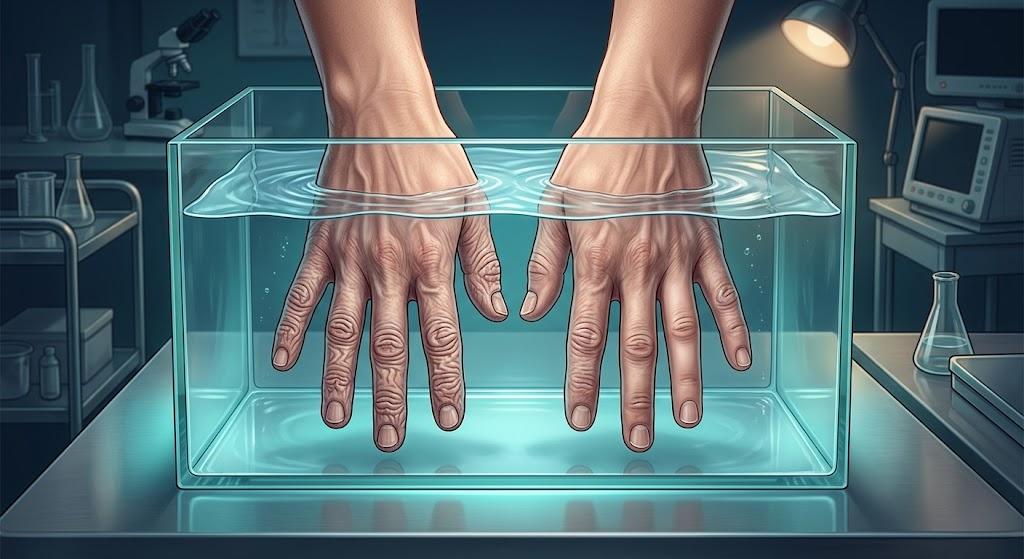
A skin cell cannot refuse an instruction it never received. If wrinkling were passive swelling, a numb finger would wrinkle exactly like its neighbors. That asymmetry is the heart of the underlying neurological mechanism.

The reflex only appears where the wiring is intact — which means the water is not the author of these wrinkles. It is only the request.
The Swelling Story Gets Reversed
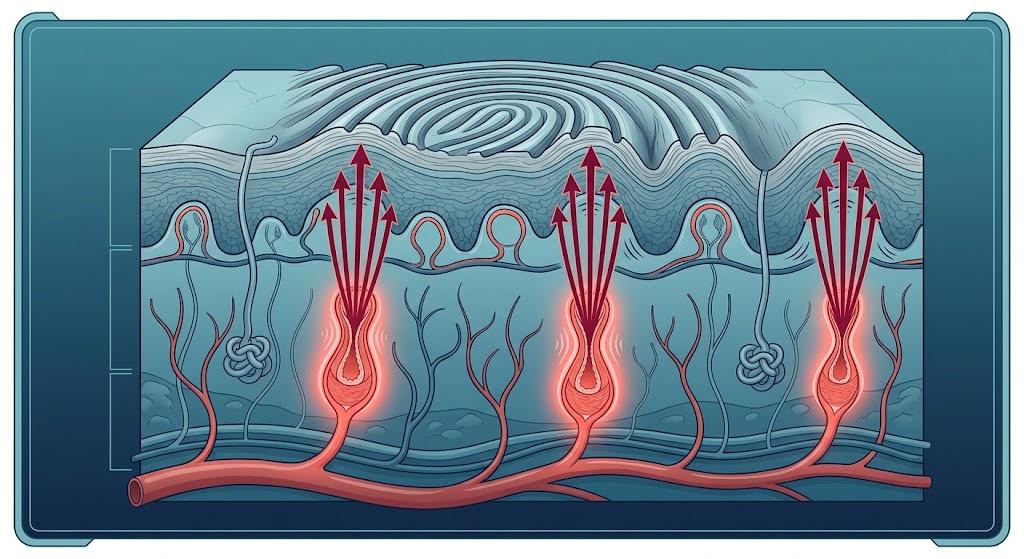
The osmosis explanation goes back a long way, and it is not stupid — it is half-true, which is what makes it so durable. The outermost layer of your skin, the stratum corneum, is dead keratin, and dead keratin really does absorb water and swell. The error was in the direction of the cause. If swelling alone shaped the surface, the wrinkles should appear everywhere the skin is thin and calloused, and they should follow the geometry of hydration. They don’t. So if swelling is not the reason our digits wrinkle, what actually causes it?
The reversal came from measuring blood flow. In 2003, E.P.V. Wilder-Smith and Adeline Chow in Singapore pointed a laser Doppler flowmeter at soaking fingertips — a device that tracks perfusion in the tiny vessels beneath the skin — and watched what happened as the wrinkles formed. Blood flow in the finger pads dropped. The pulp of the fingertip was not gaining volume; it was losing it. The paper’s conclusion is right there in the title: water-immersion wrinkling is due to vasoconstriction. The fingertip shrinks under the skin, the skin above folds to cover the missing volume, and the ridges appear.
Picture a grape folding into a raisin — except that your fingers do it on purpose, in minutes, and undo it again.
This is the true mechanism: not because the skin soaks, but because digital blood vessels constrict. That single measurement flipped the field. Your blood vessels, not your bathwater, are the active ingredient. And blood vessels answer to one master: the autonomic nervous system — specifically its sympathetic branch, the network that runs your pupils, your sweat glands, your heartbeat under stress. Wrinkling, it turns out, is a sympathetic event: a genuine nervous system reflex, not a passive physical reaction. The same year, the pair showed that a numbing cream (EMLA) produced both wrinkling and the same vasoconstriction when applied to normal fingers.
More dramatic still: replanted fingers — fingers severed and sewn back on, their nerves never fully reconnecting — refused to wrinkle even after hours in water. The plumbing was attached. The wiring was not. No wiring, no wrinkles. For anyone still tempted by the swelling story, replanted fingers are the cleanest natural experiment: same skin, same bath, no nerve — no wrinkles.

The clinical world had actually known pieces of this for decades. “New and simple test of nerve function in the hand” was O’Riain’s 1973 title. By the 2000s, neurologists were quantifying the reflex: researchers now grade how much a finger wrinkles and use the score as a cheap, repeatable probe of small-nerve function — in diabetic neuropathy, in carpal tunnel syndrome, in severed-and-repaired nerves. One group even found reduced water-induced wrinkling in patients with congestive heart failure. Think about that: your bathtub fingers and your cardiovascular system are connected through the same reflex arc. The phenomenon, from the clinic’s point of view, is a direct test of whether a peripheral nerve is still functional.
So the passive-absorption story is not just incomplete. It is biologically backwards. The next question is the obvious one: why would a nervous system spend energy reshaping its own fingertips every time they get wet? Reflexes that cost energy usually do something. Which brings us to a strange little secret of wet grip.
The Wet Grip Challenge
Try picking up a submerged smooth coin or wet glass marble with completely dry fingers, then compare after 15 minutes of water immersion.
Did you notice how wrinkled skin channels water away like rain sipes on a car tire to maintain grip?
The Pattern in the Ridges
Now — why would evolution bother wiring up a reflex this elaborate? Hold that question; the next section follows it into the evidence. A fingertip cannot read a clock, yet the ridges arrive on schedule every time you soak. Something in the body is counting. Whatever the ultimate purpose of this adaptation turns out to be, it has to explain that punctuality.
Look closely at a wrinkled fingertip and you see structure, not chaos — and the physiological significance of the reflex is etched directly into that structure. In 2011, Mark Changizi and colleagues measured the geometry of water-induced wrinkles and reported that the ridges and valleys form branching networks — with the spacing and connectivity that fluid-dynamics engineers use when they want a surface to shed liquid quickly.
The title of their paper asked a question that sounds like satire and is not: “Are wet-induced wrinkled fingers primate rain treads?” Their answer: the wrinkle networks look like drainage networks — channels that could evacuate water away from the contact patch between your finger pad and whatever you are holding, the way tire treads push water backward so the rubber can meet the road. That signature points to a wet-weather adaptation rather than a universal one, which is why the wrinkles stay restricted to the fingers and toes.
The team’s hypothesis still waits on direct behavioral confirmation — which is exactly what the next experiment set out to provide. If drainage is the true functional advantage, then wet objects should be easier to handle with wrinkled fingers than with smooth ones — and dry objects should be unaffected. Evolution does not do aesthetics. If the wrinkles form drainage-like networks on the exact skin surfaces we grip with, the simplest prediction is precisely that. The experiment that finally tested that prediction — and turned this hypothesis from anatomical theory into measurable behavior — came two years later, and it deserves a closer look.
The Wet Marble Experiment

In 2013, Kyriacos Kareklas, Daniel Nettle, and Tom Smulders at Newcastle University recruited twenty volunteers and asked them to do something absurdly specific again and again: pick up glass marbles and lead fishing weights with thumb and index finger, pass them through a small hole to the other hand, and drop them into a box. One version of the task was dry. In the other, the marbles sat at the bottom of a tank of water, and participants fished them out through twenty centimeters of it. Each participant did the whole thing twice — once with soaked, wrinkled fingers, once after the wrinkles had faded — so that every person served as their own control.
In effect, the team was testing the evolutionary purpose of the reflex by measuring what the wrinkles actually do.
The result was clean. On dry objects, wrinkles made no difference at all. On submerged objects — the setting where an evolutionary advantage would actually matter — wrinkled fingers finished about 12% faster. The advantage existed only where the hypothesis said it should: in water — the first direct behavioral evidence supporting an adaptive grip function. The findings, published in the Royal Society’s journal Biology Letters, support the idea that the reflex is an adaptation — a biological feature shaped by natural selection for handling objects in wet conditions.
Science, of course, doesn’t close on one experiment. A 2014 study of wet-object handling found no measurable benefit from wrinkling; a 2021 study measuring grip force found that wrinkled fingers let people hold a wet object with less force — bringing the effort closer to what a dry object demands. Read as a set, the studies disagree on size and setup while clustering around one idea: something about wet grip genuinely changes when wrinkles appear. Whether the mechanism is water evacuation, altered skin friction, or something else is still contested — the honest answer to the “how” is that nobody has fully pinned it down.
The neural trigger behind the reflex is well established; exactly how much the ridges aid underwater grip is still actively investigated.
What is widely agreed is that the autonomic reflex exists, that it is neurally controlled, and that it appears precisely where and when your hands are wet.
And that still leaves the deepest question dangling. A reflex that triggers this predictable morphological change every single time — same fingers, same timing, same restriction to hairless skin across the whole body — is expensive to build and costly to run. Evolution keeps expensive systems only when they pay their way. Which brings us, finally, to the why.
The Physiological Mechanism: The Whole Chain
Here is the whole story on one screen. Water touches hairless skin → sensors report the soaking → the sympathetic nervous system tightens the tiny blood vessels under the finger pads → the pulp loses volume → the skin above folds into ridges → the ridged topography facilitates water drainage, then relaxes once you dry off. While the vasomotor mechanism is well-established, the functional advantage continues to be investigated: evidence suggests wrinkling can improve wet-object handling, although the exact size and practical significance of this benefit remain debated across experimental studies. That chain illustrates the real mechanism: a nerve-mediated, blood-flow-driven vasomotor response — an adaptation whose exact evolutionary tuning is still being argued about, but whose machinery is no longer mysterious.
That machinery explains the odd details the swelling story never could.
Why only fingers and toes? Because the reflex targets glabrous skin over the pulp of your digits — the exact surfaces evolution spent on manipulation and footing. Your forearm has blood vessels, but the reflex does not engage there, because the forearm was never in the gripping business. This explains why wrinkling is restricted to digits: the reflex follows evolutionary function. (Notably, palms can join in under special circumstances — more on that below, because sometimes palm wrinkling is a message.)
Why does wrinkling sometimes take longer in hot showers? The underlying vasomotor reflex operates within a specific temperature window, and individual fingers differ in how quickly they respond — one reason clinicians standardize water temperature when they use the test. Your shower is not a standardized clinic, so your thumbs and your index fingers may wrinkle on different schedules.
Why do the wrinkles vanish so fast? The vasoconstriction releases. Blood flow returns, the pulp refills, the skin smooths out — typically within ten to twenty minutes. A wrinkle you can erase by toweling off is not damage; it is a reversible setting, like a camera’s aperture. Reversibility is built into the design: the reflex engages only while submerged and resets once dry.
There is one more consequence of this autonomic reflex, and it is the strangest fact in this whole article: the reflex can be trained wrong by disease. In some medical conditions, fingers and palms wrinkle too easily, too fast, or in the wrong places — and the wrinkle test works in both directions: it can show that a nerve is dead, and hint that something is overreacting.
When the Reflex Misfires: The Medical Side of Wrinkling
Doctors use this reflex in three directions, and each direction tells you something different about the body — all three visible in a single bowl of warm water.
Direction 1: mapping nerve damage. The classic use. In comprehensive clinical reviews of the skin-wrinkling test, clinicians summarize decades of findings: a finger that will not wrinkle in warm water (or under a topical anesthetic that normally triggers the reflex) is a finger whose sympathetic fibers are damaged or disconnected. The test is cheap enough for a battlefield and sensitive enough to correlate with the density of nerve fibers measured in biopsy.
The reflex doubles, in the clinical setting, as a sensitive probe for diabetic neuropathy, carpal tunnel syndrome, and nerve repairs. And the test pairs naturally with the bigger question of how the nervous system signals damage and recovery — because a finger that stops wrinkling today may start again if the wiring recovers.
Direction 2: the over-response. At the far end of the spectrum sits a rare condition called aquagenic wrinkling of the palms: hands that wrinkle rapidly and excessively after minutes — not half an hour — of water exposure, sometimes with swelling, tingling, or whitish papules. It is strikingly associated with cystic fibrosis: studies report the reaction in a large majority of CF patients tested, and in a meaningful minority of carriers. The underlying reports trace back years, and the reflex itself is not the disease — the disease hijacks the reflex’s threshold.
People with the condition know exactly when it will strike, because it strikes precisely in the situations that produce ordinary bath-time pruning — the difference is only speed and degree.
That is why dermatologists treat dramatic palm-wrinkling in a young person as a screening hint worth investigating, not a curiosity. Rarely, the reaction appears without any CF connection at all.
Direction 3: the blunted response. Reduced wrinkling shows up in some systemic conditions — the congestive heart failure finding above — and after injuries that sever the digital nerves. In every case the pattern is the same: the wrinkling response in any given digit is a direct readout of the underlying sympathetic wiring. Skin is the display; the nervous system is the program running on it.
None of this turns every pruney finger into a diagnosis. Ordinary bath wrinkling, on ordinary timelines, is the reflex working as designed. The medical value lives in the extremes: fingers that never wrinkle, palms that wrinkle instantly, one hand that stopped wrinkling after an injury. For anything in that territory, a clinician — not a search engine — should look at your hands.
The Timing Question: How Long Does Wrinkling Take?
Practical territory, briefly — because readers frequently ask how quickly the reflex engages and how long the whole process takes. In the clinic, standard wrinkling tests immerse fingers in warm water (around 40°C) for set durations — commonly 30 minutes for full wrinkling in lab settings, with measurable changes appearing for many people well before that. The response then fades in roughly ten to twenty minutes out of the water.
Several variables shift how quickly your fingers wrinkle in water: temperature, how hydrated your outer skin layer already is, and — in the reflex’s own signature — which finger you are watching. Anyone who has tried to time finger wrinkling across different settings — and gotten varying results from the bath, the pool, and the shower — has met these variables firsthand. Clinicians exploit exactly this: standardized timing turns “pruney fingers” into a measurement.
Two safety notes belong here, and then we will let the reflex rest. First, very hot water does not speed the reflex meaningfully, but it does dry your skin and can cause low-temperature burns over long soaks; warm is sufficient. Second, if your skin wrinkles rapidly and dramatically — palms especially — or if a finger has stopped wrinkling after an injury, that information is worth bringing to a doctor. The reflex is chatty. It is worth knowing what it is saying.
What the Wrinkles Are Really Saying
It is worth stepping back to notice what this one reflex contains, because it is a miniature of how the body works. A phenomenon so ordinary that children notice it — and so overlooked that medicine needed two centuries to look at it properly. Children notice pruney fingers in the bath long before anyone explains the physiology to them. A passive explanation so intuitive that it survived in textbooks despite counterevidence visible at every bedside. And underneath, the actual mechanism: not physics alone, but regulation — a nervous system reading the world through the skin, the same quiet surveillance apparatus behind the feeling of being watched — and quietly rebuilding your grip in response.
That is the real scientific reality. Not passive absorption, not swelling, not the passive soaking of dead skin — but a live conversation between water and wire. The next time you come out of the pool wearing prune fingertips, you are looking at that conversation in mid-sentence. Your body noticed the water. Your nerves voted — the same wiring whose repair, injury, and quiet misfires fill other stories of nerves acting on their own. Your blood vessels shrank on cue. Your skin folded into a better tool. And within twenty minutes, the whole apparatus will quietly dismantle itself — leaving nothing behind but a dried hand and, now, the knowledge of what actually happened.
Disclaimer
Medical Disclaimer: This article is intended for general educational and informational purposes only. It does not diagnose, treat, or rule out any medical condition. Ordinary finger wrinkling in water is a normal reflex, but sudden changes in how your skin reacts to water, rapid excessive wrinkling of the palms, or fingers that no longer wrinkle after an injury deserve evaluation by a qualified healthcare professional. Never use information in this article as a substitute for professional medical advice.
Scientific References & Studies
- Kareklas K, Nettle D, Smulders TV. Water-induced finger wrinkles improve handling of wet objects. Biol Lett. 2013;9(2):20120999. PMID 23303785
- Changizi M, Weber CA, Kotecha R, Palazzo J. Are wet-induced wrinkled fingers primate rain treads? Brain Behav Evol. 2011;77(4):286–290. PMID 21795269
- Wilder-Smith EP, Chow A. Water-immersion wrinkling is mediated by cutaneous vasoconstriction. Clin Auton Res. 2003;13(5):352–355. PMID 14689246
- O’Riain S. New and simple test of nerve function in the hand. Br Med J. 1973;3(5881):615–616. PMID 4745820
- Hasegawa T, et al. Water-immersion wrinkling of the skin of the fingers does not improve dexterity in handling wet objects. PLoS One. 2014;9(1):e84949. PMID 24416318
- Davis NJ. Water-immersion finger wrinkling improves grip efficiency in wet conditions. Perception. 2015;44(5):548–553. PMID 26233177
- Wilder-Smith EP. Water immersion wrinkling: physiology and use as an indicator of sympathetic function. Clin Neurophysiol. 2015;126(9):1643–1651. PMID 25680796


