


- United States & Canada: Call or text 988 to reach the Suicide & Crisis Lifeline, or text
HOMEto 741741 (Crisis Text Line). - United Kingdom: Call 111 (NHS Mental Health) or 116 123 (Samaritans).
- International Resources: Find confidential, free counseling services worldwide at Find A Helpline.
OddlyClear is an educational publication. This article is not psychiatric advice and does not substitute for clinical mental healthcare.
If you have ever spent weeks spiraling over someone who gave you mixed signals—re-reading an unread message fifty times, tracking their activity status at 2:00 AM, swinging violently between soaring euphoria and a sickening, physical dread in your chest—you probably asked yourself the same agonizing question: “Why do I care this much about someone who barely shows up for me?”
The shame of that question is often heavier than the heartbreak. You assume you are emotionally weak, needy, or losing your mind. But in cognitive psychology and neuroscience, this obsessive state is neither a personal character flaw nor genuine romantic love.
In the late 1970s, the psychologist Dorothy Tennov interviewed several hundred adults about an experience they assumed was unspeakable: a romantic fixation so total that, by her estimate, it could consume up to 95 percent of waking thought, persisting for years against every rational verdict, announcing itself in the body — an acute ache in the upper chest that arrived in waves whenever the beloved’s name surfaced. The condition had no clinical name. Tennov, working at the University of Bridgeport, gave it one in her 1979 book: limerence — involuntary, obsessive infatuation that resists both reciprocation and rejection.
The distinction that defines the field is not the loving but the losing. Healthy romantic love is other-focused and empathic; limerence is an invasive, non-empathetic virtual reality organized around a single figure — the Limerent Object, in Tennov’s clinical vocabulary — whose ambiguity is the fuel and whose attention is the only currency the brain accepts. The sufferer knows, with intact reality testing, that the fixation is irrational. Knowledge changes nothing. No diagnostic manual contains limerence, yet the phenomenon is as reproducible as any syndrome in the literature.
The slot machine is a person. The player cannot leave the machine, and the machine does not care.

The Origin of the Term: Dorothy Tennov’s Involuntary Captives
Tennov’s interviews established the phenomenology with unusual rigor: intrusive, involuntary cognition; the beloved’s face appearing unbidden hundreds of times a day; and desperate reinterpretation of every ambiguous signal — a delayed reply, a neutral tone — as evidence. The state was agonizing rather than pleasant: euphoria arrived in brief flashes, while the baseline was longing, hypervigilance, and the chest ache her subjects rated among the worst sensations of their lives.
The Striatal Casino: Prediction Error and the Limerence Engine
In Wolfram Schultz’s landmark recordings, midbrain dopamine neurons fire not for reward itself but for prediction error — the gap between expected and obtained reward. An expected reward produces modest activity; an unexpected one, a burst; an omitted one, a dip. The system is not built for pleasure but for learning what signals predict payoff, and it responds most violently to schedules it cannot master.
Limerence is the mating context in which that machinery runs without a brake. The Limerent Object — by temperament, circumstance, or design — provides cues on a variable-ratio schedule: a warm message after days of silence, a look held a second too long, then withdrawal. Each unpredictable signal triggers phasic dopamine release from the ventral tegmental area into the nucleus accumbens, stamping the person with incentive salience. Fixed rewards produce satiety; variable rewards produce compulsion — the casino mechanism. Every limerent episode contains a gambler who cannot stop pulling a lever made of another person’s attention.

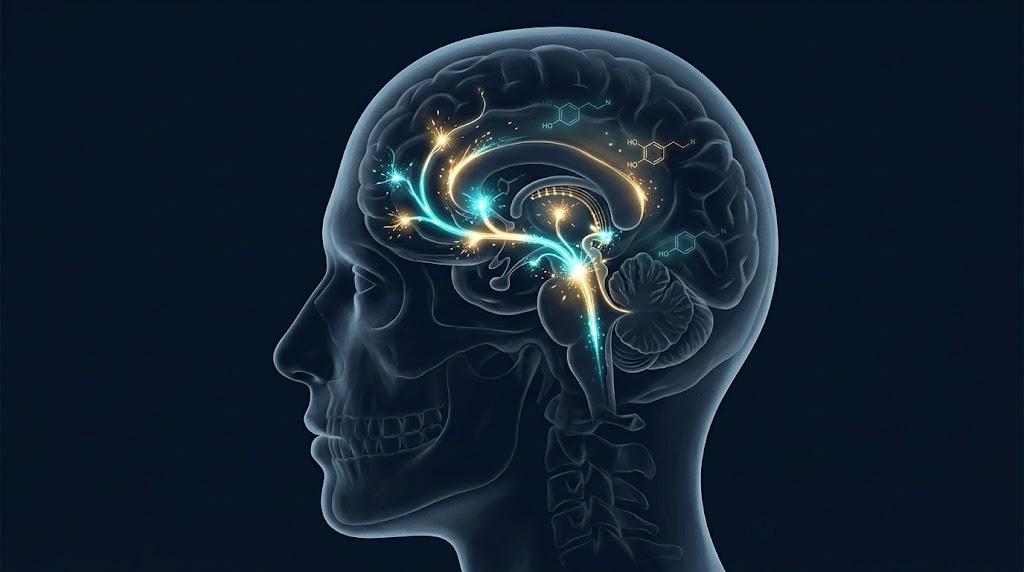
Neuroimaging confirms the overlap: photographs of early-stage romantic partners activate the ventral tegmental area, the nucleus accumbens, and the goal-pursuing caudate — reward regions also engaged by cocaine and gambling. Passion, in the scanner, is motivated craving; limerence is that craving decoupled from progress toward its goal.
The Serotonergic Collapse: Obsession’s Biochemical Twin
The most striking datum in the field arrived from Pisa in 1999. Donatella Marazziti’s group measured platelet serotonin transporter density — a validated peripheral index of the 5-HTT protein that clears serotonin from the synapse — in three groups: people newly and intensely in love, unmedicated patients with obsessive-compulsive disorder, and healthy controls. The lovers and the OCD patients were indistinguishable: both showed transporter reductions on the order of 40 percent relative to controls, and both normalized after twelve to twenty-four months as the states resolved.
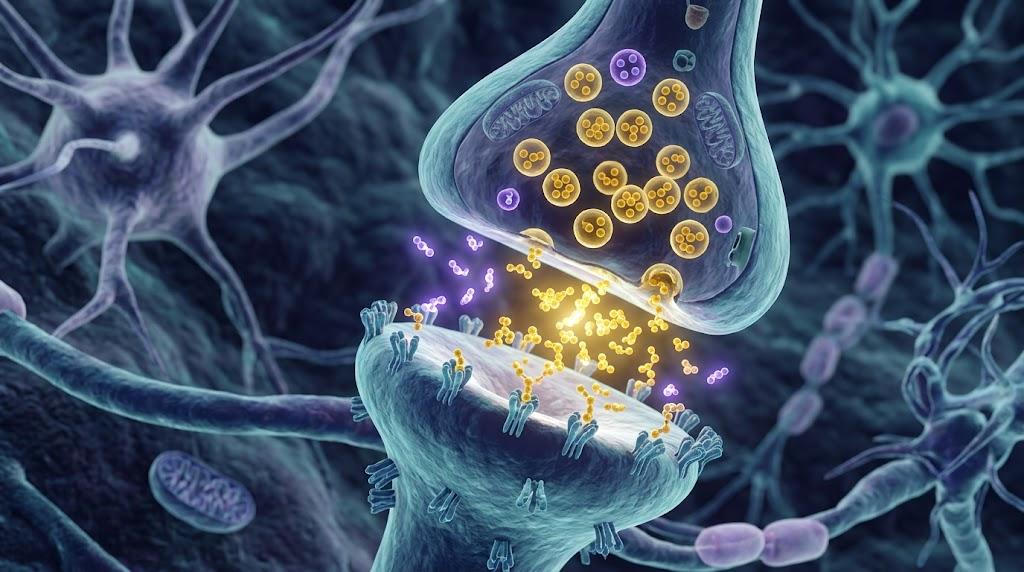
The implication is uncomfortable and clarifying. The intrusive, loop-like preoccupation of limerence is not a character flaw; it is the behavioral signature of lowered serotonergic tone — the state documented in obsessive-compulsive disorder. Serotonin gating is one mechanism by which the prefrontal cortex restrains repetitive thought; when the gate thins, rumination runs at full volume. Readers who have examined why your brain repeats the same thoughts will recognize the trap: each repetition deepens the track. Limerence is that loop with a person as its content.
Interactive Psychological Contrast: Limerence vs. Secure Attachment
- Core Focus: Fixated on an idealized mental avatar and securing reciprocal validation.
- Neurochemistry: Elevated striatal dopamine spikes alternating with serotonergic withdrawal.
- Dynamic: Thrives on uncertainty, mixed signals, and physical unavailability.
The Autonomic Storm: Where the Body Keeps the Score
The somatic complaints map precisely onto adrenergic physiology. Hyperactive discharge from the locus coeruleus — the brainstem’s norepinephrine core — produces the dilated pupils, pounding heart, gastric butterflies, and startle-boosted alertness that make the beloved feel electrifying. Sustained HPA axis activation keeps cortisol elevated, suppressing appetite and shredding sleep — hence sufferers who eat little, sleep less, and feel exhausted and wired at once.
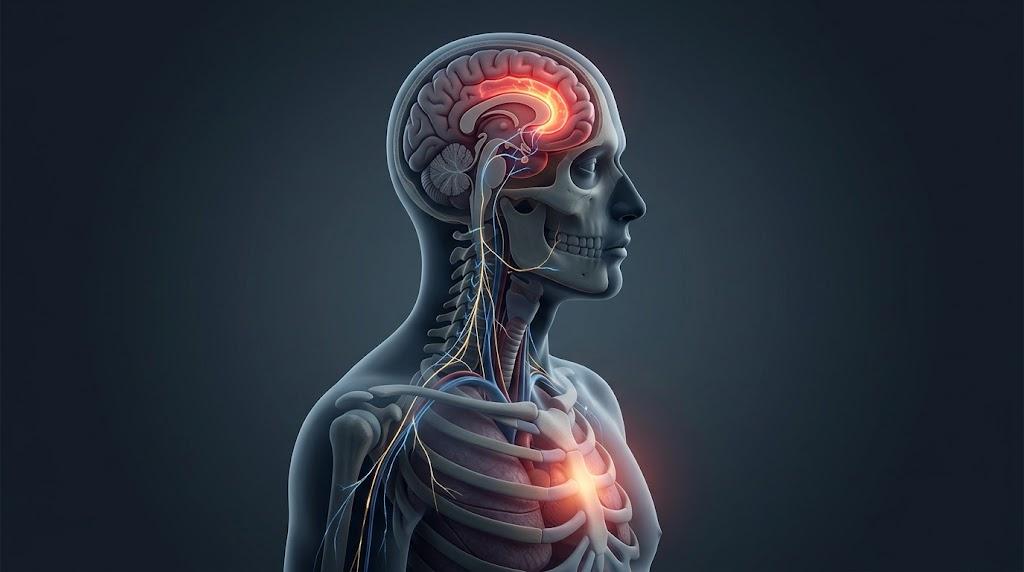
The sternal ache deserves particular attention. Neuroimaging of social exclusion shows that rejection recruits the dorsal anterior cingulate cortex — a core node of the physical pain matrix. The chest ache of limerence is not a metaphor; it is the dACC’s alarm rendered in somatic form. And because emotionally charged experience consolidates differently from ordinary fact — as our examination of how emotional memories are stored differently than facts explains — every arousal-soaked encounter with the Limerent Object is written into memory with unusual permanence.
Crystallization: The Prefrontal Manufacture of an Avatar
Two centuries before neuroimaging, Stendhal described the process he called crystallization: in the salt mines of Salzburg, a bare branch thrown into abandoned workings emerges in days sheathed in brilliant crystals. So, he argued, the lover’s imagination covers every quality of the beloved — and every absence of quality — in perfect, glittering projections. Modern cognitive science has merely supplied the mechanism. Attribute magnification and defect minimization are top-down constructions of the prefrontal cortex and medial default mode network: the brain’s simulation engine rendering an idealized internal avatar, then presenting it as perception.

Limerent sufferers are, in a precise sense, not in love with the actual human being but devoted to a rendered model built from fragments of real data and volumes of invented completion. The evidence is behavioral: sustained real contact tends to corrode limerence, because the avatar survives on ambiguity. Here limerence keeps its border with psychosis: reality testing remains intact — the sufferer knows the imagined dialogues are imagined. The avatar is not a hallucination; it is a preference, built because — unlike the person — it cannot disappoint.
What Limerence Is Not: A Behavioral & Psychological Comparison
Because limerence lives near several better-known conditions, the differential is where clinical rigor matters most.
| Dimension | Healthy romantic love | Limerence | Relationship OCD (ROCD) | Erotomania (De Clérambault) | Borderline attachment (favorite person) |
|---|---|---|---|---|---|
| Core motivational target | Shared bond and mutual growth | Uncertainty relief; reciprocation of the fixation | Certainty that the relationship is right | Possession of the imagined lover | Constant regulation by one attachment figure |
| Reality testing | Intact, empathically accurate | Intact — fixation known to be irrational | Intact, ego-dystonic doubt | Impaired — false conviction of being loved | Intact, affect-driven |
| Reaction to reciprocation | Deepens intimacy | Brief spike, then target shifts or boredom follows | Reassurance quiets doubt temporarily | Belief intensifies; confirmation distorted | Anxiety may ease, then fear of abandonment rises |
| Affective valence | Warm, stabilizing | Longing-dominant; euphoria brief and rare | Distress, guilt, shame | Grandiose serenity | Turbulent idealization and devaluation |
| Intrusive ideation | Frequent but welcome thought | Unwanted, consuming, involuntary | Unwanted obsessional doubts | Systematized delusional content | Rumination tied to perceived rejection |
| Tolerance and escalation | Satiety with closeness | Escalating risk and checking to secure contact | Rituals and reassurance-seeking escalate | Persistent delusional pursuit | Crisis-driven intensity escalates with threat |
The decisive diagnostic boundaries emerge in reality testing and reaction to reciprocation. Reaction to reciprocation separates limerence from mutual romantic love: genuine mutuality tends to transform the state into attachment, while ambiguity-fed fixation can collapse within weeks of becoming certain. Reality testing, meanwhile, is the wall against erotomania. The limerent sufferer knows the story is self-authored; the erotomanic patient believes, with systematized conviction, that the other person secretly loves them. Compulsive in structure and hedonic only in flashes, limerence sits in its own quadrant: obsession without delusion, addiction without a substance.
The Attachment Wound: Why Unavailability Feels Like Home
The etiological literature points, with unusual consistency, toward childhood. Hazan and Shaver demonstrated that adult romantic love operates as an attachment process, reproducing the styles learned from early caregivers — and the anxious-preoccupied style, formed under inconsistent or emotionally unavailable parenting, is limerence’s native soil. For such a nervous system, emotional unavailability is not a warning signal. It is familiarity itself: the developmental template of love arrived with a parent who was sometimes warm, sometimes absent, and never predictable. The adult who cannot stop pursuing a distant figure is often completing a sentence begun in childhood.
Yet the clinical reality runs deeper than simple anxious attachment. A substantial portion of chronic sufferers carry fearful-avoidant (disorganized) attachment, which produces a devastating paradox: when an emotionally available, consistent partner offers genuine closeness, the fearful-avoidant nervous system often recoils—feeling suffocated, suspicious, or numb. True intimacy feels terrifyingly dangerous. But when a partner is distant, inconsistent, or clearly unavailable, that threat vanishes. Distance makes longing safe. The sufferer can safely unleash an ocean of romantic emotion and vulnerability into the void precisely because the other person is too unavailable to demand real, reciprocal intimacy in return.
Furthermore, framing the limerent individual as merely a passive, unsuspecting victim misses the internal psychological complexity. Many sufferers possess piercing self-awareness: they spot the red flags early, recognize the hot-and-cold manipulation, and knowingly walk directly into the emotional storm. Why? Because the pursuit represents an unconscious compulsion to symbolically master early helplessness—to finally win the game they were programmed to lose. Securing the sudden warmth of someone who routinely withdraws is the ultimate psychological jackpot: it feels like proof that, this time, they are finally worthy of being chosen.
The Default Mode Network as a Dissociative Sanctuary
Neuroanatomically, the fixation consolidates inside the default mode network — the medial prefrontal and posterior cingulate midline structures that render self-referential simulation. Here the limerent imagination constructs elaborate rescue and confession fantasies: scenarios in which the beloved finally sees the sufferer and chooses them. Each replay delivers genuine analgesic reward through the very striatal circuitry described above — an internally generated drug, immediately accessible, requiring no external supply. Attention, a contested resource as our analysis of why focus is so fragile explains, has been forfeited wholesale to the simulation.
Crucially, this cognitive machinery often serves as an emotional anesthetic against baseline emptiness. When clinicians look beneath the acute agony of limerence, they frequently discover a pre-existing vacuum: chronic depression, unresolved grief, or deep-seated self-loathing. Staring at an unread message, analyzing subtle shifts in punctuation, and cycling through tears and manic hope is exhausting—but to an emotionally numb or chronically depressed nervous system, agony feels like narrative movement. It gives the day electricity, a script, and urgent meaning. Obsessing over another person becomes a convenient dissociative shelter: as long as your mind is entirely occupied by someone else’s unpredictable behavior, you never have to sit alone in the quiet, terrifying room of your own inner void.
The cost structure mirrors a cousin condition. As our examination of maladaptive daydreaming details, a sanctuary that regulates distress no adult is regulating can become a residence: relationships thin out, milestones slip, and the fantasy world — which never disappoints — outcompetes the real one, which always does. The two conditions differ in object, not architecture: one fixes on a person, the other on a saga.
Evidence-Informed Strategies: Interrupting the Prediction Loop
Because limerence is not categorized as an independent psychiatric disorder in diagnostic manuals, no dedicated randomized controlled trials have tested targeted protocols for it directly. However, clinical psychology and behavioral neuroscience support four practical, evidence-informed strategies:
1. Radical No-Contact: Triage vs. Structural Cure
Radical no-contact is the foundation: complete sensory and digital deprivation of the Limerent Object — blocking, unfollowing, and ruthlessly removing triggers and digital breadcrumbs. The immediate goal is neurochemical triage: starve the prediction-error loop until the striatal system marks the person as unrewarded. Tennov’s own data support the principle; distance and time were the only reliable remissions she documented.
However, an essential clinical truth must be stated: No-contact interrupts the acute dopamine cycle, but it does not resolve the attachment hunger that compelled you to tolerate emotional breadcrumbs in the first place. If you extinguish the fixation without addressing the underlying attachment hunger and emotional void, you have merely unplugged one slot machine while leaving the casino doors wide open. The brain remains primed to project the exact same dynamic onto the next emotionally unavailable person who crosses your path. True resolution requires moving beyond behavior suppression to structural self-worth: becoming someone whose nervous system no longer needs to manufacture chaos just to feel alive.
2. Counter-Crystallization
Counter-crystallization attacks the avatar directly: a written inventory of the beloved’s actual flaws and frictions — the tedium, the incompatibilities, the documented unkindnesses — rehearsed whenever the projection glitters. The practice works because crystallization is construction, and construction can be countered with evidence.
3. Pharmacological Considerations
Pharmacological observations in literature rest primarily on neurochemical parallels with OCD. While some clinical case literature notes that physicians occasionally consider serotonergic agents (such as SSRIs) when intrusive rumination severely impairs daily function, no medication has been formally evaluated in clinical trials specifically for limerence. Any pharmacological consideration must occur strictly under the direct diagnosis and supervision of a licensed psychiatrist or physician.
4. Retraining the Nervous System to Tolerate Peace
Schema and attachment-focused therapy address the substrate: excavating the void that made unavailability feel like home, so the next episode finds thinner soil. For a nervous system addicted to the volatile dopamine spikes of intermittent reinforcement, healthy, secure affection initially feels unfamiliar, flat, or even “boring.” A core pillar of long-term recovery is re-sensitizing the nervous system to recognize that quiet, predictable peace is not an absence of passion, but the presence of safety.
The Ungoverned Engine: An Evolutionary Synthesis
The neurobehavioral architecture of limerence: an ancient mammalian pair-bonding drive running without an off-switch on unresolvable ambiguity. Limerence is involuntary; it runs on ambiguity through the dopamine prediction system; it depletes serotonergic gating like OCD; the body burns in its storm; crystallization replaces the person with an avatar; it is diagnosably distinct from love, ROCD, erotomania, and borderline fixation; and it grows from the attachment template of early life. The synthesis is evolutionary: pair-bonding was too important to leave to contentment, so mammals inherited a motivation system that makes one specific person feel, for a season, like the solution to existence itself — the mating engine Fisher’s program has mapped across lust, attraction, and attachment.
Limerence is that engine running without a governor: an ancient adaptation trapped in permanent neutral, running on ambiguity it was never designed to outlast. The engineering lesson is not to lobotomize the machinery but to reattach the governor — certainty, proximity, reality — or, when none is available, to starve the machine by firebreak until it cools. The most consoling finding in the literature is also the most mechanical: prediction systems update. Feed them silence, and even the most magnetic stranger becomes, at last, only a person.
Frequently Asked Questions About Limerence
Is limerence officially classified as a mental illness in the DSM-5-TR?
No. Limerence appears in no diagnostic manual — not the DSM-5-TR, not the ICD-11. The construct has decades of clinical description since Tennov and a growing neuroscience literature, but no validated diagnostic instrument has achieved research-standard adoption. Clinicians currently address it through its comorbidities — obsessive-compulsive features, depression, attachment insecurity — or treat the behavior directly with the converging protocols described above. Formal recognition remains speculative.
Can limerence ever evolve into a healthy, long-term relationship?
Sometimes — but the pathway is narrower than sufferers hope. Tennov’s data were stark: in her samples, limerence that resolved into lasting bonded attachment was the minority pattern, and mutual episodes tended to transform into calmer attachment or collapse once uncertainty disappeared. The prognostic variable is not the intensity of the feeling but the fit of the underlying reality: whether the actual person, once crystallization corrodes under contact, resembles the avatar. Limerence can be the fever of a beginning; it cannot be the architecture of a marriage.
How long does an untreated episode of limerence typically last?
Tennov’s interviews documented enormous range — episodes extinguishing within weeks where the Limerent Object proved genuinely attainable or decisively unattainable, and others persisting for years, even decades, in conditions of sustained ambiguity. Resolution of uncertainty shortens the arc; intermittent reward extends it indefinitely. The serotonergic normalization documented in the Pisa follow-up — within one to two years — offers a physiological clock, but ambiguity can keep resetting it. The untreated episode ends when the brain finally learns the schedule, and the schedule is designed to be unlearnable.
What is the fastest way to break a limerent episode?
The fastest reliable intervention is radical no-contact combined with ruthless trigger removal: block every communication channel, delete old message threads and photos, and eliminate the sensory triggers (specific songs, shared places) that cue the striatal prediction loop.
Expect an intense “extinction burst” in the first 7 to 14 days—a sharp, painful surge in cravings and anxiety as the dopamine circuits protest the sudden loss of their unpredictable reward source. Treat this phase as acute neurochemical withdrawal, not evidence of a spiritual bond.
To prevent immediate relapse or transferring the obsession to someone new, pair no-contact with active cognitive reframing: rehearse counter-crystallization (listing their genuine flaws and emotional unavailability) and begin confronting the baseline emptiness or attachment wounds that made chaos feel so magnetic. Every recovered sufferer’s journey begins with absolute silence, but permanent freedom only comes when you retrain your nervous system to choose peace over volatility.
Disclaimer
Medical Disclaimer: This article is for educational purposes only and does not diagnose or treat any condition. Distressing or disabling romantic fixation, or any persistent mental health symptom, deserves evaluation by qualified healthcare professionals.
References
- Tennov D. Love and Limerence: The Experience of Being in Love. New York: Stein & Day; 1979. (Primary clinical description; book literature.)
- Marazziti D, Akiskal HS, Rossi A, Cassano GB. Alteration of the platelet serotonin transporter in romantic love. Psychol Med. 1999;29(3):741–745. PMID 10405096
- Schultz W, Dayan P, Montague PR. A neural substrate of prediction and reward. Science. 1997;275(5306):1593–1599. PMID 9054347
- Aron A, Fisher H, Mashek DJ, Strong G, Li H, Brown LL. Reward, motivation, and emotion systems associated with early-stage intense romantic love. J Neurophysiol. 2005;94(1):327–337. PMID 15928068
- Fisher H, Aron A, Brown LL. Romantic love: an fMRI study of a neural mechanism for mate choice. J Comp Neurol. 2005;493(1):58–62. PMID 16255001
- Bartels A, Zeki S. The neural basis of romantic love. NeuroReport. 2000;11(17):3829–3834. PMID 11117499
- Fisher HE, Aron A, Brown LL. Romantic love: a mammalian brain system for mate choice. Philos Trans R Soc Lond B Biol Sci. 2006;361(1476):2173–2186. PMID 17118931
- Berridge KC, Robinson TE. What is the role of dopamine in reward: hedonic impact, reward learning, or incentive salience? Brain Res Brain Res Rev. 1998;28(3):309–369. PMID 9858756
- Hazan C, Shaver P. Romantic love conceptualized as an attachment process. J Pers Soc Psychol. 1987;52(3):511–524. PMID 3572722
- Fisher HE, Brown LL, Aron A, Strong G, Mashek D. Reward, addiction, and emotion regulation systems associated with rejection in love. J Neurophysiol. 2010;104(1):51–60. PMID 20445032
- Eisenberger NI, Lieberman MD, Williams KD. Does rejection hurt? An fMRI study of social exclusion. Science. 2003;302(5643):290–292. PMID 14551436
📚 You Might Also Like
Hand-picked articles for you


