


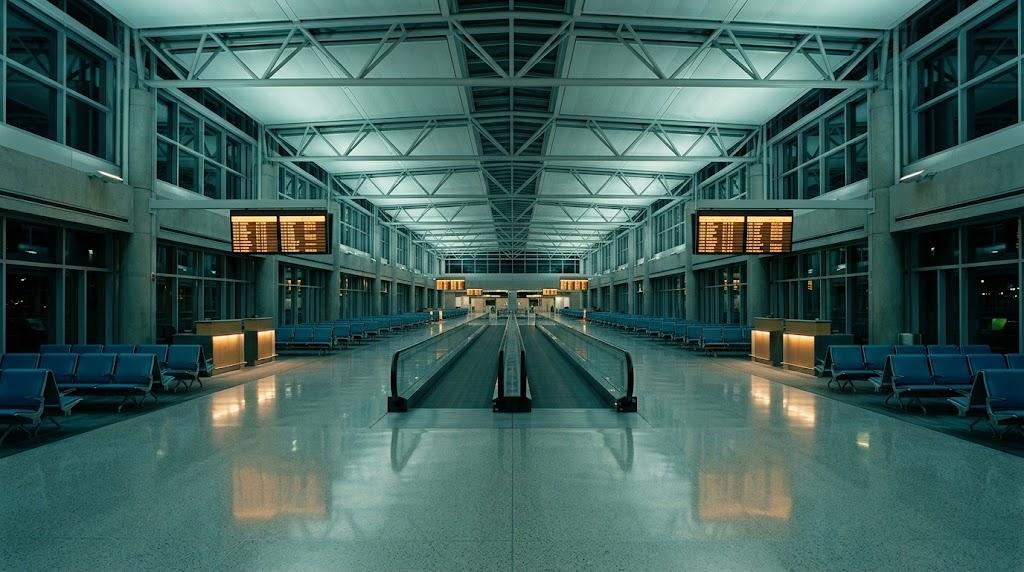
The red-eye lands late, and the terminal swallows you whole. It is 3:15 a.m. The concourse stretches ahead, cavernous and fully lit, every fluorescent panel burning for an audience of nobody. The moving walkways glide with no one on them. Departure gates repeat into the distance, each one an empty theater. Somewhere below, a baggage carousel turns and turns, lifting nothing. You can hear the air itself humming in the vents.
Nothing has gone wrong. No alarm, no smoke, no threat your eyes can find. Yet your skin prickles, your pace quickens, and some ancient part of you scans the security cameras and the black glass of shuttered shops as if the space itself were watching back. An airport is a machine for processing people. Standing inside it when the people are gone feels like finding a restaurant fully set for dinner, with every chair vacant.
Psychology has a name for these places: liminal spaces — the transit zones of human life, built to be passed through, not inhabited. Empty of people at the wrong hour, they produce a distinctly modern unease that millions now collect in photographs and horror videos. The feeling is real, repeatable, and rooted in four converging mechanisms of the brain.
What follows is not internet folklore. Each section states the claim plainly, lays out the peer-reviewed evidence, and then admits the limitations — because liminal spaces sit at a genuine frontier of environmental psychology. The prediction machine and its glitch. The architecture of the uncanny. Threat ambiguity and the evolved detector for creepiness. And the strange weight of silence in a place built for noise.
“Liminal spaces feel unsettling because our subconscious senses an unseen supernatural presence or danger.”
The uncanny chill is predictive dissonance: the brain expects transit corridors to contain people and destinations. When architecture exists stripped of human function, predictive models experience an unresolved error.
What Makes a Space “Liminal”?
Liminal comes from the Latin limen — threshold. Arnold van Gennep, the French ethnographer who coined the term in his 1909 book Les rites de passage, noticed that every major transition in human life follows the same three-part choreography: you separate from your old status, you dwell for a while in the in-between, and you are reincorporated into a new one. Weddings, funerals, graduations, initiations — all of them pass through the middle phase he named the liminal.

Victor Turner, the anthropologist who carried the idea into the modern era, described liminal people and places as betwixt and between — suspended outside the rules that govern normal positions. The airport concourse is a perfect architectural translation. It is not origin or destination, not home or hotel, not quite inside or outside. You are, in a sense, legally nowhere: a passenger in transit, inside a building engineered to keep you moving.
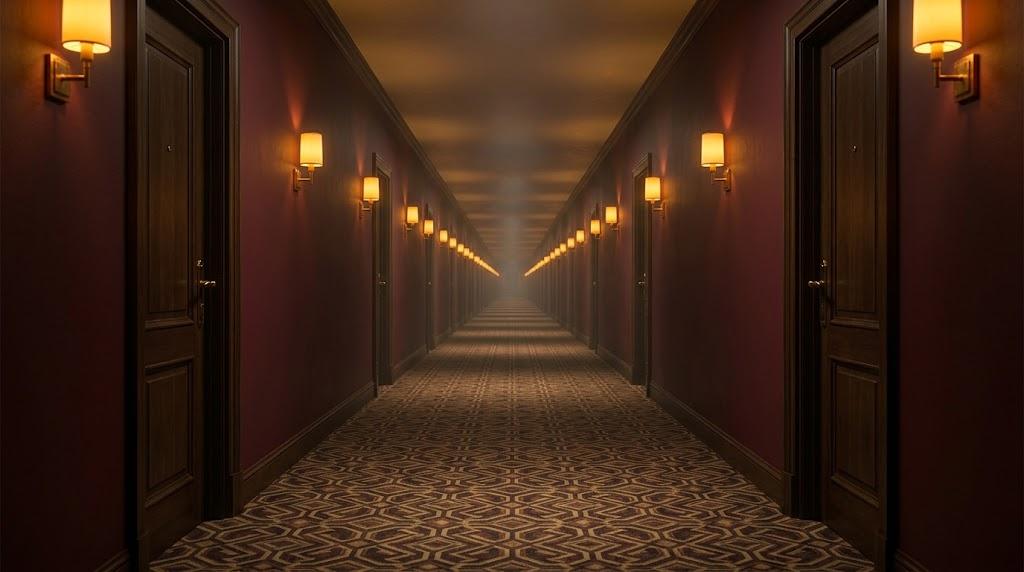
Most liminal spaces share a recognizable anatomy: corridors, waiting rooms, stairwells, lobbies, parking garages, hotel hallways at dawn. They are deliberately generic — designed for everyone, and therefore for no one — and their decor erases any sign that a particular person lives there. Add the wrong hour of the day and the absence of people, and the threshold becomes the destination: a space you are supposed to leave, quietly refusing to let you go.
Buildings have their own thresholds. Architects, psychologists, and eventually the entire internet came to call these transitional zones liminal spaces — and the eeriest versions are the ones this article is about to map, mechanism by mechanism.

The Prediction Machine Glitch: Why the Brain Panics at Empty Corridors
Modern neuroscience describes the brain not as a camera but as a prediction machine. In Karl Friston’s free-energy framework, the brain constantly generates forecasts about incoming sensation and works to minimize the error between prediction and reality. Philosopher Andy Clark calls these predictive processors: perception is a controlled hallucination, corrected by the world. A brain like this does not merely see a corridor. It predicts one full of footsteps, announcements, and faces.
An airport concourse delivers on almost every forecast — until it does not. Fluorescent light, beeping carts, boarding calls, clattering suitcases: the concourse at 3:15 a.m. matches the visual and acoustic template exactly, but strips out the humans the template exists to serve. The mismatch is the signature sensory prediction error of liminal spaces, and in predictive processing, large unresolved errors are precisely what produce attention-grabbing unease. The brain flags the scene as wrong before you can say why.
This is the same family of glitch that makes the familiar turn strange. Psychologists know its personal version as jamais vu, when the familiar suddenly feels foreign — fluent recognition briefly decoupling from expectation. In empty liminal spaces the decoupling is environmental instead of autobiographical: the template says occupied, the evidence says vacant, and the discrepancy itself is the alarm.
Claim: empty places unsettle us because they violate learned environmental priors. Evidence: predictive-coding theory and its imaging record — prediction errors reliably drive attention, arousal, and learning. Limitation: the theory is a framework, not a single testable circuit. Nobody has yet placed people in genuinely empty terminals inside a scanner, so its application to architecture is a well-reasoned inference rather than a measured result.
The Architecture of the Uncanny
Sigmund Freud gave the deepest register of this unease its name: das Unheimliche, the uncanny — the class of the frightening that leads back to what is known and long familiar. A century later, psychologists Alexander Diel and Michael Lewis brought the concept into the laboratory and asked a deceptively simple question: can a building be uncanny the way a wax figure is?
Their 2022 answer was yes. Across experiments on images of places, Diel and Lewis found that structural deviations — small violations of how rooms and buildings are supposed to be organized — reliably predicted how uncanny a space felt. Physical places, they concluded, have their own uncanny valley. More striking still: adding depicted people reduced the uncanniness of public spaces. That is almost a one-sentence explanation of liminal spaces — remove the crowd, and the uncanny rises.

The mechanism borrows directly from robotics. Ayse Saygin and colleagues scanned people watching humans, robots, and a humanlike android, and found the uncanny valley is best explained as prediction error: a form that looks human but moves mechanically forces the brain’s human-tuned forecasts to fail. A nearly right corridor does the same thing. It looks walkable, it looks populated, and it delivers emptiness — the uncanny valley rebuilt in drywall and floor tile, which is why all liminal spaces photograph so well.
Claim: places feel uncanny when their structure is almost, but not quite, right. Evidence: Diel and Lewis, 2022, across controlled image experiments, and Saygin and colleagues, 2012, on predictive coding in the uncanny valley. Limitation: the evidence comes from photographs and robots on screens, not from standing inside real architecture — and uncanny ratings are subjective reports that may not transfer to full-scale fear.
The Three Dimensions of Liminal Unease
Liminal spaces unsettle through three distinct channels. Each one can hollow out different liminal spaces — and most of the internet’s favorite images combine at least two.
1. Temporal Liminality
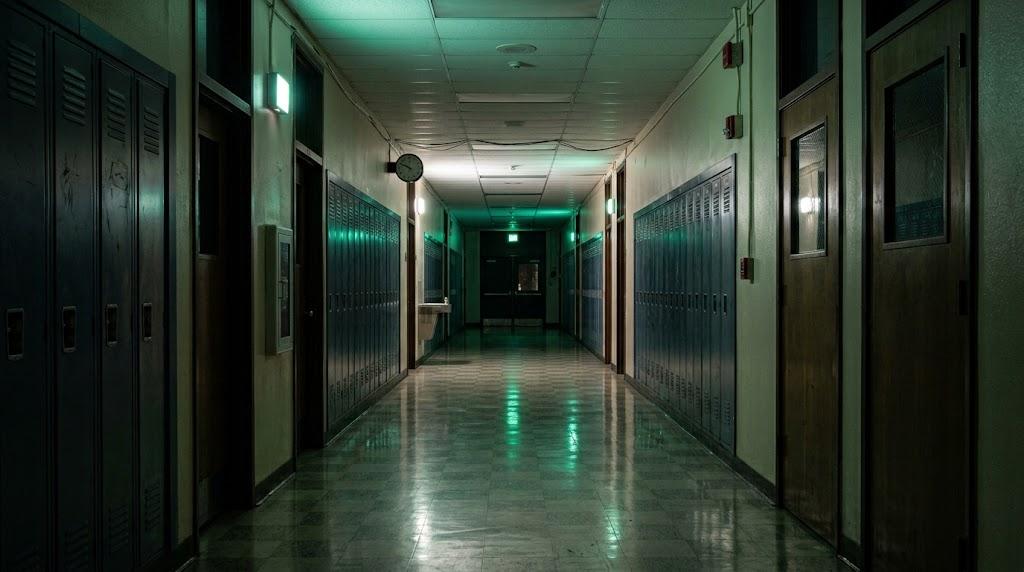
The first dimension builds liminal spaces out of ordinary schedules. A school at midnight is still a school — lockers, bell schedules, pencil-sharpener dust — but it sits outside the hours that give it meaning. The same is true of an office tower on a Sunday, an airport at dawn, a train station after the last departure. Temporal liminality is the mismatch between a space’s design purpose and its clock: the building exists for crowds, and the calendar promises that none will come.
2. Spatial and Architectural Liminality
Then there is the geometry itself: endless identical corridors, looping baggage claims, stairwells that repeat floor after floor. Environmental psychologist Jay Appleton called it prospect-refuge theory — humans feel at ease where they can see without being seen. A featureless corridor inverts that bargain: maximum exposure, no refuge, and countless corners where someone else could be waiting. Research on fear of crime in built environments consistently links exactly these features to elevated vigilance — and to why liminal spaces feel watchable.
3. Functional Decay
The third dimension is time applied with a hammer. Dead malls with fountains running for no shoppers, shuttered waterparks, indoor playgrounds sealed mid-birthday-party: here the space has stopped being a threshold at all. What was built for flow has become static, and the brain confronts an even stranger contradiction — a room whose entire design screams imminent human use, abandoned long enough for moss to argue otherwise. Functional decay turns liminal spaces into ruins that were never finished becoming anything.
The Doorway Effect and the Sound of Nothing
Liminal spaces do more to the mind than look eerie; their thresholds segment experience. Gabriel Radvansky’s experiments on the doorway effect show that walking through a door — even a doorway inside a single virtual room — measurably impairs memory for what you were just carrying in your head. The brain files each space as an event, and the boundary wipes the working slate. A concourse of repeating thresholds is a machine for slicing experience into pieces, explored more deeply in why your brain forgets at every doorstep.
Then there is the soundtrack. In 2023, Rui Goh, Ian Phillips, and Chaz Firestone showed that silences are not mere absence: when a silent gap replaced a sound in a repeating pattern, it inherited the very temporal illusions sounds show. The brain treats silence as a thing — an event it can perceive, misjudge, and remember. An empty terminal is the largest such event most people ever stand inside, a cousin of your brain’s ability to hear silence at all.
Claim: boundaries and quiet actively reshape cognition in empty places. Evidence: the doorway effect across decades of behavioral experiments, and the 2023 PNAS silence studies. Limitation: both lines of research use tightly controlled laboratory events — doorways crossed in seconds, gaps measured in milliseconds — so extending them to cathedral-sized quiet is an extrapolation, however natural it feels from the inside.
Creepiness as Threat Ambiguity: The McAndrew Framework
In 2016, psychologist Francis McAndrew and Sara Koehnke published the first systematic study of what makes a person creepy — and their conclusion explains liminal spaces almost perfectly. Creepiness, they proposed, is our evolved response to threat ambiguity: the discomfort of not knowing whether a threat exists. We cannot afford to ignore a possible predator, but we cannot afford to panic at every shadow either. Creepiness is the compromise alarm — a sustained, low-grade warning that keeps attention locked on the ambiguous.
Their online survey of 1,341 people confirmed the pattern. Creepy people are, above all, unpredictable: strange smiles, odd laughing, long stares, conversations steered toward personal topics. More than 95 percent of respondents judged men creepier than women, and clowns topped the list of creepy occupations — an entertainment profession defined, tellingly, by a hidden face and unreadable intentions. The threat is never certain. It is always merely possible: the exact recipe liminal spaces serve after hours.
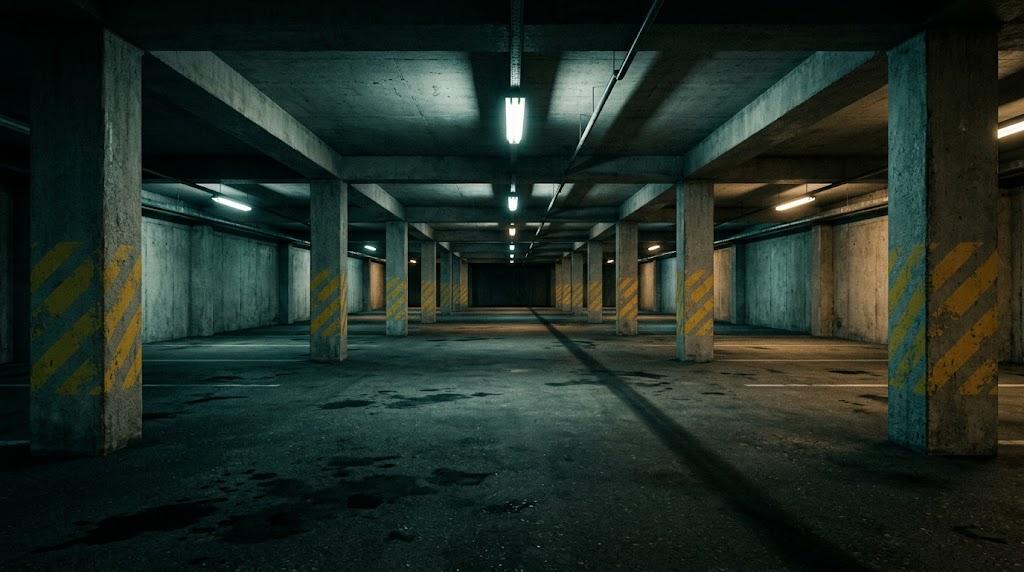
Liminal spaces are engineered threat ambiguity. Our agency-detection wiring — what psychologist Justin Barrett called the hyperactive agency detection device — errs toward seeing agents in ambiguous patterns, because misreading wind as a predator cost little, while misreading a predator as wind cost everything. That is why vacant halls feel populated by unseen watchers, and why we see faces in dark windows and wood-grain doors: the same wiring behind face pareidolia, running at full volume in a place shaped to expect people.
It also explains why small cues feel enormous in these spaces. Perception works by contrast: small sounds grow louder in the dark, and the quieter the scene, the louder its exceptions. A single distant door bang in a silent concourse reads as deliberate movement, because a vacant habitat is precisely where an unseen agent should be — and the ambiguous signal lands on a brain already biased to detect agents.
Claim: creepiness is the evolved alarm for threat ambiguity. Evidence: McAndrew and Koehnke’s 2016 survey, the first empirical study of the construct, plus the broader agency-detection literature. Limitation: the survey measures self-reported impressions of hypothetical people, not real encounters, and the evolutionary logic is a plausible story rather than a tested history. The framework explains a feeling — not a haunted building.
Liminal Spaces vs. Kenopsia vs. the Uncanny Valley vs. Agoraphobia
Not every empty-room feeling is the same feeling. Four phenomena related to liminal spaces get conflated in comment sections daily; here is how they actually differ.
| Phenomenon | Core Sensation | Primary Psychological Trigger | Environmental Context | Evolutionary Function |
|---|---|---|---|---|
| Liminal space phenomenon | Eerie unease, being watched, urge to leave | Violated environmental priors plus threat ambiguity in vacant human habitats | Airports, malls, schools, corridors at off-hours | Vigilance toward possible unseen threats |
| Kenopsia | Forlorn, wistful sadness; hollow stillness | Salience of the absent crowds a place was built for | Empty schools in summer, offices at night, closed theaters | Social-species alarm at unexpected group absence (proposed) |
| Uncanny valley | Revulsion toward almost-human entities | Prediction error from human form with nonhuman movement or texture | Robots, androids, CGI faces, mannequins, wax figures | Avoiding diseased, deceptive, or unfit individuals |
| Agoraphobia | Panic and dread; urgent need to escape | Learned fear of situations where escape or help seems impossible | Open squares, crowds, public transport, being outside alone | Maladaptive overactivity of ancient escape circuitry |
Kenopsia deserves an honest footnote: it is not a scientific term. Writer John Koenig coined it in The Dictionary of Obscure Sorrows for the forlorn atmosphere of a place that is usually bustling but now abandoned and quiet. Where liminal spaces frighten, kenopsia grieves. The two can share a photograph — unease and sorrow arriving together, like the smell of an empty swimming pool.
Agoraphobia differs in kind: it is a clinical diagnosis, not an aesthetic. It is the fear of situations where escape might be difficult or help unavailable, and it can make ordinary spaces genuinely disabling. The overlap is instructive, though — both pivot on the same questions. Can I leave? Can anyone help me? Is anyone here? Liminal spaces ask those questions playfully. Agoraphobia asks them at full volume.
Why the Internet Is Obsessed With Liminal Spaces
The internet’s obsession with liminal spaces has a precise birthday. In May 2019, an anonymous post on 4chan asked readers to picture a place where, if you are not careful and you noclip out of reality, you end up in the Backrooms: endless empty rooms with damp carpet, mono-yellow wallpaper, and the buzz of fluorescent lights at maximum hum. Within months, the Backrooms had lore, maps, video games, and a found-footage YouTube series watched by millions.
The resonance is not accidental. The Backrooms is childhood architecture with the children subtracted — waiting rooms, pool corridors, motels remembered from the back seat of a car. Digital nostalgia made them shared memory; modern life added the alienation of architecture built for flow, experienced alone. Diel and Lewis’s finding fits precisely — depicted people tame the uncanny of public places, and their absence feeds it — and liminal spaces, photographed empty, are little else.
Liking this material is not morbid; it is recreational fear — the same safe-danger appetite that draws people to horror films and to the call of the void, that odd urge to consider the abyss from behind glass. Empty spaces let the threat-detection system exercise without a threat. You feel the alarm, and then you close the tab, unharmed.
Questions You Were Going to Ask Anyway
Is it weird that I like liminal spaces?
No — it is one of the most common aesthetic instincts of the digital generation. The best explanation is recreational fear: the brain enjoys simulated threat the way muscles enjoy simulated hills. Researchers studying horror entertainment describe a sweet spot where danger feels real enough to matter and safe enough to enjoy. Photography of liminal spaces hits that window almost perfectly — real places, zero actual risk.
Why do liminal space photos feel creepier than the real places?
A photograph removes your exit. In a real corridor you can turn around, check behind you, and leave; the frame denies you all three. The image also strips context — no staff, no schedule, no reason — leaving only the mismatch that defines liminal spaces. And a photo forces the prolonged, still gaze that everyday life rarely gives an empty hall. Attention is what turns a passing oddity into an experience.
Can spending time in empty places affect your mental health?
For most people, no — visiting an empty mall is not a clinical event, and enjoying the mood is entirely normal. What deserves care is the difference between aesthetic unease and symptoms: derealization that arrives uninvited, panic that escalates instead of settling, a world that stops feeling real in contexts you cannot control. If emptiness triggers those, bring it to a professional; that is what the diagnostic toolkit is for.
Why do some people find liminal spaces calming instead of scary?
Individual differences cut both ways. People with high sensory sensitivity often find crowded spaces the threatening condition and emptiness the relief; for them, liminal spaces are where the social demands finally stop. Preference also tracks experience — night-shift workers, travelers, and city wanderers accumulate safe memories of quiet public space. The prediction machine learns either lesson: corridors can mean footsteps, or they can mean rest.
Is there any real danger in liminal spaces, or is the fear pure imagination?
The fear is imagination doing its job in a context with nothing to detect. Liminal spaces carry ordinary risks — isolation, poor security, trespassing laws if you explore closed buildings — but the specific dread of being watched is a false positive from a vigilant system. The honest summary: the unease is manufactured by architecture and expectation, which is exactly why it photographs so well.
The Evolutionary Architecture of Spatial Disquiet
An airport at 3:15 a.m. is the master class in liminal spaces: a machine running with its purpose removed. Your prediction engine forecasts a crowd; the concourse hands back silence. The uncanny-structure detectors find everything almost right; the agency detector, offered ambiguity, fills the corners with possible watchers; the doorway effect shreds the moment into fragments; and the silence, treated by the brain as an object, sits there like furniture.
None of this means the buildings are haunted. It means you are — by four million years of ancestors who survived by taking empty places seriously. The feeling is a fossil of vigilance, warmed up by modern architecture and handed to you between gates B14 and B22.
The next time an empty space stares back, remember what it is: not a presence, but an absence shaped exactly like one. Your brain is not malfunctioning. It is proving it still knows what a person is — by missing every single one.
References
- McAndrew FT, Koehnke SS. On the nature of creepiness. New Ideas Psychol. 2016;43:10-15. doi:10.1016/j.newideapsych.2016.03.003 — source of the threat-ambiguity framework, the 1,341-participant survey, the 95% male-creepier finding, and the clown ranking.
- Diel A, Lewis M. Structural deviations drive an uncanny valley of physical places. J Environ Psychol. 2022;82:101844. doi:10.1016/j.jenvp.2022.101844 — source of the place-uncanniness experiments and the social-presence finding.
- Saygin AP, Chaminade T, Ishiguro H, Driver J, Frith C. The thing that should not be: predictive coding and the uncanny valley in perceiving human and humanoid robot actions. Soc Cogn Affect Neurosci. 2012;7(4):413-422. PMID: 21515639
- Clark A. Whatever next? Predictive brains, situated agents, and the future of cognitive science. Behav Brain Sci. 2013;36(3):181-204. PMID: 23663408
- Friston K. The free-energy principle: a unified brain theory? Nat Rev Neurosci. 2010;11(2):127-138. PMID: 20068583
- Radvansky GA, Krawietz SA, Tamplin AK. Walking through doorways causes forgetting: Further explorations. Q J Exp Psychol (Hove). 2011;64(8):1632-1645. PMID: 21563019
- Goh RZ, Phillips IB, Firestone C. The perception of silence. Proc Natl Acad Sci U S A. 2023;120(29):e2301463120. PMID: 37428927
- Fisher BS, Nasar JL. Fear of crime in relation to three exterior site features: Prospect, refuge, and escape. Environ Behav. 1992;24(1):35-65. doi:10.1177/0013916592241002
Medical Disclaimer: This article is for informational purposes only and is not a substitute for professional medical advice, diagnosis, or treatment. Always seek the advice of a physician or other qualified health provider with any questions regarding a medical condition.
📚 You Might Also Like
Hand-picked articles for you


