


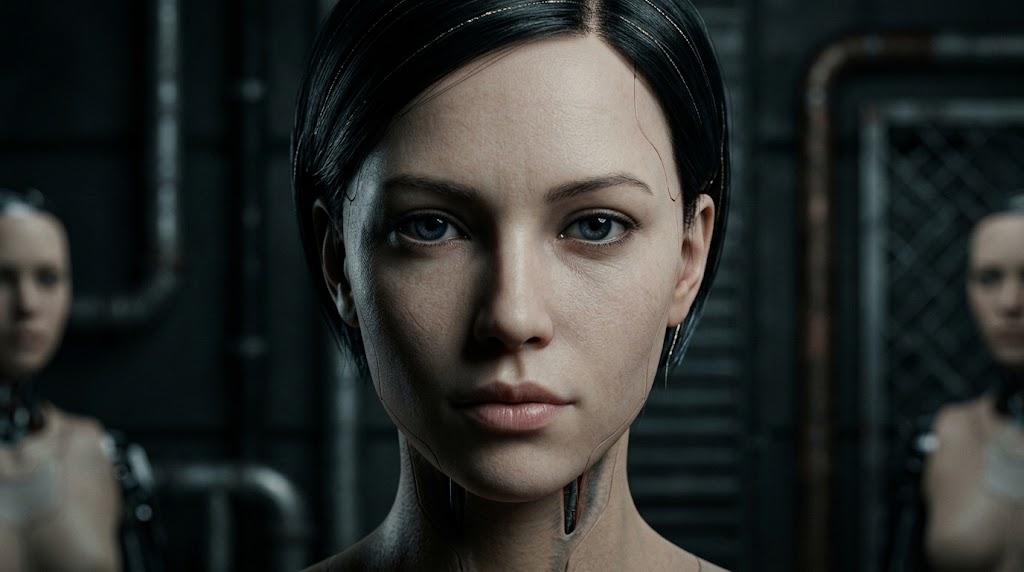
The uncanny valley effect is one of the most shocking and chilling psychological anomalies of the modern era. Have you ever looked at a highly realistic humanoid robot, a hyper-detailed CGI character in a movie, or an AI digital avatar, only to feel a sudden, involuntary shudder of horror run down your spine?
On paper, the figure looks almost completely human. It has realistic skin texture, eyes, and hair. Yet, something about its micro-expressions, dead eye movement, or rigid posture feels profoundly wrong. Your heart rate spikes, your stomach turns, and your brain instantly rejects the creation as an unnatural imposter.
Why does an obvious cartoon robot like Wall-E evoke affection, while a hyper-realistic human android evokes existential horror?
First conceptualized by Japanese robotics professor Masahiro Mori in 1970, this psychological phenomenon explains a deep evolutionary boundary hardwired into human neurology. Here is the exact neuroscience behind why human-like replicas trigger your brain’s threat-detection alarms.
Which facial feature anomaly triggers the most visceral Uncanny Valley aversion in your brain?
1. What Exactly Is the Uncanny Valley Effect?
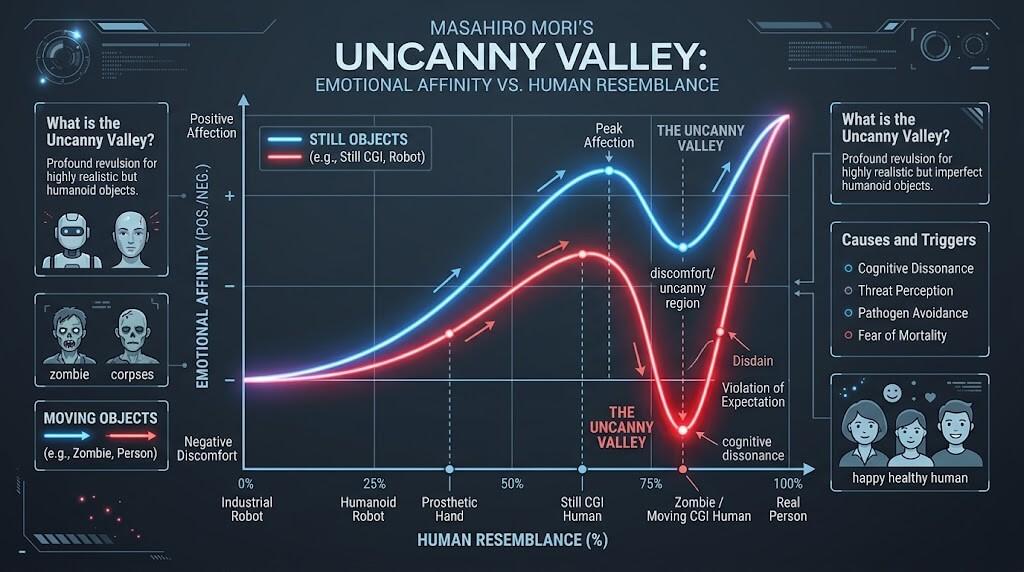
The uncanny valley effect describes a non-linear relationship between the humanlikeness of an entity and the emotional response it provokes in observers. When robotics professor Masahiro Mori plotted human emotional affinity against human resemblance on a graph, he discovered a fascinating dip:

- Low Human Resemblance: Industrial robots or mechanical toys evoke low emotional connection, but zero fear.
- High Human Resemblance (Cartoons): Stylized human figures (like Pixar characters) evoke high affection and warmth.
- Near-Perfect Human Resemblance (The Dip): As an entity approaches near-total human accuracy—but retains minor flaws—affection drops off a cliff into intense revulsion. This drop is the “Uncanny Valley.”
- 100% Human Accuracy: Once an entity becomes indistinguishable from a living human, emotional affinity returns to normal.
It is precisely within that narrow gap of near-perfection that your brain’s threat-detection machinery operates at maximum alert.
The three critical sensory cues that trigger this response are remarkably specific:
- Saccadic Eye Tracking: Human eyes execute tiny, sub-conscious micro-movements (saccades). Android eyes often lack this, making their gaze appear dead.
- Facial Micro-Expressions: Genuine human emotion involves complex muscle synchronization. Delayed micro-expressions send immediate alarm signals to your amygdala.
- Subconscious Mismatch: Your brain registers that something looks human, but does not *behave* human, triggering severe cognitive dissonance.
Your brain is an expert human-processing computer. When an entity is 95% realistic, your brain stops evaluating it as a cool robot and starts evaluating it as a sick or mutated human.

2. Evolutionary Pathogen Avoidance: Disease and Mortality Cues
Why did natural selection hardwire this intense revulsion into our nervous systems? Evolutionary psychologists propose that the uncanny valley effect is a sophisticated biological defense mechanism designed for pathogen avoidance.
In ancestral environments, encountering a human-like figure with abnormal features carried severe mortality risks:
- Contagious Disease Detection: Pale skin, vacant eyes, rigid movements, and asymmetrical facial expressions were primary biological markers of dangerous infectious diseases or neurological impairment.
- Cadaver Avoidance: A lifeless humanoid figure closely resembles a human corpse. Revulsion encouraged early humans to physically distance themselves from decomposing bodies to avoid bacterial contamination.
- Predator Mimicry Warning: Some predators in nature evolved to mimic the appearance of other species. The uncanny valley may have served as a rapid-detection system for any entity that appeared human but displayed subtle wrongness in movement or proportion.
Your modern brain looks at an artificial humanoid or a stiff AI avatar and applies the exact same ancient disease-avoidance algorithm: *”This looks like a sick or deceased human; step back immediately!”*
Neuroscience research by Dr. Jennifer Steiner at Princeton has shown that the uncanny valley response activates the amygdala, the brain’s threat detection center, as well as the fusiform face area, which specializes in facial recognition. The conflict between these two systems — one identifying the face as human, the other flagging it as potentially dangerous — creates the characteristic feeling of unease.
What makes this response so powerful is its speed. The amygdala processes threat information before your conscious mind has time to analyze what it is looking at. This means you feel the shudder of revulsion before you can even articulate *why* the figure disturbs you. By the time your prefrontal cortex attempts to rationalize the experience, your body has already initiated a mild fight-or-flight response — your palms may sweat, your muscles tense, and your attention narrows.
3. The Speciation Threat and Imposter Detection
Another evolutionary theory posits that the revulsion is driven by an ancient “speciation threat” — the biological necessity to distinguish genuine members of our species from dangerous, competing humanoids.

Throughout early evolutionary history, *Homo sapiens* coexisted alongside other hominid species including *Homo neanderthalensis* and *Homo erectus*. The ability to instantly spot subtle physical or behavioral differences between species prevented improper mating and ensured genetic survival. Mistaking a member of a rival hominid group for one of your own tribe could have had severe reproductive and social consequences.
When you look at an advanced android or hyper-realistic CGI character:
- Your prefrontal cortex attempts to categorize the entity as either “Human” or “Non-Human.”
- Because the entity sits directly on the boundary line, your category boundaries collapse.
- Your brain treats the entity as a dangerous imposter pretending to be human.
This categorization failure is not a minor cognitive hiccup. Research in social cognition has demonstrated that humans possess an innate, deeply ingrained drive to classify every entity they encounter as either “in-group” or “out-group.” When an entity violates this binary — appearing to belong to both categories simultaneously — the brain experiences what psychologists call **categorical ambiguity**. This ambiguity generates anxiety because it prevents you from deploying the appropriate social scripts. You do not know whether to smile at the android, offer it a handshake, or run.
This imposter alarm mechanism is deeply connected to how AI bots imitate human interaction under the dead internet theory, triggering subtle subconscious unease when digital reality feels synthetic.
The practical implications for robotics and animation are significant. Companies developing humanoid robots must carefully calibrate the degree of human-likeness to avoid triggering the uncanny valley response. Disney researchers have published guidelines suggesting that slightly stylized characters — clearly non-human but with human-like features — consistently outperform photorealistic attempts in terms of audience acceptance and emotional engagement.
“The Uncanny Valley proves that human empathy is hyper-tuned to authenticity. We do not fear robots because they look like metal; we fear them when they wear a human mask that doesn’t quite fit.”
4. Predictive Coding Errors in the Visual Cortex
Neuroscientists explain the uncanny valley effect using the concept of Predictive Coding. Your visual cortex does not passively observe the world; it actively predicts what it expects to see milliseconds before visual data arrives. This predictive engine is one of the most energy-efficient systems in the human brain — it constantly generates hypotheses about incoming sensory data and only devotes conscious processing power to situations where predictions fail.
When observing a standard human:
- Your brain predicts natural skin reflections, fluid eye movement, and synchronized vocal cadence.
- When watching a hyper-realistic CGI avatar, its visual appearance signals “Human,” so your brain generates human behavioral predictions.
- When the avatar moves with slight mechanical stiffness, your visual predictions fail catastrophically.
This prediction error causes a spike of neural activity in the anterior cingulate cortex — the brain’s error-detection hub. This internal error processing generates immediate feelings of anxiety and psychological discomfort. The more realistic the entity appears, the stronger your brain’s initial predictions become, and the more jarring the eventual prediction failure feels. This explains why a crude robot puppet does not disturb you — your brain never generated human predictions for it in the first place.
This cognitive strain is similar to how decision fatigue weakens executive processing, as your brain exhausts resources trying to resolve contradictory sensory data.
The predictive coding framework also explains why the uncanny valley is so context-dependent. An entity that appears perfectly acceptable in a static photograph may become deeply disturbing the moment it begins to move. Movement introduces dozens of additional prediction variables — gait rhythm, weight distribution, facial muscle coordination, hand gesture timing — each of which provides another opportunity for the brain to detect a mismatch between expectation and reality. This is why video game developers and filmmakers report that the uncanny valley is significantly harder to navigate in animated sequences than in still images.
5. AI Avatars, Virtual Humans, and Modern CGI Challenges
Why has this 50-year-old robotics theory suddenly become one of the hottest topics in modern digital media? Because artificial intelligence and CGI have finally pushed digital design directly into the center of the Uncanny Valley.
Modern digital examples include:
- Digital Actor De-aging: De-aged Hollywood actors in blockbuster movies often look visually stunning in screenshots, but feel creepy and lifeless in motion. The skin may appear perfectly smooth, but the micro-movements around the eyes and mouth betray the artificial origin.
- AI Video Presenters: Corporate training videos utilizing synthetic AI avatars frequently evoke viewer repulsion due to unnatural lip-syncing and unblinking gazes. The uncanny effect is amplified when the avatar attempts emotional expression — a smile that engages only the mouth without involving the orbicularis oculi muscles around the eyes triggers immediate distrust.
- Humanoid Robotics: Modern robotics labs developing elderly-care androids find that elderly patients frequently reject hyper-realistic silicon skin in favor of friendly, mechanical-looking robots. The emotional comfort of a clearly artificial companion outweighs the visual fidelity of a near-human one.
This digital unnerviteness feeds into why the brain struggles with digital hyper-stimulation, as subconscious threat-detection systems remain hyper-active during screen exposure.
The healthcare industry has also encountered the uncanny valley in unexpected ways. Telemedicine platforms experimenting with AI-driven virtual assistants report that patients respond more warmly to cartoonish or abstract interface characters than to photorealistic digital nurses. Similarly, educational software that uses hyper-realistic child avatars to teach young students has been abandoned in favor of clearly fictional characters, because children displayed measurable distress when interacting with figures that looked almost — but not entirely — like other children. These real-world failures reinforce a consistent lesson: near-human realism is not a neutral design choice. It actively triggers neurological threat responses that can undermine the intended purpose of the technology.
The Pixar Solution
Animation studios like Pixar deliberately avoid the Uncanny Valley by keeping human characters highly stylized (oversized eyes, exaggerated proportions), keeping them safely at the peak of affection on Mori’s curve.
The Perceptual Mismatch
Studies show that revulsion peaks when there is a mismatch between features — such as a synthetic figure with hyper-realistic human eyes paired with a static, unnatural mouth motion.
Where Biological Identity Meets Synthetic Simulation
The Uncanny Valley Effect is a biological tribute to the sophistication of human perception. It demonstrates that our brains possess a hyper-sensitive, protective boundary that demands absolute authenticity before granting emotional trust. Far from being a flaw in human cognition, this response represents millions of years of evolutionary refinement — a survival system that kept our ancestors alive by detecting anything that wore a human face without truly being one.
As AI-generated content and humanoid robotics continue to advance, understanding the uncanny valley is no longer an academic curiosity. It is a practical necessity for designers, engineers, filmmakers, and anyone building digital humans. The line between “almost human” and “convincingly human” is not just an aesthetic threshold — it is a neurological one, etched into the deepest circuits of the human brain.
The practical takeaway for creators is straightforward: either commit fully to stylization and stay on the safe side of the valley, or invest the enormous resources required to achieve photorealism that is genuinely indistinguishable from a living person. The worst possible strategy is to aim for realism and fall short — because the closer you get to human perfection without crossing the line, the more intensely your audience will recoil. The uncanny valley does not reward partial effort.
Frequently Asked Questions
Who first identified the Uncanny Valley Effect?
It was identified in 1970 by Japanese robotics professor Masahiro Mori, who mapped human emotional reactions against the physical realism of artificial entities. His original paper, published in the Japanese journal *Energy*, proposed that as robots became more human-like, observers’ emotional response would grow increasingly positive until a sudden, dramatic drop into revulsion — the valley itself.
Can artificial intelligence ever cross the Uncanny Valley?
Yes. As real-time rendering, neural lip-syncing, and micro-expression simulation improve, artificial humanoids will eventually cross the valley to achieve 100% emotional authenticity. Some researchers argue that advances in generative adversarial networks (GANs) and deep learning-based animation may close the gap within the next decade, though others believe the final few percentage points of human realism will prove the most difficult to achieve.
Why do some people experience the uncanny valley more intensely than others?
Individual sensitivity to the uncanny valley varies based on several factors, including baseline anxiety levels, familiarity with technology, and individual differences in facial processing ability. People with higher trait anxiety or those who spend less time interacting with digital media tend to report stronger aversion responses. Additionally, cultural background plays a role — research suggests that individuals from cultures with greater exposure to humanoid robotics may have a slightly elevated threshold for the uncanny response.
Does the uncanny valley apply to voice and audio, or only visual appearance?
The uncanny valley is not limited to visual perception. Auditory uncanny valley effects have been documented in speech synthesis and vocal AI. When a computer-generated voice achieves near-human realism but retains subtle artifacts — unnatural breathing patterns, slightly flat prosody, or inconsistent emotional tone — listeners report similar feelings of unease. This cross-modal response suggests that the underlying neural mechanism operates on a principle of “almost but not quite” that transcends any single sensory modality.
Where can I read more scientific research on humanoid robotics?
To explore technical studies on visual perception and android engineering, consult the Mori, M. (1970/2012) – The Uncanny Valley: Robotics and Cognition as well as robotics research published in IEEE Spectrum on humanoid robotics design.
References
- Mori, M. (1970). The uncanny valley. Energy, 7(4), 33-35. (Translated by K.F. MacDorman & N. Kageki, 2012. IEEE Robotics & Automation Magazine, 19(2), 98-100.)
- MacDorman, K.F. (2005). Androids as an experimental apparatus: Why avoid the uncanny valley? Proceedings of the AAAI Workshop on Android Science, 128-135.
- Kätsyri, J. et al. (2015). A review of empirical evidence on graphic determinants of the uncanny valley. Journal of Vision, 15(12), 263. DOI: 10.1167/15.12.263
- Mathur, M.B. & Reichling, D.B. (2016). Navigating a social world with robot partners: A quantitative cartography of the uncanny valley. Cognition, 146, 22-32. DOI: 10.1016/j.cognition.2015.09.008
📚 You Might Also Like
Hand-picked articles for you


