


Fact-checked by Aly ElDeeb — Science writer & literature researcher, last verified September 2026. Sources: Hobson et al. (2000), Revonsuo (2000), Walker & van der Helm (2009), Stickgold (2005).
Every night, without your permission, your brain closes its eyes and begins broadcasting a private movie of vivid dreams. You wake up in impossible places, speak to people who died years ago, fall from rooftops, and forget most of it before breakfast. Nobody trained you to do this. No app generates it. It is simply what a human brain does when the body sleeps — and it happens to every person on Earth, roughly four to six times per night.
The question why do we dream is one of the oldest puzzles in human history, and for most of that history the answers were pure speculation. Philosophers blamed demons, gods, and omens. Psychoanalysts blamed repressed desires. Even today, fully explaining why we dream the way we do remains active research. It was only in the last seventy years — after the discovery of rapid eye movement (REM) sleep in 1953 — that dreaming finally became a measurable laboratory subject instead of a mystical riddle.
Even now, sleep scientists openly admit that no single theory explains everything about dreaming. What exists instead is a set of five competing, overlapping scientific theories, each supported by real experiments, each explaining some part of the phenomenon, and each leaving different clues behind. The five leading theories below dismantle that nocturnal engine, weighing what the laboratory evidence confirms against what still eludes even the sharpest sleep researchers.

Science has not settled on one answer to why we dream, but five leading theories dominate dream research: dreams rehearse threats (evolutionary protection), they consolidate and file memories, they regulate emotions by draining stress from experiences, they are the brain’s simulation of reality running without external input, and they are partly the result of random neural activity that the cortex weaves into stories. Most researchers today believe dreaming is a combination of these processes rather than a single function.
First, What Counts as a Dream?
Before testing any theory, scientists need a working definition, and answering why do we dream at all turned out to be harder than expected, because dreams are private experiences that vanish on waking. In laboratory terms, a dream is a sequence of sensations, emotions, and ideas experienced during sleep that the sleeper typically attributes to an external reality — at least while it lasts. Most dreams are visual stories with emotional weight. Some include sound and touch. Very few include smell or taste, because those sensory channels are heavily dampened during sleep.

Modern sleep research distinguishes between two very different forms of dreaming. REM dreams — the kind that occur during rapid eye movement sleep — are long, bizarre, emotional, and story-like. Non-REM dreams, which surface in lighter stages of sleep, are shorter and more thought-like: a fragment of a conversation, a vague sense of working through a problem, a static image. When people report the vivid cinematic dreams they remember at breakfast, they are almost always describing REM experiences.
The timing matters too. REM periods cycle roughly every ninety minutes, growing longer as the night progresses. The final REM period before waking can stretch beyond half an hour, which is exactly why most remembered dreams come from the moments just before the alarm rings. Dreams you never recalled were not absent — they simply dissolved before reaching long-term memory, a phenomenon we have covered separately in our guide to why the brain erases dreams so quickly.
What evolutionary purpose explains why human dreams are frequently tense, intense, and bizarre?
Theory 1: Dreams as Ancient Threat Simulation
The evolutionary theory, formalized by Finnish neuroscientist Antti Revonsuo in 2000, argues that dreaming exists because it rehearses survival. During the long human prehistory of predator attacks, tribal warfare, and resource scarcity, individuals who could practice dangerous situations safely — while paralyzed in a protected shelter — gained a genuine survival edge. Dreams, in this view, are a biological flight simulator.

The theory makes a bold prediction: if dreams evolved for threat rehearsal, then negative events should dominate dream content. Across cultures, age groups, and historical eras, the data deliver exactly that. Studies of dream diaries consistently find that the most frequent dream themes are being chased, attacked, confronted, or failing at something urgent. Around two-thirds of the emotions reported in dreams are classified as negative — fear, anxiety, and distress outrank joy and calm. Children’s dreams, which contain the fewest learned complications, are even more heavily populated by animal threats and monsters than adult dreams.
Ancestral content also appears in statistically strange ways. Modern dreamers who have never touched a snake report snake dreams. People who have never been near a major body of water dream of drowning. Cities are strangely absent from dreams compared to open natural landscapes. This bias toward ancient dangers rather than modern ones is exactly what a legacy program — software written for an old environment — would produce.
Critics raise a fair objection: if dreams were designed as training, sleepers should gain measurable skills, and most people wake up from nightmare chases having learned nothing obvious. Supporters answer that rehearsal effects do not require conscious lessons — fighter pilots improve in simulators even when a single session feels chaotic. The theory also struggles to explain pleasant dreams, though Revonsuo argues that non-threatening content is simply simulation noise produced by the dreaming brain, the way gym equipment produces both muscle growth and sweat.

⚔️ The Simulator Evidence at a Glance
- Chase dreams are universal — reported in every culture ever sampled, from hunter-gatherer communities to modern students.
- Aggression appears in dreams far more than cooperation — the reverse of waking life, where cooperation dominates.
- Children around age five dream of animal attacks regardless of exposure, matching the ancestral threat inventory.
- The amygdala and insula — fear circuits — are among the most active regions in REM sleep.
This is also why nightmares — the most intensively studied dreams of all — are best understood as a feature, not a malfunction. The occasional bad dream is the simulator doing a routine drill. Problems arise only when real-world stress floods the system with drill material, which is one documented mechanism behind the racing thoughts that follow you to bed in nighttime overthinking.
Theory 2: Dreams as Memory Consolidation — The Night Filing Cabinet
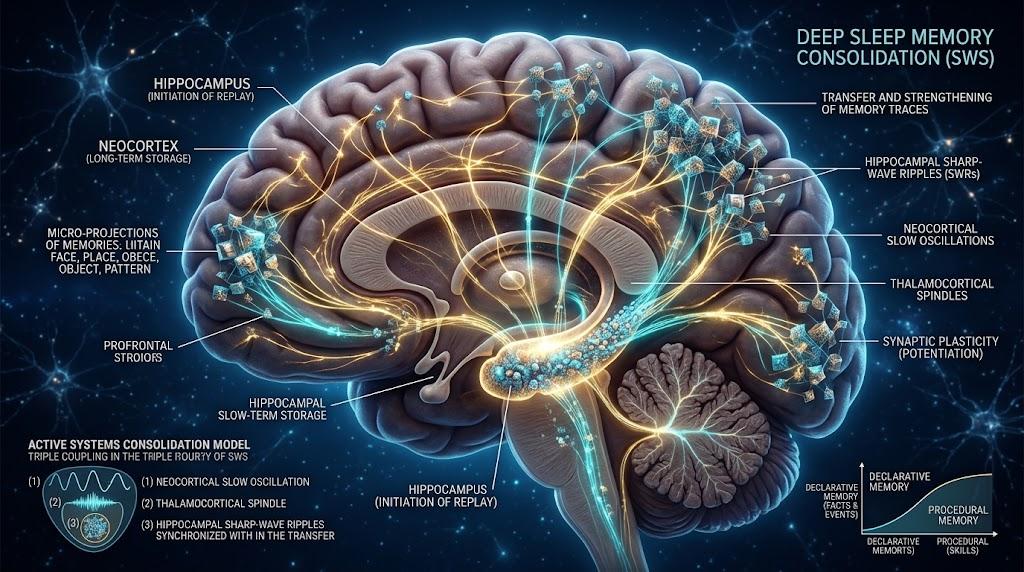
The second major theory argues that dreaming is the conscious side-effect of the brain filing its memories. Sleep, especially deep non-REM sleep early in the night, is when the hippocampus — the temporary storage hub for daily experiences — replays the day’s information to the cortex for long-term storage. In this framework, dreams are not the filing itself; they are the fragments of filing that leak into awareness.
The evidence linking sleep and dreaming to memory is among the strongest in all of neuroscience. Research by Matthew Walker and colleagues at the University of California, Berkeley, demonstrated that sleeping after learning produces measurable memory gains compared to staying awake for the same interval, and that specific sleep stages protect specific memory types. Later work from Lyon’s Center for Research in Neuroscience showed that slow brain waves during deep sleep physically replay learning patterns, and that disrupting this replay in students measurably weakened their next-day recall.

What makes this theory elegant is its explanation of dream content. Dreams are famously biased toward recent experiences — researchers call this the day-residue effect. Freud noticed it over a century ago: events from the day before the dream appear constantly, while events a week old almost never do. Modern experiments sharpened the picture. In one landmark German study led by neuroscientist Jan Born, participants trained on a virtual maze and then slept. Those who dreamed about the maze — even for a few seconds, even without remembering it vividly — improved their navigation ten times more than those who did not. The dream about the maze was not entertainment; it was a marker of active overnight processing.
The theory also elegantly explains why dream logic is so strange. The filing system is associative, not chronological. The cortex integrates new memories by linking them to old ones by theme, emotion, and meaning — not by date. A difficult conversation at work can therefore merge into a dream with your third-grade classroom and a hallway from a home you moved out of fifteen years ago. Each element is real memory, connected by association rather than sequence.
Why do dreams surface people and places we believed we had forgotten? Because memory consolidation retrieves more than conscious recollection. The brain reactivates weakly stored material and re-links it, surfacing associations the waking mind filed away long ago — a retrieval job the sleeping brain performs far more reliably than the daytime forgetting we describe in why we forget things so easily. This associative stitching is also why creative insight so often arrives after sleep — a phenomenon documented in studies where participants solved hidden-rule puzzles far better after a period of sleep than after equal time awake.
Theory 3: Dreams as Overnight Emotion Therapy
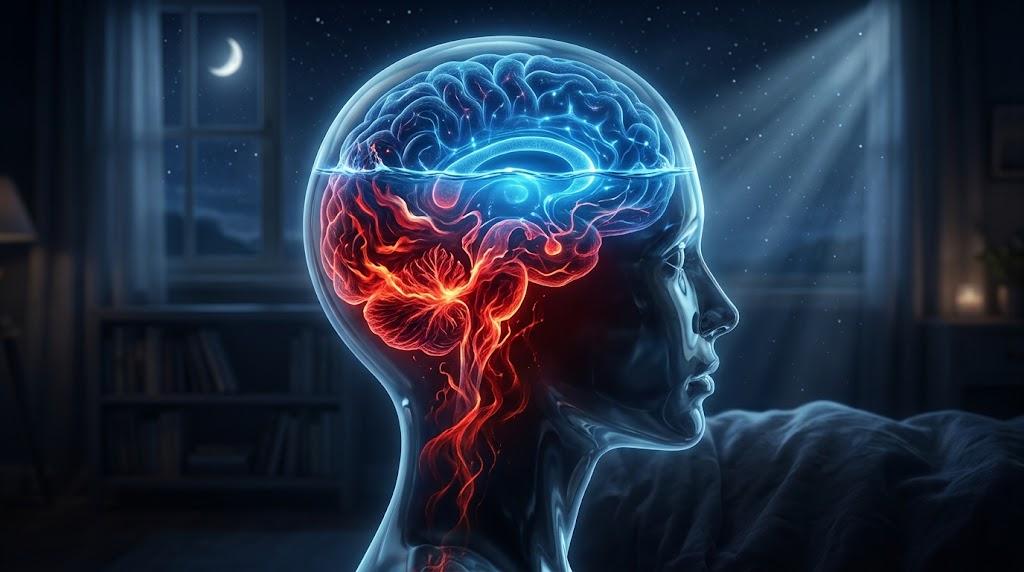
The third theory, advanced powerfully by Matthew Walker and colleagues, treats REM dreaming as emotional first aid. The claim: during REM sleep, the brain reprocesses emotionally charged memories of the day while stress chemistry is switched nearly off — and this combination strips the raw sting out of difficult experiences while keeping the lesson.
The neurochemistry is what makes the idea credible. Waking emotional memory is cemented by noradrenaline, the brain’s alarm chemical. During REM sleep, noradrenaline levels fall to their lowest point of the entire 24-hour cycle. The theory proposes this creates a unique processing environment: the brain can revisit painful material — the raw fuel of that night’s dreams — without the alarm system firing, effectively re-running yesterday’s argument, embarrassment, or loss in a chemically calm state. Each night of REM sleep re-tunes the memory a little further away from panic and a little closer to perspective. The experience stays; the heart rate spike attached to it fades.
Clinical evidence supports the mechanism. Trauma researchers studying post-traumatic nightmares found that recurring trauma dreams often include the addition of new, non-traumatic characters and themes over time — evidence of the brain actively working on the material night after night, weaving the terror into broader narrative context. When this reprocessing succeeds, the trauma loses intrusive power. When REM sleep is chronically disrupted, the raw version persists, which is one reason sleep disturbance and emotional disorders are so tightly intertwined.
Everyday evidence surrounds us. Waking up calmer about yesterday’s conflict is such a universal experience that the phrase “sleep on it” exists in nearly every language. MRI research gives the saying biological teeth: after sleep deprivation, the amygdala of the dream-starved brain overreacts to negative images by well over half again as much, because the overnight emotional recalibration never happened. The brain’s built-in bias toward bad news runs unchecked without that nightly therapy session.
This theory also reframes what dreaming is for in emotional terms: dreams are not just stories, they are the visible surface of the brain’s emotional maintenance window. Bizarre, upsetting dream content during stressful life periods is not a sign that something is wrong — it is the sound of maintenance in progress.
Theory 4: Dreams as Reality Simulation Running Offline
The fourth theory reframes the question entirely: instead of asking what dreams are for, it asks what the brain’s default business is — and answers that the brain’s core product is a simulated world. During waking hours, sensory input steers the simulation. During sleep, the sensory channels go quiet and the simulator keeps rendering, driven only by memory, emotion, and expectation. A dream, in this framework, is what your model of reality looks like with nobody at the controls.
This perspective aligns with modern predictive-processing neuroscience, which holds that perception is never a direct window onto the world. The brain continuously generates a model of what is about to happen and uses incoming senses mainly to correct it. Dreams are the natural demonstration that the model exists: with the senses muted, the model keeps producing a complete world — complete with persistent locations, stable characters, and a physical logic that holds just well enough to feel convincing.
The strongest supporting phenomenon is the dream’s uncanny realism. People blind from birth do not see in their dreams, but still experience complete auditory and tactile worlds. Sleepers dream in continuous, navigable three-dimensional space. Characters in dreams argue, resist, and surprise the dreamer — because they are running on the brain’s social simulation circuits, the same ones used to model real people. The dream is less a video played at you and more a world generated around you, using the very machinery that models your waking reality.
This theory also explains the eerie feeling of reality inside dreams — including the strange confidence with which dream events unfold. There is no sensory veto to check the simulation against, so whatever the model produces is accepted as real. For readers who have ever achieved awareness inside that world, our guide to what happens in the brain during a lucid dream covers what changes when the dreamer’s insight networks come back online mid-simulation.
Critics note that a pure simulation account describes how dreams happen more than why. But it connects dreaming to a bigger scientific story: the brain as a prediction engine that never stops rendering. In that story, waking perception is the controlled version, and dreaming is the uncontrolled one.
Theory 5: Dreams as Random Neural Noise — The Activation-Synthesis Model
The fifth and most provocative theory argues that dreams are not messages, rehearsals, or filings — they are interpretations. Proposed by psychiatrists J. Allan Hobson and Robert McCarley in 1977, the activation-synthesis model begins with an uncomfortable fact: during REM sleep, a brainstem generator called the pons fires bursts of random electrical activation through the forebrain. It also sends signals to the eyes, producing the rapid movements that named the sleep stage.
The cortex, receiving this storm of scattered activation, does what it always does: it makes sense of the signal. It searches memory for fragments that match the firing patterns — a face here, a corridor there, an emotion attached to nothing in particular — and synthesizes a narrative. The dream is the story the cortex writes to explain noise that was never intended to mean anything.
Hobson’s team supported the model with formal analysis of thousands of dream reports, arguing that dream bizarreness is exactly what stitching random fragments produces: discontinuities, incongruities, and uncertain meanings. The model also correctly predicted that dream content can be influenced by physical stimulation during sleep — in one study, researchers administered tones during REM sleep and found the sounds woven into the dream narratives of a meaningful share of participants.
To its critics, activation-synthesis feels like it explains away dreaming rather than explaining it. If dreams are noise, why are they so emotionally coherent? Why do nightmares track real-life stress? Why do dreams over-represent threats and recent concerns rather than firing purely at random? Even Hobson’s later writing softened the hard edge of the original model, describing a secondary process of sense-making that actively shapes dream content.
The modern resolution is that activation and meaning are partners, not rivals. Random activation sets the stage; the brain’s memory, emotion, and concern-driven systems direct the play. The noise theory failed as a complete explanation of why we dream, but it succeeded as a crucial correction: it proved that dream content is constructed, not received, and it identified the biological engine that switches the whole show on.
When Do People Dream the Most? REM Timing and the Why of Dreams
The five theories explain what dreaming does, but the clock answers another part of the puzzle. If you have ever wondered why do we dream more heavily toward morning, the answer lies in how REM sleep is distributed across the night.
Sleep runs in cycles of roughly ninety minutes. The first REM window of the night is short — often five to ten minutes — while each successive cycle contains a longer one. By the final cycle before waking, REM stretches past half an hour. This is why we dream our most elaborate, story-like dreams just before the alarm: the longest rendering sessions are scheduled for the last hours of sleep, when the brain has the most material filed and the most time to run.
Chemistry can hijack the schedule. Alcohol and cannabis suppress REM sleep during the first half of the night, which is why nights spent sleeping after drinking feel heavy but dreamless. Once the substance clears, the brain overcompensates with a phenomenon called REM rebound — longer, more intense dreaming that can feel feverish and surreal. Timing, not mystery, explains those vivid nights.
Waking moments matter as much as sleeping ones, because dreams evaporate unless the sleeper wakes during or immediately after REM. This is why we dream vividly during long afternoon naps that reach REM, why natural waking without an alarm improves dream recall, and why jarring early-morning awakenings can drag the body through transitional glitches like the hypnic jerk. Timing does not explain why we dream, but it explains when the machinery runs — and why protecting the final hours of sleep protects the richest dreams.
So Which Theory Is Right? The Modern Consensus
Ask a contemporary sleep scientist to pick one answer to why do we dream, and you will likely be handed a synthesis. The five models answer different layers of one question. The activation-synthesis engine explains how dreaming starts. The reality-simulation view explains what medium the dream takes place in. Threat simulation explains the content biases. Memory consolidation explains the day-residue structure and why sleep protects learning. Emotional regulation explains why sleep changes how yesterday feels.
The most defensible current position: dreaming is a multi-purpose state generated by a reality-simulating brain, switched on by brainstem activation, stocked with material the cortex needs to file and emotionally process, and shaped over evolution toward rehearsing danger. Different nights — and different REM periods within a night — may tilt toward different mixes of these jobs.
What the field agrees on is equally important. Dreams are generated by the brain, not received from outside it — the mystical versions of the question are settled science at this point. Dreaming and REM sleep overlap heavily but are not identical, since non-REM dreaming exists. Dreams reliably over-include emotion, threat, and recent experience, which no noise model alone can explain. And sleep that lacks dreaming — through deprivation or disorder — costs memory integrity, emotional stability, and creativity.
What remains honestly unsolved is the deepest part: why dreaming feels like anything at all. Science can trace the machinery of the dream studio without yet explaining why there is an audience inside it. That question — the neural basis of experience itself — is the frontier where dream research meets the study of consciousness, and it remains open.
Why Do We Dream? Five Theories, One Night
- Brainstem activation switches the dreaming engine on (Hobson & McCarley).
- The reality simulator renders a world without sensory correction.
- Memory consolidation supplies the cast and locations from your day.
- Emotional regulation drains the stress chemistry from the replay.
- Threat simulation bias explains why the script skews toward danger.
What Your Dreams Are Probably Doing Tonight
For the reader rather than the researcher, the practical takeaway is reassuring. Once you understand why we dream, dreams stop looking like warnings, verdicts, or coded prophecies. They are the visible edge of maintenance work your brain performs nightly: filing memories, processing feelings, rehearsing threats, and keeping the reality-simulation calibrated. The dream where you showed up unprepared for an exam twenty years after graduating says nothing about your future — it is standard-issue threat rehearsal cycling through old fear templates.
If you want to influence the process, the levers are the same ones that improve sleep generally, since dreaming quality follows sleep quality: consistent sleep timing, protection of the final morning REM period from abrupt interruption, and managing the stress load that supplies dream material. Noticing that a dream borrowed yesterday’s stress is often the clearest signal that today’s stress is worth addressing while awake.
And if you want to explore rather than merely watch, the science says it can be learned. Conscious dreaming remains a verified, trainable state — the start line for that skill is our full lucid dreaming techniques guide.
Frequently Asked Questions About Why Do We Dream
Do dreams have any real meaning?
The science of why we dream points to practical functions, not mystical ones. Dream content reliably reflects your recent experiences, current concerns, and emotional load. Dream dictionaries that assign universal symbols have no scientific support, but your own dreams meaningfully track your own life.
Why are dreams so weird?
Dream bizarreness comes from how dreams are built: the brain binds memories by association and emotion rather than by time and logic, and during REM sleep the brainstem adds bursts of activation the cortex must weave into the story. Discontinuity and strange combinations are the expected output of that process.
Can dreams predict the future?
No controlled study has ever shown that dreams predict future events beyond coincidence and probability. What feels like prediction is usually a trick of dream memory: events you dreamed about are more likely to be remembered when something similar happens later.
Is it bad that I never remember my dreams?
Not at all. Dream recall depends on waking at the right moment, mostly near the end of a REM period, and on how your brain handles the transfer into memory. Many healthy, well-rested people recall almost nothing — the dreaming itself still happened.
How long do dreams actually last?
Longer than the myth of a two-second flash. REM periods range from roughly five minutes early in the night to over half an hour near morning, and dream timing in laboratory studies closely matches the length of the sleep stage the dreamer was in.
References
- Revonsuo, A. (2000). The reinterpretation of dreams: An evolutionary hypothesis of the function of dreaming. Behavioral and Brain Sciences, 23(6), 877-901. DOI: 10.1017/S0140525X00004015
- Walker, M.P. & van der Helm, E. (2009). Overnight therapy? The role of sleep in emotional brain processing. Psychological Bulletin, 135(5), 731-748. DOI: 10.1037/a0016570
- Hobson, J.A., Pace-Schott, E.F. & Stickgold, R. (2000). Dreaming and the brain: Toward a cognitive neuroscience of conscious states. Behavioral and Brain Sciences, 23(6), 793-842. DOI: 10.1017/S0140525X00003976
- Maquet, P. et al. (2000). Experience-dependent changes in cerebral activation during human REM sleep. Nature Neuroscience, 3(8), 831-836. DOI: 10.1038/77715
- Wamsley, E.J. et al. (2010). Dreaming of a learning task is associated with enhanced sleep-dependent memory consolidation. Current Biology, 20(9), 850-855. DOI: 10.1016/j.cub.2010.03.027
- Stickgold, R., Malia, A., Maguire, D., Roddenberry, D. & O’Connor, M. (2000). Replaying the game: Hypnagogic images in normals and amnesics. Science, 290(5490), 350-353. DOI: 10.1126/science.290.5490.350
- Nir, Y. et al. (2017). Single-neuron activity and eye movements during human REM sleep and awake vision. Nature Communications, 8, 15760. DOI: 10.1038/ncomms15760
- Siclari, F. et al. (2017). The neural correlates of dreaming. Nature Neuroscience, 20(6), 872-878. DOI: 10.1038/nn.4545
⚕️ Medical Disclaimer: This article on the science of dreaming is for educational and informational purposes only and is not a substitute for professional medical advice. If you experience chronic nightmares, disturbed sleep, or distressing dream patterns that affect your daytime functioning, consult a qualified sleep medicine specialist for proper evaluation.
📚 You Might Also Like
Hand-picked articles for you


