


Look up at the clouds for thirty seconds and it will happen: a face will drift into view. A profile here, a grinning monster there — complete with eyes, a mouth, maybe an angry brow. You know, rationally, that nobody is sculpting the sky. It is water vapor. Yet your brain does not care what you know, because for your brain, a face-shaped thing is a face, and faces are never ignored.
You are not imagining that you see faces everywhere. You are — in the precise neurological sense — face pareidolia: the illusion of seeing a face in an object, a pattern, or a patch of noise where no face exists. In electrical sockets. In car front-ends. In the grain of wooden doors, in cinnamon buns, in the Moon’s craters, in burnt toast. And this is not a quirk of creative minds. It is what a hyper-specialized face-detector does when it is built to never, ever miss a real face.
Face pareidolia is the illusory perception of non-existent faces — and the science behind it says something remarkable about you: the same brain circuitry that recognizes your mother’s face can be hijacked by a wall socket, and it happens in roughly a third of all noise-matching moments, measurably and on demand.
What Is Face Pareidolia, Exactly?

Face pareidolia is the experience of seeing a specific, detailed face — an expression, an age, even a gender — in an object that contains no face at all. In everyday language, face pareidolia is simply “seeing faces in things”; in the laboratory it is a measurable perceptual event with a signature on a brain scanner. The word “pareidolia” comes from the Greek para (beside, instead of) and eidōlon (image, form): an image beside the image, a form layered on top of reality.
Crucially, pareidolia is not just noticing that something “looks like” a face. Under the illusion, the illusory face is processed as a face. People instantly judge whether the face in the outlet looks happy or angry, old or young, male or female — judgments that are normally reserved for real human faces. The illusion recruits the brain’s full social face-reading machinery, not just a vague visual similarity.

This everyday illusion sits inside a much larger family. Hearing hidden words in static or a fan’s hum, seeing shapes in Rorschach inkblots, spotting animals in constellations — all are forms of pareidolia, the brain’s tendency to project meaningful patterns onto ambiguous input. Faces are simply the most powerful trigger, because no other visual category has a brain region so devoted to finding it.
The 170-Millisecond Face Scan
Glance at the nearest electrical wall socket, car grille, or coffee foam for a single fraction of a second.
Did your mind detect two eyes and a mouth before you even had time to think? Your Fusiform Face Area (FFA) fires in under 170 milliseconds to prioritize social threat detection.
Your Brain Has a Face Detector — and It Fires First
Deep in the brain’s underside, on the fusiform gyrus, sits a patch of cortex called the fusiform face area (FFA) — the closest thing humans have to dedicated face hardware. It responds powerfully to faces, barely to letters, houses, or objects, and it does not wait politely for a clear image.
It responds to the possibility of a face. This is the same passive editing you live with all day — your own nose is filtered out of view by the same economy of attention — and it is why face pareidolia feels instant and effortless: the detector answers before deliberation begins.

The developmental evidence is striking: newborn babies just hours old track face-like patterns preferentially over equally complex non-face patterns — before any real experience with faces. The bias that drives face pareidolia, in other words, is present from the first day of life. Decades of experience then sculpt this early bias into an expert system, with the FFA growing in selectivity and specialization through childhood and adolescence as the social world trains it.
Why so eager? Because the cost structure of face detection is asymmetric. A false alarm — seeing a face that is not there — costs you nothing but a smile. A miss — failing to see the person crouched in the bushes, or the emotion on an approaching stranger — can cost you everything. Evolution built the detector with the sensitivity knob turned high, and pareidolia is the price of that setting. The socket’s two dots and one line fall inside the detector’s filter, and it fires before your knowledge can intervene.
The Toast Experiment: Pareidolia Under the Brain Scanner
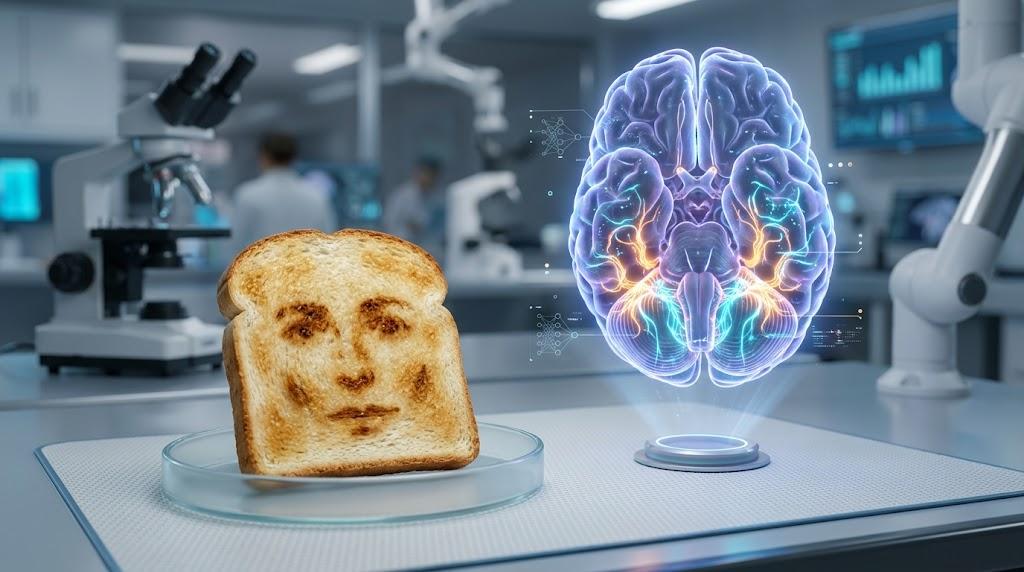
The clearest proof that face pareidolia is a real perceptual event — not imagination — comes from a 2014 experiment with an unforgettable premise. Researchers showed people pure visual noise and told them that half the images might contain faces or letters, then simply asked them to report what they saw.
Participants reported seeing illusory faces in the pure-noise images 34% of the time. Brain imaging showed that whenever they did, the right fusiform face area lit up with a face-specific response — the same region that responds to real faces — while their behavioral responses reconstructed an image that looked like a face, not like a letter. The strength of that right-FFA signal tracked how face-like each person’s illusory percept was.
Think about what that means: the brain was not passively receiving a face-shaped input. It was constructing a face out of noise, with the face-detection system leading the construction. Face pareidolia, in the most literal experimental sense, is top-down perception caught in the act — and “seeing Jesus in toast” is its most famous case.
A later fMRI study added the second half of the story: when people viewed images of face-like objects, the same degree of activation appeared in the right FFA and the right prefrontal cortex as when they viewed real faces. In fMRI terms, face pareidolia and real face perception share the same core network — bottom-up shape analysis from the visual cortex meeting top-down expectations from the frontal lobes. The illusion is the real system, running on thin evidence.

Faces Have Feelings: The Illusion Goes Beyond Detection
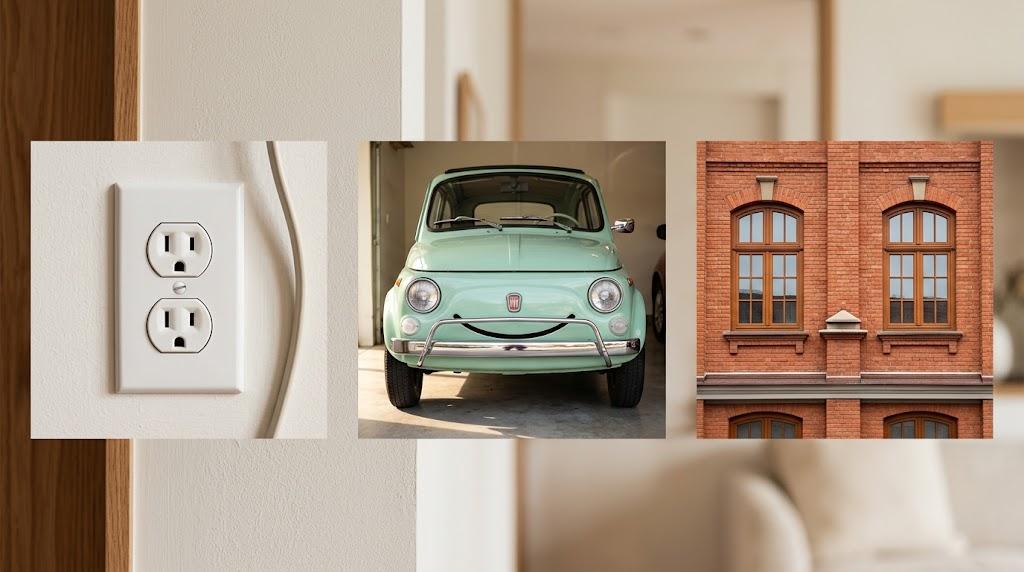
Face pareidolia does not stop at “there is a face in that object.” Your brain assigns the illusory face a full social profile — an emotional expression, an approximate age, and a gender — within milliseconds, automatically.
In a large series of experiments with 3,815 adults, researchers found that illusory faces in objects are readily perceived to have a specific emotional expression, age, and gender.
Most strikingly, there is a strong bias to perceive illusory faces as male rather than female — a bias so robust it appears in children as well, cannot be explained by the objects’ shapes or cultural associations, and is strong enough that object photographs with illusory faces are systematically misjudged as male-biased in memory tasks. Face pareidolia, in other words, imports real social biases into lifeless objects. The bias appears to originate inside the face-evaluation system itself, not in the objects.
The same overreach happens in the rest of the social brain. The macaque brain — our laboratory cousin — shows face-selective responses to pareidolia images extending beyond its face patches into the amygdala, the emotional-salience hub. Face pareidolia, it turns out, is not even unique to humans. In humans, that maps onto everyday experience: a “menacing” front of a car, a “kind” face in a doorknob. The emotion is not in the object. It is your face system telling your emotional system a story, and the story feels real.
And when the illusory face is judged, judgments behave like real social judgments. Photographs of cars with “facial” front-ends draw eye movements to the headlight-eyes, and the more a person anthropomorphizes, the stronger the fusiform response to car faces becomes. The detector’s verdict does not just say “face” — it launches the full social-processing cascade. This is face pareidolia with consequences: drivers swear their cars have “personalities,” and designers know it.
Why Faces? Why Not Something Else?
Two properties make faces the perfect pareidolia trigger. First, faces share a rigid geometry: two dark spots above a vertical central feature above a horizontal one. That template is simple enough to be satisfied by thousands of everyday objects — outlets, buttons, sink drains, house fronts. Other meaningful categories, like written words, demand far more precise geometry, which is why “letter pareidolia” exists in the lab but rarely visits your kitchen. Face pareidolia wins because its template is loose.
Second, the face system is tuned from birth and sharpened by a lifetime of reading expressions. It is the single most practiced visual skill you own, operating constantly and involuntarily. When the input is ambiguous — clouds, noise, grain, shadows — the brain does not output “unclear.” It fills the gap with its most expert prediction: a face — expectations shape perception long before awareness.
Face pareidolia is prediction, not hallucination: the difference between the two is whether the evidence agrees, and most of the time your brain correctly dismisses the socket within a heartbeat. The trick of pareidolia is that for a moment, it does not.
When Pareidolia Signals Something More
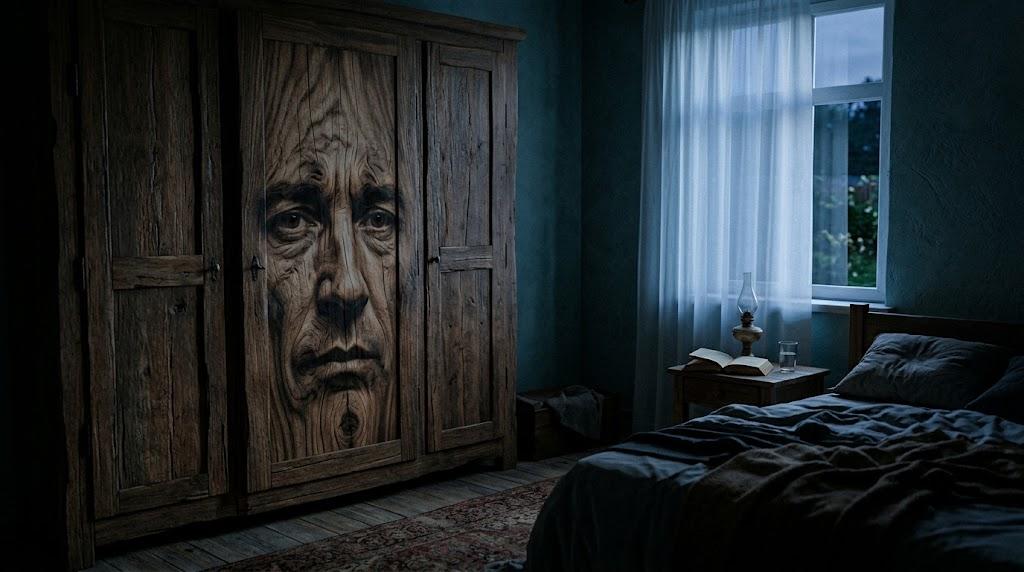
For healthy brains, face pareidolia is completely normal and even beneficial — evidence that your face machinery is working overtime, exactly as designed. But clinicians have learned to measure it, because the rate of face pareidolia changes in some conditions.
People with dementia with Lewy bodies, a disease defined partly by recurrent visual hallucinations, see pareidolic faces far more often than healthy older adults or people with Alzheimer’s disease — and see more of them as the disease progresses. Measuring face pareidolia, in other words, tracks the disease along its visual pathway.
This is concrete enough that a Japanese team built the Pareidolia Test into a simple neuropsychological tool: patients view noisy, real-world-like images and simply count the illusory faces and animals they see. The test turns face pareidolia from a curiosity into a number a clinician can track. Newer work uses the test for early detection, because elevated pareidolia can appear before hallucinations do — making a “glitch” you have always laughed about into a genuine clinical biomarker.
Everyday context modulates the effect too: pareidolic illusions rise when the brain’s perceptual gates loosen — in low light, in drowsy states, and in the hypnagogic window around sleep — which is why the face in the wardrobe door seems bolder at 2 a.m. than at noon. Night-time face pareidolia is the same circuit with a lower threshold — and it is one more reason your body’s night-time quirks feel stranger after dark.
Can You Turn It Off?
No — and you would not want to. You can defeat a single pareidolia by looking deliberately at the geometry: naming the shapes (“two screws, a hinge, a shadow”) engages the object-recognition pathway and lets the frontal veto win. Artists systematically train exactly this skill to draw what is actually there instead of what the face detector insists on. But the underlying detector keeps firing; with repetition, the illusory face fades — the brain stops predicting what is not rewarded — and a new object can restart it instantly. Face pareidolia is stubborn precisely because it is useful.
The goal, then, is not suppression but partnership: your face system supplies instant social meaning, and your knowledge supplies the correction. The illusion is the toll your brain pays for never missing a real face — and, in clinics, it is quietly becoming a window into the brain’s health. The science of face pareidolia ends on a reassuring note: the glitch is the guarantee.
Myth vs. Fact
Myth: Seeing faces in objects means you are highly creative or spiritually sensitive.
Fact: Face pareidolia is a universal byproduct of standard face-detection circuitry — newborns show the bias and so do macaques. Creativity changes what you do with the illusion, not whether you have it.
Myth: Frequent pareidolia means your brain is malfunctioning.
Fact: A healthy detector fires often. Only when pareidolia becomes overwhelming — or hallucinations begin — does it enter clinical territory, such as dementia with Lewy bodies.
Frequently Asked Questions About Face Pareidolia
Why do I see faces in clouds and objects?
Because your brain runs a face detector that prefers false alarms to misses. When ambiguous patterns like clouds match the rough geometry of a face, the fusiform face area fires and constructs a face — complete with expression, age, and gender — before conscious knowledge can correct it.
Is face pareidolia normal?
Completely. It is a universal feature of the human visual system, present from the first hours of life. In one laboratory test, people reported illusory faces in pure noise 34% of the time — that is how eager the detector is.
What does it mean when you see faces in everything?
Usually nothing at all — it means your face-detection system is highly sensitive. Clinically, only a strongly elevated rate, measured with tools like the Pareidolia Test, is associated with conditions involving visual hallucinations, such as dementia with Lewy bodies.
Why does the face in the object look angry or happy?
The face-evaluation system that reads emotion, age, and gender on real faces also fires on illusory faces — automatically. One study of 3,815 adults found people readily assign expressions and even gender to face-like objects, with a strong bias toward judging illusory faces as male.
Why do cars look like they have faces?
Headlight-eyes and grille-mouths fit the face template, and studies show people fixate on car “faces” with real eye movements, while stronger anthropomorphizers show stronger fusiform face area activation to vehicle fronts. Some car designers exploit this deliberately.
Can babies see faces in objects too?
Newborns preferentially track face-like patterns over matched non-face patterns within hours of birth, long before experience could teach them what a face is. The bias that produces pareidolia is present from the start of life.
Is pareidolia the same as a hallucination?
Face pareidolia requires an ambiguous external trigger and is instantly correctable — look again and the socket is just a socket. A hallucination is a perception without an external source. In some illnesses the boundary blurs, which is why face pareidolia rates are used as a clinical measure.
Why do I see faces more at night?
Dim light, low contrast, and drowsy, hypnagogic states loosen the brain’s perceptual gating, so the detector’s threshold drops. The same wardrobe becomes more face-like at 2 a.m. because the brain’s evidence-checking is at its weakest.
Does everyone see faces in the Moon?
Nearly everyone sees some pattern in the lunar maria, because the patches fit the face template well enough. Culture shapes the story — a Man in the Moon, a rabbit, a toad — but the underlying detection is universal.
Can you train yourself to stop seeing faces?
You can weaken individual illusions by naming the actual geometry and engaging object perception, and the effect fades with repetition. But the detector itself stays on: it is wired too deep, and it serves the essential job of never missing a real face.
Why the Brain Refuses to See Purely Random Noise
Face pareidolia is your brain’s face detector doing its job too well: a right fusiform face area tuned from birth, running so hot that clouds, sockets, and toast get read as social beings with expressions and gender. The illusion costs nothing, reveals the architecture of perception, and in clinics has become an unlikely biomarker.
Next time a wall outlet smiles at you, smile back — you are watching your own neural hardware at work. It is the same lesson the McGurk effect teaches: perception is a construction, and your brain would rather be useful than accurate. Face pareidolia is simply the friendliest face of that construction.
References
- Liu J, Li J, Feng L, Li L, Tian J, Lee K. Seeing Jesus in toast: neural and behavioral correlates of face pareidolia. Cortex. 2014;53:60-77. PMID: 24583223
- Wardle SG, Paranjape S, Taubert J, Baker CI. Illusory faces are more likely to be perceived as male than female. Proc Natl Acad Sci U S A. 2022;119(5):e2117413119. PMID: 35074880
- Akdeniz G, Toker S, Atli I. Neural mechanisms underlying visual pareidolia processing: An fMRI study. Pak J Med Sci. 2018;34(6):1560-1566. PMID: 30559823
- Wardle SG, Ewing L, Malcolm GL, Paranjape S, Baker CI. Children perceive illusory faces in objects as male more often than female. Cognition. 2023;235:105398. PMID: 36791506
- Taubert J, Wardle SG, Tardiff CT, Koele EA, Kumar S, Messinger A, et al. The cortical and subcortical correlates of face pareidolia in the macaque brain. Soc Cogn Affect Neurosci. 2022;17(11):965-976. PMID: 35445247
- Johnson MH, Dziurawiec S, Ellis H, Morton J. Newborns’ preferential tracking of face-like stimuli and its subsequent decline. Cognition. 1991;40(1-2):1-19. PMID: 1786670
- Golarai G, Liberman A, Grill-Spector K. Experience Shapes the Development of Neural Substrates of Face Processing in Human Ventral Temporal Cortex. Cereb Cortex. 2017;27(2):1229-1244. PMID: 26683171
- Mamiya Y, Nishio Y, Watanabe H, Yokoi K, Uchiyama M, Baba T, et al. The Pareidolia Test: A Simple Neuropsychological Test Measuring Visual Hallucination-Like Illusions. PLoS One. 2016;11(5):e0154546. PMID: 27171377
- Kühn S, Brick TR, Müller BCN, Gallinat J. Is this car looking at you? How anthropomorphism predicts fusiform face area activation when seeing cars. PLoS One. 2014;9(10):e108904. PMID: 25517511
- Mori F, D’Antonio F, Zazzaro G, Conti D, Mitolo M, Cagnin A, Venneri A. Neuropsychological Tests for Detecting Prodromal DLB: A Systematic Review. Eur J Neurol. 2026;33(7):e70681. PMID: 42427279
Medical Disclaimer: This article is for informational purposes only and is not a substitute for professional medical advice, diagnosis, or treatment. Always seek the advice of a physician or other qualified health provider with any questions regarding a medical condition.
📚 You Might Also Like
Hand-picked articles for you


