



Decision fatigue is a silent biological phenomenon that almost everyone experiences, yet very few people fully comprehend. It is the precise neuro-chemical reason why you can easily analyze complex strategic problems at work at 10:00 AM, but find yourself completely paralyzed when trying to decide what to order for dinner at 7:00 PM. As the day progresses, your brain’s cognitive battery simply runs out.
This state is not a sign of laziness, weak willpower, or a lack of discipline. It is a biological reality of human brain architecture. Every single choice you make—from selecting your morning outfit to prioritizing work emails—burns a finite daily supply of mental fuel, leaving your prefrontal cortex depleted and emotionally vulnerable by the evening hours.
1. How Decision Fatigue Drains Your Prefrontal Cortex
To understand decision fatigue, we must look directly behind your forehead to the prefrontal cortex. This region of the brain functions as your executive control center, responsible for logical reasoning, risk calculation, emotional regulation, and long-term planning.
However, your prefrontal cortex operates much like a rechargeable smartphone battery:
- Every time you execute a choice, your prefrontal cortex consumes a small amount of glucose and neurotransmitters.
- Surprisingly, your brain makes very little distinction between high-stakes choices and trivial ones.
- Evaluating a multi-page business contract burns cognitive fuel, but so does agonizing over which cereal brand to purchase at the grocery store.
By late afternoon, your prefrontal cortex is operating on low power. This state is a primary driver of how your brain misinterprets reality under stress, making simple evening questions like “What movie should we watch?” feel uniquely exhausting.

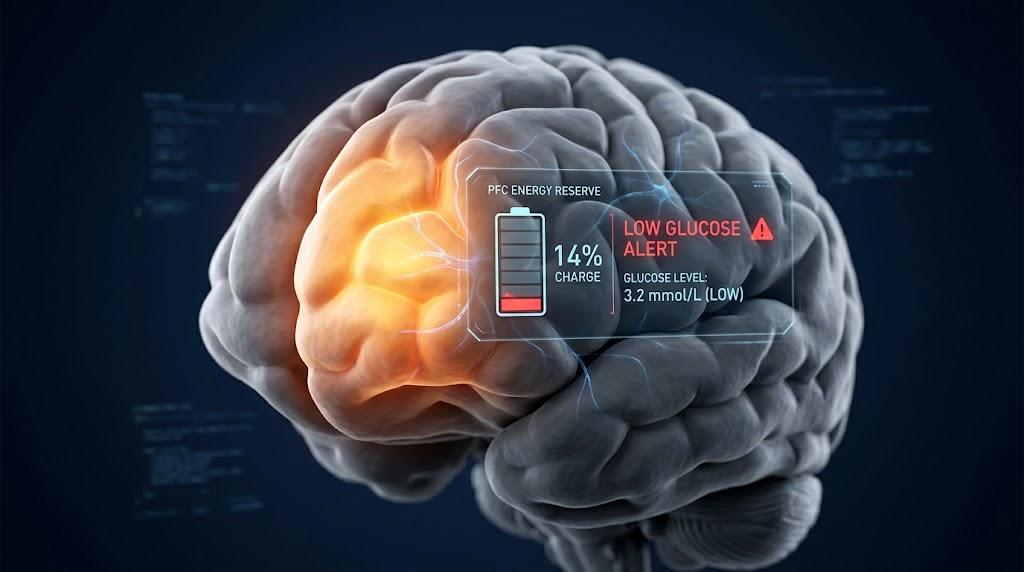
The Biological Toll: The executive brain treats all micro-choices as energy expenses. Making a hundred trivial choices during the morning leaves you neurologically bankrupt by nightfall.
2. Why Depleted Minds Trigger Impulse Spending
Have you ever wondered why retail stores surround checkout lines with candy bars, magazines, and minor impulse items? This layout is a carefully calculated psychological maneuver built around executive depletion. By the time a shopper reaches the checkout register, they have already made dozens of choices regarding brands, prices, and quantities.
A landmark study by Dr. Baumeister at Florida State University found that judges reviewing parole applications became significantly more lenient immediately after meal breaks and significantly more punitive as the time between meals increased. The food restored their depleted cognitive resources.

As your prefrontal cortex exhausts its daily glucose supply:
- Your capacity for impulse control deteriorates.
- Control over your decision-making shifts from the logical prefrontal cortex to deeper, primitive structures like the amygdala, as explored in our guide on primitive threat-detection mechanisms.
- These primitive regions seek immediate sensory rewards and do not care about financial budgets or long-term health goals.
This neurological shift explains why late-night online shopping is so common. After a long day of making work choices, your brain lacks the executive friction required to resist buying non-essential items. Research by Dr. Vohs has demonstrated that the mere act of making choices impairs subsequent self-control, creating a vicious feedback loop where more decisions lead to worse decisions.

Evening Prefrontal Depletion & Willpower Index
Assess how severely your prefrontal cortex depletes its glucose reserves by the end of the day.
By 8:00 PM, how easy is it to resist snacking, impulse purchases, or scrolling?
3. The Status Quo Bias: Brain Shortcuts for Energy Conservation
When your brain suffers from severe executive depletion, it desperately searches for mental shortcuts to conserve remaining energy. The most common shortcut is the “Status Quo Bias”—a cognitive default where the brain automatically chooses the easiest, most familiar option or avoids making a choice altogether.
This biological shortcut manifests in everyday habits:
- Staying subscribed to unused services simply because cancelling requires new decision steps.
- Ordering the exact same meal from a food app every night to avoid evaluating new options.
- Rewatching familiar TV shows rather than starting new ones.
In legal research, this phenomenon has been documented extensively. Landmark judicial studies revealed that judges are significantly more likely to grant parole (which requires careful risk evaluation) early in the morning, while defaulting to denying parole (the safe, low-energy default option) late in the afternoon when their brains are depleted.

The Path of Least Friction: An exhausted brain defaults to non-action. If no obvious default path exists, it experiences decision paralysis, freezing your ability to proceed.
4. The Hidden Link Between Decision Fatigue and Ego Depletion
In social psychology, decision fatigue is intimately connected to “ego depletion”—the model suggesting that human self-control operates like a muscle that gets tired after use. If you spend your morning forcing yourself to focus on tedious projects, holding back frustration during meetings, and resisting digital distractions, you are continuously burning through your self-control reserves.
Research by Dr. Sheena Iyengar at Columbia University has found that knowledge workers make an average of 35,000 decisions per day. Each of these decisions—from what to eat for breakfast to how to respond to an email—draws from the same limited pool of executive function. By late afternoon, the quality of these decisions measurably declines.
By 8:00 PM, your ego reserves are completely drained. This explains why nutritional diets almost always collapse in the late evening. You can easily choose a healthy lunch because your prefrontal battery is fully charged, but your resistance to junk food crumbles when your willpower engine runs dry at night.
This is why many successful people—from Barack Obama to Steve Jobs—deliberately reduced the number of trivial decisions they made each day, wearing the same outfit or eating the same meal to preserve cognitive resources for more important choices. They understood that decision fatigue is not a character flaw—it is a biological constraint that can be managed through strategic routine design.
5. Decision Fatigue and Decision Avoidance: The Paralysis Effect
Beyond simply making poor choices, decision fatigue can push your brain into a state of complete paralysis known as “decision avoidance.” When the prefrontal cortex is sufficiently depleted, it does not simply default to the easiest option—it actively avoids making any choice at all. This is why exhausted people frequently respond to questions like “What do you want for dinner?” with frustrated deflections such as “I don’t care, you decide” or “Whatever is fine.”
This avoidance behavior is neurologically expensive in its own way. Unmade decisions create what psychologists call the “Zeigarnik effect”—unfinished tasks that loop endlessly in your subconscious, consuming mental bandwidth even while you sleep. The irony is devastating: by avoiding a decision to conserve energy, your brain actually wastes more energy ruminating on the unresolved choice than it would have spent simply deciding.
This is particularly damaging in relationships. When one partner consistently defers all evening decisions to the other—”You pick the movie, you choose the restaurant, you decide our weekend plans”—it creates an invisible burden of “decision labor” that can erode relationship satisfaction over time. Understanding this dynamic helps explain why couples argue more frequently in the evening: one partner is exhausted from a full day of executive depletion, while the other is frustrated from carrying the weight of every unmade choice.
The solution is not to avoid decisions entirely but to create pre-committed defaults. When you pre-decide recurring choices during your peak cognitive hours—meal plans on Sunday, weekday outfits on Monday morning—you eliminate the decision avoidance trap entirely, freeing your depleted evening brain from both the choice and the rumination that follows.
6. Emotional Reactivity and Irritability at Night
One of the most damaging consequences of executive mental fatigue is its impact on emotional regulation. When your prefrontal cortex loses processing power, it can no longer effectively quiet down the emotional responses of your limbic system.
As a result, your emotional threshold drops dramatically:
- Minor inconveniences that you would easily brush off in the morning feel like overwhelming insults at night.
- You become irritable with family members, short-tempered with partners, and easily frustrated by minor technical glitches.
Your depleted brain simply lacks the bandwidth to process complex emotional responses, defaulting to primitive reactions like anger and frustration. This is directly related to why your brain overthinks at night—without the prefrontal cortex acting as an emotional brake, your limbic system runs unchecked through anxious, irritable, and catastrophic thought patterns.
This emotional volatility compounds throughout the week. A single night of depleted decision-making can trigger an argument that strains a relationship for days, leading to further stress that accelerates executive depletion the following morning. Breaking this cascade requires recognizing that your evening irritability is not a reflection of your true feelings—it is a symptom of a chemically exhausted brain processing the world through a distorted emotional filter.

⚡ The Nightly Emotional Crash
Studies show that couples are 3x more likely to have heated arguments after 9:00 PM compared to the same time in the morning. The reason is not the topic of disagreement—it is the depleted executive state of both partners’ prefrontal cortices.
7. How High Performers Automate Daily Choices
If you analyze the daily habits of prominent historical figures and innovators, you will notice a consistent pattern: they systematically eliminate trivial daily choices. Former U.S. President Barack Obama, Steve Jobs, and Mark Zuckerberg famously wore identical daily outfits to minimize wardrobe selection.
This is not a lack of style; it is a calculated defense strategy against executive depletion:
- By turning low-stakes daily choices (clothing, breakfast, daily schedules) into fixed routines, they protect their prefrontal reserves.
- They preserve their highest-quality cognitive fuel for complex, high-stakes decisions that truly matter.
The same principle applies to personal finance. People who automate savings transfers, bill payments, and investment contributions remove dozens of weekly decision points from their cognitive load. Each automated choice is one fewer drain on their prefrontal battery, leaving more executive resources available for creative thinking and strategic planning during peak hours.
Military commanders use standardized decision-making frameworks (OODA loops, checklists) precisely because combat environments generate extreme decision loads. These frameworks externalize cognitive work, reducing the burden on individual prefrontal cortex resources.
Surgeons follow rigid pre-operative rituals not for superstition, but to eliminate decision variability. By standardizing every step before the first incision, they conserve maximum cognitive bandwidth for the critical decisions that determine patient survival.
8. Neuroscience-Backed Strategies to Preserve Mental Energy
While you cannot eliminate daily choices entirely, you can apply practical cognitive strategies to protect your brain from severe depletion:
Set a strict personal rule forbidding major financial, professional, or relationship decisions after 6:00 PM. Recognize that your brain is chemically compromised at night.
Process emails only twice per day and plan weekly meals in advance. Reducing the frequency of micro-choices preserves prefrontal glucose reserves for the decisions that actually matter.
Consuming complex carbohydrates or taking brief restorative breaks can temporarily restore glucose and support your brain’s capacity to adapt to stress. A 20-minute nap between 2-3 PM can restore up to 40% of depleted executive function.
Pre-decide your evening routine with “if-then” statements: “If it is 9:00 PM, then I will put my phone on the charger and pick up a book.” This shifts the decision from your depleted prefrontal cortex to an automatic behavioral script.
Summary
Decision fatigue is a natural biological limitation of the human prefrontal cortex—not a failure of character. Every choice you make from sunrise to sunset draws from the same finite cognitive well. By the time evening arrives, your executive function is running on fumes, which is exactly why you impulse-buy products you do not need, snap at people you love, and choose junk food over the salad you promised yourself at 8:00 AM.
The research is clear: judges become harsher before lunch, shoppers overspend at checkout, and couples fight after 9 PM. These are not coincidences—they are the predictable consequences of a brain that has exhausted its decision-making fuel. Understanding this pattern is the first step toward breaking it.
The good news is that this biological constraint is manageable. By establishing routines, automating trivial daily choices, and implementing a decision curfew for evening hours, you can protect your mental energy and maintain clarity throughout the day. Start with one change this week: automate your breakfast, set an evening decision curfew, or batch your email processing. Small structural shifts compound into dramatic improvements in cognitive performance, emotional stability, and overall quality of life.
Frequently Asked Questions
What is the main difference between decision fatigue and general tiredness?
General tiredness is physical fatigue of the body, whereas decision fatigue is specific depletion of the prefrontal cortex’s ability to make choices, exercise self-control, and regulate emotions. You can be physically rested but still experience severe decision fatigue after a mentally demanding day.
Can food help restore decision-making ability?
Yes. Because the prefrontal cortex relies on blood glucose to function, consuming a healthy meal or snack can temporarily restore executive function and willpower. However, sugary snacks cause a spike and crash that ultimately worsen depletion.
Does decision fatigue affect children differently than adults?
Children experience decision fatigue even more intensely because their prefrontal cortex is still developing and has fewer executive resources to draw from. This is why children often have emotional meltdowns in the afternoon after a full school day of constant choices.
Where can I read more about the scientific research behind mental depletion?
For deeper scientific exploration of cognitive depletion, consult the Baumeister et al. (1998) – Ego Depletion and Self-Control Demands as well as educational materials from the American Psychological Association on willpower and ego depletion.
References
- Baumeister, R.F. et al. (1998). Ego depletion: Is the active self a limited resource? Journal of Personality and Social Psychology, 74(5), 1252-1265. DOI: 10.1037/0022-3514.74.5.1252
- Danziger, S. et al. (2011). Extraneous factors in judicial decisions. Proceedings of the National Academy of Sciences, 108(17), 6889-6892. DOI: 10.1073/pnas.1018033108
- Vohs, K.D. et al. (2008). Making choices impairs subsequent self-control: A limited-resource account of decision making, self-regulation, and active initiative. Journal of Personality and Social Psychology, 94(5), 883-898. DOI: 10.1037/0022-3514.94.5.883
📚 You Might Also Like
Hand-picked articles for you


