



You are sitting alone in an empty room, reading a book or working on your computer. It is completely quiet. But suddenly, the hairs on the back of your neck stand up. A cold prickle of electricity runs down your spine. Without any logical reason, you feel an overwhelming, undeniable feeling of being watched. You turn around, fully expecting to see someone standing there—but the room is completely empty.
This is not a ghost story, and you are not losing your mind. This terrifying sensation is a documented neurological phenomenon known as scopaesthesia. It is one of the most powerful, primitive, and highly tuned survival mechanisms left over from our evolutionary past.
Today, we are going to look at your brain as a highly advanced biological CCTV system. We will explore exactly why your internal security cameras sometimes trigger a false alarm, the anatomy of the “gaze detection system,” and the 7 scientific reasons behind the creepy feeling of being watched.
1. The Biological CCTV: How Your Brain Detects Eyes
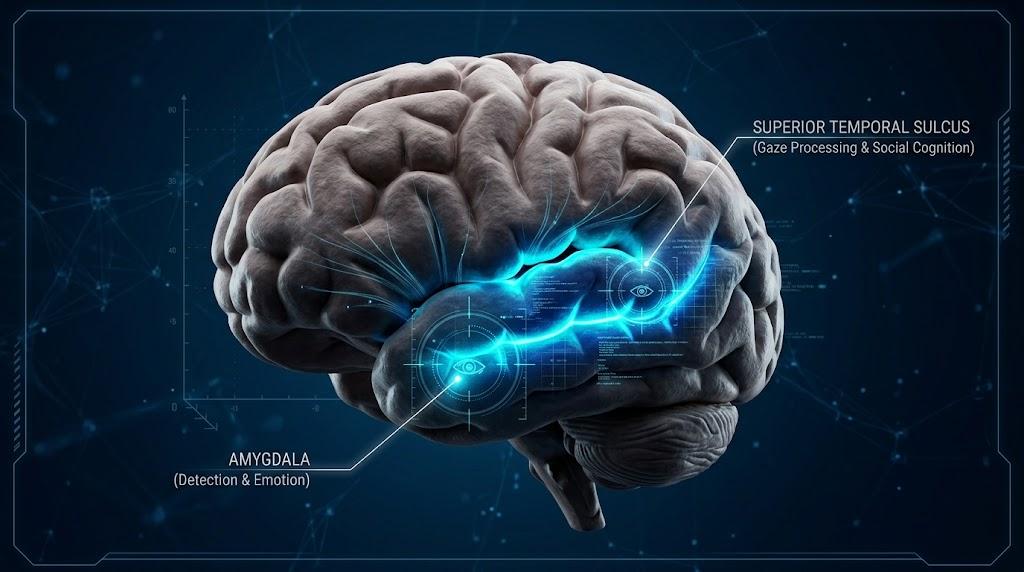
To understand the feeling of being watched, you have to realize that human neurology is deeply obsessed with eyes. In the animal kingdom, eye contact is the ultimate indicator of immediate intent. If another creature locks its gaze onto you, it is either preparing to attack or attempting to mate. Because of this high evolutionary stake, the human brain developed a dedicated neural network entirely focused on “gaze detection.”
This biological CCTV system operates independently of your conscious visual awareness:

- It processes peripheral visual data, spatial lighting, and subtle shadow shifts to calculate if a pair of eyes is pointed in your direction.
- The white part of the human eye (the sclera) evolved specifically to make it exceptionally easy for this system to track another human’s gaze, even from great distances.
When this system detects that eyes are locked onto you, it immediately alerts the amygdala—the brain’s emotional threat center. The amygdala instantly triggers an adrenaline surge, causing your muscles to tense and the hairs on your neck to stand up. This entire sequence occurs in milliseconds, completely bypassing logical thought.
The Cortical Blindness Phenomenon
The gaze detection system is so deeply hardwired that it operates even without conscious vision. Clinical studies on patients with “cortical blindness”—damage to the visual cortex that prevents conscious sight—reveal fascinating neurological insights:
- Unconscious Gaze Detection: When researchers stared directly at blind patients, the patients’ amygdalas lit up on functional brain scans, triggering feelings of uneasiness.
- The Scientific Takeaway: The human brain can register a gaze through subconscious pathways, proving that this sensation is a primitive biological reflex rather than mere imagination.
You are sitting alone in a library or park and suddenly feel eyes on your back. Why did this happen?
2. Hypervigilance, Stress, and Evolutionary Error Management
If our biological CCTV system is so precise, why does it trigger when you are completely alone in a locked room? The primary reason lies in cognitive hypervigilance and Error Management Theory.

Research by Dr. Coltan Scrivner at the University of Chicago has shown that the feeling of being watched is more common in people with higher levels of vigilance—a trait associated with anxiety, hypervigilance, and past traumatic experiences. For people with PTSD, the sensation can be overwhelming and persistent. Brain imaging studies have revealed that in individuals with anxiety disorders, the amygdala shows heightened activity even in safe, controlled environments, which may explain the chronic sense of being observed.
When you experience high daily stress or anxiety:
- Your brain assumes you are navigating a hostile environment, turning the sensitivity of your gaze detection system to maximum.
- In this hyper-vigilant state, minor environmental noise—a house settling, shadow shifts, or a subtle draft—is misinterpreted by the amygdala as an approaching predator.
Psychologists explain this using Error Management Theory. Imagine two early humans hearing a bush rustle. Human A assumes it is just the wind, ignores it, and gets attacked by a predator. Human B assumes it is a predator, experiences a terrifying feeling of being watched, and retreats. Human B survives to pass on their genes. Evolutionary biology favored brains that generate false alarms, because a false alarm costs nothing, whereas ignoring a genuine threat costs your life.

3. Pareidolia and Peripheral Visual Glitches
The human brain is an aggressive pattern-recognition engine, particularly when it comes to identifying human facial features. This cognitive phenomenon, known as pareidolia, explains why we spot faces in clouds, electrical outlets, or wood grain patterns on doors.
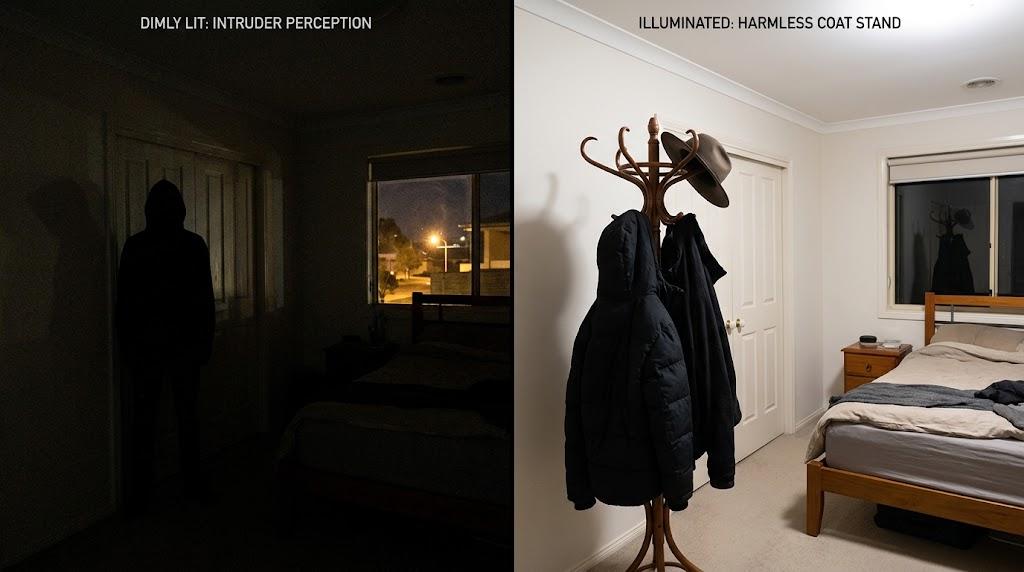
Your peripheral vision is designed for speed, not accuracy. It prioritizes rapid threat detection over precise image resolution. This means that when your peripheral field catches a shadowy cluster that vaguely resembles two dark shapes—eye-like openings in a dark corner, or the outline of a coat hanging on a chair—your visual cortex instantly alerts your threat-detection center before your logical brain can evaluate the image.
The result? Your amygdala fires, generating an immediate sensation of being observed. When you turn to look directly at the shadow, your logical brain realizes you were intimidated by a jacket hanging on a chair. But the damage is done—your body already flooded with adrenaline, and the feeling of being watched lingers for minutes afterward.

?️ The Self-Fulfilling Stare
Occasionally, the sensation feels real because your own movements caused it. If you suddenly feel uneasy and snap your head around in a public setting, that rapid movement naturally draws the eyes of nearby people. They look at you simply because you moved, creating a false confirmation that they were staring all along.
Confirmation Bias Distortion
You have likely experienced this sensation hundreds of times, turned around, and found no one there. Your brain quickly deletes these uneventful memories. But on the rare occasion someone *is* looking, your brain permanently archives it as proof of a “sixth sense.”
4. Acoustic Shifts, Spatial Mapping, and Media Priming
Your brain continuously maps the acoustic profile of your immediate environment, calculating how ambient sound bounces off walls and objects. This spatial mapping is normally a background process you never notice. But when something disrupts the expected acoustic pattern, your subconscious flags it as a potential intrusion.
Subconscious Acoustic Mapping: If someone quietly enters a room behind you, their physical presence subtly dampens ambient sound and alters air pressure. Even if you cannot consciously hear them, your spatial processing detects the anomaly and triggers an alert. This is why you sometimes “know” someone has entered a room before you see or hear them.
Horror Media Priming: Watching suspenseful or horror media actively programs your brain to anticipate threats. It puts your biological CCTV on maximum alert, causing normal house settling noises to trigger intense unease. Studies have shown that participants who watched horror films before a “haunted” experiment reported significantly more feeling of being watched sensations than control groups.
This heightened state is deeply linked to why your brain overthinks at night, as declining visual data forces the brain to rely on hyper-sensitive internal threat systems.
5. The Subconscious Radar vs. Sixth Sense Debunked
Many people attribute this uneasy sensation to a supernatural “sixth sense” or telepathic ability. However, cognitive science demonstrates that it is entirely grounded in subconscious processing.
While your conscious mind processes roughly 40 bits of information per second, your subconscious processes over 11 million bits per second. This massive disparity means your subconscious is constantly absorbing environmental data—micro-movements in peripheral vision, barely perceptible shifts in air temperature, faint sounds below your conscious hearing threshold—that your conscious mind simply discards as irrelevant.
When enough of these micro-inputs accumulate and point toward the presence of another person, your subconscious aggregates them and delivers a unified alarm signal: the feeling of being watched. It is not telepathy. It is raw data processing power that your conscious mind cannot match. Understanding this biological reality helps demystify related phenomena, such as why yawning is contagious through visual empathy networks.
A False Alarm Keeps You Safe
The next time the hairs on your neck stand up in an empty room, do not panic. Your biological security system simply detected a minor shadow shift or acoustic anomaly and triggered a protective false alarm. Your brain would rather scare you unnecessarily a thousand times than fail to alert you to a genuine danger.
6. The Role of Sleep Deprivation in Amplifying False Alarms
One frequently overlooked factor that intensifies the feeling of being watched is sleep deprivation. When you are exhausted, your prefrontal cortex—the brain region responsible for rational evaluation and emotional regulation—loses its ability to properly inhibit the amygdala’s threat responses.
Research published in the journal Sleep has demonstrated that sleep-deprived individuals show up to 60% greater amygdala reactivity to neutral stimuli compared to well-rested participants. This means that mundane shadows, quiet house sounds, and peripheral visual noise that your rested brain would instantly dismiss become amplified threat signals when you are running on insufficient sleep.
This is why the feeling of being watched is dramatically more intense during late-night hours. Your visual cortex is fatigued, your pattern-recognition becomes sloppy, and your threat-detection threshold drops to its lowest point. Combined with the natural darkness of nighttime and the absence of social company, sleep deprivation creates the perfect neurological storm for false alarms. Understanding how sleep paralysis and night hallucinations work can help you recognize how sleep disruption feeds directly into these paranoid sensations.
Key Finding: Sleep-deprived individuals show 60% greater amygdala reactivity to neutral stimuli—meaning harmless shadows and quiet sounds become amplified threat signals when you are exhausted.
7. How to Calibrate Your Biological CCTV and Reduce False Alarms
While the feeling of being watched is a normal evolutionary mechanism and not a medical condition, there are evidence-based strategies to reduce its frequency and intensity:
Ground yourself with sensory anchoring.
When the sensation hits, immediately engage your logical brain by naming 5 things you can see, 4 you can touch, 3 you can hear, 2 you can smell, and 1 you can taste. This 5-4-3-2-1 technique activates the prefrontal cortex and suppresses the amygdala’s automatic threat response.
Audit your environment.
Check for environmental triggers: a flickering light casting moving shadows, a fan creating subtle air pressure changes, or a reflective surface producing unexpected glare. Eliminating these physical triggers removes the raw data your subconscious uses to build its false alarm.
Limit horror media before sleep.
If you are sensitive to nighttime anxiety, avoid suspenseful content for at least two hours before bed. This prevents your threat-detection system from entering a primed, hyper-sensitive state during your most vulnerable hours.
Understanding the neuroscience behind this sensation removes its power over you. The feeling of being watched is not evidence of ghosts, stalkers, or supernatural forces—it is your ancient biological security system doing exactly what it evolved to do: protect you, even if it means scaring you in the process.
Summary
The feeling of being watched is a powerful biological artifact of human gaze detection, evolutionary error management, and subconscious sensory mapping. It demonstrates how fiercely protective your nervous system remains in modern environments—even when there is no actual threat present.
From the dedicated gaze-detection neurons in your superior temporal sulcus to the error-management calculations running in your amygdala, every layer of this sensation is rooted in survival. Your brain would rather trigger a thousand false alarms than miss one genuine predator. That is not a bug in your biology—it is the feature that kept your ancestors alive long enough to pass their genes to you.
To explore the peer-reviewed research behind gaze detection and human perception, consult Psychology Today’s analysis of scopaesthesia research as well as neurobiology guides published in Scientific American on visual gaze networks.
Scientific References & Studies
- Clifford, C. W. (2013). The perception of eye gaze direction: Mechanisms, neural circuitry, and social significance. Vision Research. PubMed PMID: 23577317.
- Perrett, D. I., Smith, P. A., Potter, D. D., et al. (1985). Visual cells in the temporal cortex sensitive to face view and gaze direction. Proceedings of the Royal Society of London. PubMed PMID: 4067347.
- Emery, N. J. (2000). The eyes have it: The neuroethology, function and evolution of social gaze. Neuroscience & Biobehavioral Reviews. PubMed PMID: 10989186.
📚 You Might Also Like
Hand-picked articles for you


