


Say your own name out loud twenty times. Somewhere around repetition fifteen, the strangest thing happens: the word starts to peel away from you. The sounds are still yours, the spelling is still correct, but the meaning drains out of it, and for a few seconds you are saying the name of a stranger. That flicker of wrongness has a name, and it is not a mistake in your head — it is one of memory’s most repeatable experiments.
Psychologists call it jamais vu — French for “never seen.” It is the eerie opposite of déjà vu: instead of feeling that something new is strangely familiar, you feel that something you know perfectly well has turned suddenly unfamiliar, unreal, almost fake. Your childhood street. The face in the mirror. The word you have written a thousand times. The knowledge is still there — you have not forgotten — but the feeling of knowing has briefly detached from it.
Jamais vu is your brain’s familiarity system caught in a moment of reset, and scientists can now switch it on in the laboratory on demand. Here is what it is, how researchers trigger it with nothing more than a pencil and a word, what is happening in your brain when the world goes briefly strange, and when — rarely — it is worth a doctor’s attention.
What Is Jamais Vu, Exactly?

Jamais vu is the experience of finding something subjectively unfamiliar that you know to be familiar. That double judgment is the signature of the phenomenon: you can state with total confidence that you know your way home, recognize your best friend, or remember your own name — and at the same time feel, vividly and unpleasantly, that none of it is real. Memory researchers define it precisely as the opposite of déjà vu, and study it as a genuine metacognitive experience rather than a curiosity.
The word comes from French and means “never seen,” the mirror image of déjà vu’s “already seen.” In everyday language: déjà vu makes the new feel old, while jamais vu makes the old feel new in the most unsettling way. Both are glitches in the same machinery — the brain’s separate systems for recognizing something and for feeling that you recognize it — briefly disagreeing with each other.

It helps to see where jamais vu sits in the family. déjà vu is the famous sibling: roughly two-thirds of people report it, and it is considered completely normal — the déjà vu phenomenon is one of memory science’s best-studied oddities. The latter is its rarer, quieter counterpart: most people have felt it a handful of times, usually when exhausted, staring too long at one thing, or repeating a word until it dissolves.
A close cousin lives on the tip of your tongue. Stare at the word “spoon” long enough and it stops looking like an implement for eating; hunt for a word you know well and it hides behind a wall of almost-meaning — the tip-of-the-tongue phenomenon is the same feeling of knowing without the feeling of access. In all of these states, the fact and the feeling come apart. Jamais vu is simply the most dramatic version: the whole world, or a whole word, briefly fails the feeling test.
The Experiment: How Scientists Induce Jamais Vu in the Laboratory
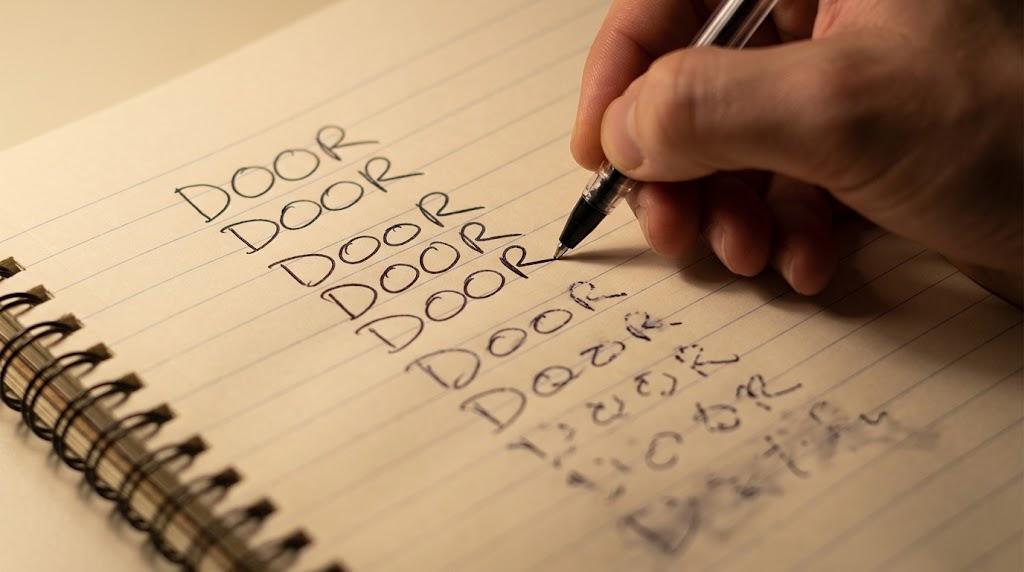
For decades, déjà vu researchers made progress because they could trigger déjà-like states in scanners and questionnaires. Jamais vu stayed stubborn — until a team led by memory researcher Christopher Moulin brought it under the lamp with an experiment so simple it fits in one sentence: people copied words by hand, over and over, until the words felt peculiar.

The details are what make the study remarkable. Participants wrote words like “door” again and again; about two-thirds of them reported strange, unfamiliar feelings during the task — and in about a third of all trials overall. The sensation reliably arrived after about thirty repetitions, or one minute. People described the words as losing their meaning, looking like random letters, or feeling as if they were writing a word they had never seen. The researchers classified these reports as true jamais vu experiences, not mere boredom.
Crucially, the induced jamais vu behaved like the real-world version. People who reported more of it in daily life produced more in the lab, and the experience correlated with everyday déjà vu frequency: people with frequent everyday déjà vu also report the opposite more often. The two phenomena, in other words, are siblings not just in name but in the data — a finding that lets decades of déjà vu research fast-track the science of its opposite.
Psychologists had a name for the word-dissolution half of the effect long before this study: semantic satiation, the temporary loss of a word’s meaning under rapid repetition — the same reason your name sounds bizarre when repeated, as explored in semantic satiation and the strange case of your own name. What the new experiments added was the subjective report: satiation is what happens to the word, and jamais vu is what it feels like to be the person watching it happen.
30-Second Semantic Satiation Experiment
Pick a familiar everyday word like 'DOOR' or 'CHAIR'. Repeat it out loud or write it on paper 30 times continuously for 45 seconds.
Did the word suddenly disintegrate into meaningless phonetic noises or bizarre abstract shapes?
What Happens in the Brain When the Familiar Turns Strange
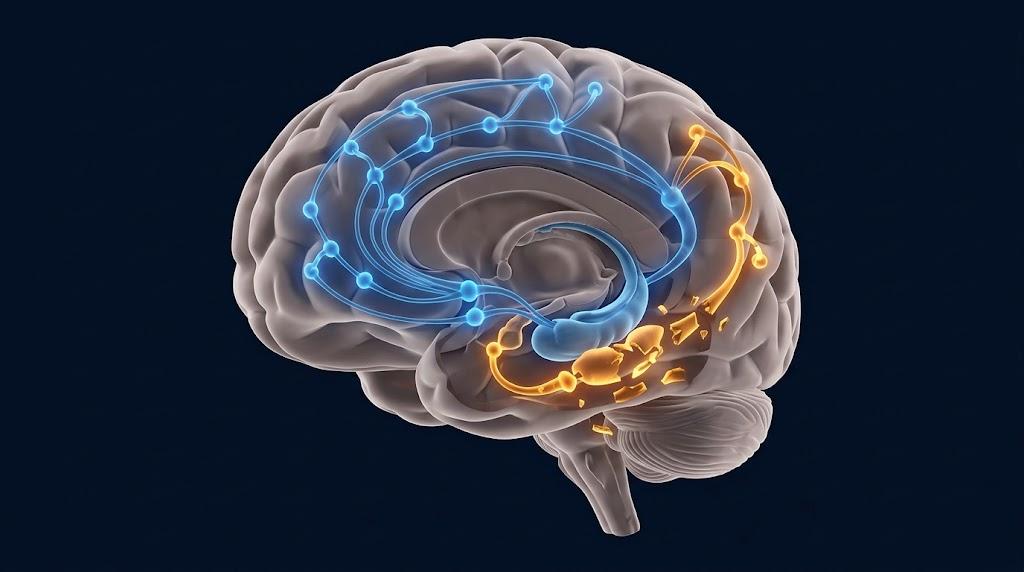
Your brain holds two separate streams about every familiar thing. One is the match itself: a stored representation fires when you see your home, your name, your friend’s face. The other is a fluency signal — a fast, wordless feeling that recognition went smoothly. Normal familiarity is the two streams agreeing. Jamais vu is what happens when the stream of facts keeps flowing while the fluency signal briefly flatlines.
Repetition is a natural way to make that happen. Responding to the same word again and again adapts — and effectively tires — the neural pathways that carry its meaning, a fatigue measurable in the brain’s electrical activity: EEG studies show that satiated words produce a reduced N400, the brainwave that normally surges when meaning is being processed. The letters still arrive; the interpreter behind them has stopped raising its hand.
The same logic explains a gentler version you already live with. Walk into your kitchen after a week away and the smell of your own home is briefly loud and strange; minutes later it has vanished — your brain actively filters familiar smells to save its attention for the new. Habituation is the brain’s economy of familiarity. Jamais vu looks like a hiccup in that economy: the automatic dampening briefly spills over from “background noise” onto things that matter, and a known world reads as unknown.

This is also why jamais vu clusters at the edges of attention. It shows up when you are tired, drowsy, or staring blankly — states in which the brain’s monitoring systems loosen their grip. Absorption can even protect the other direction: experiments on semantic satiation show that mind-wandering episodes reduce the numbing effect, as if attention that drifts away spares the word’s meaning from being worn down. This state, in short, is not damage. It is a healthy system momentarily caught between modes — with the feeling of unfamiliarity briefly turned up and the world briefly re-labeled.
The Family of Familiarity Glitches
Jamais vu rarely travels alone in the mind’s catalog of strange recognitions. déjà vu gives the new a false halo of the old; its opposite strips the old of its glow. The doorway effect adds spatial amnesia — walk through a door and the thought you carried evaporates, because the brain filed the room as a completed episode: why your brain forgets at every doorstep. And semantic satiation, as we saw, dissolves words under repetition.
All four are failures of the same handshake between content and feeling — which is why they so often get discussed together by memory scientists.
One more relative deserves a mention because it frightens people unnecessarily: the sudden feeling that you have already dreamed this exact moment. That experience belongs to the same family of memory misfirings, and like déjà vu and jamais vu, it is an illusion of the feeling-of-knowing system rather than evidence of anything paranormal. The brain occasionally serves up certainty without a receipt. Remembering that these glitches are shared, common, and lab-reproducible is the fastest way to stop them feeling ominous.
When Jamais Vu Signals Something More
In healthy people, jamais vu is harmless and fleeting — seconds of strangeness that resolve on their own. Medicine’s interest in it comes from a simple fact: brief, sudden distortions of familiarity are also a known language of the temporal lobes. When a focal seizure starts in brain regions that assign familiarity — the medial temporal structures — it can produce an “experiential aura”: a wave of déjà vu, sudden unfamiliarity, dreaminess, or sudden emotion lasting seconds, with awareness intact.
Neurology references catalog the experience among these focal onset seizure manifestations, which is why an isolated, explainable glitch is nothing to worry about, but recurrent unexplained episodes deserve a doctor’s eye.
Drugs can do it too. A published case report describes a patient whose jamais vu episodes appeared in relationship to baclofen, a muscle-relaxant that acts on the brain’s inhibitory signaling — the episodes resolved when the treatment was adjusted. The lesson is not “fear medication,” but that the familiarity system can be nudged chemically as well as electrically, and new-onset strange feelings after any medication change are worth reporting.
Psychology adds one more context. In obsessive-compulsive disorder, forced repetition of thoughts and rituals can induce a related feeling — a dissociative uncertainty in which done actions stop feeling done, so the loop restarts. Researchers use the word “uncertainty” deliberately: repetition does not only dull meaning, it can erode the felt certainty that normally closes an experience.
And the large déjà vu literature offers reassurance by extension: common déjà vu experiences are rarely associated with pathological dissociation, and the lab-induced state in Moulin’s study did not track pathological markers the way everyday déjà vu does. The everyday version is a quirk, not a crisis.
Why Jamais Vu Might Actually Be Good for You
Here is the reframe that the research quietly suggests: jamais vu may be a feature, not a bug. A familiarity system that can never reset would eventually stop verifying anything — you would glide through your home, your name, your loved ones with zero fresh processing. A system that occasionally forces a “second look” keeps its own machinery calibrated, the way rebooting a sticky app restores it. The word that dissolved comes back with its meaning fully restored; the street that turned strange snaps back to known. The return of meaning is the proof that the system is healthy.
Recent laboratory work places jamais vu among the brain’s spontaneous metacognitive experiences — the mind’s unplanned self-monitoring moments, alongside déjà vu, tip-of-the-tongue states, and sudden error awareness. In a 2026 experiment, people doing a dull vigilance task spontaneously reported the whole family of these states, the whole family included, without any prompting. The mind, it turns out, audits itself in the background — and it is one of the audit reports occasionally flashing on screen.
Can You Snap Out of Jamais Vu?
You usually do not need to — it fades on its own in seconds. But the same principle that induces it points to the exit: rest the loop. Stop repeating the word, look away from the face, change the sensory channel — say the word in a different voice, write it in different letters, touch the object you are staring at. Meaning returns fastest when the pattern arrives through a fresh pathway, which is exactly why a short break restores a word you had read into nonsense.
Novelty works at the larger scale too. Travelers get less of it, not more, because new places keep the fluency signal genuinely low and honest — there is nothing to mismatch. The unsettling version appears when high familiarity meets low attention: the long commute, the ten-thousandth email, the mirror at midnight. It is loudest in the dullest moments of life, and it quiets down the moment the moment becomes interesting again.
Myth vs. Fact
Myth: Feeling that familiar things are unreal means something is wrong with your memory.
Fact: It is a normal, temporary decoupling of recognition from the feeling of knowing. Two-thirds of people can have it induced in the lab with a pencil and thirty repetitions of a word.
Myth: Jamais vu and déjà vu are unrelated oddities.
Fact: They are opposites built on the same machinery. In daily life, people who experience déjà vu frequently also experience its opposite frequently — the two track each other in the data.
Frequently Asked Questions About Jamais Vu
What is jamais vu in simple terms?
It is the strange feeling that something you know well — a word, a place, a face — has suddenly become unfamiliar or unreal, even while you still know exactly what it is. It is the opposite of déjà vu: the old feeling new, instead of the new feeling old.
Is jamais vu normal?
Completely. It happens to healthy people when tired, staring, or after repetition, and researchers induced it in about two-thirds of participants simply by having them copy words around thirty times. Brief episodes are a sign your familiarity system is working, not failing.
What causes jamais vu?
Repetition and fatigue temporarily dampen the fluency signal that carries the feeling of familiarity, while the factual recognition keeps firing. The mismatch between “I know this” and “this feels unknown” is experienced as jamais vu.
How is jamais vu different from déjà vu?
Déjà vu makes a new experience feel familiar; this is the mirror image — the familiar turning strange. They correlate — people with frequent déjà vu report the opposite just as often — and researchers study them as opposite outputs of the same memory system.
Why does a word stop looking like a word when I repeat it?
That is semantic satiation: rapid repetition tires the neural processing of the word’s meaning, which shows up in the brain’s N400 signal, and the form detaches from the meaning. The subjective side of that dissolution is a mild, reliable version of the same glitch.
Can jamais vu be a sign of epilepsy?
In rare clinical contexts, yes: focal seizures beginning in the temporal lobes can produce seconds-long experiential auras that include déjà vu or its opposite, and medications like baclofen have triggered episodes in isolated case reports. Occasional explainable glitches are normal; recurrent unexplained episodes warrant a neurologist.
Is jamais vu linked to mental illness?
No strong link. Common déjà vu experiences are rarely associated with pathological dissociation, and the lab-induced version did not track pathological markers. In OCD, repetition can erode the feeling of certainty, but everyday episodes themselves is not a symptom of illness.
Why do I feel like a stranger in the mirror sometimes?
Prolonged gazing at a familiar face in low arousal is a classic trigger: the face’s representation keeps matching while the fluency feeling drops, and the glitch briefly re-labels your own reflection as unfamiliar. Look away for a moment and it resolves.
How long does it last?
Usually seconds. The feeling fades as soon as attention shifts or repetition stops, and the familiar meaning of the word, place, or face snaps back fully restored.
Can you trigger jamais vu on purpose?
Yes — it is the easiest memory glitch to reproduce. Write the same word by hand about thirty times over a minute, and roughly two-thirds of people report the word turning peculiar, alien, and suddenly unfamiliar: the glitch on demand.
The Fragile Illusion of Familiarity
Jamais vu is your brain’s familiarity system doing a hard reset: the facts stay, the feeling drops, and for a few seconds your own street or your own name reads like a stranger’s. It is repeatable in the lab with thirty pencil strokes, it travels in the same data as déjà vu, and its rare clinical shadows — focal seizures, medication effects — are the exception, not the rule. The glitch is the guarantee: a familiarity system that can still be surprised is a system that still checks its work. The next time the world goes briefly unreal, let it. This glitch is your memory pausing to look again.
References
- Moulin CJA, Bell N, Turunen M, Baharin A, O’Connor AR. The the the the induction of jamais vu in the laboratory: word alienation and semantic satiation. Memory. 2021;29(7):933-942. PMID: 32079491
- Zareen G, Souchay C, Barzykowski K, Moulin CJA. Spontaneous metacognitive experiences and involuntary memories in the laboratory. Conscious Cogn. 2026;137:103976. PMID: 41401545
- Ströberg K, Andersen LM, Wiens S. Electrocortical N400 Effects of Semantic Satiation. Front Psychol. 2017;8:2117. PMID: 29375411
- Black SR, Wood MM, Choi J, Jackson BS, Evans TZ. Adult Age Differences in Sensitivity to Semantic Satiation. Exp Aging Res. 2023;49(2):152-172. PMID: 35287550
- Mooneyham BW, Schooler JW. Mind wandering minimizes mind numbing: Reducing semantic-satiation effects through absorptive lapses of attention. Psychon Bull Rev. 2016;23(4):1273-9. PMID: 26739259
- Giele CL, van den Hout MA, Engelhard IM, Dek ECP, Toffolo MBJ, Cath DC. Perseveration induces dissociative uncertainty in obsessive-compulsive disorder. J Behav Ther Exp Psychiatry. 2016;52:1-10. PMID: 26901818
- Struck TH. Jamais vu episodes in relationship to baclofen treatment: a case report. Arch Phys Med Rehabil. 2002;83(6):846-9. PMID: 12048665
- Ighodaro ET, Maini K, Arya K, Sharma S. Focal Onset Seizure. 2023. PMID: 29763181
- Adachi N, Akanuma N, Adachi T, Takekawa Y, Adachi Y, Ito M, Ikeda H. Déjà vu experiences are rarely associated with pathological dissociation. J Nerv Ment Dis. 2008;196(5):417-9. PMID: 18477885
Medical Disclaimer: This article is for informational purposes only and is not a substitute for professional medical advice, diagnosis, or treatment. Always seek the advice of a physician or other qualified health provider with any questions regarding a medical condition.
📚 You Might Also Like
Hand-picked articles for you


