



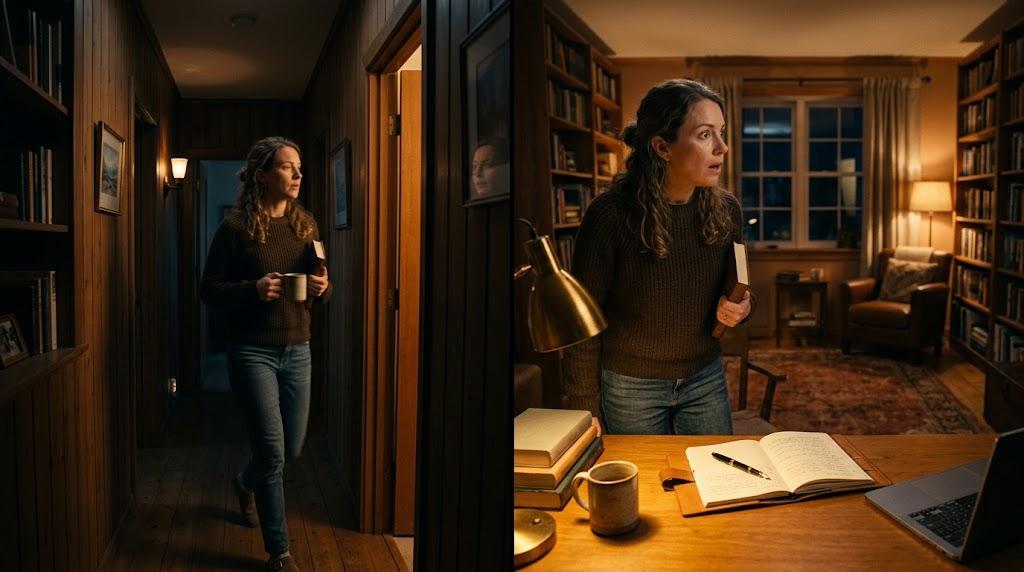
You stand up from your desk with a clear, urgent purpose: you need to grab a specific document from the kitchen. You walk down the hallway, step through the doorway, and suddenly stop dead in your tracks. Your mind goes completely blank. You look around, utterly confused, asking yourself: “Wait… what did I come in here for?”
You are not losing your memory. You have not developed early-onset dementia. You have just experienced one of the most universal and well-documented quirks of human cognition — the doorway effect.
This frustrating mental glitch happens because the human brain uses physical environments as boundaries to organize short-term memory. When you cross a physical boundary — like walking through a door — your brain “purges” the old memory cache to prepare for new sensory information, causing you to instantly forget your original intention.
What makes the doorway effect particularly fascinating is that it reveals something profound about how human memory actually works. Your brain does not store memories like a video camera recording continuous footage. Instead, it operates more like a filing clerk who closes one folder and opens a new one every time you change locations — and sometimes, the clerk throws away information you still need. Here are seven science-backed reasons why the doorway effect happens, and how to stop it.
1. Event Segmentation: How Your Brain Cuts Life Into Episodes
The doorway effect is not an isolated glitch. It is the most recognizable symptom of a broader cognitive system called event segmentation — the brain’s method of dividing continuous experience into discrete, manageable episodes.
Think of your day as a long film reel. Your brain does not watch it as one unbroken sequence. Instead, it automatically cuts the film at “event boundaries” — moments where the environment, activity, or context changes significantly. Each cut creates a new cognitive episode with its own mental file folder.

Doorways are among the most powerful event boundaries because they combine multiple sensory changes simultaneously:
- Visual shift — different lighting, different objects, different spatial layout.
- Acoustic change — different room acoustics, background noise, echo patterns.
- Spatial reorientation — your brain must construct a new mental map of the surrounding environment.
When all three change at once, the brain interprets this as a definitive signal: “Old episode ended. New episode beginning.” It closes the previous event file and opens a fresh one — and the information you were carrying in your working memory gets archived with the old file.
In 2011, cognitive psychologist Dr. Gabriel Radvansky and his team at the University of Notre Dame conducted landmark experiments to measure the doorway effect. They placed participants in virtual and real-world environments, asking them to pick up objects from a table, carry them across a room, and exchange them at another table.

The findings were striking:
- When participants walked across a large single room to complete a task, their memory remained sharp and accurate.
- However, when participants walked the exact same physical distance — but passed through a door into an adjacent room — their error rate doubled. They consistently forgot what object they were carrying or what task they were supposed to execute.
The simple act of walking through a door caused the brain to archive previous information, proving that physical thresholds act as hard neurological reset buttons.
THE NEURAL RESET: Event Segmentation Theory
Your brain does not record life as one continuous film reel. Instead, it operates on “Event Segmentation Theory.”
- Event Files: Your brain divides your day into distinct cognitive episodes — “Working at Desk,” “Walking in Hallway,” “Entering Kitchen.”
- File Archiving: When you cross an event boundary like a door, the brain closes the previous file and creates a fresh, blank file for the new space.
- Memory Flushing: Information that was vital in the previous room is categorized as “old data” and flushed out of working memory to make room for potential threats in the new room.
The Physical Doorway Horizon Test
Stand up, pick an everyday object in your mind, walk through a doorway into another room, and immediately notice the sudden brief cognitive blanking.
Did crossing the physical threshold cause a momentary hesitation in your working memory?
2. Evolution’s Memory Budget: Why Your Brain Purges at Doorsteps
To understand why the doorway effect persists in modern life, we need to examine the brutal limitations of human working memory.
Your short-term working memory acts like a mental whiteboard, capable of holding only 4 to 7 items at any given moment. This is an extraordinarily tight constraint for a species that needs to navigate complex, changing environments while simultaneously tracking threats, social cues, and goals.
In ancestral environments, rapid adaptation was critical:
- When an early human left a cave (Environment A) and stepped out into the open savannah (Environment B), their brain needed to immediately purge thoughts about cave maintenance — cave temperature, food storage, sleeping arrangements.
- They needed their mental whiteboard completely clear to scan for hidden predators, changing weather, or food opportunities in the new environment.
- Holding onto irrelevant thoughts from the previous space reduced situational awareness and increased mortality risk. A human still mentally cataloging cave supplies while scanning for lions on the savannah was a human who got eaten.
Your modern brain uses the exact same evolutionary software. When you walk from your living room into your kitchen, your prefrontal cortex assumes you are entering a new survival context. It clears your working memory whiteboard, causing you to stand in front of an open refrigerator wondering why you walked there in the first place.

The brain does not distinguish between a doorway into a dangerous savannah and a doorway into your bathroom. Both trigger the same ancient memory-flushing protocol. This type of mismatch — where ancient brain responses collide with modern environments — is also at the heart of why your body jerks when falling asleep — another survival reflex that made sense in trees but causes confusion in modern bedrooms.

3. The Digital Doorway Effect: Why Your Phone Makes You Forget
Do you frequently open a new tab on your web browser, or unlock your smartphone, only to immediately forget what app or website you intended to open? You reach for your phone to check the weather and somehow end up scrolling social media ten minutes later with no memory of why you picked up the device.
This is the digital doorway effect — and it is arguably more damaging to modern productivity than the physical version.
The digital doorway effect is particularly destructive because it triggers dozens of micro-resets throughout a single work session. Every screen transition forces your brain to archive the previous context and construct a new event file, draining your working memory budget at an alarming rate.
Modern digital interfaces are designed around visual boundaries that trigger the exact same event-segmentation mechanisms as physical doors:
- Unlocking your phone screen acts as a digital doorway — the sudden visual change from black screen to colorful icons forces a micro-reset.
- Swiping from one app screen to another creates an artificial event boundary, causing the brain to archive the previous app’s context.
- Opening a new browser tab forces your prefrontal cortex to archive the previous tab’s context and construct a new event file for the incoming page.
This constant digital switching explains why heavy multitasking accelerates severe decision fatigue that drains your cognitive energy. Each digital doorway effect triggers a micro-reset, constantly forcing your working memory to reload new contexts. After dozens of these micro-resets in a single morning, your brain is running on empty — not because you did anything physically demanding, but because you exhausted your working memory budget on context-switching.

“Cognitive scientists confirm that virtual boundaries trigger identical neurological resets as physical doors. Every screen swipe or tab change forces your prefrontal cortex to construct a new event file.”
4. Why Walking Back Instantly Restores Lost Memory
Understanding why the doorway effect reverses when you retrace your steps reveals something important about how context-dependent memory works.
When you forget what you came for, what is the first thing you naturally do? You walk back into the original room. The moment you step back across the threshold, your memory instantly returns: “Oh right, I needed my car keys!”
Neuroscience explains why retracing your steps works so reliably:
- Memory is deeply tied to environmental context cues. Your brain does not store memories in isolation — it stores them as part of a sensory package that includes the lighting, sounds, smells, and spatial layout of the environment where the memory was formed.
- When you return to the original room, your sensory system re-absorbs the visual lighting, background acoustics, and spatial orientation of that space.
- These sensory inputs trigger your brain to reopen the archived “Event File” associated with that space, making the lost thought immediately accessible again.
This is why retracing your steps feels almost magical — the memory was never truly lost. It was simply filed away in a cabinet that required the right key to unlock. The “key” is the sensory environment of the room where the memory was created.
This context-dependent memory system also explains why your brain replays embarrassing moments at night — the familiar darkness and silence of your bedroom reopen old emotional event files from your past, flooding your working memory with memories you thought you had buried.
5. Stress and the Doorway Effect: Why Bad Days Make It Worse
The doorway effect does not strike equally on all days. Research shows that stress, anxiety, and cognitive overload significantly amplify the memory-flushing mechanism.
When your brain is already under stress, cortisol floods the prefrontal cortex — the exact region responsible for maintaining working memory during environmental transitions. A stressed prefrontal cortex is like a filing clerk working overtime: it makes more errors, archives information more aggressively, and is more likely to flush files that should have been retained.
This explains why you experience the doorway effect more frequently during high-pressure periods — exam weeks, work deadlines, or when juggling multiple responsibilities. Your working memory budget is already depleted by stress, leaving fewer cognitive resources to survive the environmental reset.
The connection between stress and memory fragmentation is also why stress alters your memories without you noticing — chronic cortisol exposure literally reshapes how your brain encodes, stores, and retrieves information.
6. Age, Fatigue, and the Doorway Effect
A common misconception is that the doorway effect gets worse with age. Research suggests the underlying mechanism remains consistent across adulthood — your brain segments events the same way at 25 as it does at 65.
However, two factors can make the doorway effect feel more pronounced as you get older:
- Reduced working memory capacity: Working memory naturally declines with age. Since the doorway effect operates on a limited working memory budget, a smaller budget means each flush has a larger proportional impact.
- Fatigue: A tired brain segments events more aggressively. When you are exhausted, the prefrontal cortex conserves energy by archiving files faster and more completely — meaning the doorway effect hits harder when you are sleep-deprived or mentally drained.
This connects directly to why you feel tired after 8 hours of sleep — fragmented sleep reduces working memory capacity the following day, making you more susceptible to the doorway effect throughout the morning.
7. How to Beat the Doorway Effect: Seven Neuroscience-Backed Hacks
While you cannot eliminate the doorway effect entirely — it is hardwired into your neurology — you can apply seven practical cognitive strategies to protect your working memory when moving between spaces:
Hack 1: Verbalize Your Intent
Say your goal out loud before crossing a doorway: “I am grabbing my phone charger.” Vocalizing engages motor speech networks, creating a redundant memory trace that survives the environmental reset.
Hack 2: Visualize the Physical Object
Hold a vivid visual image of the object in your mind as you walk. Visual mental imagery occupies active working memory space, preventing the prefrontal cortex from flushing the file during the transition.
Beyond these two foundational doorway effect hacks, five additional strategies are backed by cognitive research:
- Hack 3: Anchor with a physical touch. Hold something related to your task as you walk — your keys, your wallet, a sticky note. The tactile sensation creates an additional sensory anchor that resists the memory flush caused by the doorway effect.
- Hack 4: Create artificial continuity. Talk to yourself or a companion as you walk through doorways. Continuous speech forces the brain to maintain the current event file rather than archiving it. This is why people who talk on the phone while walking rarely experience the doorway effect.
- Hack 5: Use visual landmarks. Before leaving a room, fix your eyes on a specific object in the destination room and hold it in your visual field. This creates a sensory bridge that links the two event files together.
- Hack 6: Write it down. If you need to complete a multi-step task across rooms, plan the sequence in advance and write it on paper. A physical list bypasses working memory entirely, giving your brain an external hard drive that is immune to the doorway effect.
- Hack 7: Slow down at thresholds. The doorway effect is strongest when transitions are rapid. Pausing for two seconds at a doorway — consciously acknowledging the boundary — gives your prefrontal cortex time to archive the previous file deliberately rather than reflexively.
The Bigger Picture: What the Doorway Effect Reveals About Memory
The doorway effect is more than a quirky brain glitch — it is a window into the fundamental architecture of human memory.
Your memory is not a video recorder. It is a creative reconstruction engine that builds, edits, and occasionally discards narratives based on context, emotion, and environmental cues. The memories you trust most are not perfect recordings — they are best-guess reconstructions generated by a brain that prioritizes survival over accuracy.
Understanding the doorway effect does not make your memory worse. It makes you more compassionate toward yourself when you forget things. Your brain is not failing — it is running ancient survival software in a modern world that constantly triggers its environmental boundaries. The same system that once saved your ancestors from predators now causes you to forget why you walked into the kitchen.
Every time you experience the doorway effect, you are witnessing millions of years of evolutionary engineering in real time. The fact that it occasionally misfires in a modern house is a small price to pay for a memory system that once kept an entire species alive on the African savannah.
Questions People Also Ask
Is the doorway effect a sign of dementia or memory loss?
No. It is a completely normal biological phenomenon experienced by healthy people of all ages. It is caused by event segmentation — a fundamental feature of how memory works — not by neurodegenerative damage. If you only forget things when crossing physical boundaries, your memory is functioning exactly as designed.
Why do physical doors affect memory more than walking across an open room?
Physical doors create simultaneous changes in lighting, acoustics, and spatial layout. This triple sensory shift is interpreted by the brain as a definitive event boundary, triggering the memory-flushing protocol. Walking across an open room does not create these simultaneous shifts, so the brain does not archive the current event file.
Can the doorway effect be completely eliminated?
Not entirely — event segmentation is hardwired into your neurology. However, you can significantly reduce its impact by verbalizing your intentions, visualizing the target object, or creating sensory bridges between environments. These strategies give your working memory redundant pathways that resist the flush.
Is the doorway effect worse in open-plan offices?
Yes. Open-plan offices create fewer physical doorway effects but more digital doorway effects — constant tab-switching and app-hopping trigger the same event-segmentation resets, fragmenting your working memory throughout the day. Noise and visual distraction compound the problem.
Does the doorway effect get worse with age?
Research suggests the mechanism itself remains consistent across adulthood. However, age-related changes in working memory capacity may make the resulting blanks feel more pronounced. The doorway effect hits hardest when you are already tired or stressed, regardless of age.
Where can I read more about the scientific research on memory boundaries?
Explore the Radvansky et al. (2011) – Walking Through Doorways Causes Forgetting and Dr. Radvansky’s original research published in Scientific American.
References
- Radvansky, G.A. & Copeland, D.E. (2006). Walking through doorways causes forgetting: Event model updates. Memory & Cognition, 34(5), 1036-1044. DOI: 10.3758/BF03193350
- Radvansky, G.A. et al. (2011). Event boundaries and memory updating. Psychological Science, 22(4), 443-448. DOI: 10.1177/0956797610393346
- Zipser, S. et al. (2014). Event boundaries and spatial updating. Journal of Experimental Psychology: Learning, Memory, and Cognition, 40(6), 1616-1638.
📚 You Might Also Like
Hand-picked articles for you


