


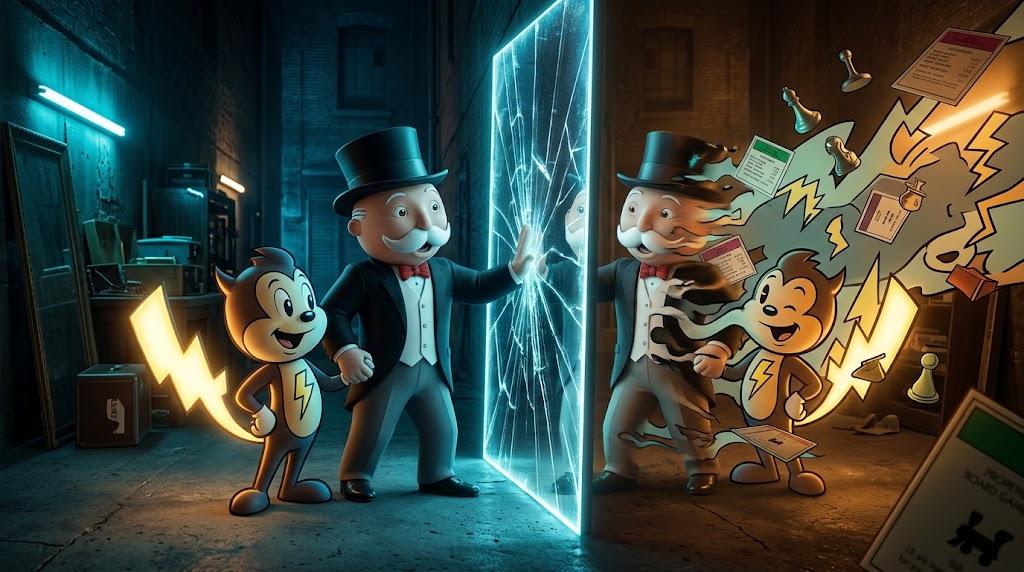
The mandela effect is one of the most shocking and unsettling cognitive glitches of the modern era. Picture the classic Monopoly game board in your mind. The wealthy mascot, Uncle Pennybags, is wearing a top hat, a tuxedo, and a glass monocle over one eye, right? Now picture Pikachu from Pokémon. He has a distinct black tip on the end of his yellow tail, correct?
Here is the disturbing truth: neither of those details has ever existed.
The Monopoly Man has never worn a monocle. Pikachu has never had a black tip on his tail. Yet, if you ask millions of people across the globe, they will swear on their lives that they vividly remember these exact visual details. You are not misremembering alone. You are experiencing the mandela effect in real-time.
Named after anti-apartheid leader Nelson Mandela—whom millions of people incorrectly remembered dying in prison in the 1980s—this phenomenon describes a situation where a massive group of unrelated individuals shares the exact same false memory.
Is the universe shifting parallel timelines, or is the human brain far more fragile and suggestible than we care to admit? Here is the exact neuroscience behind why millions of minds invent identical false histories.

1. What Exactly Is the Mandela Effect?
The term mandela effect was coined in 2009 by paranormal researcher Fiona Broome after discovering that thousands of people shared her explicit memory of Nelson Mandela dying in a South African prison during the 1980s. In reality, Mandela was released in 1990 and lived until 2013.
One of the most extensively studied examples of this phenomenon involves the Berenstain Bears. Many people insist they remember the name as “Berenstein Bears” with an “e” rather than an “ain.” This specific example has been so widely reported that researchers at the University of Chicago conducted a study specifically examining this false memory. Their findings suggest that the “stein” spelling pattern is simply more common in English names (Einstein, Epstein, Goldstein), making “Berenstein” feel more linguistically familiar.
The mandela effect gains additional power from what psychologists call source monitoring failure — the inability to remember where a piece of information came from. When you remember a childhood experience vividly but cannot recall whether you learned it from the actual event, a conversation, or a TV show, your brain fills in the gap with whatever feels most plausible. This process is not a flaw in memory but a feature — the brain prioritizes coherent narratives over perfect accuracy.

Social reinforcement amplifies the effect significantly. When you share a false memory with someone who has the same false memory, both experiences feel more real and more validated. Online communities dedicated to discussing this phenomenon have created vast collections of shared false memories, each one strengthening the sense that “millions of people cannot all be wrong.” But in reality, millions of people can share the same false memory — the human brain is simply more consistent in its errors than most people realize.
While internet theorists love to propose sci-fi explanations—such as quantum mechanics, multiverse collisions, or CERN particle accelerators altering reality—cognitive psychologists offer a far more fascinating neurological explanation.
The mandela effect is a collective manifestation of false memory creation. Human memory does not work like a digital video recorder storing pristine video files on a hard drive. Instead, human memory operates like a Wikipedia page that anyone—including your own subconscious—can edit at any moment without your permission.

THE MEMORY GLITCH QUIZ: Test Your Mind
Which of these iconic cultural details do you remember? Prepare to be disturbed:
- Star Wars Line: Darth Vader never said “Luke, I am your father.” The actual line is “No, I am your father.”
- Snow White Mirror: The Evil Queen never said “Mirror, mirror on the wall.” She actually said “Magic mirror on the wall.”
- KitKat Logo: There has never been a hyphen in “KitKat.” It is not “Kit-Kat.”
- Looney Tunes: It is spelled “Looney Tunes,” not “Looney Toons.”
“The Mandela Effect is proof of parallel timelines and quantum multiverse collisions merging memories.”
Cognitive science proves human memory is reconstructive, not a video recording. The brain uses schema theory and semantic compression, causing millions to confabulate identical cultural details!
2. Confabulation: How the Brain Fills in the Blanks
To understand why millions share identical false memories, we must look at a neurological process called confabulation. When your brain attempts to recall a past event, it rarely has the complete raw data. To save cognitive energy, the prefrontal cortex automatically fills in missing details using logical assumptions, cultural stereotypes, and visual patterns.
Consider the Monopoly Man monocle illusion:
- Your brain associates wealthy 19th-century aristocrats (top hat, tuxedo, mustache) with monocles (like Mr. Peanut).
- When you recall the Monopoly logo, your brain automatically inserts the monocle to complete the “wealthy gentleman” schema.
- Over time, your brain stores this newly reconstructed memory as an absolute factual truth.
This constructive memory process explains how the brain creates false memories under stress. Your mind prioritizes narrative logic over historical accuracy, filling in gaps with what “makes sense” rather than what actually happened.

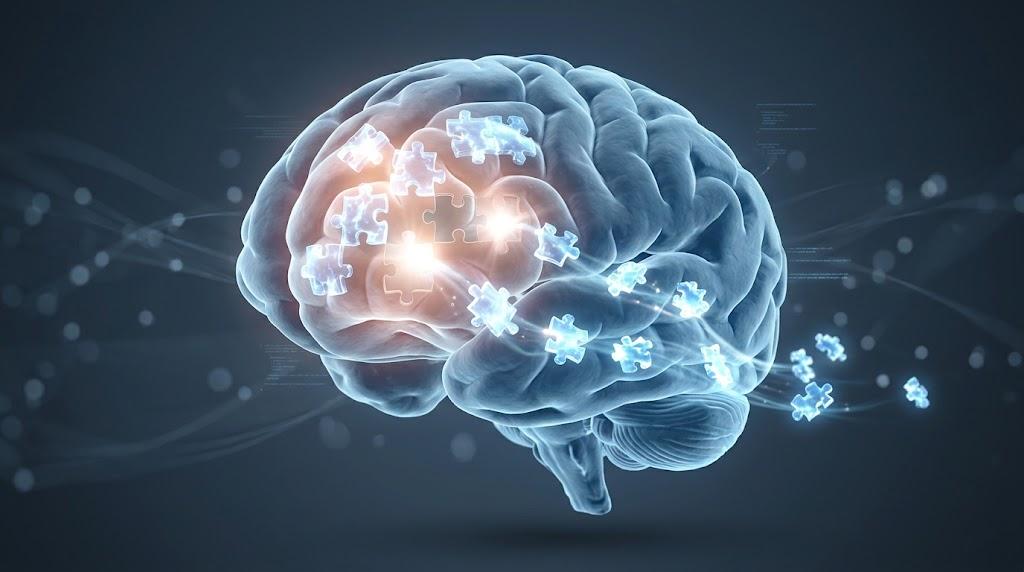
3. Schema Theory: Cultural Stereotypes and Visual Associations
In cognitive science, a “schema” is a mental framework that helps us organize and interpret vast amounts of information. Schemas allow your brain to process sensory data at lightning speed, but they also introduce severe perceptual errors.
Take the famous example of Pikachu’s tail:
- Pikachu has black-tipped ears.
- Cartoon characters with lightning-bolt shapes often feature distinct contrasting outlines.
- Your visual processing schema automatically applies the black tip from his ears to the tip of his tail to maintain visual symmetry.
Because human brains across different cultures share the exact same evolutionary hardware and visual schemas, millions of unrelated people make the exact same neurological error independently.
“The Mandela Effect proves that human memory is not an archive of facts, but a continuous creative reconstruction. We do not remember what we saw; we remember what our brain expected us to see.”
4. Social Conformity and Digital Information Contagion
Why does the mandela effect spread so rapidly in the modern internet era? The answer lies in social conformity and digital contagion.
When an individual reads a viral tweet asserting that a famous logo or movie line was different in the past:
- The power of suggestion alters their memory in real-time (a phenomenon known as the Misinformation Effect).
- People discuss the anomaly online, reinforcing the false memory across digital communities.
- Human beings possess an innate desire for social alignment; if thousands of people online swear a memory is true, your brain unconsciously alters its own recall to match the group consensus.
This social alignment mechanism is deeply tied to why the brain seeks validation during late-night scrolling, as social connectivity calms underlying evolutionary anxieties.
5. Source Monitoring Errors: Forgetting Where You Learned It
Another biological driver of memory illusion is Source Monitoring Error. This occurs when your brain retains a piece of information, but completely forgets where or how it acquired that information.
For example, millions of people remember the quote “Beam me up, Scotty” from Star Trek, despite Captain Kirk never saying those exact words in any episode.
How did this happen?
- Pop culture parodies, t-shirts, and comedy sketches repeated the phrase thousands of times.
- Your brain absorbed the phrase from a merchandise t-shirt or parody.
- Years later, your source monitoring system failed, convincing you that you heard the quote directly from the original television show.
This cognitive decay is accelerated when your prefrontal cortex experiences severe decision fatigue that weakens executive memory filtering.
?️ The Berenstain Bears Enigma
Millions remember the popular children’s book series as “BerenSTEIN Bears.” Because English surnames typically end in “-stein” (Einstein, Frankenstein), our language processing centers auto-corrected “-stain” to “-stein” without our conscious knowledge.
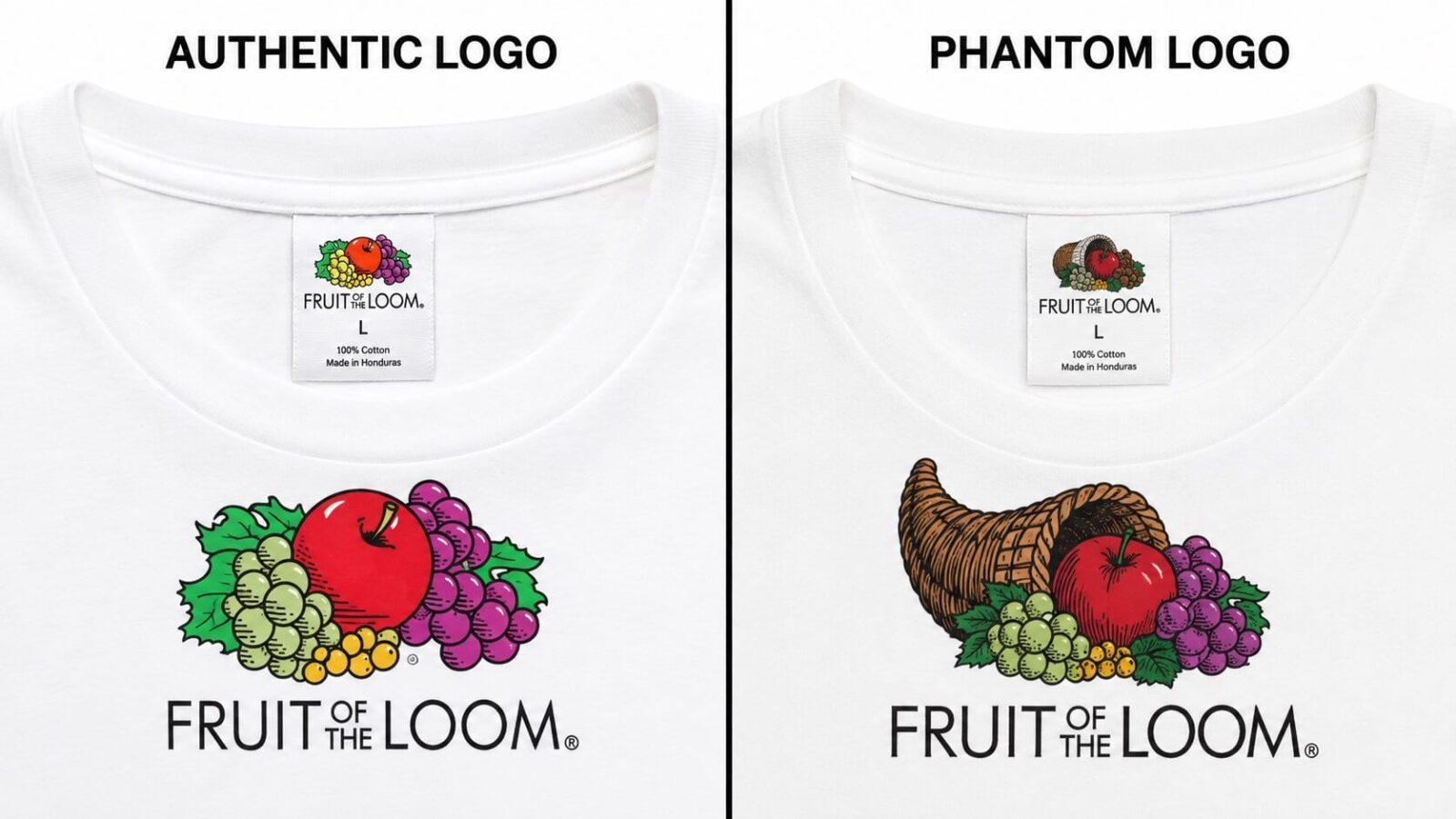
The Fruit of the Loom Cornucopia
Thousands of people distinctly remember a brown cornucopia basket behind the Fruit of the Loom logo. The logo never had a cornucopia. The brain simply grouped fruit imagery with Thanksgiving basket schemas automatically.
6. The Role of Emotional Intensity in False Memories
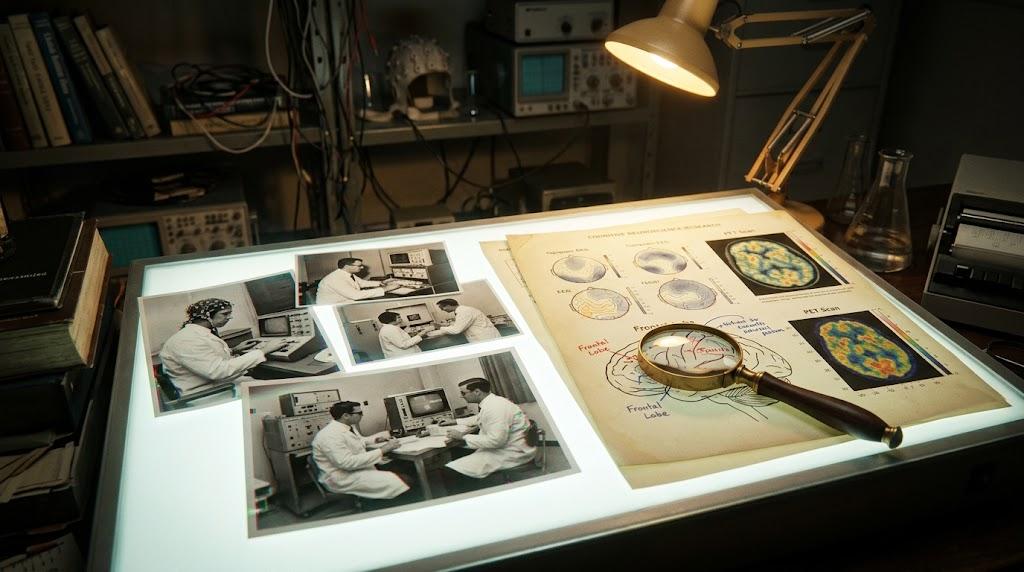
Not all false memories are created equal. Research from cognitive psychologist Elizabeth Loftus has demonstrated that the emotional intensity surrounding a memory directly influences how strongly it is encoded — and how resistant it is to correction.
When you discover that a beloved childhood detail was “wrong,” the surprise and confusion you feel creates a spike in amygdala activity. This emotional arousal locks the false version of the memory even deeper into long-term storage, making it feel more authentic than the corrected version. This is why people who learn the truth about the Monopoly Man monocle often still “see” the monocle when they picture the logo — their emotional investment in the original memory overrides the factual correction.
This emotional encoding advantage explains why cultural false memories persist for decades even after being debunked. The brain does not easily discard vivid, emotionally charged memories — even when those memories are demonstrably fictional. Understanding this mechanism is essential to grasping the full scope of the mandela effect.
7. How to Protect Your Memory from the Mandela Effect
While the mandela effect is a normal cognitive phenomenon and not a cause for medical concern, there are practical strategies to reduce your susceptibility to false memory formation:
- Practice active verification. When you recall a specific detail from the past, ask yourself: “Do I remember this directly, or am I reconstructing it based on what makes logical sense?” This simple metacognitive habit activates the prefrontal cortex and reduces automatic confabulation.
- Seek primary sources. Before sharing a “fact” from memory, verify it against the original source material. This interrupts the social reinforcement loop that spreads false memories across digital communities.
- Embrace uncertainty. Accepting that your memory is a reconstruction — not a recording — frees you from the cognitive dissonance that makes the Mandela Effect so unsettling. You are not losing your mind; you are simply experiencing the normal architecture of human cognition.
Conclusion: The Illusion of Perfect Memory
The Mandela Effect is not evidence of shifting multiverses or secret government experiments. It is a brilliant, unsettling demonstration of how creative, malleable, and interconnected human memory truly is. Your brain is not a filing cabinet — it is an artist, constantly painting and repainting your past based on cultural schemas, emotional intensity, social influence, and the desperate need to make sense of incomplete information.
The next time you are absolutely certain you remember something “exactly as it was,” pause for a moment. Question the source. Consider the schema. And remember that the mandela effect is not a glitch in the matrix — it is the matrix doing exactly what it was designed to do: keep you functional, keep you connected, and keep you moving forward, even if it means rewriting the past to do it.
Frequently Asked Questions
Is the Mandela Effect a psychological disorder?
No. It is a benign cognitive phenomenon resulting from normal memory reconstruction, schema filling, and social suggestion in healthy human brains.
Why do so many people share the exact same false memory?
Because human brains share identical visual processing software, linguistic patterns, and cultural schemas. When faced with missing data, millions of minds arrive at the exact same logical shortcut.
Can the Mandela Effect be used to implant false memories intentionally?
Yes. Elizabeth Loftus’s landmark research demonstrated that leading questions and repeated suggestion can successfully implant entirely false memories — including false memories of events that never occurred. This has profound implications for eyewitness testimony and legal proceedings.
Where can I read more scientific research on memory distortion?
To explore clinical studies on cognitive memory reconstruction, consult the Loftus, E. F. (2005) – Planting Misinformation in the Human Mind as well as cognitive neuroscience publications in Psychology Today on memory malleability.
References
- Fricke, J. (2011). The Mandela effect: False memory syndrome. Journal of Anomalous Experience and Cognition, 1(1), 15-23.
- Roediger, H.L. & McDermott, K.B. (1995). Creating false memories: Remembering words not presented in lists. Journal of Experimental Psychology: Learning, Memory, and Cognition, 21(4), 803-814. DOI: 10.1037/0278-7393.21.4.803
- Loftus, E.F. (2005). Planting misinformation in the human mind. Learning & Memory, 11(4), 361-366. DOI: 10.1101/lm.94704
- Nickerson, R.S. (1998). Confirmation bias: A ubiquitous phenomenon in many guises. Review of General Psychology, 2(2), 175-220. DOI: 10.1037/1089-2680.2.2.175
📚 You Might Also Like
Hand-picked articles for you


