


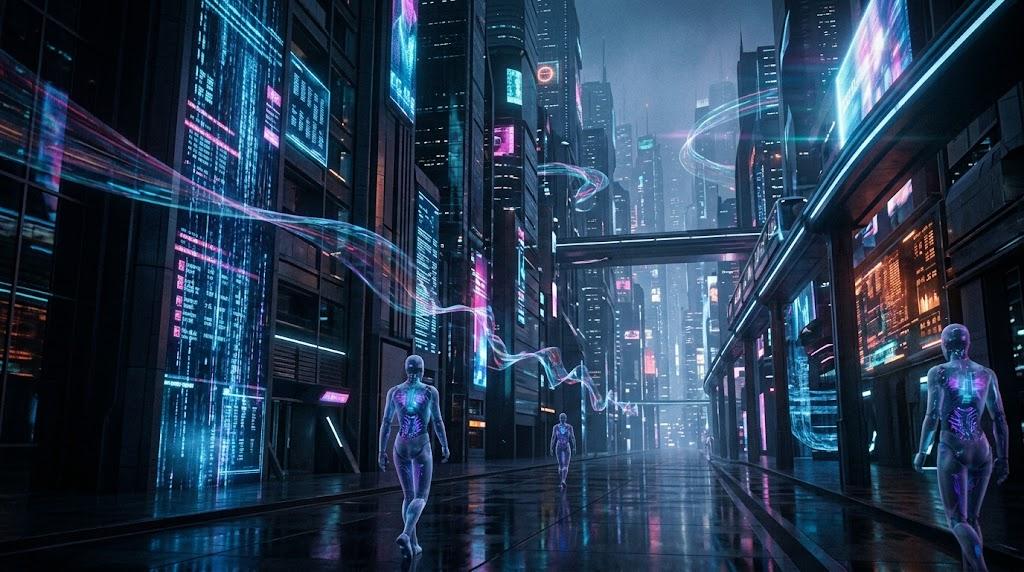
Have you ever spent an evening scrolling through social media, reading comments on a viral post, only to feel an uncomfortable sensation that something is fundamentally off?
The replies feel formulaic. The arguments sound repetitive. The viral posts feel artificially manufactured. Your gut tells you that something strange is happening beneath the surface of what you see online.
What if your intuition is completely correct? What if the vibrant, organic, human-driven internet you grew up with no longer exists?
The dead internet theory is one of the most mind-bending digital phenomena of the modern era. Originating in late-2010s digital forums, it asserts that the organic human web died somewhere between 2016 and 2017. The dead internet theory has since become a cultural touchpoint for anyone who senses that online life feels increasingly artificial.
Proponents of the dead internet theory argue that the overwhelming majority of modern internet traffic, social media commentary, and digital content is now autonomously generated by artificial intelligence bots and automated engagement systems.

While it sounds like a dystopian science-fiction novel, cybersecurity data reveals a chilling reality: the web is far less human than you think.
The Core Claim
The dead internet theory is a cultural and technological critique positing that the modern web has become heavily populated by automated bot traffic, algorithmic curation, and AI-generated content, raising pressing questions about the authenticity and visibility of human interaction online.
1. What Exactly Is the Dead Internet Theory?
At its core, the dead internet theory claims that the modern web has been systematically replaced by synthetic, automated content designed to inflate engagement metrics, control consumer behavior, and manipulate public perception.
The theory is not a single unified claim. Different versions of the dead internet theory exist, ranging from mild to extreme. The mild version suggests that bots and algorithms heavily influence what you see online. The extreme version claims that nearly all online interaction is artificial.

The original post that sparked the theory appeared on a forum called “Anonymous” in 2021. The anonymous author argued that government agencies and corporations had taken control of the internet, replacing organic human activity with automated content.
While the conspiracy angle is debatable, the underlying data is not. Cybersecurity research supports the more moderate interpretation of the dead internet theory.
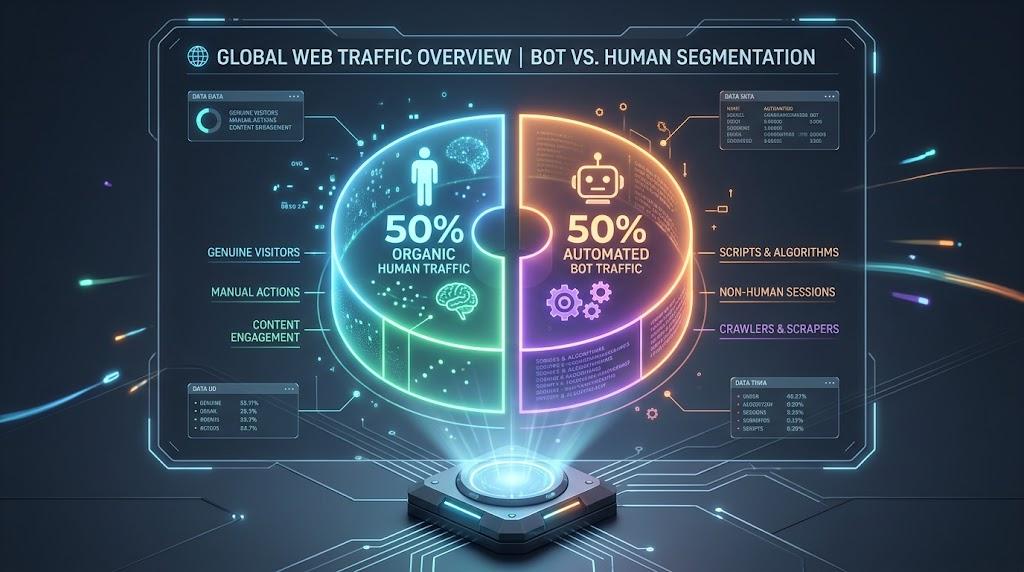
According to cybersecurity telemetry published in Imperva’s 2024 Bad Bot Report, automated bot traffic accounted for 49.6% of internet network requests measured across its monitored enterprise clients in 2023. Sophisticated “bad bots” — comprising automated web scrapers, credential stuffers, and commercial automation scripts — accounted for roughly 32% of that total measured volume.
Importantly, these network-level statistics measure automated HTTP requests and server interactions, not necessarily the proportion of individual human posts or conscious conversations. However, with the emergence of generative AI and automated social syndication, the prevalence of synthetic text, automated customer service agents, and programmatic engagement has visibly expanded.
While the extreme conspiratorial claim that all organic human users have vanished is clearly hyperbolic, cybersecurity data and internet research confirm a measurable trend: an increasing share of web activity consists of automated scripts interacting with web applications and algorithms.
The Three Pillars of Automation
- Generative AI Content: Large Language Models generating millions of synthetic articles and posts per second.
- Algorithmic Curation: Recommendation engines amplifying high-dopamine, repetitive content to maximize watch time.
- Automated Bot Networks: Millions of headless browser accounts executing artificial likes, shares, and comments.
2. Generative AI and the Explosion of “Slop” Content
The rapid evolution of generative AI has accelerated the reality of the dead internet theory at an unprecedented pace. Content farms can now deploy autonomous scripts that generate thousands of fully formatted articles in seconds without any human editorial oversight.

This deluge of automated media is referred to by digital researchers as “AI Slop” — low-quality, machine-generated content designed to capture search traffic and ad revenue. The term has become central to discussions about the dead internet theory because it describes exactly the kind of synthetic content the theory warns about.
The scale is staggering. A single content farm can produce over 1,000 articles per day using tools like GPT-based models. Each article is optimized for SEO keywords, formatted with proper headings, and published automatically across dozens of websites.
Search engines are flooded with this content. When you search for a simple product review or health question, the top results are increasingly likely to be AI-generated articles that quote other AI-generated articles in a closed loop of synthetic information.
This creates what researchers call a “hall of mirrors” effect. You read an article that seems authoritative, but it was written by an AI trained on other AI-generated content, with no original human research or experience behind it. This is the essence of the dead internet theory in action.
Social platforms face the same problem. Synthetic images depicting bizarre AI-generated scenarios are designed to bait reactions from older or less tech-savvy users. These images spread rapidly because they trigger strong emotional responses.
Human creators find their original work buried beneath an avalanche of automated, hyper-optimized synthetic media. A human writer spending 20 hours on a carefully researched article competes against an AI system that produces 1,000 articles in the same timeframe.
The economic model rewards volume over quality. Advertising revenue flows to whoever captures the most traffic, and AI-generated content is nearly free to produce. This creates a race to the bottom where authentic human voices are drowned out by synthetic noise.
This synthetic flood is closely related to how the brain processes false information under cognitive overload, as repetitive synthetic media alters human perception of truth and cultural consensus.
3. Algorithmic Echo Chambers and Artificial Engagement
Why do social media platforms feel so homogenous and repetitive? Modern recommendation algorithms do not prioritize truth, artistic value, or human connection. They prioritize time-on-site and ad impressions. The dead internet theory argues that this algorithmic preference is a primary driver of the shift toward synthetic content.
Algorithms create extreme emotional friction, pushing outrage and sensationalism to trigger immediate dopamine spikes. Content that generates strong reactions gets amplified. Calm, nuanced content gets suppressed because it does not keep users scrolling.
Automated accounts are deployed by marketing agencies and political campaigns to artificially inflate post counts, making a niche topic appear like a nationwide movement. A political campaign can make a hashtag trend globally with fewer than 50 human participants by deploying thousands of bot accounts.
A 2022 study by researchers at Oxford University found that organized political campaigns in over 80 countries used bot networks to manipulate public opinion during elections. These networks were capable of producing thousands of unique posts per hour.
The most disturbing aspect of algorithmic manipulation is how it changes human behavior. Human users unknowingly mimic bot behavior, adopting repetitive slang, meme templates, and automated phrasing just to remain visible within algorithmic feeds.
Content creators report modifying their writing style to match what algorithms favor — shorter sentences, more emotional language, controversial takes, and clickbait headlines. The algorithm rewards bot-like content, so humans start producing bot-like content.
When humans begin speaking and writing like algorithms just to get views, the line between human expression and synthetic automation disappears completely. This is what makes the dead internet theory so unsettling — the boundary between human and machine is already dissolving.
Research on algorithmic amplification shows that content containing emotional triggers receives 6-8 times more engagement than factual, informative content. This creates a perverse incentive structure where the most extreme or synthetic content rises to the top.
“The tragedy of the modern internet is not just that bots are mimicking humans. It is that algorithms have incentivized human beings to start behaving, writing, and communicating like bots.”
The Authentic vs Synthetic Social Paradox
You discover that 80% of comments, likes, and replies on your favorite online forum are generated by autonomous AI agents designed to simulate warmth and engagement. What do you do?
4. Commercial Incentives: The Ad-Tech Illusion
Follow the money, and the reality behind the dead internet theory becomes undeniable. The modern digital economy runs on digital advertising — specifically cost-per-click and cost-per-mille metrics.
This ad-tech architecture creates perverse economic incentives. Ad brokers pay websites based on traffic volumes and click metrics. The more visitors a site appears to have, the more revenue it generates from advertisers.
Site owners deploy automated bots to visit their own sites and click on ads, generating fake revenue. This practice, known as “ad fraud,” costs the advertising industry an estimated $84 billion annually worldwide.
Ad networks deploy bot-detection algorithms, which ad fraudsters bypass using even smarter AI bots. It is an arms race with no end in sight, where each side deploys increasingly sophisticated technology against the other.
In this shadow ecosystem, brands pay real money to advertise on websites where AI bots write articles read by other AI bots. Entire multi-million dollar ad ecosystems operate without a single human ever laying eyes on the advertisement.
The implications extend beyond wasted advertising budgets. When companies believe they are reaching millions of human consumers, they make strategic decisions based on phantom data. Product launches, marketing budgets, and entire business models are built on engagement metrics that are substantially fabricated.
This continuous digital simulation accelerates severe decision fatigue during late-night browsing, as your executive brain struggles to extract genuine human connection from automated commercial noise.
5. Psychological Impact: Digital Loneliness in a Synthetic Web
Living in a world dominated by synthetic content carries severe psychological consequences for the human nervous system. Humans evolved over millions of years to seek genuine social connection, facial cues, and empathetic resonance within small communities.
When you spend hours interacting with a synthetic web, your subconscious registers the lack of genuine human empathy. This leads to severe digital isolation despite constant connectivity — you are surrounded by “voices” but connected to no one. The dead internet theory gives a name to this growing sense of digital emptiness.
You may experience depersonalization — a feeling that the digital world around you is artificial, staged, and lifeless. This is not paranoia. It is a rational response to an environment that is increasingly devoid of authentic human presence.
The psychological friction of navigating a bot-dominated web contributes directly to why your brain overthinks at night after scrolling, as your nervous system searches for real social resolution that the algorithmic feed cannot provide.
Studies on social media usage show that heavy users report higher levels of loneliness than moderate users, despite spending more time “connected.” The quantity of digital interaction has increased, but the quality of genuine human connection has plummeted.
Clinical psychologists have identified a new pattern they call “digital depersonalization syndrome” — a condition where patients feel detached from online interactions because they sense the other party may not be human. This feeling is increasingly validated by the actual prevalence of bots on social platforms.

?️ The Dark Forest Theory of the Web
In response to bot-dominated public platforms, human users are retreating into private digital communities — Discord servers, private group chats, and newsletters. This is the “Dark Forest” of the internet.
The Authenticity Premium
As AI content becomes free and infinite, verified human-created content, raw audio podcasts, and hand-written essays are becoming premium economic assets valued for their undeniable human origin.
Scientific & Technical Distinction: Verified Data vs. Internet Mythology
- High Volume of Automated Network Requests: Telemetry from major cybersecurity and CDN firms (Imperva, Cloudflare) consistently documents that ~40–50% of global web requests originate from automated scripts, search indexers, API scrapers, and malicious bots.
- Digital Ad Fraud: Programmatic advertising fraud and click-bot networks extract billions of dollars annually by simulating impressions and human interactions.
- Proliferation of Synthetic Media: Large language models enable automated content farms to produce vast quantities of synthetic, SEO-optimized text and images at negligible marginal cost.
- “The Human Web Died in 2016”: The claim that genuine human engagement largely ceased around 2016–2017 is an online conspiracy theory. Billions of genuine humans interact, communicate, and create content on the internet daily.
- Conflating Network Traffic with Human Dialogue: A high percentage of automated network requests does not equate to half of all comment sections being bots arguing with bots; most bot requests consist of back-end scraping, API queries, and vulnerability scanning.
Summary and Frequently Asked Questions About the Dead Internet Theory
The dead internet theory highlights a profound shift in how the digital world operates. While the public web is increasingly populated by automated bots and synthetic media, understanding these systems allows us to reclaim authentic human connections in smaller, intentional spaces.
The theory is not a reason to abandon the internet. It is a reason to use it more intentionally and critically. The tools to find genuine human connection still exist — they are simply harder to find amidst the synthetic noise.
Is the dead internet theory 100% true?
The literal claim that “the internet died in 2016 and almost all users are bots” is internet folklore. However, the observation that inspired it is grounded in real trends: cybersecurity datasets (such as Imperva’s Bad Bot reports) report that automated network traffic accounts for nearly 50% of measured web requests, and generative AI has made automated text and media creation cheap and pervasive.
How can I protect my mind from synthetic AI content?
Seek out verified human-curated publications, participate in closed group communities, limit algorithmic social feeds, and prioritize real-world social interactions over digital commentary. Develop strong media literacy skills to identify AI-generated content.
What percentage of the internet is actually bots?
According to Imperva’s Bad Bot Report, automated requests represented roughly 49.6% of analyzed web traffic in 2023, with 32% classified as malicious automation (scrapers, scanners, credential attacks) and the remainder as benign automation (search engine indexers, partner APIs). Account automation levels vary widely by platform and verification standards.
How do I know if I am interacting with a bot?
Look for signs like generic responses, repetitive phrasing, accounts that post at inhuman frequency, profiles with no personal photos, and engagement patterns that seem artificially timed. However, as AI improves, detecting bots becomes increasingly difficult, even for experts.
References
- Imperva Threat Research. (2024). 2024 Imperva Bad Bot Report: An Analysis of Automated Threats to Web Applications and APIs. Thales Group. Imperva Report
- Pew Research Center. (2018). Bots in the Twittersphere: An Analysis of Automated Activity on Twitter. Pew Research Center Internet & Technology. Pew Research Report
- Vosoughi, S., Roy, D., & Aral, S. (2018). The spread of true and false news online. Science, 359(6380), 1146-1151. DOI: 10.1126/science.aap9559
- Ferrara, E., Varol, O., Davis, C., Menczer, F., & Flammini, A. (2016). The rise of social bots. Communications of the ACM, 59(7), 96-104. DOI: 10.1145/2818717
📚 You Might Also Like
Hand-picked articles for you


