


Open the collection of scientific puzzles that has traveled for centuries under Aristotle’s name, and you will find this question, written down more than two thousand years ago: why does the heat of the sun provoke sneezing? It sits there without an answer, one of the oldest open questions in the entire history of biology.
Since then, a philosopher tested it by closing his eyes, a neurologist collected case histories from hundreds of patients, geneticists screened the DNA of thousands of strangers, and a Max Planck review in 2025 concluded — honestly — that no proposed mechanism has been conclusively validated. And yet we know more about the photic sneeze reflex than ever before.
The condition has a name now: the photic sneeze reflex. It makes bright light — usually sudden sunlight — trigger an uncontrollable sneeze or a rapid burst of them. Roughly one person in four carries it. It runs in families along the strict lines of Mendelian inheritance. Fighter pilots have been formally warned about it. Its official backronym spells “ACHOO.”
What follows is organized the way the science itself is organized: as a case file. Six exhibits, from Aristotle to genome-wide association studies. Four suspects — four competing theories of why light sets off the nose of a photic sneezer. A case board showing what each theory has and what it lacks. And at the end, the practical question Aristotle never got to: what to do about the photic sneeze reflex once you realize you carry it.
Exhibit A: The Question That Is 2,300 Years Old

The sun-sneeze appears in the Problems, a question-and-answer collection attributed to Aristotle and his school from the fourth century BC. The proposed answer of that era was physical and quite reasonable for its time: the sun’s heat, the author guessed, causes a kind of sweating inside the nose, and the sneeze simply expels the moisture.

In the seventeenth century, Francis Bacon ran what may be history’s cheapest neuroscience experiment. He faced the sun with his eyes closed — and did not sneeze. Whatever drives the reflex, Bacon concluded, passes through the eyes. His own hypothesis was that sunlight makes the eyes water, and the tears drain into the nose and irritate it. Hold that thought; the tears will be tried again later, and acquitted on a technicality.
Then the question disappeared from serious science for three hundred years. It resurfaced only in 1964, when a neurologist named Henry Everett published the first systematic clinical study of sneezing in response to light. Modern research on the photic sneeze reflex is barely sixty years old — younger than the theory of plate tectonics.
Set the whole arc in one line of sight and the pace of the investigation becomes obvious:

| Year | Milestone | Who |
|---|---|---|
| ~350 BC | Question first written down: why does the sun provoke sneezing? | Aristotelian Problems |
| 1600s | Eyes closed, no sneeze: the trigger enters through vision | Francis Bacon |
| 1964 | First clinical study; coined the “photic sneeze effect”; three theories proposed | Henry Everett, Neurology |
| 1978 | The ACHOO backronym appears in the medical literature | Collie and colleagues |
| 1984 | Autosomal dominant inheritance documented in a four-generation family | Peroutka & Peroutka, NEJM |
| 1993 | Flight-safety risk flagged; first comprehensive clinical review published | Breitenbach et al.; Whitman & Packer |
| 2010 | EEG finds a hyperexcitable visual cortex; first GWAS finds a genetic association | Langer et al.; Eriksson et al. |
| 2019 | rs10427255 replicated in 3,417 people; a pressure technique formally reported | Wang et al.; Bobba et al. |
| 2025 | Review of light parameters concludes: no mechanism yet conclusively validated | Trinkl et al., Max Planck Institute |
Do You Sneeze When Stepping into Bright Sunlight?
Medically termed the ACHOO syndrome (Autosomal Compelling Helio-Ophthalmic Outburst), this optical-trigeminal nerve cross-talk is an inherited autosomal dominant trait affecting roughly 18% to 35% of people.
Exhibit B: Naming the Reflex — Everett, ACHOO, and the Family Tree
Everett’s 1964 paper gave the phenomenon its scientific name and its scientific start. He gathered patients who sneezed at bright light, described the pattern carefully, and proposed that the wiring of the nervous system itself was responsible. One of his own patients had mentioned sneezing at sexual thoughts — a detail that seemed like a footnote at the time and will matter in Exhibit C.
The acronym came in 1978, when Collie and colleagues gave the condition its deliberately contrived formal title: Autosomal-dominant Compelling Helio-Ophthalmic Outburst syndrome. The letters spell the sound of the sneeze itself. It is the rare medical term designed as a joke — and it stuck, because the first word of the backronym happens to be the most important fact about the condition.
The photic sneeze reflex is not a quirk of upbringing or habit. Autosomal dominant is genetics for: one copy is enough.
Four years after the acronym, a pharmacologist named Stephen Peroutka noticed that his four-week-old daughter sneezed, twice and always twice, when he carried her into bright sunlight. The same reflex was present in himself, his father, and his brother — and absent in his mother and his wife. He wrote it up in the New England Journal of Medicine as a textbook case of father-to-daughter transmission. A formal genetic analysis by Forrester in 1985 confirmed what the family trees suggested: sneezing at bright light is an inherited response.
The practical translation: if one of your parents sun-sneezes, you have roughly a fifty percent chance of carrying the photic sneeze reflex yourself. Many people discover their half of the coin the first time they walk out of a matinee into the afternoon sun and detonate three sneezes in a row.
The photic sneeze reflex belongs to the same family of ancient, automated body programs as the hypnic jerk that lurches you awake and the yawn that cools your brain — behaviors that need no learning, run on their own schedule, and only attract attention when something odd sets them off.

Exhibit C: The Suspects — Four Theories of Why Light Sets Off the Nose
Here is the strange part that makes the case genuinely interesting. The sneeze is triggered by irritation of the nose — that is how the reflex is built. Light, meanwhile, arrives at the eye. Between the eye and the nose there is no obvious road. Every theory of the photic sneeze reflex is a proposal for the hidden road the signal takes, and after sixty years of investigation, four suspects in the case of the photic sneeze reflex remain on the board. None has been convicted. None has been acquitted.
Suspect One: Crossed Wires in the Trigeminal Nerve
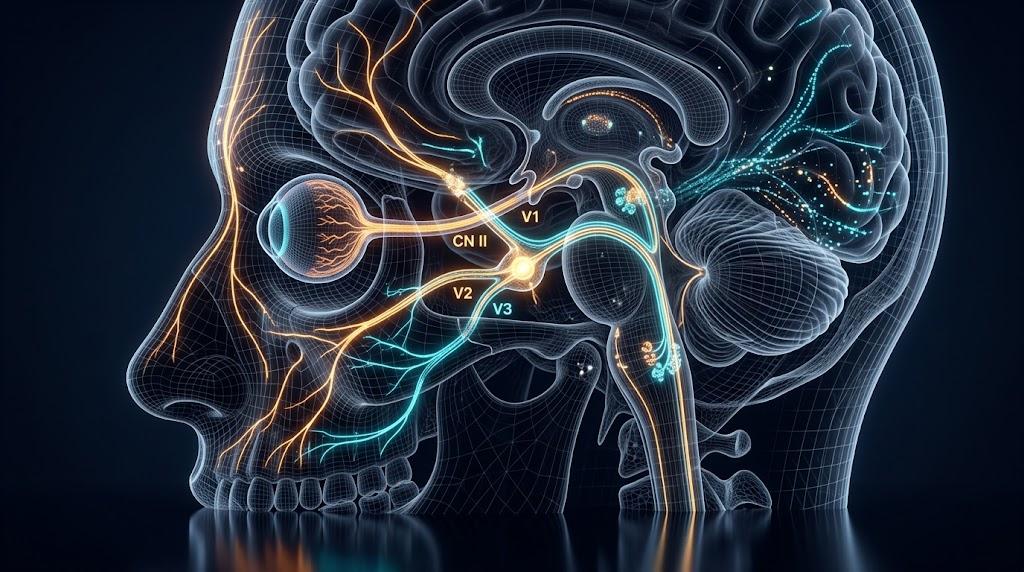
The trigeminal nerve is the great sensory cable of the face, and the sneeze reflex listens to two of its branches: the ophthalmic branch above (forehead, eye region) and the maxillary branch below (cheek, nasal lining). Everett’s first proposal was summation: bright light aggravates the ophthalmic branch — the same pathway that produces photophobia, the painful light sensitivity of migraine — and that extra traffic spills over into the maxillary branch, which reads it as nasal irritation and calls the sneeze.
Evidence for: the wiring is real, adjacent, and shared; plucking an eyebrow, which is ophthalmic-branch territory, can genuinely provoke a sneeze in some people. Evidence against: on the evidence assembled in a 2008 review by Bhutta and Maxwell, ordinary trigeminal triggering does not appear to be more frequent in photic sneezers than in anyone else. A real road, but possibly not this case’s road.
Suspect Two: The Overflowing Tap — Parasympathetic Summation
Everett’s third theory is the one modern reviewers keep returning to when they explain the photic sneeze reflex. The parasympathetic nervous system is the body’s “rest and digest” automation, and one of its jobs is constricting the pupil in bright light. The theory of parasympathetic summation holds that this outflow is not perfectly discreet: switching on the pupil’s response can slop over into neighboring parasympathetic channels — including the ones that make the nasal lining secrete fluid. The nose, mildly flooded, does what noses do when irritated. It sneezes.
The strength of this theory is that it explains company the reflex visibly keeps. Two families described in the literature sneeze when their stomachs are full — digestion is parasympathetic business. Documented reports link sneezing fits to sexual thoughts and to orgasm — also parasympathetic business.
Bhutta and Maxwell concluded that every known “unusual trigger” of sneezing shares a single signature: parasympathetic outflow. Anatomy even offers a plausible route, with descending projections from the pupil’s parasympathetic nucleus (the Edinger-Westphal nucleus) into the brainstem near the sneeze circuitry. Verdict: best-supported, unproven — a theory with strong circumstantial evidence and no smoking gun.
Suspect Three: The Tear-Drainage Theory and Why Timing Kills It
This is Bacon’s old idea in modern dress: light makes the eyes water, tears drain through the nasolacrimal duct into the nose, the wet lining sends up the irritation signal, and the sneeze follows. It survives because it is so intuitive — and it fails on arithmetic. Tear production and drainage are slow processes measured in minutes. The photic sneeze arrives within seconds of stepping into the sun, far too fast for a trickle of tears to reach and irritate the nasal lining. Verdict: closed. The eyes do matter — Bacon was right about that much — but the tears are not the courier.
Suspect Four: The Shouting Cortex — What the EEG Found

In 2010, neuroscientists Langer, Beeli and Jäncke did something no one had done before: they put photic sneezers and non-sneezers in front of an EEG and measured how their brains answered light. The photic sneezers’ visual cortex responded with measurably higher excitability — and their secondary somatosensory cortex, the region that maps bodily sensation, lit up more strongly in response to the same visual stimulus.
In this account, the hidden road is not a cable at all. The hyperexcitable visual cortex shouts, and the shout leaks into neighboring somatosensory processing — one step from circuits that interpret irritation in the face. The US National Library of Medicine’s clinical summary describes the mechanism in exactly these terms: over-excitability of the visual cortex leading to stronger activation of secondary somatosensory areas. Verdict: open. It is the only theory with a direct brain measurement behind it — but a correlation on a scalp EEG is a fingerprint at the scene, not the crime itself.
Lay the four accounts side by side and the state of the case is easy to read:
| Suspect theory | First proposed | Strongest clue | Case status |
|---|---|---|---|
| Optic-trigeminal summation | Everett, 1964 | Trigeminal branches are adjacent; eyebrow plucking can provoke sneezes | Open — wiring real, but photic sneezers show no extra trigeminal reactivity |
| Parasympathetic summation | Everett, 1964; revived by Bhutta, 2008 | All other odd sneeze triggers (full stomach, sexual arousal) share parasympathetic outflow | Open — best-supported, no direct proof |
| Tear drainage into the nose | Bacon, 1600s | Explains why closing the eyes ends the reflex | Closed — tear flow is far too slow for the reflex timing |
| Visual cortex hyperexcitability | Langer et al., 2010 (EEG) | Photic sneezers show higher visual excitability and stronger somatosensory activation | Open — measured correlate, mechanism unproven |
| Polygenic inheritance of the photic sneeze reflex | Eriksson et al., 2010; Wang et al., 2019 | rs10427255 replicated across two populations (odds ratio up to 1.68) | Open — loci found, genes and pathway unknown |
Which is why the honest headline, repeated by the 2025 Max Planck review, is unusual for science: the photic sneeze reflex is common, measurable, and inherited — and its mechanism is still officially unresolved. The brain misfiling one sense as another is a recurring theme in neuroscience, the same family of crossed signals behind the small lies your brain tells you every day; the photic sneeze is simply the only one you can hear.
Exhibit D: The Genetic Fingerprint — What DNA Testing Revealed
In 2010, the personal-genomics company 23andMe ran web-based genome-wide association studies on thousands of its customers for dozens of everyday traits, and the photic sneeze reflex was among the findings: a single-letter variant, rs10427255, sitting on chromosome 2, was associated with sun-sneezing — carriers had about a 1.3-fold higher odds of it. It was the first genetic handle anyone had ever gripped.
Nine years later, an independent team led by Wang tested the finding properly, in a Chinese population of 3,417 people. The photic sneeze reflex showed a prevalence of 25.6 percent — almost exactly one in four. The chromosome 2 variant replicated, with even larger effect (odds ratio 1.68), and a second variant, rs1032507 on chromosome 3, emerged independently. Neither variant sits inside a gene. Both sit in the gaps between them — stretches of DNA that regulate how genes are used, in a genome whose instructions for wiring the sneeze reflex remain unread.
Two conclusions follow, and both are humbling. First, the trait is polygenic: many variants, each contributing a little, with no single “sun-sneeze gene.” Second, the effect is non-ethnicity-specific — the same association appears across populations. Genetics has confirmed the inheritance pattern Everett’s era could only observe, located two molecular signposts of the photic sneeze reflex, and left the actual wiring diagram for the next generation of researchers to draw.
Exhibit E: Who Has It — The Numbers and a Surprising Septum Link
Prevalence estimates for the photic sneeze reflex cluster between roughly 18 and 35 percent of the population, with the most careful recent measurement — Wang’s 3,417-person cohort — landing on 25.6 percent. A widely cited review figure puts it as high as 24 percent. Whichever number you prefer, the people carrying the photic sneeze reflex are not a curiosity. They are a quarter of every crowd, which is why the question of why sunlight makes you sneeze is also a question about a billion noses at once.
The largest clinic-based survey, from the University of Alabama at Birmingham’s School of Optometry, added texture to that fraction. Among respondents with the reflex, 67 percent were female and 94 percent were Caucasian — a composition the authors themselves noted likely reflects who walks into an Alabama optometry clinic as much as biology.
More intriguing was a clinical correlation that sounds like folklore but is printed in the journal: photic sneezing was significantly associated with having a deviated nasal septum. A nose already working harder to move air may simply be easier to tip into a sneeze — one more entry in the catalogue of small facial-nerve quirks like the random eyelid twitch, harmless on their own and revealing about the wiring underneath.
One nuance keeps the numbers honest. NCBI’s clinical summary distinguishes between people who sneeze at sunlight outright and the larger group who sneeze at sunlight only when the nose is already primed with a prickling, pre-sneeze irritation — about one in four of those will finish the job when light arrives. “Pure” photic sneezing, with light as the sole trigger, is real but less common than the headline statistic suggests.
The reflex also has a peculiar relationship with darkness. It fires hardest on transition — the change of light intensity, not the absolute brightness of a lamp — which is why matinee exits and tunnel mouths are its natural habitat. That sensitivity to context is not unique to vision: it belongs to the general rule that the brain judges every signal against its backdrop, the same principle behind why small sounds grow louder in the dark.
Exhibit F: When a Sneeze Really Matters — Tunnels, Cockpits, and Operating Rooms
For most carriers, the photic sneeze reflex is a parlor trick. In three documented contexts, it is a genuine safety variable.
The road. In 1991, a British ophthalmologist catalogued the “practical hazards of photic sneezing” in the British Journal of Ophthalmology, with the classic scenario being a driver carrying the photic sneeze reflex leaving a road tunnel on a bright day: dark-adapted eyes, sudden glare, and a reflex that does not care that both hands are occupied. Traffic-safety advice for carriers is simple and cheap — sunglasses before the tunnel, not after.
The cockpit. In 1993, Breitenbach and colleagues published a paper in the journal Military Medicine with a title that reads like a thriller: “The photic sneeze reflex as a risk factor to combat pilots.” Sunlight glinting off water and terrain is precisely the rapid-brightness-change that triggers the reflex, and landing an aircraft on a carrier deck is precisely the moment you cannot spare it for a triple sneeze. The paper examined a pilot with a lifelong history of the photic sneeze reflex and argued the trait belonged in the aviation-safety conversation. Civilian fliers with the reflex wear the same insurance: eye protection already in place before the sun swings into view.
The operating room. The strangest documented context for the photic sneeze reflex is surgical. During eye surgery, anesthetic is sometimes injected around the eye — and anesthesiologists have observed patients under propofol sedation erupting into sneezing exactly at the moment of the injection, forcing the surgeon to pause mid-procedure. Propofol appears to temporarily suppress inhibitory neurons in the brainstem, lowering the threshold of the sneeze circuitry, and the needle’s stimulation of the trigeminal territory supplies the spark. The reflex even follows the operating light indoors.
How to Outsmart the Photic Sneeze Reflex
No medication targets the photic sneeze reflex directly, and nothing needs to. The countermeasures are behavioral, and they work because they attack the only two ingredients the reflex requires: sudden light, and a trigger-happy nose.
- Pre-position your eye protection. Sunglasses or a hat brim, deployed before the brightness changes, remove the trigger entirely. This is the formal recommendation of NCBI’s clinical summary — and the reason pilots and drivers with the reflex treat sunglasses as safety equipment, not fashion.
- Try the philtrum press. In 2019, ophthalmology case reports described patients suppressing an imminent photic sneeze by pressing a finger firmly upward on the philtrum — the groove between nose and upper lip. The pressure appears to compete with the light signal for the trigeminal system’s attention. The evidence base is small, but it costs nothing and travels everywhere.
- Blur the transition. Squinting, turning your head away from the light source, or stepping out through shade instead of open glare slows the rate of change — the variable the reflex actually responds to. The sun is not the trigger; the switch is.
- Work with your nose’s mood. Since a primed, prickling nose makes light-triggered sneezes far more likely, managing allergies and dry nasal irritation removes the accomplice even when the light cannot be avoided.
Case Summary
📁 Case Summary — Photic Sneeze Reflex (ACHOO syndrome)
The phenomenon: the photic sneeze reflex makes bright light, usually sudden sunlight, trigger sneezing in roughly one person in four.
The inheritance: the photic sneeze reflex is autosomal dominant; one affected parent means about a 50% chance per child; multiple genetic loci contribute.
The suspects: four mechanisms proposed since 1964; parasympathetic summation and visual cortex hyperexcitability are the front-runners; none is conclusively proven as of 2025.
The risk: the photic sneeze reflex is harmless in daily life; a real variable when sneezing and control coincide, on roads, in cockpits, and in eye surgery.
The countermeasure: manage the transition to light, not the sun itself — sunglasses before the tunnel.
Frequently Asked Questions About the Photic Sneeze Reflex
The questions below are the ones readers most often file about the photic sneeze reflex.
Why does sunlight make you sneeze?
Short answer: nobody has proven it yet — but the leading explanation is crossed signals between the eye and the nose. Bright light switches on parasympathetic pupil response and, in people with the photic sneeze reflex, that outflow may spill into nasal secretion channels, irritating the nose into a sneeze. An EEG study offers a second route: photic sneezers’ visual cortex is hyperexcitable and over-activates adjacent body-sensation maps. Both theories fit; neither has been confirmed.
Is the photic sneeze reflex dangerous?
Short answer: no — the photic sneeze reflex is harmless by itself. It is a benign inherited reflex, not a disease, and it requires no treatment. The only documented risks come from situation: sneezing while driving out of a tunnel, landing an aircraft, or during eye surgery. Those contexts are manageable with eye protection and timing.
How many people have the photic sneeze reflex?
Short answer: roughly one in four people carry the photic sneeze reflex. Estimates range from 18 to 35 percent, and the most rigorous recent measurement found a 25.6 percent prevalence in a 3,417-person study. People whose only trigger is light, with no pre-existing nose irritation, are the smaller subset within that group.
Will my children inherit sun-sneezing?
Short answer: if you have the photic sneeze reflex, each child has about a fifty percent chance. The trait follows an autosomal dominant pattern, confirmed in four-generation family studies and by genome-wide association data. Two variants on chromosomes 2 and 3 raise the odds, but no single gene decides it.
Why does a lamp not make me sneeze, only the sun?
Short answer: the photic sneeze reflex responds to change in light intensity, not brightness itself. Steady indoor light produces no transition for the system to overreact to. The classic triggers are rapid switches: stepping from shade into glare, leaving a tunnel, or watching the sun break past a horizon. Slow exposure to the same total brightness usually passes without a sneeze.
Can you stop a photic sneeze once it starts?
Short answer: sometimes — the photic sneeze reflex can be intercepted with pressure or shade. Pressing a finger upward on the philtrum, the groove between nose and lip, has been formally reported to abort imminent photic sneezes, and looking away or closing the eyes removes the ongoing trigger. Prevention is more reliable than interception: get your sunglasses on before the brightness changes.
The Verdict
So, why does bright light make some people sneeze?
The case file now holds a verified inheritance pattern, a replicated genetic locus, a measured brain signature, and four mechanisms of which none has confessed. What it does not yet hold is the road itself — the exact wiring that lets the photic sneeze reflex pull a sneeze out of the nose. That is a remarkable sentence to be able to write about a reflex carried by a quarter of humanity, but it is the honest one, and science earns more from open cases honestly kept than from closed ones quietly fudged.
Aristotle filed the first report 2,300 years ago. Bacon narrowed the search to the eyes four centuries ago. Everett named the phenomenon, the geneticists found its fingerprints, the EEG saw the cortex shout. The photic sneeze reflex today is exactly what the deepest mysteries look like up close: not a puzzle nobody has touched, but a trail every generation has extended a little further — with sunglasses on.
The next time you walk out of a dark theater into blinding noon and sneeze twice, you can enjoy a rare double privilege: you are running the photic sneeze reflex that Aristotle wondered about, and you know precisely why it remains, after all this time, officially unsolved.
References and Sources
- Everett, H. C. (1964). “Sneezing in Response to Light.” Neurology, 14(5), 483–490. PubMed (PMID: 14144120)
- Collie, W. R., Pagon, R. A., Hall, J. G., & Shokeir, M. H. (1978). “ACHOO syndrome (autosomal dominant compelling helio-ophthalmic outburst syndrome).” Birth Defects Original Article Series, 14(6B), 361–363.
- Peroutka, S. J., & Peroutka, L. A. (1984). “Autosomal dominant transmission of the ‘photic sneeze reflex’.” New England Journal of Medicine, 310(9), 599–600. PubMed (PMID: 6694722)
- Forrester, J. M. (1985). “Sneezing on exposure to bright light as an inherited response.” Human Heredity, 35(2), 113–114. PubMed (PMID: 3988295)
- Benbow, E. W. (1991). “Practical hazards of photic sneezing.” British Journal of Ophthalmology, 75(7), 447. PubMed (PMID: 1854707)
- Breitenbach, R. A., Swisher, P. K., Kim, M. K., & Patel, B. S. (1993). “The photic sneeze reflex as a risk factor to combat pilots.” Military Medicine, 158(12), 806–809. PubMed (PMID: 8108024)
- Whitman, B. W., & Packer, R. J. (1993). “The photic sneeze reflex: literature review and discussion.” Neurology, 43(5), 868–871. PubMed (PMID: 8492938)
- Semes, L. P., Amos, J. F., & Waterbor, J. W. (1995). “The photic sneeze response: a descriptive report of a clinic population.” Journal of the American Optometric Association, 66(6), 372–377. PubMed (PMID: 7673597)
- Bhutta, M. F., & Maxwell, H. (2008). “Sneezing induced by sexual ideation or orgasm: an under-reported phenomenon.” Journal of the Royal Society of Medicine, 101(12), 587–591. PubMed (PMID: 19092028)
- Langer, N., Beeli, G., & Jäncke, L. (2010). “When the sun prickles your nose: an EEG study identifying neural bases of photic sneezing.” PLoS ONE, 5(2), e9208. PubMed (PMID: 20169159)
- Eriksson, N., et al. (2010). “Web-Based, Participant-Driven Studies Yield Novel Genetic Associations for Common Traits.” PLoS Genetics, 6(6), e1000993. PubMed (PMID: 20585627)
- Wang, M., Sun, X., Shi, Y., Song, X., & Mi, H. (2019). “A genome-wide association study on photic sneeze reflex in the Chinese population.” Scientific Reports, 9(1), 4993. PubMed (PMID: 30899065)
- Bobba, S., Spencer, S. K., Fox, O. J., Agar, A., Coroneo, M. T., & Francis, I. C. (2019). “Management of the photic sneeze reflex utilising the philtral pressure technique.” Eye, 33(7), 1186–1187. PubMed (PMID: 30783255)
- Dean, L. (2015). “ACHOO Syndrome.” Medical Genetics Summaries, NCBI Bookshelf (NBK109193). NCBI Bookshelf
- Trinkl, J., Bickerstaff, L., Munkwitz, S., & Spitschan, M. (2025). “Stimulus conditions eliciting sneezing in response to bright light.” Experimental Brain Research, 243(2). PubMed (PMID: 39893297)
Disclaimer
By Aly ElDeeb — Science Writer & Literature Researcher | 📚 Fact-Checked & Sourced from Peer-Reviewed Studies


