


At some point in your life, you have almost certainly taken a personality test that tried to box your mind into a neat little binary: Are you an analytical, logical “left-brainer,” or a creative, free-spirited “right-brainer”?
For millions of people, this classification became an invisible ceiling. It gave us a tidy, pseudo-scientific excuse to limit our own potential: “I’ll never understand algebra; I’m strictly right-brained,” or “I could never write fiction or paint; my left brain runs the whole show.” Even today, corporate hiring managers and career counselors still sort employees into “analytical accountants” versus “creative visionaries” based on this division.
It feels intuitively true because feeling torn between cold logic and chaotic emotion is a universal human experience. But in modern cognitive neuroscience, the classic left brain right brain personality divide is not just an oversimplification—it is an outright myth.
The real story of how human hemispheres collaborate is infinitely more fascinating than a pop-psychology quiz. Five decades of high-resolution neuroimaging and connectome mapping have revealed that our brains do not operate as two competing rivals trapped inside a single skull, but as an intricately synchronized, bilateral super-network. Here is what modern science actually tells us about how your mind works—and why you were never just half a brain.
The Nobel Experiment That Got Hijacked
The origin of this myth began not in a corporate seminar, but in an operating theater during the early 1960s. Surgeons facing patients with catastrophic, untreatable epilepsy made a radical surgical decision: they severed the corpus callosum—the thick superhighway of neural fibers connecting the two cerebral hemispheres—to prevent violent electrical seizures from ricocheting back and forth across the brain.

The procedure, known as a commissurotomy, was remarkably successful at controlling seizures. But it also created an unprecedented scientific opportunity. For the first time in medical history, neurobiologist Roger Sperry and his team could interrogate each hemisphere of a living human mind in isolation. The groundbreaking work earned Sperry the Nobel Prize in Physiology or Medicine in 1981.
In these “split-brain” patients, specialized micro-skills were revealed with startling clarity. If Sperry flashed an image of an object exclusively to a patient’s right hemisphere (via their left visual field), the patient’s left hand—controlled by that right hemisphere—could easily reach into a bag and pick out the matching item. Yet, when asked what they saw, the patient would verbally insist: “Nothing.” Why? Because the language production centers located in their left hemisphere had been physically cut off from the information processed by the right side.
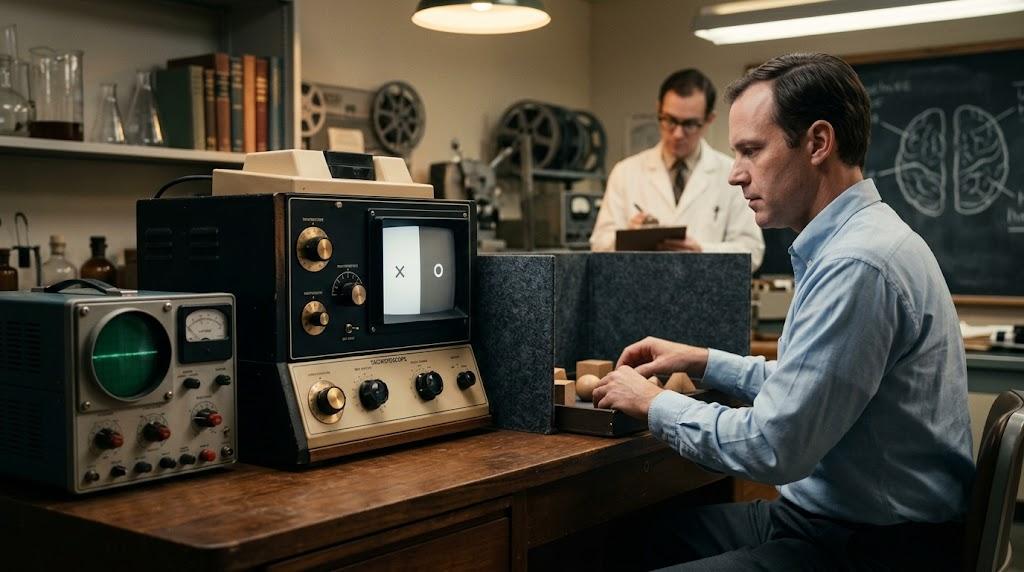
Michael Gazzaniga, who conducted many of these landmark experiments, made a profound discovery that pop culture completely overlooked: the left hemisphere hosts an “interpreter module.” Whenever the right hemisphere acted on information the left side didn’t have access to, the left hemisphere would immediately fabricate a fluent, perfectly logical story to explain the behavior after the fact.

Unfortunately, popular culture took experiments performed on patients whose brains had literally been sliced down the middle and made a wild leap of logic: it assumed that healthy, intact people walk around every day with two independent minds battling for control. Localized functional specializations were stripped of their surgical context, transformed into fictional personality archetypes, and sold to the self-help market.
Are You Left-Brained or Right-Brained? The Whole-Brain Test
Take 3 quick questions to test your problem-solving style and discover why modern neuroscience debunks the hemispheric myth.
When learning a new skill (like an instrument, coding, or language), what is your natural starting point?
The Connectome Verdict: 1,011 Brains, Zero Dominant Halves
If human beings truly belonged to distinct “left-brained” or “right-brained” personality types, modern brain imaging would detect it immediately. Brain scans would look like right-handedness versus left-handedness: analytical individuals would light up predominantly on the left, while artists and poets would cluster heavily on the right.
In 2013, neuroscientist Jared Nielsen and his research team at the University of Utah set out to test this exact claim. Using resting-state functional connectivity MRI (rs-fcMRI), they scanned the brains of 1,011 individuals aged 7 to 29, meticulously mapping 7,266 distinct regions across the entire cerebrum.
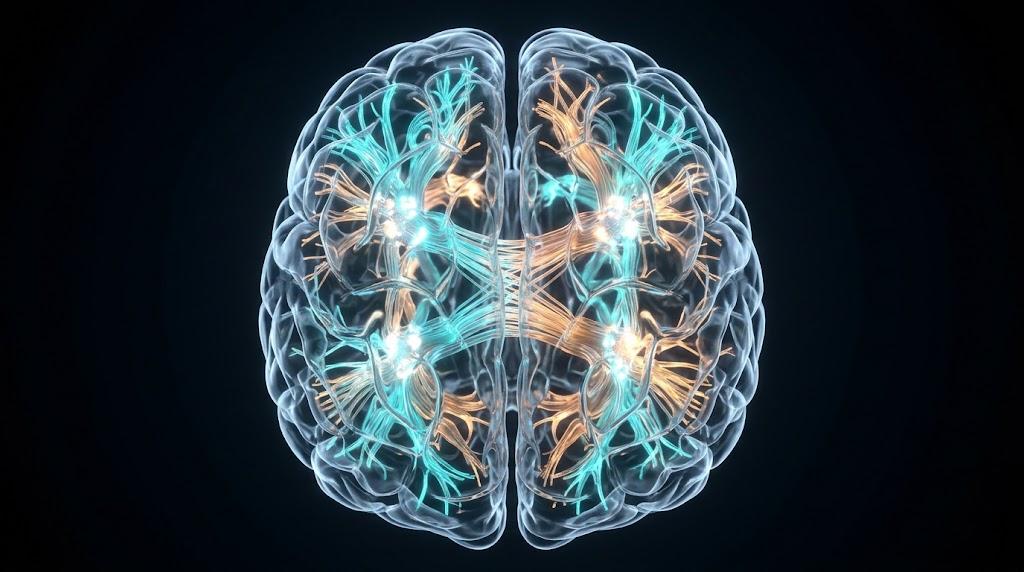
The findings were unequivocal. While the researchers confirmed that specific computational tasks have localized hubs—such as syntax processing leaning toward the left and complex spatial attention leaning toward the right—they found zero evidence that any individual possesses an overall stronger left-sided or right-sided network.
Across more than a thousand human brains, not a single person exhibited global hemispheric dominance. The connectome—the comprehensive wiring map of the human nervous system—revealed that healthy brains operate with dynamic bilateral balance. You do not have a dominant hemisphere that dictates whether you are logical or intuitive; you have an integrated organ that draws on both sides simultaneously for almost every complex task you perform.
What the Corpus Callosum Actually Does
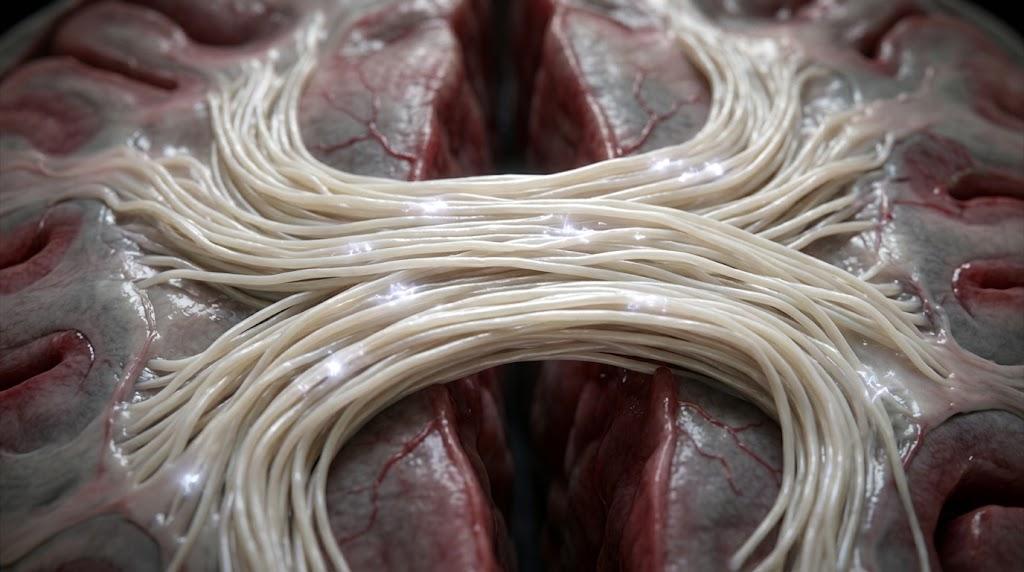
The anatomical architecture of the brain itself refutes the idea of isolation. Linking your two cerebral hemispheres is the corpus callosum—a dense, white-matter super-bridge packed with an astonishing 200 to 250 million nerve fibers.

Research by neuroanatomist Francisco Aboitiz revealed that the vast majority of these callosal fibers are finely calibrated, slowly conducting axons dedicated to continuous, microscopic coordination. Evolutionary neurobiologists suggest that as mammalian brains expanded, the physical distance between distant cortical areas created a conduction delay. Rather than keeping every capability duplicated on both sides, the hemispheres specialized to save metabolic wiring costs, while relying on the callosum to fuse their outputs in real time.
Much of this callosal signaling is actually inhibitory—a process known as transcallosal inhibition. When one hemisphere activates to perform a precise micro-task, it sends rapid inhibitory pulses across the bridge to dampen background noise in the opposing side, allowing both hemispheres to sharpen each other’s performance.
The measurable relay speed—the interhemispheric transfer time (IHTT)—takes just 10 to 20 milliseconds. That is roughly ten times faster than the blink of an eye. Every time you read a sentence, solve a puzzle, or listen to a song, information ricochets across that bridge thousands of times every minute. Calling an intact human being “left-brained” ignores the fact that their hemispheres never stop talking to each other.
The Real Division of Labor: Milliseconds, Not Mysticism
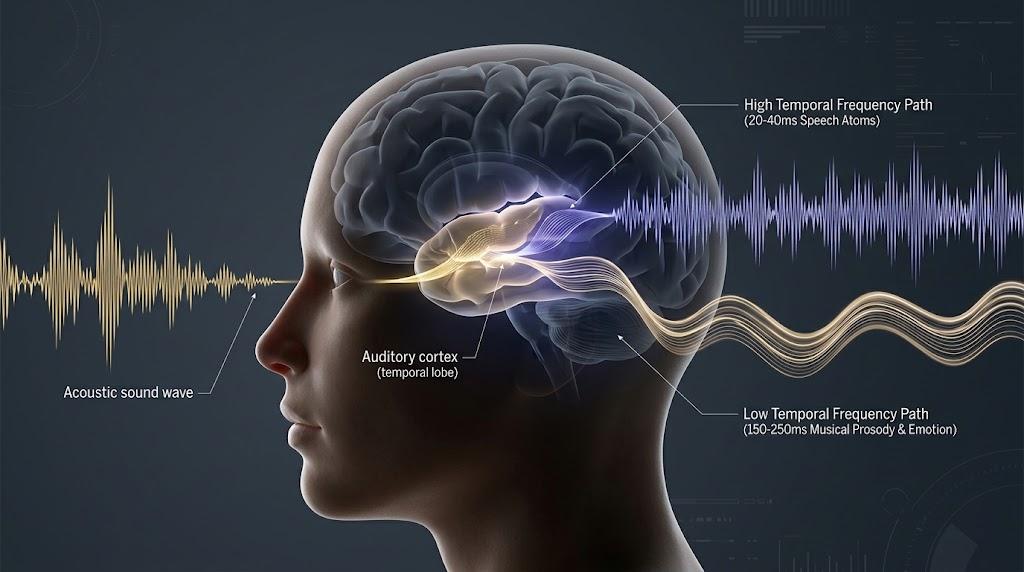
If the hemispheres do not divide along the lines of “logic versus passion,” how do they actually divide their workload? The answer discovered by modern sensory neuroscience is far more elegant: they divide their work by timescales.
Under David Poeppel’s influential Asymmetric Sampling in Time (AST) framework, both hemispheres listen to the exact same sensory stream, but process it through different temporal lenses:
* The Left Hemisphere: Operates at an ultra-fast temporal resolution, sampling signals in narrow windows of 20 to 40 milliseconds. This rapid-fire processing is biologically required to decode phonemes—the micro-units of speech (such as distinguishing the sound of a “b” from a “p”).
* The Right Hemisphere: Operates on a broader timescale, integrating signals over windows of 150 to 250 milliseconds. This slower lens captures syllable structure, musical pitch, emotional prosody, and the cadence of a speaker’s voice.
Imagine listening to someone tell a sarcastic joke. Your left auditory cortex rapidly transcribes the literal grammar and vocabulary of the words, while your right auditory cortex simultaneously decodes the mocking pitch and emotional inflection.
The two banks of auditory cortex function like dual microprocessors running at different clock speeds, stitched together in real time by axonal tracts like the arcuate fasciculus. This same dual stream explains why music gives you goosebumps: while one network maps structural chord progressions, bilateral striatal networks release waves of anticipatory dopamine. Language and music are not rival territories belonging to different sides; they are two complementary resolutions of the exact same experience.
The Creativity Fallacy: Art Runs on Cold Logic Too

Perhaps the most pervasive cultural myth is that creative people are “right-brained,” while analytical people are “left-brained.” In real-world neuroscience, this distinction completely collapses.
High-level creative thinking is not a localized spark; it is a synchronized dialogue between two massive, bilateral brain networks:
1. The Default Mode Network (DMN): Spanning medial structures across both hemispheres, the DMN generates spontaneous associations, retrieves distant memories, and dreams up novel concepts.
2. The Executive Control Network (ECN): Anchored in lateral prefrontal regions across both hemispheres, the ECN acts as a disciplined editorial committee—evaluating spontaneous ideas for usefulness, logic, and aesthetic cohesion.
A landmark study led by Roger Beaty demonstrated that individual creative ability is predicted by how strongly these two networks communicate with each other across both hemispheres. A novelist cannot produce a masterpiece through raw daydreaming alone; they need rigorous analytical faculties to structure chapters, maintain pacing, and prune inconsistencies. Similarly, a mathematician or programmer facing a novel problem relies on creative leaps and visual pattern recognition just as much as formal deductive logic.
Furthermore, translating a creative insight into a finished piece of work requires the goal-directed motivation systems explored in our breakdown of the dopamine detox and the brain’s reward system—bilateral circuits that weigh cognitive effort against anticipated reward. Creativity is not a hemisphere; it is an entire brain in conversation with itself.
Why the Left Brain Right Brain Myth Feels True
If the science is so decisive, why does the dichotomy remain so popular?
The myth survives because it mirrors genuine, everyday psychological sensations. We frequently feel torn between conflicting internal impulses: reason versus impulse, caution versus ambition, planning versus instinct. But pop culture mistakenly mapped those internal struggles to a left-versus-right geography, when the real neurobiology operates along a front-to-back and top-to-bottom axis.
Consider the eerie sensation known as the “call of the void”—standing on a high balcony and feeling a fleeting, terrifying urge to jump. Pop culture might mischaracterize this as a conflict between your logical and emotional halves. In reality, as our analysis of the psychology of the call of the void explores, it is a rapid subcortical alarm signal being arbitrated by midline prefrontal networks.
Similarly, consider the universal experience of walking through a doorway and instantly forgetting what you walked into the room to retrieve. That momentary blankness is not a failure of your “memory hemisphere.” It is an event boundary managed by hippocampal networks, a phenomenon detailed in our exploration of why you forget when entering a room. Human cognition is organized by functional networks and temporal sequences, not by political borders between two halves of the head.
Individual differences certainly exist, but as neuropsychologist Guy Vingerhoets points out, hemispheric lateralization exists on a fluid continuum, not in discrete personality castes. Treating population-level statistical tendencies as fixed personal identities is the fundamental error that spawned the neuromyth.
The Commercial Industry of Neuromyths
The dichotomy escaped the lab and took root in the culture because it was commercially irresistible: it is simple, it flatters the ego, and it promises deep self-knowledge from a five-minute quiz.
Corporate training seminars built an entire industry around this folklore. Descendants of the Myers-Briggs (MBTI) tradition and brain-dominance profiling tools categorized employees into “left-brained analytical planners” and “right-brained creative disruptors,” selling expensive restructuring workshops under the guise of applied neuroscience.
The educational system adopted the myth with equal enthusiasm. Just as the widely debunked “learning styles” theory (visual, auditory, kinesthetic) convinced teachers that students must be taught according to rigid sensory preferences, the left/right dichotomy gave educators a simplistic tool to label children early in life. When researchers surveyed educators across multiple countries, over 90 percent believed that hemispheric dominance explained student learning differences.
Neuromyths sell because they feel actionable: give someone a binary label, and you give them an identity. But as cognitive psychologist Michael Corballis documented, inflating subtle perceptual asymmetries into sweeping doctrines about human personality did real harm, locking people into self-limiting beliefs about what they could and could not achieve.
The Hemispheric Complementarity Matrix
The table below directly contrasts common pop-culture claims with the actual neurobiological mechanisms discovered by modern research. Notice that for every localized specialization, the opposing hemisphere provides an indispensable partner:
| Domain | Popular Cultural Myth | Empirical Left Hemisphere Role | Empirical Right Hemisphere Role | Bilateral Integration Mechanism |
|---|---|---|---|---|
| Language & Speech | “Language is purely left-sided; the right side is silent.” | Drives phonemic decoding, grammar, and rapid syntax processing | Decodes vocal inflection, emotional cadence, and speaker intent | Asymmetric Sampling in Time, coupled via the arcuate fasciculus |
| Mathematical Thinking | “Math is exclusively analytical left-brain property.” | Hosts exact symbolic retrieval and memorized arithmetic facts | Supplies spatial quantity estimation and number-line mapping | Bilateral co-activation across the intraparietal sulcus |
| Spatial Navigation | “Space belongs to the right hemisphere; the left is blind.” | Anchors route sequencing and verbal landmark memory | Excels at global, survey-level environmental mapping | Hippocampal circuits fusing egocentric and allocentric spatial frames |
| Emotional Processing | “Emotions are strictly right-sided and irrational.” | Names, conceptualizes, and regulates conscious emotional states | Reads subtle facial affect and raw autonomic cues | Bilateral fronto-limbic loops balancing approach and withdrawal |
| Creative Insight | “Creativity is right-brained; analytical thinking kills it.” | Structures, refines, and edits raw ideas for coherence | Explores novel, distant associative connections | Synchronized connectivity between bilateral DMN and Executive Control networks |
| Auditory Perception | “Speech is left, music is right, end of story.” | Samples rapid 20–40 millisecond phonetic units | Integrates broader 150–250 millisecond melodic envelopes | Bilateral auditory cortex integration across the corpus callosum |
Across every single cognitive domain, the scientific reality is identical: what pop psychology mistook for two independent minds is actually an ensemble cast of specialists working in seamless harmony.
The Ultimate Proof: The Resilient, Plastic Brain
The most astonishing refutation of the dichotomy comes from medicine’s most dramatic surgical intervention: hemispherectomy.
In rare cases of severe childhood encephalitis or catastrophic seizures, surgeons must physically remove or disconnect an entire cerebral hemisphere. Under the logic of the pop-science myth, removing the left hemisphere should permanently eradicate all logic, language, and grammar forever, while removing the right should destroy all emotional and spatial awareness.
Yet the reality of neuroplasticity is staggering. A systematic review published in Neurology revealed that children who undergo hemispherectomy—even those who lose their entire left hemisphere—frequently develop fluent, functional language, learn to read, tell jokes, and pursue higher education. The remaining hemisphere dynamically reorganizes its neural real estate, building brand-new linguistic and analytical hubs from scratch.
If a single hemisphere can adapt to run an entire human mind, then the personality traits we observe in everyday life cannot possibly be the rigid dictates of a dominant half. They are flexible habits of an integrated network, continually shaped and reshaped by learning, attention, and practice.
Beyond the Dichotomy: Embracing the Whole Mind
The left brain right brain myth asked an understandable question: Why are human brains asymmetrical? But it answered that question with a corporate horoscope.
Modern connectome science offers a far more empowering reality. You are not an accountant trapped in a skull with an artist, nor are you a creative soul perpetually sabotaged by cold logic. Your mind is an integrated super-network of 86 billion neurons, firing across hundreds of millions of callosal bridges every second to turn raw sensory data into conscious experience.
You were never left-brained, and you were never right-brained. Stop using an outdated 1970s myth to set boundaries on who you can become—you possess the entire instrument.
Frequently Asked Questions About the Left Brain Right Brain Myth
Is it true that logical people are left-brained and creative people right-brained?
No. A comprehensive study evaluating 1,011 resting-state fMRI connectomes across 7,266 brain regions found zero individuals with global left- or right-sided dominance. Brain imaging confirms that both logical reasoning and creative problem-solving recruit large-scale, bilateral networks spanning both hemispheres.
What did Roger Sperry’s split-brain research actually show?
Sperry’s work proved that when the corpus callosum is surgically severed to treat severe epilepsy, each hemisphere can process information independently. These experiments revealed localized functional specializations under artificial, surgical conditions. They never demonstrated that healthy people with intact brains operate using a dominant hemisphere.
Where did the left brain right brain idea originate?
The idea emerged from real 1960s split-brain research and genuine functional lateralization, but was distorted by pop psychology, self-help books, and corporate personality tests throughout the 1970s and 1980s. Popular culture stripped away the surgical context, creating two fictional personality types that the scientific evidence never supported.
Can you train one hemisphere of your brain to become dominant?
No, and there is no scientific reason to attempt it. Skill practice strengthens neural networks across both hemispheres simultaneously, reinforcing communication across the corpus callosum. Real cognitive growth comes from integrating analytical discipline with creative exploration, not isolating half of your brain.
Disclaimer
Science & Health Disclaimer: This article is for educational purposes only and does not provide medical, psychological, or educational advice. For questions regarding neurological conditions, development, or cognitive health, always consult qualified healthcare professionals.
References
- Sperry RW. Mental unity following surgical disconnection of the cerebral hemispheres. Harvey Lect. 1966–1967;62:293–323. PMID 4969963
- Gazzaniga MS. Forty-five years of split-brain research and still going strong. Nat Rev Neurosci. 2005;6(8):653–659. PMID 16062172
- Nielsen JA, Zielinski BA, Ferguson MA, Lainhart JE, Anderson JS. An evaluation of the left-brain vs. right-brain hypothesis with resting state functional connectivity magnetic resonance imaging. PLoS One. 2013;8(8):e71275. PMID 23967180
- Aboitiz F, Scheibel AB, Fisher RS, Zaidel E. Fiber composition of the human corpus callosum. Brain Res. 1992;598(1-2):143–153. PMID 1486477
- Ringo JL, Doty RW, Demeter S, Simard PY. Time is of the essence: a conjecture that hemispheric specialization arises from interhemispheric conduction delay. Cereb Cortex. 1994;4(4):331–343. PMID 7950307
- Oderbolz C, Poeppel D, Meyer M. Asymmetric Sampling in Time: Evidence and perspectives. Neurosci Biobehav Rev. 2025;171:106082. PMID 40010659
- Beaty RE, Kenett YN, Christensen AP, Rosenberg MD, Benedek M, Chen Q, et al. Robust prediction of individual creative ability from brain functional connectivity. Proc Natl Acad Sci U S A. 2018;115(5):1087–1092. PMID 29339474
- Corballis MC. Left brain, right brain: facts and fantasies. PLoS Biol. 2014;12(1):e1001767. PMID 24465175
- Dekker S, Lee NC, Howard-Jones P, Jolles J. Neuromyths in education: prevalence and predictors of misconceptions among teachers. Front Psychol. 2012;3:429. PMID 23087664
- Vingerhoets G. Phenotypes in hemispheric functional segregation? Perspectives and challenges. Phys Life Rev. 2019;30:1–18. PMID 31230893
- Nahum AS, Liégeois FJ, Chaminade T, et al. Language after childhood hemispherectomy: a systematic review. Neurology. 2020;95(23):1043–1056. PMID 33087498
📚 You Might Also Like
Hand-picked articles for you


