


It arrives without permission. You are on the bus, half-listening to your playlist, when the singer climbs into the bridge of the song — and suddenly the hair on your arms is standing up. A shiver rolls from your scalp down your spine. The music hasn’t changed the temperature of the world by even one degree, yet your skin has decided it is winter.
Why music gives you goosebumps when nothing is cold? Why the same song that gives you chills leaves your friend unmoved? Those are the two questions this article answers.
This moment has a name: musical frisson — the chill, the thrill, the goosebump response that music can trigger in a large share of listeners. Researchers have called it a skin orgasm: a brief, measurable peak of the same physiological machinery that handles emotion, reward, and threat. And the science behind it explains why music gives you goosebumps at all, why your favorite song produces them and a stranger’s song does not, and why some people go through life never feeling them even once.
Why music gives you goosebumps, why it peaks before the climax even arrives, and why a single pill can switch it off — the answers stack neatly, layer by layer.
Why music gives you goosebumps is a question with a precise, testable answer — and the answer starts on your skin. Let’s open the machinery.

What Happens in Your Body: The Anatomy of a Chill
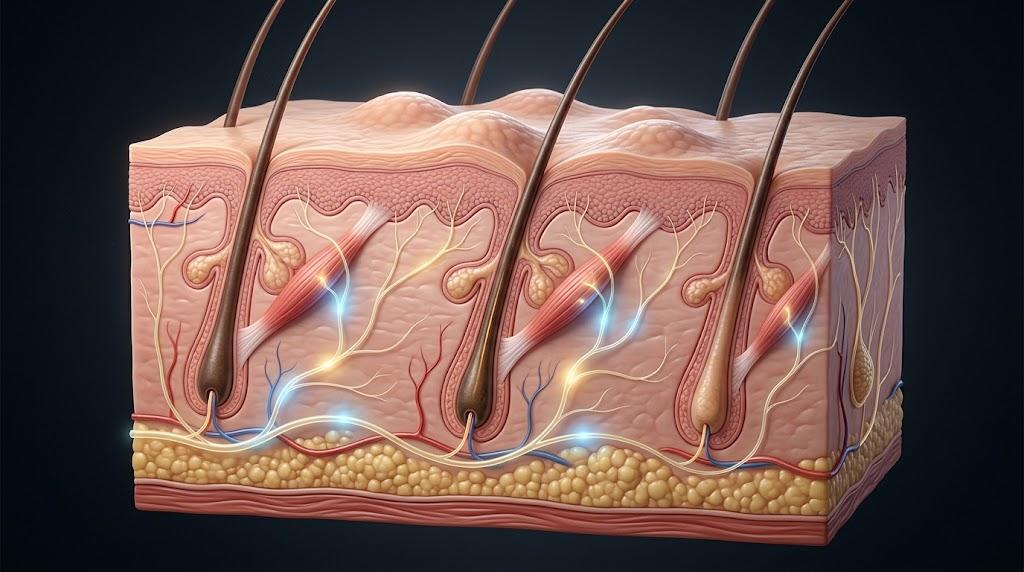
Start with the skin itself, because the phenomenon is literally visible. Goosebumps are the work of the pilomotor reflex: tiny muscles at the base of each hair follicle contract and pull the hairs upright. In cold weather, this traps a layer of insulating air — it is the same reflex that puffs up a frightened cat. It belongs to the sympathetic nervous system, the arousal branch that also speeds your heart and opens your airways.
What makes musical frisson scientifically interesting is that music triggers this cold-weather reflex with no cold anywhere. In a controlled laboratory study, researchers recorded goosebumps, skin conductance, heart rate, and breathing while participants listened to music and watched film clips, and found that piloerection appears specifically at peak emotional moments — a more specific marker of a peak than general arousal measures like skin conductance, which rise during many kinds of intensity (Benedek & Kaernbach, 2011). Your body is not confused about temperature. It is reporting, in the only language skin has, that something important just happened.
That is why the field treats the goosebump not as a quirk but as data. A chill is a timestamped, physical signature of a moment when the brain’s emotional machinery hit its ceiling. Reviewers have grouped chills, shivers, and thrills together as transcendent psychophysiological experiences — one family of peaks, whether triggered by music, awe, or speech (Harrison & Loui, 2014). The question is what music does to hit that ceiling so reliably.

Why music gives you goosebumps, in short, starts here: skin keeping honest score of a peak.
Why do dramatic musical harmonies trigger physical chills and goosebumps in certain listeners?
Why Music Gives You Goosebumps: The Dopamine Machinery
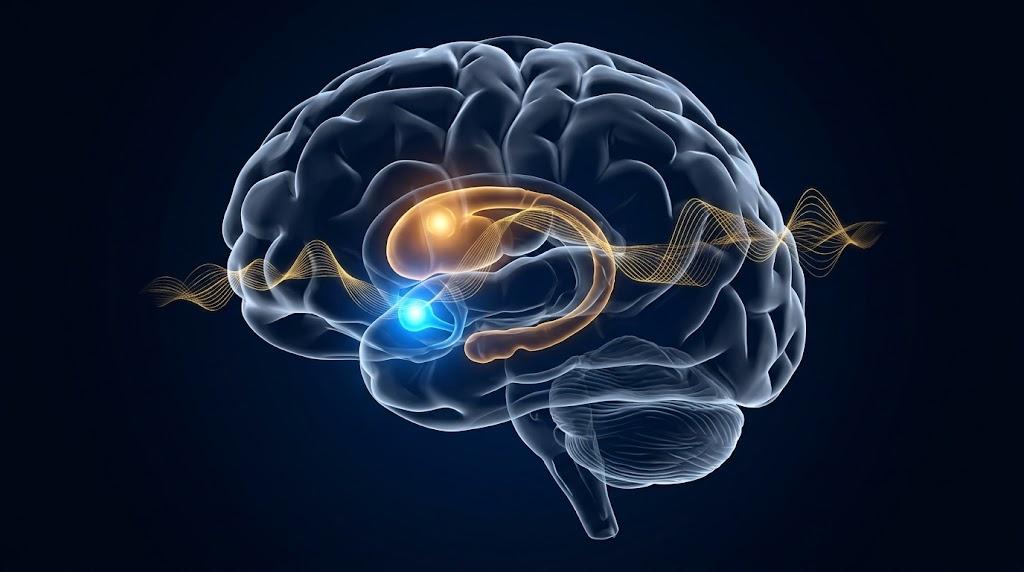
Why music gives you goosebumps? Because the brain treats a favorite song like a reward it can see coming.
The cleanest answer comes from a famous experiment that caught the brain in the act. Researchers scanned listeners with PET imaging while playing them their own chosen chill-music — the songs that reliably produced goosebumps — and found that the chills activated exactly the brain circuitry involved in reward, motivation, and emotion: the ventral striatum including the nucleus accumbens, the amygdala, and regions of the frontal cortex (Blood & Zatorre, 2001). These are the same structures that respond to food, social connection, and other primary rewards. Abstract sound patterns were driving the brain’s deepest pleasure hardware.
That experiment turned “why music gives you goosebumps” from a poetic question into an anatomical one — and the map pointed straight at the reward system.
A follow-up study made the story sharper and stranger. Using PET with a dopamine-specific tracer, researchers showed that dopamine is released in two distinct phases: one surge in the caudate during the anticipation of the musical peak, and a second surge in the nucleus accumbens during the peak itself — with the anticipation peak arriving roughly nine to thirteen seconds before the reported chill (Salimpoor et al., 2011). Read that again: your brain begins secreting reward chemistry before the good part happens. The goosebump is the endpoint of a built-up surge, which is why the best chills arrive after tension has been allowed to simmer.
This is also why the experience feels both automatic and earned. Why music gives you goosebumps is not about the notes alone — it is about a reward system that has learned the song, forms an expectation, rides the suspense, and then cashes in. The same circuitry explains why reward loops can quietly run your habits, and why music is so easy to return to.

Why music gives you goosebumps and why the build-up feels almost as good as the drop — same machinery, two phases.
The Prediction Engine: How Your Brain Gets Ambushed by a Chord Change
So why does music — of all things — own this machinery? The leading answer is prediction. Your brain is a forecast engine that constantly models what comes next, and music is an art form built from patterns the brain can’t help but learn: keys, rhythms, repetitions, and the grammar of tension and release. When a song sets up an expectation and then resolves it — especially with sudden new instrumentation, a key change, or an entrance of the voice — the prediction error and the reward signal fire together. This is the broader principle that expectations quietly filter everything you perceive, and music exploits it with millisecond precision.
The experimental evidence lines up. In detailed listening studies that recorded chills moment by moment, the passages that produced them were consistently climaxes of dynamic and texture: the entry of a new instrument or voice, a sudden increase in loudness, a widening of the sound — followed by resolution (Grewe et al., 2005). Chills behaved as individual emotional peaks — the same piece might produce them at different spots for different listeners, but always at moments of build-and-release (Grewe et al., 2009). And the connection runs in the other direction, too: even complex, sad music can be pleasurable precisely because it is perceived as safe, non-threatening, and aesthetic — a controlled dose of intensity with the danger removed (Sachs, Damasio & Habibi, 2015).
Why music gives you goosebumps, then, is a three-line story: a learned pattern creates suspense, a violation or resolution of that pattern spikes the reward system, and the autonomic nervous system answers with a full-body shiver. Why do some chord changes feel like a held breath finally released? Because that is exactly what they are, chemically.
Why music gives you goosebumps at the drop and not the drone? Because only the drop breaks a prediction.
The Triggers: Suspense, Sudden Sound, and the Human Voice

Why music gives you goosebumps more from some sounds than others? Three culprits keep appearing in the data.
Not all sounds are equally good at this. Across studies, a small set of musical features keeps showing up at the scene of the chill:
- Suspense and dynamics. Long builds, crescendos, and the entry of a big ensemble right after a quiet stretch are among the strongest chill predictors in event-based analyses (Grewe et al., 2005).
- Sudden or deep sounds. Loud, abrupt, or very low sounds recruit ancient auditory reflexes — the brainstem-level reactions that flag anything big and sudden as worth attending to, one of the proposed mechanisms by which music reaches emotion (Juslin & Västfjäll, 2008). This is why a sudden solo after a wall of sound can feel physically startling in a pleasant way.
- The solo human voice. In a study comparing recordings, participants reported significantly more chills when a soprano sang than when the same melody was played by violin — evidence that the timbre of the human voice is a privileged chill-trigger (Nusbaum & Silvia, 2010). A related survey of everyday listening found that moments of swelling dynamics in full-band arrangements predicted frisson best (Colver & El-Alayli, 2016) — one more clue to why music gives you goosebumps most at full-band swells.
Why do music gives you goosebumps moments cluster around voices and build-ups rather than, say, a metronome? Because the triggers that work are the ones your auditory system treats as socially and emotionally alive — a voice, an approach, a reveal. A metronome makes a prediction but never breaks one.
Why Music Gives You Goosebumps — for Some People and Not Others
Here is the twist: the machinery is common, but the goosebumps are not guaranteed. Estimates reviewed in the scientific literature suggest only around half of listeners ever experience music-induced chills at all (Harrison & Loui, 2014). Among those who do, the response varies enormously from person to person — and, famously, from song to song. The strongest personality correlate is openness to experience: people high in openness — reflective, imaginative, aesthetically hungry — report chills more often and more intensely, to the point that researchers have proposed aesthetic chills as a marker of the trait (McCrae, 2007).
That does not make chills a certificate of depth. It means the response depends on what the listener brings: familiarity with a musical style (you need a model to violate), attention (chills fade when you multitask), and even mood and context. Why music gives you goosebumps on a night commute but not in a busy supermarket is the same perceptual principle that decides why your brain can turn silence into phantom sound — the listening brain is an active constructor, not a microphone.
And no, never feeling them is not a diagnosis. It is a personality-and-predictions thing, not a malfunction — one more example of how the same emotional machinery produces very different signatures in different people, from tears of joy to shivers of awe.
Why music gives you goosebumps for them and not for you, then, is a question about predictions and personality — not about who loves music more.
Myth vs. Fact
⚡ Myth vs. Fact
Myth: Music goosebumps are just cold — the room must be chilly.
Fact: Goosebumps are a pilomotor reflex, and laboratory work shows they fire at peak emotional moments with no temperature change — a more specific marker of an emotional peak than skin conductance.
Myth: If you never get chills from music, something is wrong with your emotions.
Fact: Only around half of listeners ever experience them, and the trait of openness plus familiarity with the music strongly shape who does. Their absence is not a disorder.
Myth: Chills mean the song is objectively a masterpiece.
Fact: The response depends on your personal prediction model — your history with the style and the specific song. The same climax can trigger frisson in one listener and nothing in another.
Myth: The goosebump is the reward itself.
Fact: Dopamine actually peaks in anticipation, roughly nine to thirteen seconds before the reported chill — the shiver is the climax, not the whole story.
Myth: Chills are a random, unmeasurable feeling.
Fact: They are timestamped physiological events — piloerection, skin conductance spikes, heart-rate changes — that experiments can predict from musical features like dynamic swells and voice entries.
Myth: You must be a trained musician to feel frisson.
Fact: Why music gives you goosebumps has nothing to do with training — familiarity, attention, and openness do the work.
Can You Turn the Chills On? What the Evidence Suggests

You cannot force a chill — but you can build the conditions that reliably produce it, because every verified ingredient is something you can arrange:
- Learn the pattern first. Familiarity builds the predictive model that the climax will violate. This is why a song’s goosebumps moment often appears on the second or third listen — the brain must know the road before a detour thrills it — the first rule of why music gives you goosebumps.
- Then add the violation. Skip to the moment just before the key change, the dropped beat, the voice entering alone. The contrast between held-back and full-on is the trigger.
- Use volume and attention deliberately. Chills ride on autonomic arousal; quiet-listening under-stimulates, and distraction kills the prediction. Eyes closed, one task, headphones on.
- Try live music. Enormous dynamic range, shared anticipation with a crowd, and real air pressure from a stage — the survey literature points to exactly these ingredients.
Why music gives you goosebumps more with certain rituals is really a question about how deeply songs embed themselves in memory — the same loops that keep a chorus playing in your head also make its climax a landmark your brain has been circling all day.
Why music gives you goosebumps on demand, then, is really a recipe question — and you now hold the recipe.
When Chills Go Missing: What the Chemistry Says
Why music gives you goosebumps — or stops — is a question pharmacology has answered directly.
The strongest proof that this is chemistry rather than mystique comes from studies that blocked it. In a double-blind pharmacology study, enhancing dopamine with levodopa increased listeners’ pleasure and chills ratings, while blocking dopamine receptors with risperidone reduced them — causal evidence that the reward system drives the response (Ferreri et al., 2019). And in a separate double-blind study, the opioid-blocker naltrexone reduced both the pleasure and the frequency of music-induced chills, implicating the brain’s own endorphin system in the shiver (Mallik, Chanda & Levitin, 2017). Naltrexone is prescribed to problem drinkers for a reason; music turns out to touch the same levers.
So if you have a friend who shrugs at the climax of your favorite song, the honest scientific answer is: their reward wiring, their history with the genre, and their openness trait are simply configured differently. Why music gives you goosebumps and not them is no more insulting than why some people love cilantro — variation, not malfunction.
Why music gives you goosebumps, in the end, is chemistry — and chemistry varies between brains.
FAQ: Why Music Gives You Goosebumps
Why music gives you goosebumps is the thread running through every answer below.
Are music goosebumps the same as cold goosebumps?
The reflex is identical — the same pilomotor muscles raise the same hairs. The difference is the trigger: cold, or a peak emotional event. Laboratory work shows music goosebumps occur at emotional peaks with no drop in temperature, which is what makes them a useful window into emotion.
Why music gives you goosebumps only with certain songs?
Because the mechanism is a learned prediction. Your brain needs familiarity with the style and the specific piece to build suspense, and the chill lands when the music resolves or violates it. Songs without a personally meaningful climax — or genres you have no model for — rarely produce them.
Why music gives you goosebumps, but some people never get them — is that normal?
Yes. Reviews estimate roughly half of listeners never experience music-induced chills. Lower openness to experience, less familiarity with the style, and divided attention all reduce the odds. It is not a disorder and says nothing about your ability to love music.
Why music gives you goosebumps more with the human voice — is that proven?
The timbre effect is supported experimentally: a soprano voice produced more chills than a violin playing the same melody, and everyday-listening surveys implicate swelling vocal-and-band climaxes. The voice appears to be a privileged trigger for the emotional system.
Do goosebumps mean the music is objectively great?
No. They mean the music produced a strong prediction-and-reward event in you. The same passage can chill one listener and bore another, which is why reviews treat frisson as an individual emotional peak rather than a quality stamp.
Where do the chills happen in the brain?
PET studies show activation in the reward circuitry — ventral striatum and nucleus accumbens — plus emotion structures like the amygdala, with dopamine released in distinct anticipation and peak phases. In short: the pleasure hardware, not the hearing hardware alone.
Can medication really change music chills?
Yes. Double-blind studies found that a dopamine booster (levodopa) increased pleasure and chills, a dopamine blocker (risperidone) reduced them, and the opioid-blocker naltrexone blunted both chills and pleasure. The chemistry is causally involved.
Is musical frisson the same as ASMR?
No. Frisson is a brief, high-arousal peak — a shiver with a fast rise and fall tied to a musical event. ASMR is typically slower, tingling, and calming. Many people experience only one of the two, and the research literature treats them as distinct phenomena.
Why music gives you goosebumps and tears at the same time?
Both are autonomic outputs of the same peak state — the systems governing piloerection, tears, and heart rate rise together at emotional maxima. That overlap is why moments of frisson and moments of sudden tears often arrive in the same verse.
Why music gives you goosebumps more often — can you train it?
Indirectly, yes: know the piece, listen with full attention, use good volume and headphones, and aim at the moment just before a big resolution. You are engineering the ingredients studies identify — suspense, violation, and attention — not the shiver itself.
Why Music Gives You Goosebumps: The Bottom Line
The goosebump is a small miracle of translation. Sound — vibrating air — becomes suspense in a forecasting brain, suspense becomes dopamine, and dopamine arrives at the skin as a shiver your ancestors evolved for cold and fear. Musicians discovered, centuries before the neuroscience, exactly where the levers were: the held note, the key change, the lone voice after the silence.
Why music gives you goosebumps is, finally, a story about being a prediction machine that can be moved by patterns — and about the strange luck that the same reflex that puffs a cat in the rain can also mark the exact second a chorus lifts you. Why music gives you goosebumps has been answered above; what remains is the pleasure of feeling it happen. When it happens, you are not hearing the music. You are feeling your own brain agree with it.
References and Sources
- Blood, A. J., & Zatorre, R. J. (2001). “Intensely pleasurable responses to music correlate with activity in brain regions implicated in reward and emotion.” PNAS, 98(20), 11818–11823. PubMed (PMID: 11573015) — verified; source of the PET findings linking chills to reward and emotion circuitry.
- Salimpoor, V. N., Benovoy, M., Larcher, K., Dagher, A., & Zatorre, R. J. (2011). “Anatomically distinct dopamine release during anticipation and experience of peak emotion to music.” Nature Neuroscience, 14(2), 257–262. PubMed (PMID: 21217764) — verified; source of the two-phase dopamine finding and the ~9–13 s anticipation window.
- Benedek, M., & Kaernbach, C. (2011). “Physiological correlates and emotional specificity of human piloerection.” Biological Psychology, 86(1), 44–51. PubMed (PMID: 21276827) — verified; source of goosebumps as a specific marker of peak emotional moments.
- Grewe, O., Nagel, F., Kopiez, R., & Altenmüller, E. (2005). “How does music arouse ‘chills’?” Annals of the New York Academy of Sciences, 1060, 446–449. PubMed (PMID: 16597800) — verified; source of event-based chill triggers (build-ups, voice entries).
- Grewe, O., Kopiez, R., & Altenmüller, E. (2009). “Chills as an indicator of individual emotional peaks.” Annals of the New York Academy of Sciences, 1169, 351–354. PubMed (PMID: 19673806) — verified; source of the individual-peak interpretation.
- Juslin, P. N., & Västfjäll, D. (2008). “Emotional responses to music: The need to consider underlying mechanisms.” Behavioral and Brain Sciences, 31(5), 559–575. PubMed (PMID: 18826699) — verified; source of the mechanism framework including brainstem reflexes and evaluative conditioning.
- Nusbaum, E. C., & Silvia, P. J. (2010). “Shivers and timbres: Personality and the experience of chills from music.” Social Psychological and Personality Science, 2(2), 152–159. doi:10.1177/1948550610386810 — verified via Crossref; source of the soprano-vs-violin chill finding and openness correlation.
- McCrae, R. R. (2007). “Aesthetic chills as a universal marker of openness to experience.” Motivation and Emotion, 31(1), 5–15. doi:10.1007/s11031-007-9053-1 — verified via Crossref.
- Colver, M. C., & El-Alayli, A. (2016). “Getting aesthetic chills from music: The connection between openness to experience and frisson.” Psychology of Music, 44(3), 413–427. doi:10.1177/0305735615572358 — verified via Crossref; source of the big-band-dynamics chill predictor.
- Harrison, L., & Loui, P. (2014). “Thrills, chills, frissons, and skin orgasms: Toward an integrative model of transcendent psychophysiological experiences in music.” Frontiers in Psychology, 5:790. doi:10.3389/fpsyg.2014.00790 — verified via Crossref; source of the “skin orgasm” framing and the prevalence estimate.
- Ferreri, L., Mas-Herrero, E., Zatorre, R. J., et al. (2019). “Dopamine modulates the reward experiences elicited by music.” PNAS, 116(9), 3776–3781. PubMed (PMID: 30670642) — verified; double-blind levodopa/risperidone pharmacology study.
- Mallik, A., Chanda, M. L., & Levitin, D. J. (2017). “Anhedonia to music and mu-opioids: Evidence from the administration of naltrexone.” Scientific Reports, 7, 41952. PubMed (PMID: 28196062) — verified; source of the naltrexone chill-suppression finding.
Disclaimer
By Aly ElDeeb — Science Writer & Literature Researcher | 📚 Fact-Checked & Sourced from Peer-Reviewed Studies
📚 You Might Also Like
Hand-picked articles for you


