


You look up from your desk. The task you sat down to at nine o’clock is almost finished — and somehow the clock says one. Your coffee is cold. You never heard the phone, never noticed the construction outside the window, never felt the hours pass. Hours that usually crawl by went somewhere else entirely, and you were not there to watch them go.
Athletes call it being in the zone. Musicians call it losing themselves in the music. Psychologists call it the flow state — and it is not a metaphor, a mood, or a motivational poster. It is a measurable state of the brain and body, with a signature your heart can show and a brain scan can see.
The flow state is your brain’s peak performance mode: a condition in which attention locks onto one task so completely that self-awareness, distraction, and even the sense of time get switched down to make room for the work.
Let’s follow the science of the flow state into the zone — what it actually is, what your brain and heart do during it, why time disappears, why you can’t force it, and how to give your brain its best shot at finding it.
What Is the Flow State, Exactly?

The concept was named and mapped by psychologist Mihaly Csikszentmihalyi, starting with his 1975 book Beyond Boredom and Anxiety. He studied artists, climbers, chess players, and surgeons — people who kept describing the same paradox: hours of hard, effortful work that felt effortless. When he asked what the experience felt like, the same elements kept recurring, and eventually they became the scientific definition of the flow state.

The classic profile looks like this:
- Complete concentration on the task at hand.
- Merging of action and awareness — you stop feeling like a separate observer of the work.
- Loss of self-consciousness — the inner commentator goes quiet.
- A distorted sense of time — hours pass like minutes.
- A sense of control over what you’re doing.
- Immediate feedback — you can tell, moment to moment, how it’s going.
- Autotelic quality — the activity becomes rewarding in itself; you’d do it even if nobody paid you.
Two conditions have to hold for the flow state to switch on. First, the challenge–skill balance: the task must be hard enough to demand everything you have, but not harder. Second, a clear goal and immediate feedback — the brain needs to know what winning looks like and whether you just did it.
If the challenge is too low for your skill, you get boredom. If it’s too high, you get anxiety and overload. The flow state lives on the razor’s edge between the two — which is exactly what makes it possible to study in a laboratory.

“Being in a deep flow state means your brain is supercharged and operating at 100% full conscious capacity.”
Neuroimaging proves flow is actually 'transient hypofrontality': the dorsolateral prefrontal cortex temporarily powers down, quieting self-criticism and time-perception to enable pure automatic execution.
Proof It’s Real: The Experiment That Puts People in Flow on Demand
The flow state sounds like the kind of thing that only happens by accident. So how do you study it scientifically? A team at the University of Ulm in Germany solved the problem with something unexpectedly ordinary: arithmetic.
In a 2014 study published in NeuroImage, Martin Ulrich, Johannes Keller, and Georg Grön gave participants mental arithmetic tasks whose difficulty was adjusted continuously and automatically to each person’s skill level. When the difficulty sat at that perfect personal edge, people reported the full flow state profile — deep involvement, enjoyment, intrinsic motivation, the feeling that demands and skills matched. When the tasks were too easy, they reported boredom. Too hard, overload. The researchers had built a machine for producing the flow state on demand.
Then they scanned the participants’ brains while it happened — and this is where the story gets interesting.
Inside the Zone: What Brain Scans Show About the Flow State
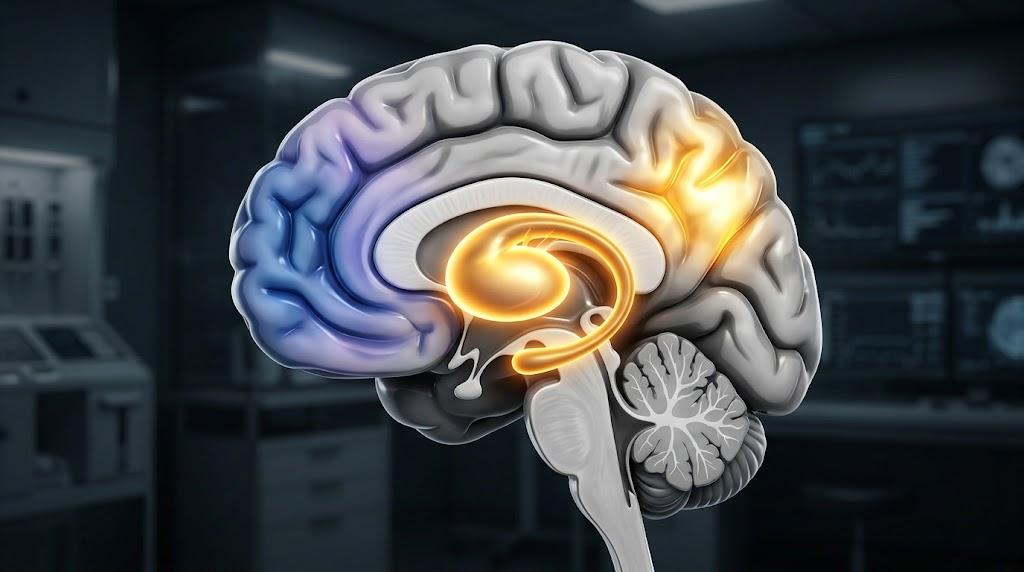
During the flow condition, two opposite patterns appeared at once.
Some regions worked harder. Blood flow increased in the left inferior frontal gyrus (a hub for cognitive control — keeping the task on track) and the left basal ganglia (deep structures involved in reward and predicting good outcomes). The researchers read this as the brain’s machinery of control and reward coding a high chance of success.
Other regions went quiet. Activity decreased in the medial prefrontal cortex — a core node of the brain’s default mode network, the system most active during self-referential thought: thinking about yourself, replaying the past, rehearsing the future. Parts of the amygdala, heavily involved in negative emotion, also quieted down.

The interpretation is elegant: the quieting of the self-referential network is the neural version of one of the flow state’s defining features — the loss of self-consciousness. You don’t feel like you disappeared because you’re imagining it; the brain region that constructs the observing self is literally running at lower volume. A 2016 follow-up from the same group replicated the pattern with standard fMRI and added the anterior insula, the midbrain, and more of the basal ganglia to the picture — regions tied to salience, attention, and reward.
Electroencephalography studies add a third layer. In a 2018 EEG experiment, researchers measured brain waves during the same boredom–flow–overload arithmetic design and found that the flow state combined increased frontal theta activity — a rhythm associated with focused cognitive control and immersion — with moderate alpha activity, suggesting working memory was loaded but not overloaded. The flow state, electrically, is a very particular cocktail: total engagement without strain.
And brain scanning has even caught flow happening between people: in a 2021 study, pairs cooperating on a music game showed the strongest interbrain synchrony — aligned neural activity across two skulls — when they were in team flow together.
Transient Hypofrontality: Why Time Disappears When You Are in the Zone
So why does the clock vanish? The leading explanation comes from a hypothesis proposed by neuroscientist Arne Dietrich in 2003, called transient hypofrontality — literally, “temporary below-normal frontal lobe functioning.”
Your prefrontal cortex is the seat of the brain’s most expensive programs: self-monitoring, planning far ahead, worrying about outcomes — and keeping track of time. These processes are flexible and powerful, but they are slow and metabolically costly. Dietrich’s proposal: during intense, well-practiced activity, the brain downregulates exactly these expensive frontal processes and reallocates resources to the circuits doing the actual work.
Apply that to the flow state and everything falls into place. The sense of self fades (self-monitoring is offline). Worries go silent (they are prefrontal productions). And time dissolves because tracking elapsed time is itself a frontal, resource-hungry computation. Your brain hasn’t stopped counting the seconds because it’s broken — it has stopped because the seconds stopped mattering. Every cycle spent watching the clock is a cycle stolen from the task, so in flow the clock-watcher gets furloughed.
Importantly, this is the same temporary reorganization that researchers describe in other absorbed states — including lucid dreaming, where parts of the frontal control system also step in and out of the picture. Absorption changes the brain’s allocation of resources, whether the absorber is a task or a dream.
Your Heart Knows Too: The Body’s Signature of Flow

The flow state is not only in the head. In 2010, researchers in Sweden had professional classical pianists play the same piece five times while measuring their physiology, then rate their flow after each repetition. The results were striking: the more flow the pianists reported, the more their bodies showed a distinctive pattern — relaxed muscles, deeper respiration, a longer heart period (slower heart rate) alongside higher blood pressure, and changes in heart rate variability.
That combination is unusual. Many intense states push heart rate and blood pressure in the same direction. The flow state looks more like a state of energized calm — high engagement, low strain — which is why researchers have described it as a form of “effortless attention” built from an interaction between positive affect and high attention.
The body also provides the short-term reward. Flow states are accompanied by increased electrodermal activity — a marker of heightened autonomic arousal, visible even in the short blocks of the Ulm laboratory experiments — and researchers have proposed that flow functions as an intrinsic reward signal that makes an activity worth returning to. That’s part of why flow-prone people practice more, and why flow keeps pulling you back to difficult things.
The Reward Trap: Why Flow Can Also Keep You Hooked
That reward mechanism explains something paradoxical about the flow state: the same property that makes it wonderful makes it exploitable. Game designers understand the flow channel intuitively — difficulty that rises to meet your skill, immediate feedback, clear goals — and they tune it deliberately. That’s why certain loops are so hard to step out of: a well-designed game is a flow machine, and your brain’s control and reward circuits will happily take the deal it offers.
The difference between productive flow and a wasted evening is rarely the state itself — it’s what you’re in flow with. The neural signature doesn’t care whether you’re debugging code or matching candies.
What Flow Is Not
Because the word gets thrown around, it’s worth clearing the ground. The flow state is not relaxation — relaxation lowers arousal and lets attention wander; flow is deep attention with arousal, and the physiology shows it. It is not the same as pleasure, and it is not simply happiness — although people in flow report the experience as highly pleasant, self-referential worry (which correlates with unhappiness) is precisely what’s switched down.
It’s also not a trance. In a trance, responsiveness to the world narrows and control passes inward; in the flow state, you are continuously reading feedback from the task and adjusting with millisecond precision. And it is not luck, talent, or a personality upgrade — it’s a state that certain conditions reliably produce, in most brains, most of the time those conditions hold. If flow sometimes seems to visit other people more often, part of the difference is simply that their work is better shaped for it — a pattern familiar from how fragile focus is in the first place.
How to Enter the Flow State: What the Conditions Actually Require
Because the flow state is produced by conditions rather than willpower, the practical recipe is to engineer the conditions. Every item below maps onto the verified profile:
- Set the challenge just above your comfort zone. Too easy is boredom; too hard is overload; the edge is the target. If a task feels flat, add a constraint — a shorter deadline, a harder variant, one fewer tool. If it feels terrifying, shrink it.
- Define the goal narrowly, then get feedback fast. “Work on the novel” is fog; “finish this scene” is a goal. Break work until the finish line is visible, and pick tasks that tell you immediately how you’re doing.
- Remove interruption before you start, not during. The flow state takes time to build and seconds to destroy — each interruption resets the attentional ramp. Notifications off, phone in another room, one tab.
- Give it a runway. Deep engagement builds gradually; the first minutes of any session are the toll booth. Protect a block long enough for the ramp to complete — the last hour of a two-hour block is where flow lives.
- Warm up with the easiest possible version of the task. Starting is the highest-friction moment; trick the brain past it with a trivially small first step.
- Match the work to your best hours. The flow state depends on attention systems that fluctuate through the day. Put your hardest, most skill-demanding work where your attention is strongest, and use low hours for low-stakes tasks.
- Don’t chase the feeling. The paradox of the flow state is that monitoring yourself for flow reactivates the self-referential network that flow quiets. Aim at the conditions; the state follows.
Notice what’s missing from this list: no special music, no supplements, no rituals. The verified conditions are challenge, clarity, feedback, and undisturbed time. Everything else is decoration.
Can You Have Too Much Flow?
A quiet concern among researchers: a state this pleasant, this quieting of self-awareness, is a state you might not want to leave. The risk is not addiction in the clinical sense — it’s misallocation. Flow feels best when challenge meets skill, which means it’s easiest to find in the work you’re already good at. The unfinished, awkward, high-friction work that would most grow your skills is precisely the work least likely to produce flow — and a brain that chases the flow state can end up avoiding it.
The practical guardrail: treat the flow state as fuel for chosen goals, not as the goal itself. Check afterward what the absorption was actually for. If the answer is “the thing I decided mattered,” excellent. If it’s “level 47,” you’ve found the difference between the state and its use — the same distinction that separates restorative habits from the mental cost of constant stimulation.
Myth vs. Fact
⚡ Myth vs. Fact
Myth: The flow state is a vague feeling that can’t be measured.
Fact: It has a measurable profile in both body and brain: specific changes in heart period, blood pressure, and electrodermal activity, plus reproducible fMRI and EEG signatures in lab experiments.
Myth: The flow state means your whole brain goes into overdrive.
Fact: Brain-imaging studies show both increases and decreases: control and reward regions work harder, while self-referential regions — including the medial prefrontal cortex — quiet down.
Myth: Time distortion in flow is just a memory illusion.
Fact: Timing and time estimation are frontally mediated, resource-hungry processes; the transient hypofrontality account explains why they are among the first things to be downregulated during absorbed states.
Myth: The flow state is the same as being relaxed.
Fact: Flow involves heightened autonomic arousal — increased electrodermal activity and elevated blood pressure — alongside relaxed muscles. It is energized calm, not rest.
Myth: You can force the flow state through willpower.
Fact: Monitoring yourself for flow reengages exactly the self-referential circuitry that flow reduces. You can only set the conditions — challenge, goals, feedback, undisturbed time — and let the state arrive.
Myth: The flow state is always good and more is always better.
Fact: Flow rewards whatever activity produces it, productive or not; and chasing the feeling can pull you toward comfortable, familiar challenges instead of the difficult work that actually grows skill.
Myth: The flow state is pseudoscience.
Fact: It is an active research area in psychology and neuroscience, with a systematic review of its neural basis published in 2022, dedicated experimental paradigms that induce flow on demand — and even brain-stimulation experiments: applying transcranial direct current stimulation to the medial prefrontal cortex during a flow task measurably changed both the blood-flow signature and the subjective intensity of the experience.
Frequently Asked Questions About the Flow State
What is the flow state?
The flow state is a condition of complete absorption in a task, defined by deep focus, merging of action and awareness, loss of self-consciousness, distorted time perception, and the feeling that the activity is rewarding in itself. It arises when a challenging task is matched to your skill level and provides clear goals and immediate feedback.
What happens in the brain during flow?
Neuroimaging studies show a split pattern: increased activation in regions of cognitive control and reward — the inferior frontal gyrus and basal ganglia — alongside decreased activation in self-referential regions, including the medial prefrontal cortex and parts of the amygdala. EEG studies find increased frontal theta together with moderate alpha activity, a signature of full engagement without excessive strain.
Why does time disappear when you are in the zone?
Keeping track of elapsed time is an expensive, frontally mediated process. According to the transient hypofrontality hypothesis, absorbed states downregulate exactly these costly prefrontal programs to free resources for the task — so the sense of time passing is among the first things to fade.
What triggers the flow state?
The verified triggers are conditions, not tricks: a challenge–skill balance sitting at the edge of your ability, a clear goal, immediate feedback, and a stretch of undisturbed time long enough for deep engagement to build. Laboratory studies induce the flow state by continuously adjusting task difficulty to the individual’s skill level.
Can you force yourself into the flow state?
Not directly. Self-monitoring for the flow state reactivates the self-referential circuitry that flow quiets down. What you can do is engineer the conditions — right difficulty, clear goals, fast feedback, no interruptions — and the state tends to follow.
How long does the flow state last?
Research experiments typically sustain flow for blocks of minutes; in everyday work, episodes often run from roughly half an hour to a few hours. It ends predictably with interruption, fatigue, or the moment the challenge stops matching your skill.
Is the flow state good for you?
In moderation, it is one of the most rewarding states a brain can produce and a strong predictor of enjoyment and continued practice. The caveats are allocation and balance: the flow state rewards whatever produces it — productive or not — and a life that only chases flow can drift toward familiar, comfortable challenges rather than growth.
Is flow the same as hyperfocus?
They overlap but are not identical. Hyperfocus, discussed especially in ADHD, can involve deep absorption but is often harder to steer and can persist past the point of usefulness. Flow is typically self-terminating when conditions change and is accompanied by positive affect and a sense of control.
What is transient hypofrontality?
A hypothesis proposed by neuroscientist Arne Dietrich in 2003: during intense, well-matched activity, the brain temporarily downregulates prefrontal processes — self-monitoring, time tracking, rumination — reallocating resources to the circuits doing the work. It explains the flow state’s signature experiences: loss of self-consciousness and vanished time.
How is the flow state measured scientifically?
Three ways, often combined: validated self-report questionnaires administered after tasks; physiology — heart period, blood pressure, heart rate variability, and electrodermal activity; and brain measures — fMRI and EEG signatures captured while people perform difficulty-tuned tasks designed to induce flow.
The Bottom Line: What the Flow State Reveals About the Brain
For most of the twentieth century, the flow state was a story athletes told and psychologists filed under “subjective experience.” It has since earned harder evidence: a laboratory paradigm that switches it on with arithmetic, a physiological signature in the heart and skin, fMRI showing the self-referential network dimming while control and reward circuits brighten, EEG showing engagement without strain, and a coherent mechanistic account — transient hypofrontality — for its strangest gift: the disappearance of time.
Perhaps the most human part is what the science implies. Your brain is a timekeeping, self-monitoring, worry-generating machine — and it is willing to switch all of that off, voluntarily, whenever you give it work hard enough to deserve every cycle it has. The flow state is not the brain malfunctioning. It is the brain negotiating: give me a task worth everything, and I’ll forget everything else.
The zone isn’t a place your brain can’t find. It’s a deal your brain is always ready to make.
References and Sources
- Ulrich, M., Keller, J., Hoenig, K., Waller, C., & Grön, G. (2014). “Neural correlates of experimentally induced flow experiences.” NeuroImage, 86, 194–202. PubMed (PMID: 23959200) — verified; source of the arithmetic flow paradigm, the increased rCBF in the left inferior frontal gyrus and basal ganglia, the decreased rCBF in the medial prefrontal cortex, angular gyri and amygdala, and the self-referential-processing interpretation.
- Ulrich, M., Keller, J., & Grön, G. (2016). “Neural signatures of experimentally induced flow experiences identified in a typical fMRI block design with BOLD imaging.” Social Cognitive and Affective Neuroscience, 11(3), 496–507. PubMed (PMID: 26508774) — verified; source of the BOLD replication (23 participants, 30-second blocks), the anterior insula / inferior frontal gyri / basal ganglia / midbrain activation, the medial prefrontal, posterior cingulate and medial temporal lobe (amygdala) decreases, and the electrodermal activity findings.
- Dietrich, A. (2003). “Functional neuroanatomy of altered states of consciousness: The transient hypofrontality hypothesis.” Consciousness and Cognition, 12(2), 231–256. PubMed (PMID: 12763007) — verified; source of the transient hypofrontality hypothesis used to explain the downregulation of self-monitoring and timekeeping during absorbed states.
- Katahira, K., Yamazaki, Y., Yamaoka, C., Ozaki, H., Nakagawa, S., & Nagata, N. (2018). “EEG correlates of the flow state: A combination of increased frontal theta and moderate frontocentral alpha rhythm in the mental arithmetic task.” Frontiers in Psychology, 9, 300. PubMed (PMID: 29593605) — verified; source of the increased frontal theta plus moderate alpha characterization and the working-memory-load interpretation.
- de Manzano, Ö., Theorell, T., Harmat, L., & Ullén, F. (2010). “The psychophysiology of flow during piano playing.” Emotion, 10(3), 301–311. PubMed (PMID: 20515220) — verified; source of the pianist study (five repetitions, measured physiology) and the significant relation between flow and heart period, blood pressure, heart rate variability, zygomaticus activity, and respiratory depth.
- Shehata, M., Cheng, M., Leung, A., et al. (2021). “Team flow is a unique brain state associated with enhanced information integration and interbrain synchrony.” eNeuro, 8(5). PubMed (PMID: 34607804) — verified; source of the enhanced interbrain synchrony during team flow while playing a music game.
- Alameda, C., Sanabria, D., & Ciria, L. F. (2022). “The brain in flow: A systematic review on the neural basis of the flow state.” Cortex, 154, 348–364. PubMed (PMID: 35926367) — verified; systematic review used for the claim that flow’s neural basis is an active research area.
- van der Linden, D., Tops, M., & Bakker, A. B. (2021). “Go with the flow: A neuroscientific view on being fully engaged.” European Journal of Neuroscience, 53(4), 947–963. PubMed (PMID: 33084102) — verified; source of the network-based model: dopaminergic and noradrenergic motivation systems interacting with the default mode, salience, and central executive networks.
- Ulrich, M., Niemann, J., Boland, M., Kammer, T., Niemann, F., & Grön, G. (2018). “The neural correlates of flow experience explored with transcranial direct current stimulation.” Experimental Brain Research, 236(12), 3223–3237. PubMed (PMID: 30209517) — verified; source of the causal evidence that the medial prefrontal cortex mediates the flow experience (tDCS during the perfusion-imaged flow paradigm, 22 participants), and of the tDCS claim in the Myth vs. Fact section.
- Csikszentmihalyi, M. (1975). Beyond Boredom and Anxiety: Experiencing Flow in Work and Play. San Francisco: Jossey-Bass. — verified; the original research and theoretical model of the flow experience, source of the defining elements and the challenge–skill balance.
Disclaimer
By Aly ElDeeb — Science Writer & Literature Researcher | 📚 Fact-Checked & Sourced from Peer-Reviewed Studies
📚 You Might Also Like
Hand-picked articles for you


