


Why body jerks when falling asleep is one of the most common — and least understood — experiences in human sleep. You’re drifting off. Your muscles are relaxing, your thoughts are slowing — and then, suddenly, your whole body jolts as if you’ve just tripped off a curb. Your heart pounds. You’re wide awake again.
If you’ve ever experienced this, you’ve had a hypnic jerk — and understanding why body jerks when falling asleep turns out to reveal something remarkable about how the brain manages the transition into unconsciousness.
This article explains exactly what happens during a hypnic jerk, why some people experience them far more violently than others, what the latest neuroscience says about their purpose — and when they stop being just a strange curiosity and start being a signal worth paying attention to.
What Is a Hypnic Jerk?
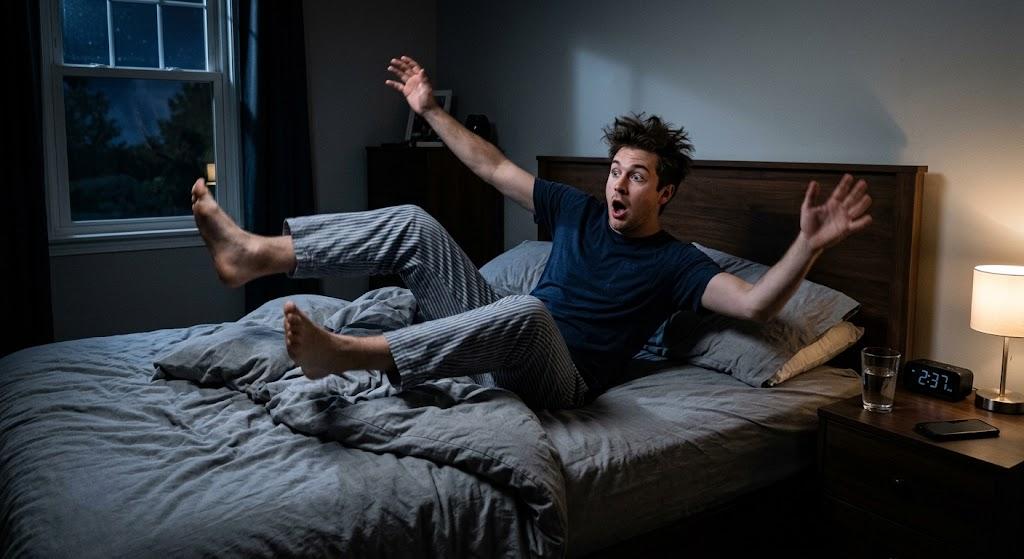
A hypnic jerk (also called a sleep start, hypnagogic jerk, or myoclonus) is an involuntary muscle contraction that occurs during the transition between wakefulness and sleep. It typically affects the entire body at once — arms, legs, torso — with a sudden, sharp movement that often snaps you back to full wakefulness.
They are extraordinarily common. Research estimates that 60–70% of all people experience hypnic jerks regularly, making them one of the most widespread neurological phenomena in human experience. Yet most people have never been told why it happens — because for a long time, science wasn’t entirely sure.

Hypnic jerks typically occur during what is called hypnagogia — the transitional state between full wakefulness and sleep. It’s the period when you start to see fragmented images, when sounds begin to distort, and when the sense of your own body begins to fade. It is, in neurological terms, a genuinely strange few minutes that the brain navigates differently every night.
“The sudden violent twitch when falling asleep means your heart stopped or your soul detached.”
It is a benign physiological reflex called a Hypnic Jerk. As motor inhibition sets in, your descending reticular activating system misinterprets muscle relaxation as a free-fall from a tree branch, firing a protective motor spasm!
Why Body Jerks When Falling Asleep — The Brain Science
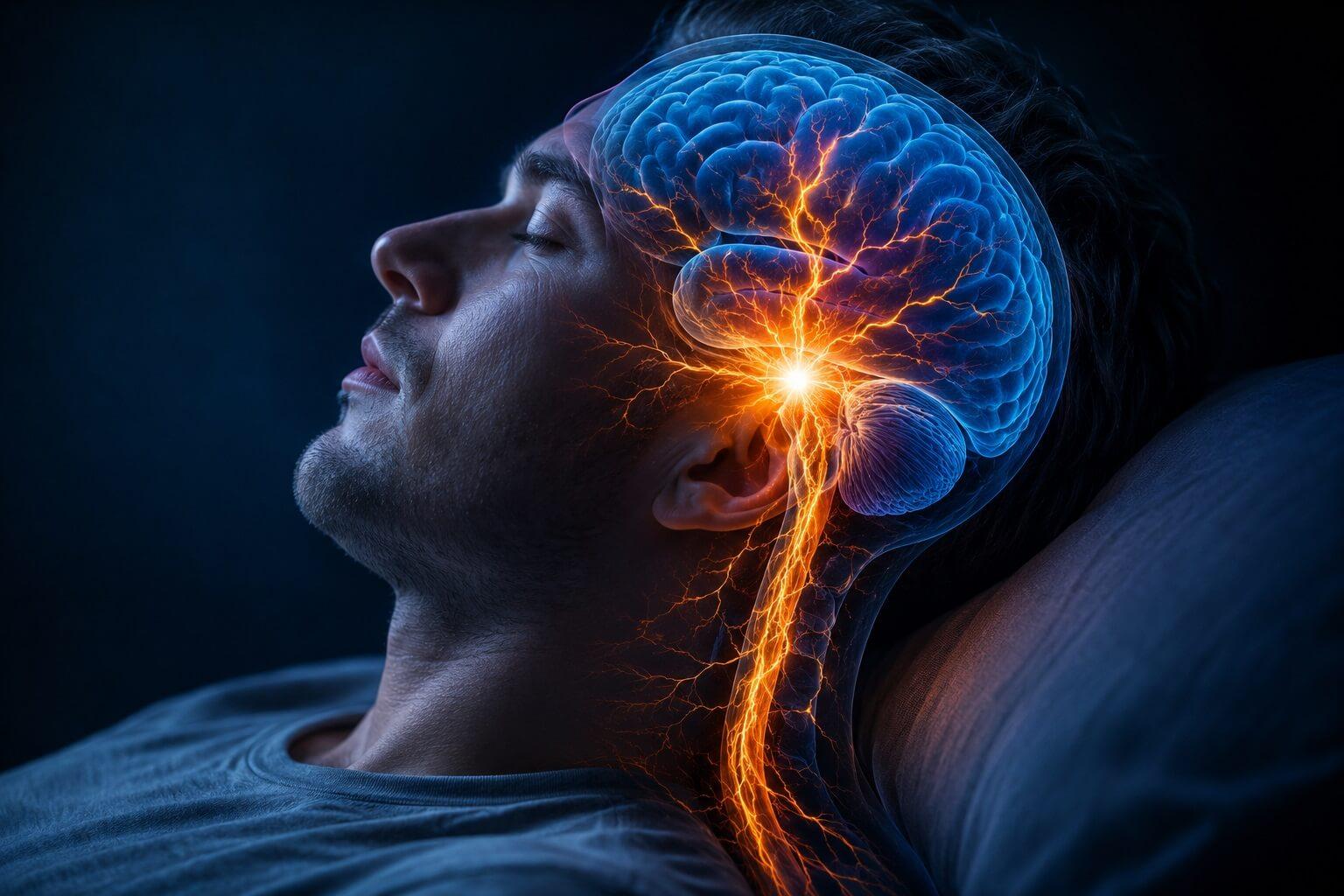
The most widely accepted scientific explanation for why body jerks when falling asleep involves a specific failure in the brain’s shutdown process.
As you fall asleep, the brain progressively reduces activity. The reticular activating system — the brain’s arousal network — begins to power down. Simultaneously, the nervous system starts sending signals to relax the muscles, preparing the body for the physical stillness of sleep.

Here’s where things go wrong. During the early stages of this shutdown, the brain may briefly misread the drop in muscle tone as a sign that the body is falling. In response, it fires a rapid corrective signal — a muscular contraction designed to prevent a fall. The result is the hypnic jerk: a full-body spasm triggered by the brain’s own emergency response to its own process of shutting down.
It is, in essence, the brain startling itself.
This same process connects to a broader principle described in research on how the brain anticipates events before conscious awareness — the nervous system is always running predictive models, and during sleep onset, those models can generate false alarms that produce a very real physical response.
The Evolutionary Theory — Why This Reflex May Have Kept Us Alive
There is a fascinating evolutionary explanation for why body jerks when falling asleep, proposed by several anthropologists and sleep researchers.
For millions of years of primate evolution, humans and their ancestors slept in trees. Falling asleep while perched in a branch was genuinely dangerous — nodding off too deeply meant falling to the ground, with potentially lethal consequences.
The hypnic jerk, according to this theory, is an evolutionary remnant: a reflex designed to jolt sleeping primates back to alertness if their muscles relaxed too much while in a precarious sleeping position. When the brain sensed the body beginning to go limp — a condition that would precede a fall from a branch — it triggered a corrective muscle contraction.

Modern humans no longer sleep in trees. But the reflex remains — activated now not by genuine danger, but by the brain misreading the normal muscle relaxation of sleep onset. The environment changed in 10,000 years. The brain’s deep wiring has not.
This kind of evolutionary mismatch — where ancient brain responses collide with modern environments — is also at the heart of why what neuroscience reveals about human adaptation is so often counterintuitive. We are not adapted to modern life; we are adapted to conditions that no longer exist.
Why Hypnic Jerks Are Worse on Some Nights
Not every night brings the same hypnic jerk experience. Some nights they’re barely noticeable; other nights they’re violent enough to fully wake you multiple times. The difference comes down to the state of your nervous system at sleep onset.
The following factors reliably intensify hypnic jerks:
1. Caffeine Late in the Day
Caffeine blocks adenosine receptors — the receptors that signal the brain to slow down. When caffeine is still active in the system at bedtime, the brain’s shutdown process is noisier and less orderly. The transition into sleep is more abrupt and disorganized, increasing the likelihood and intensity of hypnic jerks. This is closely related to how the body signals fatigue before collapse — caffeine masks these signals but doesn’t resolve the underlying state.
2. Physical and Mental Exhaustion
When the body is severely fatigued, the transition into sleep happens faster and more abruptly. The brain shifts from wakefulness to sleep more rapidly, giving the arousal system less time to gracefully power down. This faster transition increases the mismatch that triggers hypnic jerks.
3. Stress and Anxiety
The stress response keeps the nervous system in a state of low-level activation. When you try to sleep while stressed, the brain is simultaneously trying to power down and maintain alertness — a contradiction that creates an unstable transition. During this unstable window, hypnic jerks are far more common and intense. For a deeper look at what sustained stress does to the body’s systems, read about what happens in the body during chronic stress.
4. Sleep Deprivation
Paradoxically, being severely sleep-deprived increases hypnic jerk intensity. The brain, desperate for sleep, attempts to enter it too quickly — bypassing the gradual transition and dropping into sleep states abruptly. The reticular activating system, suddenly cut off, generates the startle response as an artifact of the rapid shutdown.
5. Exercise Too Close to Bedtime
Intense physical activity raises core body temperature, heart rate, and nervous system arousal. If the body hasn’t had time to cool down before sleep, the heightened physiological state makes the sleep-onset transition more turbulent — and hypnic jerks more frequent.
What Happens in the Brain During a Hypnic Jerk
At the neurological level, a hypnic jerk involves a cascade of activity:
- The reticular activating system begins its shutdown sequence, progressively reducing arousal signals sent to the cortex.
- The motor cortex receives a sudden drop in inhibitory signals — the “hold still” command from higher brain centers temporarily loses strength.
- A burst of motor neuron activity fires — this is the actual jerk, the body executing a rapid muscle contraction across large muscle groups.
- The arousal system briefly reactivates, jolting you back toward wakefulness, which is why you often “wake up” from a hypnic jerk feeling slightly alarmed.
- The brain resets and attempts the sleep-onset transition again, usually successfully the second time.
The entire sequence takes less than a second. But its effects — pounding heart, momentary confusion, the vivid sensation of having fallen — can linger for several minutes before the nervous system settles back toward sleep.
This abrupt reactivation is one reason why rest is so essential for brain performance — repeated disruptions to sleep onset, even ones as brief as hypnic jerks, fragment the early stages of the sleep cycle and reduce the overall quality of the night’s recovery.
The Vivid Falling Dream — Why It Often Comes With an Image
Many people who experience hypnic jerks report a brief, intensely vivid hallucination at the moment of the jolt — most commonly, the sensation of falling, tripping on a step, or stepping off a curb.
This image is not random. It is the brain’s narrative system rapidly constructing an explanation for the physical sensation it just experienced.
When the hypnic jerk occurs, the brain’s sensory and motor systems generate a physical experience (the sudden muscular contraction, the feeling of falling) before the conscious mind can interpret it. The narrative centers of the cortex — waking up a fraction of a second later — receive the signal of movement and falling and construct the most logical story: I was falling.
The “dream” of falling didn’t cause the jerk. The jerk caused the “dream.” The brain created a story to explain a physical event that had already happened — a process it does constantly during sleep, but which is rarely as obvious as it is during a hypnic jerk.
When Hypnic Jerks Are Normal — And When They’re Not
For the vast majority of people, hypnic jerks are entirely benign. They are a normal variation in how the human nervous system manages sleep onset — a distinction documented in clinical references on myoclonus, which classify sleep-start jerks as physiologic rather than pathological.
Normal hypnic jerks:
- Occur occasionally or regularly, with no pattern of increasing frequency or severity
- Do not prevent you from falling asleep after the initial jolt
- Are not accompanied by pain, confusion lasting more than a few seconds, or other symptoms
- Are more frequent during periods of high stress, poor sleep, or caffeine excess
When to consult a healthcare professional:
- Jerks are happening throughout the night, not just at sleep onset
- You experience repetitive jerking movements in your legs during sleep (this may indicate Restless Leg Syndrome or Periodic Limb Movement Disorder)
- The jerks are accompanied by confusion, disorientation, or amnesia upon waking
- You wake multiple times per night and feel severely unrefreshed in the morning
- Jerks began suddenly after a change in medication
The clinical distinction between benign hypnic jerks and pathological myoclonus is an important one — while hypnic jerks are harmless, generalized myoclonus during sleep can sometimes indicate an underlying neurological condition that warrants evaluation.
5 Ways to Reduce Hypnic Jerks
Since hypnic jerks are driven primarily by nervous system state at sleep onset, the most effective strategies focus on creating a calmer, more gradual transition into sleep.
- Cut caffeine by early afternoon. Caffeine has a half-life of approximately 5-6 hours in most adults. Coffee consumed at 3 PM still has half its stimulant effect at 9 PM. Moving your last coffee to before noon gives the brain a cleaner shutdown window.
- Wind down actively for 30-60 minutes before sleep. The brain needs a gradual deceleration period. Screens, intense conversations, and stimulating content all delay the shutdown sequence. Replace them with something low-stimulation: reading, light stretching, or simply sitting quietly.
- Manage stress before bed, not after it keeps you awake. The techniques that reduce hypnic jerks most effectively — slow diaphragmatic breathing, progressive muscle relaxation — work because they actively reduce sympathetic nervous system arousal before sleep onset, making the transition smoother.
- Keep a consistent sleep schedule. Erratic sleep timing disrupts the circadian regulation of the sleep-onset process. A consistent schedule trains the brain to begin its shutdown sequence at the same time each night, producing a smoother and more predictable transition.
- Avoid intense exercise in the 2-3 hours before bed. If you exercise in the evening, give your body enough time to lower core temperature and nervous system arousal before attempting sleep. Light walking or stretching in the evening is fine — but high-intensity training too close to bedtime reliably increases hypnic jerk intensity.
These strategies also align with the broader research on the psychological cost of constant mental stimulation — the brain needs a genuine wind-down period, and a nervous system that is overstimulated right up until the moment you close your eyes will resist the sleep-onset transition far more than one that has been given space to decelerate.
Soothing the Motor Transition into Deep Rest
- Hypnic jerks are universal — 60-70% of people experience them, making them one of the most common neurological events in human sleep
- The core reason why body jerks when falling asleep is a brief miscommunication between the brain’s shutdown sequence and the nervous system’s muscle-relaxation process
- The evolutionary explanation suggests this reflex originally prevented tree-sleeping primates from falling during sleep — we no longer need it, but the wiring remains
- They are significantly worsened by caffeine, stress, sleep deprivation, and intense evening exercise
- For most people, hypnic jerks are entirely benign — but jerks occurring throughout the night, or accompanied by pain and confusion, warrant medical evaluation
- The vivid falling sensation that accompanies them is not the cause — it is the brain inventing a story to explain the physical jolt after the fact
Frequently Asked Questions
Why body jerks when falling asleep?
The reason why body jerks when falling asleep is a neurological miscommunication during the transition from wakefulness to sleep. (This delicate boundary is actually the exact same transition window where practitioners learn to initiate conscious awareness during lucid dreaming). As the brain begins its shutdown sequence, it may briefly misinterpret the drop in muscle tone as a sign of falling. In response, it fires a corrective muscle contraction — the hypnic jerk — designed to “catch” the body. The result is the sudden full-body jolt that snaps you back to wakefulness just as you were drifting off. This is entirely normal and happens to the majority of the human population.
Are hypnic jerks dangerous?
No, hypnic jerks are completely harmless and are classified by sleep specialists as benign physiological myoclonus. They do not cause nerve damage, indicate a neurological disorder, or harm your heart. In fact, research shows that up to 70% of healthy humans experience these sudden involuntary twitches when drifting off to sleep. They require no medical treatment. However, if you experience repetitive jerking movements throughout the night, or if the jerks are accompanied by confusion, pain, or amnesia upon waking, consult a sleep specialist to rule out Periodic Limb Movement Disorder.
Can anxiety make you twitch when falling asleep?
Yes. High stress and anxiety flood your nervous system with cortisol and adrenaline, keeping your motor cortex hyper-reactive even as your body tries to shut down. This neurological conflict between a hyper-aroused mind and relaxing muscles significantly amplifies both the frequency and intensity of hypnic jerks.
Why do hypnic jerks happen more on some nights than others?
Hypnic jerk frequency and intensity are directly tied to the state of your nervous system at sleep onset. They are reliably worse after consuming caffeine late in the day, during periods of high stress or anxiety, when severely sleep-deprived, and after intense physical exercise close to bedtime. On nights when the nervous system is calmer and the transition into sleep is more gradual, hypnic jerks are typically milder or absent.
Why does falling feel so real during a hypnic jerk?
The falling sensation feels real because it is generated by real physical signals. When the hypnic jerk occurs, the body actually moves — muscles contract, the sense of balance is disrupted, and the nervous system registers a genuine physical event. The brain’s narrative centers, waking a fraction of a second after the physical event, construct the most logical explanation for what just happened: falling. The “dream” of falling didn’t cause the jerk — the jerk caused the “dream”.
How can I stop hypnic jerks from waking me up?
The most effective strategies focus on creating a calmer nervous system state at sleep onset: eliminate caffeine after early afternoon, create a 30-60 minute wind-down routine before bed, practice slow diaphragmatic breathing to reduce sympathetic arousal, maintain a consistent sleep schedule, and avoid intense exercise in the 2-3 hours before sleep. These approaches don’t eliminate hypnic jerks entirely — but they significantly reduce their frequency and intensity by making the brain’s shutdown process smoother and more gradual.
References
- Alghamdi, S. A. et al. (2023). Hypnic jerks, major depressive disorder, and antidepressant-associated sleep starts. Cureus.
- Chiaro, G. et al. (2016). Hypnic jerks are an underestimated sleep motor phenomenon in patients with parkinsonism. Sleep Medicine, 26, 63–70.
- Epstein, L. J. et al. (2012). A clinical guide to pediatric sleep: diagnosis and management of sleep problems — adult sleep starts appendix. Journal of Clinical Sleep Medicine (AASM).
- Myoclonus. StatPearls, NCBI Bookshelf — classification of sleep-start jerks as physiologic myoclonus.
📚 You Might Also Like
Hand-picked articles for you


