


Of every ten fibers in the vagus nerve, at least eight carry information upward — from the gut to the brain, not the other way around. That anatomical fact is the load-bearing wall of the gut brain axis: a two-way communication network that makes your digestive tract one of the busiest voices your central nervous system hears.
We imagine the opposite: a supervisor in the skull ordering a subordinate gut. The wiring says something stranger. Sensory fibers from your intestines feed into the nucleus tractus solitarius in the brainstem, a relay touching sleep, stress, and nearly every organ below the neck. Your gut is not waiting for instructions. It is filing reports — on stretch, on chemistry, on inflammation — and those reports reach circuits that shape how vigilant, calm, or low you feel before the conscious mind assembles a thought.
This article maps the network: the nerve architecture, the second brain in the gut wall, the chemical plant making neurotransmitters from food, and the microbes reaching the brain’s immune system. Every study below is real and linked.
Most vagal traffic runs upward, not downward — the gut reports before the brain commands.
The Asymmetry That Rewrites the Chain of Command
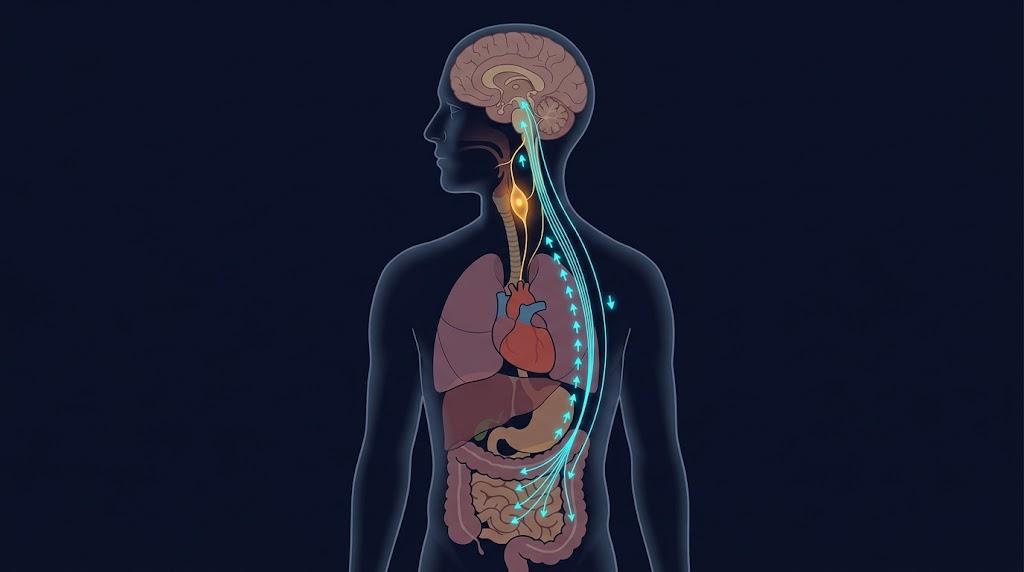
The 80–90% afferent figure comes from neuroanatomists Hans-Rudolf Berthoud and Winfried Neuhuber, whose 2000 review remains the field’s standard citation. Their cell bodies sit not in the brain but in the nodose ganglion, a cluster in the neck acting as the gut’s switching station. The fibers monitor the viscera: distension, nutrient concentration, osmolarity, inflammatory tone — the surveillance half of the gut brain axis.

The efferent minority — the fibers running brain-to-gut — modulates motility, acid secretion, and digestive timing. But the ratio matters. A network with four to nine upward fibers for every downward one is not a command line; it is a monitoring system, closer in spirit to an interoceptive sense than a control cable — the first rule of the gut brain axis. That is why the vagus appears far from digestion: stimulating it — a treatment for drug-resistant epilepsy and depression — reaches mood and arousal circuitry through brainstem relays. The traffic direction of this one nerve is the first clue that “thinking with your stomach” is less metaphor than neuroanatomy.
The 10-Second Vagal Breathing Test
Inhale deeply through your nose for 4 seconds, then exhale slowly through pursed lips for 7 seconds while focusing on your abdomen.
Did you feel your heart rate soften? That is the vagus nerve transmitting parasympathetic braking across the gut-brain highway.
The Second Brain in Your Gut Wall
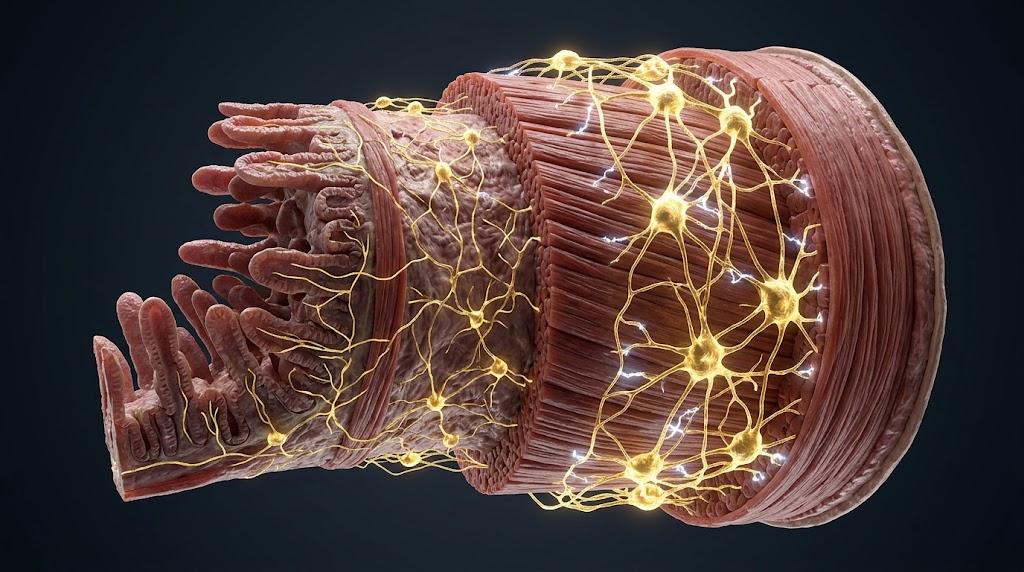
Embedded in the lining of the gastrointestinal tract is a nervous system large enough to run the gut without asking the brain for permission. The enteric nervous system — the ENS — contains an estimated 400 to 600 million neurons in humans, more than the entire spinal cord. It spans two networks: the myenteric plexus, wedged between the muscle layers that push food along, and the submucosal plexus, which regulates secretion, blood flow, and the lining’s chemical environment.
The name “second brain” is earned on functional grounds. Segments of gut, isolated from all central connections, still produce the rhythmic waves of peristalsis; local reflex circuits complete entirely within the wall. The ENS coordinates motility, enzyme release, barrier maintenance, and microcirculation through more than 30 neurotransmitter candidates, supported by enteric glial cells that regulate barrier integrity and neuroinflammation.

When brain and second brain disagree — motility disorders, visceral hypersensitivity — the gut brain axis is arguing with itself, and treatment negotiates with both at once. The same upward flow that reports a stomach bug reports subtler states too: the fatigue signals preceding collapse are partly this network’s doing, as covered in our article on how the body signals fatigue before collapse.
| Layer | Location | Primary role |
|---|---|---|
| Myenteric plexus (Auerbach’s) | Between circular and longitudinal muscle layers | Peristalsis, gut motility |
| Submucosal plexus (Meissner’s) | Submucosa, near the epithelial lining | Secretion, local blood flow, barrier signals |
| Vagal bridge | Nodose ganglion → brainstem (NTS) | Upward visceral reporting; downward modulation |
A Chemical Plant That Outproduces Your Skull
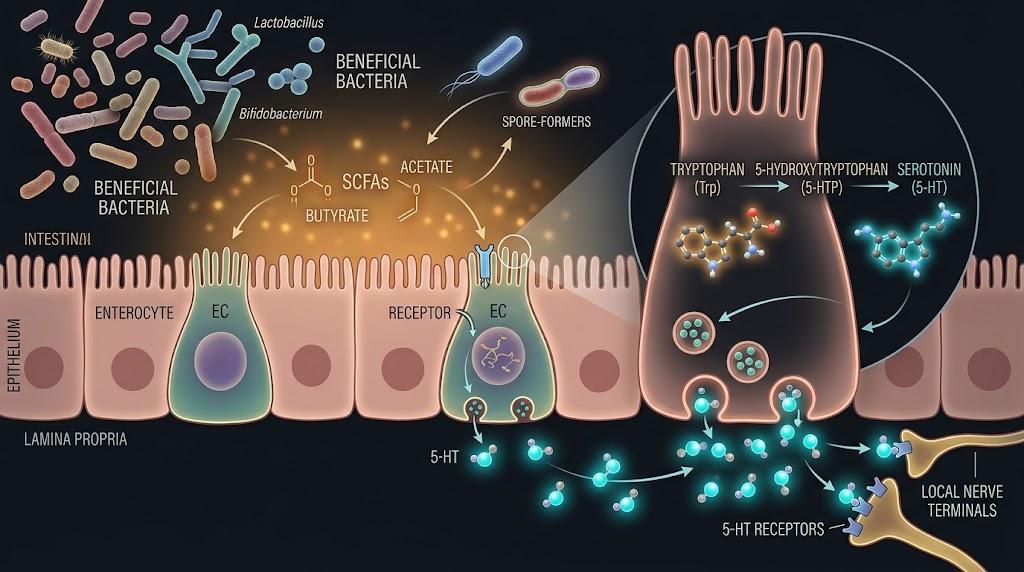
Here the story of the gut brain axis shifts from wiring to chemistry, and the numbers stop feeling intuitive. More than 90% of the body’s peripheral serotonin is synthesized inside the gut, by enterochromaffin cells lining the intestinal epithelium; roughly 50% of peripheral dopamine arises there as well. These cells sit one layer from the lumen, sampling what digestion leaves behind, and translate it into transmitter output through the enzyme TPH1 — a gut-specific isoform the brain never uses; the brain runs its own synthesis on TPH2, behind the blood-brain barrier.
The bacteria in the lumen are not spectators to this layer of the gut brain axis. A 2015 Cell study led by Jessica Yano at Caltech showed that spore-forming gut bacteria drive host serotonin biosynthesis — germ-free mice carried severely depleted gut serotonin, reversed when microbial metabolites were restored.
One correction belongs here, because this is the internet’s most recycled misconception about the gut brain axis: gut serotonin does not walk into the brain. It crosses the blood-brain barrier poorly to not at all, and the brain makes its own supply — the gut brain axis has no direct serotonin lane. The gut’s chemistry influences the brain by other routes — vagal afferents sensing luminal chemistry, immune signaling, and hormones like ghrelin. Gut serotonin does something more local and just as consequential for the gut brain axis: it regulates motility, secretion, and visceral sensation — which is why serotonergic drugs so often have digestive side effects.
One Hundred Trillion Puppet Masters, and Their Industrial Output
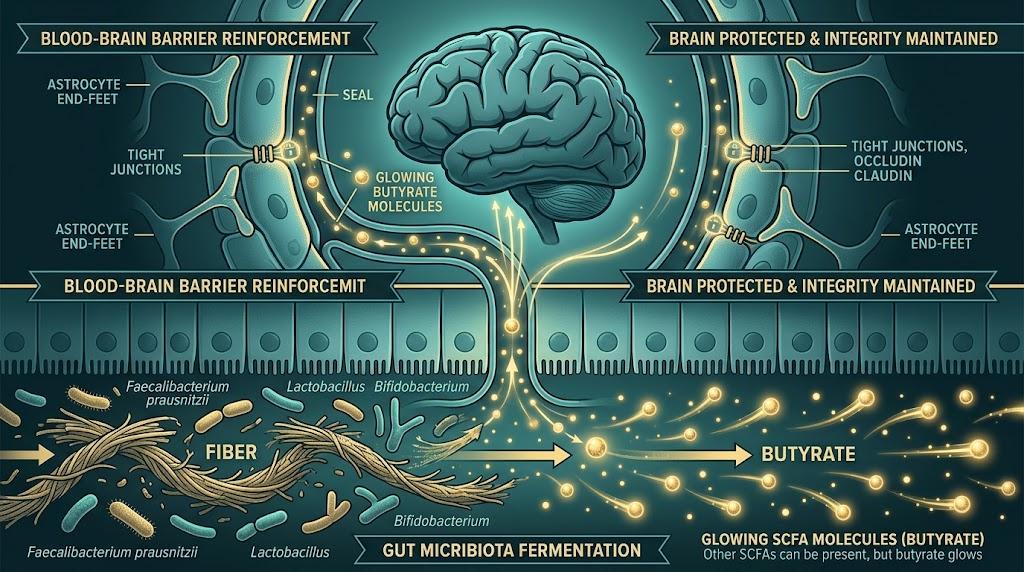
The human gut hosts roughly 100 trillion microorganisms, and their most industrially significant products are the short-chain fatty acids (SCFAs) — acetate, propionate, and butyrate — manufactured when bacterial enzymes ferment the fibers our own enzymes cannot digest, the heavy freight of the gut brain axis.
Butyrate is the primary energy source of the colonocytes lining the colon and strengthens the intestinal barrier’s tight junctions. Acetate and propionate travel in blood — and the evidence shows they reach the brain’s doorstep, a direct metabolic lane of the gut brain axis. A landmark experiment in Science Translational Medicine found that germ-free mice had leakier blood-brain barriers, and that restoring a normal microbiota — or supplying butyrate — restored barrier integrity by upregulating tight-junction proteins. The brain’s resident immune cells, the microglia, fail to mature normally without microbial input; their activation state is tuned by SCFAs reaching the central nervous system.

The clearest causal demonstration came from Elaine Hsiao’s UCLA laboratory in 2013. Mice carrying autism-associated risk from maternal immune activation produced markedly elevated levels of a gut metabolite, 4-ethylphenylsulfate (4-EPS). Oral treatment with the microbe Bacteroides fragilis corrected the imbalance and reduced both the metabolite and several behavioral abnormalities — while injecting 4-EPS alone into healthy mice increased anxious behaviors. One metabolite, one direction of causality, traced from microbe to blood to brain to behavior. The honest summary of this stretch of the gut brain axis: the microbes are less like passengers than a metabolic organ with its own opinions.
Fiber in, SCFAs out: microbial metabolism with direct access to brain-level systems.
Why Your Gut and Your Anxiety Share One Wiring Diagram
The clinical evidence is where the two-way street becomes a traffic jam. People with irritable bowel syndrome carry a gut diagnosis yet show elevated rates of anxiety and depression; people with major depression show elevated rates of IBS and functional dyspepsia. The overlap is shared biology: pro-inflammatory cytokines (IL-6, TNF-alpha, CRP) are elevated in both conditions, the hypothalamic-pituitary-adrenal stress axis alters gut permeability and motility while visceral inflammation feeds back into stress responsiveness, and altered tryptophan metabolism — the raw material of serotonin — sits in the middle of the loop.
Pharmacology exposes the loop from the other end. Selective serotonin reuptake inhibitors (SSRIs), the most prescribed antidepressants on Earth, are notorious for acute gastrointestinal side effects — nausea, diarrhea, cramping — beginning within hours to days of the first dose. The mechanism is anatomically obvious inside the gut brain axis: the gut wall is packed with serotonergic signaling, and a drug elevating extracellular serotonin does not check which nervous system it is acting on first. Serotonin receptors in the gut directly modulate peristalsis and secretion — which is why 5-HT3 and 5-HT4 drugs serve as IBS therapies in both directions.
This is the practical meaning of the gut brain axis: disorders filed under “psychiatry” and disorders filed under “gastroenterology” share inflammatory markers, neural relays, and pharmacology. The same wiring lets brain states reach the gut in moments — the panic that accelerates intestinal transit. Even a purely neural event like brain freeze rides cranial nerves shared with facial and palatal sensation.
Behavioral Transplants and the Birth of Microbial Psychiatry
The field’s transformation came from an experiment that sounds like a prank: transplanting gut bacteria between animals, and watching behavior transfer across the gut brain axis.
Germ-free mice — raised with no microbiome at all — show exaggerated stress responses and altered anxiety-like behavior — early proof that the gut brain axis shapes temperament. When researchers colonized them with microbes from other strains, behavior followed the microbes, not the mouse genome: colonies from more anxious strains made recipients more anxious; bolder colonies made them bolder. John Cryan and Ted Dinan’s 2012 review in Nature Reviews Neuroscience, the field’s founding manifesto, collected this evidence under the term “psychobiotics” — live organisms that in adequate doses may benefit mental health through gut-to-brain signaling.
In 2013, Kirsten Tillisch’s UCLA group published the first randomized trial showing that four weeks of a fermented milk product with probiotic strains measurably altered brain activity — connectivity and task responses in emotion-processing regions — in healthy women. Ingested microbes had changed what emotional circuitry did — the gut brain axis, demonstrated in volunteers.
The frontier is cautious: fecal microbiota transplantation is established medicine for recurrent C. difficile infection and under investigation for neuropsychiatric indications, with real safety questions — including case reports of mania. Causality in animal models is established; in humans, strain-specific benefits remain under trial. The same tempering applies to adaptation stories — evolutionary claims require evidence, as our article on what neuroscience reveals about human adaptation argues.
Recalibrating the Axis Through Physiology
If microbes make the chemistry and the vagus carries the traffic, the gut brain axis has a predictable — and mostly unglamorous — intervention surface. Prebiotic fibers work by mechanism, not magic: the fibers you cannot digest are the feedstock your microbes ferment into SCFAs, the working currency of the gut brain axis. More fermentable fiber means more butyrate — strengthening colonic tight junctions and, per the animal evidence, brain-side barrier and immune signaling. Fermented foods instead add live organisms — a Stanford feeding trial measured higher microbiota diversity and lower inflammatory markers.
The vagal side of the ledger is slower but real. Vagal tone — the heart-rate variability reflecting parasympathetic activity — improves measurably with slow diaphragmatic breathing and biofeedback in controlled studies. Slow breathing at roughly five to six breaths per minute stimulates the baroreflex and shifts autonomic balance toward the parasympathetic branch — the same branch running the efferent fibers to the gut. This is not “vagus reset” folklore; it is respiratory modulation of the vagal arm of the gut brain axis.
Deep sleep is the other lever on the gut brain axis. The sleep-onset transition is itself a vagal event, and the apparatus that jerks you awake at sleep onset is the same autonomic system whose daytime state shapes your gut’s chemistry. Neither fiber nor breathing exercises treats psychiatric disease — but as physiological maintenance of a real system, the mechanisms are sound.
Prebiotic fiber, fermented diversity, and slow breathing — levers with known mechanisms.
What the Gut Brain Axis Is Really Telling You
Zoom out far enough and the gut brain axis stops being a curiosity about digestion and becomes a statement about what a brain is. The nervous system inside your gut wall predates the one in your skull by hundreds of millions of years — jellyfish manage with a nerve net and no brain at all — and in modern humans that older network still runs the body’s most basic chemistry while the newer one plans the future on top of it.
The brain is not a conductor above an orchestra of organs. It is more like the first violin of a section that includes a hundred trillion players, tuning itself continuously against their sound. Emotional tone, in this picture of the gut brain axis, is negotiated constantly among visceral signals, immune chemistry, and microbial metabolism. Two decades of research support a narrower conclusion: not that the gut “controls” the mind — the evidence does not go that far — but that the mind was never a solo instrument. The dialogue never stops. It only changes what it is about.
Frequently Asked Questions About the Gut Brain Axis
Can gut problems cause anxiety?
The causal arrow runs both ways, and the gut-to-brain direction of the gut brain axis has real mechanisms: gut inflammation raises cytokines that alter brain function, visceral signals climb afferent vagal fibers, dysbiosis shifts tryptophan away from serotonin synthesis, and altered SCFA production affects barrier and immune signaling. IBS and anxiety disorders are strongly comorbid, and microbiome transplants transfer anxiety-like behavior between animals. Gut problems do not explain every anxiety disorder — but a dysregulated axis is a measurable contributor.
How long does the gut take to signal the brain?
The neural route is fast: afferent vagal signals reach the brainstem in milliseconds to seconds. Hormonal routes — gut peptides like ghrelin — act over minutes; microbial metabolites over hours to days, tracking diet. Sudden “gut feelings” are usually the gut brain axis’s fast lane reporting what the conscious mind has not yet caught.
Does serotonin from the gut enter the brain directly?
No. Peripheral serotonin crosses the blood-brain barrier poorly to not at all, and the brain synthesizes its own with a different enzyme, TPH2. Gut serotonin acts locally on motility, secretion, and visceral sensation, influencing mood only indirectly through the vagal, immune, and metabolic channels of the gut brain axis. The claim that “90% of your serotonin is in your gut, so your gut controls your mood” collapses that indirect communication into a direct transport that does not exist.
Can probiotics actually improve mood?
The honest answer: strain-specific and not yet settled. Meta-analyses report small positive effects for some multi-strain formulations, with high variability between studies. Probiotics are not a replacement for psychiatric care — but the mechanism, real microbes reaching the brain through real channels, is legitimate physiology.
What are the real signs your gut brain axis is off?
Look for the paired pattern: persistent digestive symptoms — bloating, irregular motility, visceral discomfort — moving together with shifts in stress tolerance, sleep, or mood. Gut flares that precede mood dips, or the reverse, suggest the loop is out of calibration. None of this is diagnostic alone; persistent symptoms deserve a clinician who reads both ends of the gut brain axis.
Disclaimer
Medical Disclaimer: This article is for educational purposes only and does not diagnose or treat any condition. Persistent gastrointestinal symptoms or significant mood changes deserve evaluation by qualified healthcare professionals — never a substitute for professional medical advice.
References
- Berthoud HR, Neuhuber WL. Functional and chemical anatomy of the afferent vagal system. Auton Neurosci. 2000;85(1–3):1–17. PMID 11189015
- Fleming MA, Ehsan L, Moore SR, Levin DE. The enteric nervous system and its emerging role as a therapeutic target. Gastroenterol Res Pract. 2020;2020:8024171. PMID 32963521
- Yano JM, Yu K, Donaldson GP, et al. Indigenous bacteria from the gut microbiota regulate host serotonin biosynthesis. Cell. 2015;161(2):264–276. PMID 25860609
- O’Mahony SM, Clarke G, Borre YE, Dinan TG, Cryan JF. Serotonin, tryptophan metabolism and the brain-gut-microbiome axis. Behav Brain Res. 2015;277:32–48. PMID 25078296
- Braniste V, Al-Asmakh M, Kowal C, et al. The gut microbiota influences blood-brain barrier permeability in mice. Sci Transl Med. 2014;6(263):263ra158. PMID 25411471
- Dalile B, Van Oudenhove L, Vervliet B, Verbeke K. The role of short-chain fatty acids in microbiota-gut-brain communication. Nat Rev Gastroenterol Hepatol. 2019;16(8):461–478. PMID 31123355
- Hsiao EY, McBride SW, Hsien S, et al. Microbiota modulate behavioral and physiological abnormalities associated with neurodevelopmental disorders. Cell. 2013;155(7):1451–1463. PMID 24315484
- Tillisch K, Labus J, Kilpatrick L, et al. Consumption of fermented milk product with probiotic modulates brain activity. Gastroenterology. 2013;144(7):1394–1401.e4. PMID 23474283
- Cryan JF, Dinan TG. Mind-altering microorganisms: the impact of the gut microbiota on brain and behaviour. Nat Rev Neurosci. 2012;13(10):701–712. PMID 22968153
📚 You Might Also Like
Hand-picked articles for you


