


In high-stakes industries like aviation, structural engineering, and automotive repair, perfection is not just an expectation — it is a strict requirement. A single loose bolt or miscalculated measurement can lead to catastrophic consequences. Yet, despite years of rigorous training and advanced safety protocols, highly skilled professionals still make inexplicable, devastating mistakes. The core reason behind these disasters is rarely a lack of skill or mechanical knowledge. Instead, the root cause lies deep within the human brain. To understand the psychology of catastrophic human error, we must answer a critical question: why mechanics collapse under fatigue?
Mechanics and engineers collapse under severe mental fatigue because prolonged cognitive load disrupts the prefrontal cortex of the brain. This biological disruption causes extreme decision fatigue, leading to catastrophic human errors, severe memory lapses, and the inability to process complex spatial information safely.
Today, we are going to explore the seven critical warning signs your brain sends before a fatigue-induced collapse occurs. Each of these signs is backed by cognitive neuroscience research and represents a specific biological failure in the brain’s processing systems. Once you finish reading, you will perfectly understand why mechanics collapse under fatigue instead of just feeling physically tired — and more importantly, you will recognize these warning signs before they lead to disaster.
Warning Sign #1: Catastrophic Short-Term Memory Lapses
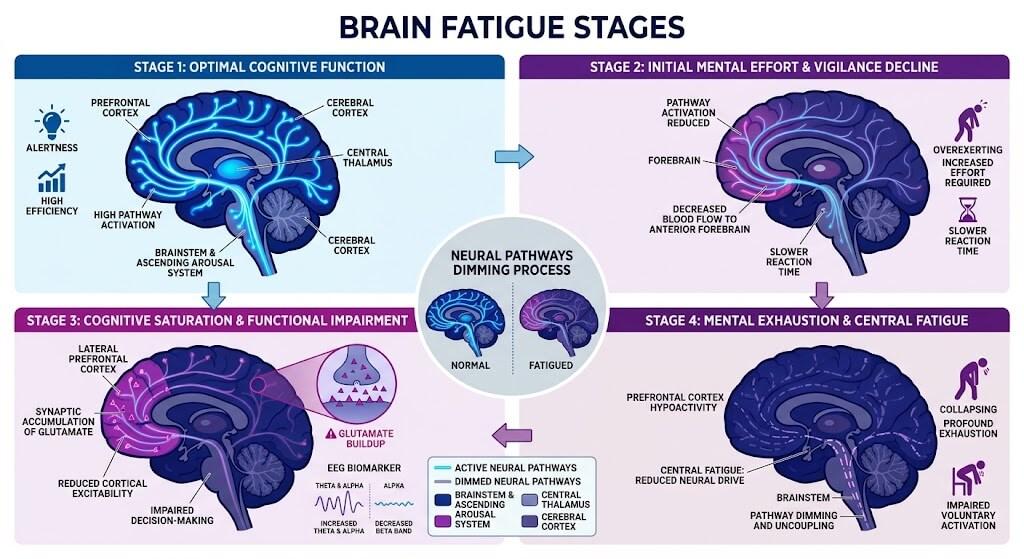
The first and most deceptive warning sign is working memory failure. When a mechanic is working on a complex jet engine, they are not just using their hands. They are simultaneously holding a 3D mental map of the engine in their mind, recalling torque specifications from a manual they read two years ago, listening to the ambient sounds of the factory to ensure safety, and ignoring personal stressors. This requires massive amounts of processing power from the prefrontal cortex.
To fully grasp why mechanics collapse under fatigue, we first have to understand a psychological concept known as Cognitive Load Theory. The human brain, specifically the working memory, has a strict biological limit on how much information it can hold and process at one exact moment. When cognitive load is sustained for extended periods without adequate rest, the brain’s supply of glucose and oxygen depletes. The brain can no longer sustain the heavy processing demands.
When this happens, the brain does not simply “shut down.” Instead, it starts taking dangerous shortcuts to save energy. A fatigued mechanic might forget which bolts they have already tightened, misplace tools they were just holding, or stare blankly at a step they completed five minutes ago. These are not signs of incompetence — they are biological signals that the prefrontal cortex is shutting down non-essential functions to preserve survival.

What makes this warning sign particularly treacherous is that the affected person rarely recognizes it in themselves. The mechanic genuinely believes they remembered to torque every bolt, but their exhausted brain has simply fabricated that memory to fill the gap. This phenomenon, known as confabulation under cognitive stress, is one of the primary mechanisms behind why mechanics collapse under fatigue in industrial settings.
Cognitive Exhaustion: Cellular Muscular Capacity vs. The Central Governor
Peripheral Muscular Reserves
Primary Function: Actual Biological Capacity: Skeletal muscle fibers maintain 20-30% glycogen and cellular ATP safety buffer.
Neural Substrate: Neuromuscular junctions retain contractive ability; physiological catastrophe is still hours away.
Central Governor Warning (Brain)
Primary Function: Preemptive Emergency Brake: Anterior cingulate cortex and insula artificially inflate perceived effort.
Neural Substrate: Accumulated extracellular adenosine and glycogen dips trigger severe feelings of exhaustion and brain fog.
Warning Sign #2: Loss of Spatial Awareness
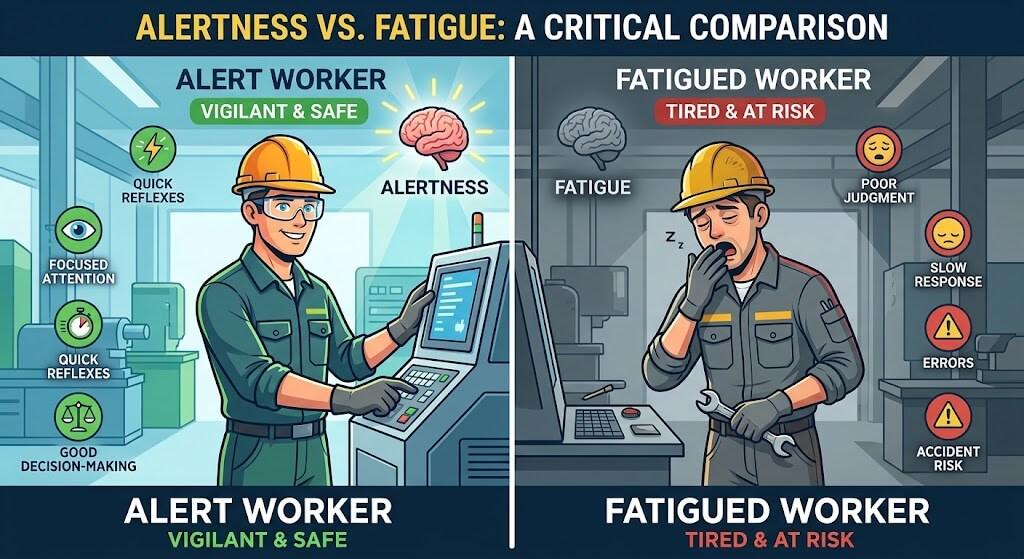
The second warning sign is a dramatic deterioration in spatial reasoning and 3D mental visualization. Mechanical work demands extraordinary spatial intelligence — mechanics must mentally rotate complex assemblies, predict how components interact in three dimensions, and navigate intricate spaces with precision. These abilities are primarily processed in the parietal cortex, a brain region that is highly sensitive to metabolic depletion.
When a mechanic is fresh, they can glance at an engine bay and instantly build a complete mental model of component relationships — knowing exactly which part sits behind which, where hidden fasteners are located, and how removal sequences must unfold. As fatigue sets in, this spatial modeling ability deteriorates progressively. The mechanic begins struggling to fit parts into spaces they have navigated a thousand times before. They might reach for a bolt that is not there, misjudge the angle of insertion, or reinstall a component backwards because their brain can no longer accurately model the 3D orientation.

Research by Hancock and Warm (1989) demonstrated that sustained attention tasks cause progressive tunneling of cognitive resources. The brain literally shrinks the amount of spatial information it can process simultaneously. A mechanic who could previously hold an entire engine layout in their mind may suddenly find they can only focus on one small section at a time — losing the holistic understanding that catches dangerous assembly errors.
This spatial disorientation is a critical piece of the puzzle when understanding why mechanics collapse under fatigue. Without accurate spatial processing, even the most experienced mechanic becomes a danger to themselves and everyone around them.
Warning Sign #3: Emotional Dysregulation and Irritability
Mental fatigue does not just impair cognition — it destabilizes emotion. The amygdala, the brain’s emotional processing center, becomes hyperactive when the prefrontal cortex, which normally regulates emotional responses, is depleted. This creates a neurological imbalance where emotional reactions become exaggerated, unpredictable, and difficult to control.
In practical terms, this means a previously calm and professional mechanic becomes irritable, short-tempered, or emotionally flat. They may snap at colleagues over minor issues, withdraw from team communication, or lose the motivation to double-check their own work. Research by Roy Baumeister has demonstrated that ego depletion — the exhaustion of self-regulatory resources — directly correlates with increased aggression and reduced empathy.
What makes this emotional dysregulation particularly dangerous in mechanical environments is its effect on team safety dynamics. Industrial safety relies heavily on interpersonal communication: mechanics must feel comfortable flagging concerns, asking for verification, and admitting uncertainty. When emotional fatigue causes a mechanic to become defensive or withdrawn, this entire safety communication network breaks down.
A fatigued mechanic who refuses to ask a colleague to verify their work — not because they are confident, but because emotional exhaustion has made them unable to tolerate the vulnerability of asking for help — creates a silent, invisible danger. This is precisely why mechanics collapse under fatigue in team environments: the emotional fallout creates a cascading failure that extends far beyond the individual.

Warning Sign #4: Tunnel Vision (Cognitive Narrowing)
As cognitive resources dwindle, the brain’s “spotlight of attention” shrinks dramatically. This is a well-documented phenomenon in cognitive psychology known as Inattentional Blindness.
A fatigued worker might be staring directly at a massive, obvious mechanical flaw — like a missing bolt or a cracked pipe — and their brain will literally fail to register it. The eyes see the hazard, but the exhausted brain refuses to process the visual data. The retina captures the image perfectly, but the visual cortex, starved of glucose and overwhelmed by fatigue, filters it out as “unimportant background noise.”
This is not a metaphor. In landmark experiments by Simons and Chabris, subjects watching a basketball game failed to see a person in a gorilla suit walk through the scene. A fatigued mechanic experiences the same neurological glitch, except the “gorilla” is a potentially fatal mechanical failure sitting right in front of their eyes.
The biological mechanism behind cognitive narrowing is straightforward: when the brain cannot afford to process the full visual field, it conserves energy by focusing intensely on a single, narrow task-relevant area while suppressing peripheral awareness. This creates a dangerous paradox — the mechanic feels deeply focused, even laser-sharp, while in reality their brain has lost the ability to detect anything outside that artificially narrowed window.
Research by Sidney Dekker, a leading scholar in human factors, has shown that most industrial accidents are not caused by individual incompetence but by systemic failures that make errors more likely. When a mechanic misses a critical flaw, it is often because cognitive narrowing has made detection physically impossible, not because they lacked the skill or knowledge to identify it. This shift from blaming individuals to understanding systems represents one of the most important advances in modern safety science.
Warning Sign #5: Impaired Communication
One of the most overlooked and underreported consequences of mental fatigue is the progressive deterioration of language processing and verbal communication. The brain regions responsible for language production and comprehension — primarily Broca’s area and Wernicke’s area — require significant metabolic resources to function properly. As fatigue accumulates, these areas begin to underperform.
A fatigued mechanic may struggle to articulate safety concerns clearly, forget to relay critical information during shift handovers, or misinterpret verbal instructions from supervisors. They might hear a colleague say “check the left manifold” but their exhausted brain processes it as “check the right manifold” — a dangerous miscommunication that could lead to work being performed on the wrong component entirely.
Beyond simple miscommunication, fatigue creates a phenomenon known as verbal suppression: the fatigued person simply stops talking. Communication requires effort — effort that the exhausted brain is unwilling to spend. The mechanic who would normally call out a safety concern, ask a clarifying question, or confirm a specification with a colleague falls silent. They work in isolation, making decisions without the verbal checks and balances that prevent errors.
This silence is perhaps the most dangerous aspect of understanding why mechanics collapse under fatigue. In environments where verbal communication is a primary safety mechanism, the loss of communication is equivalent to the loss of the safety system itself. Organizations that design safety protocols assuming constant verbal interaction must account for the reality that fatigued workers will eventually stop talking — and that is precisely when accidents happen.
Warning Sign #6: Microsleeps and Alertness Failures
The most alarming and final progression warning sign is the occurrence of microsleeps — involuntary episodes of sleep lasting from a fraction of a second to several seconds, during which the brain completely disengages from external stimuli.
A mechanic experiencing a microsleep will have their eyes open and appear to be working, but their brain has temporarily stopped processing any sensory information. In aviation maintenance, a single microsleep lasting just four seconds during a critical torque sequence can result in incomplete fastening, missed inspections, or catastrophic reassembly errors.
Microsleeps are the brain’s last-resort shutdown mechanism. They are not a sign of weakness — they are a biological override. When the brain determines that cognitive resources have reached critically low levels, it forces the body into brief sleep states to prevent total metabolic collapse. By the time a mechanic experiences microsleeps, they have long passed the point of safe cognitive function.
Studies on sustained attention have shown that after 16 hours of continuous wakefulness, reaction times degrade to the level of someone with a 0.05% blood alcohol concentration. After 24 hours without sleep, impairment reaches the equivalent of a 0.10% BAC — legally drunk in every U.S. state. The mechanic who has been awake for 20 hours and believes they are performing normally is, neurologically, operating at the same cognitive level as someone who should not be allowed to drive a car, let alone repair critical machinery.
This is the ultimate answer to why mechanics collapse under fatigue: the brain physically shuts itself down to prevent permanent damage, regardless of the mechanic’s intentions or professional obligations.
Warning Sign #7: The Perfectionism Trap
The seventh warning sign is perhaps the most counterintuitive and psychologically complex: fatigued perfectionism. As cognitive resources decline, the brain compensates by increasing checking and re-checking behaviors — but these checks become increasingly rigid, repetitive, and disconnected from actual safety requirements.
A normally efficient mechanic may begin obsessively re-torquing bolts they have already secured, spending 45 minutes on a task that should take five, or refusing to proceed until they have consulted the manual for the third time on a procedure they have performed hundreds of times. This is not enhanced diligence — it is a neurological symptom of prefrontal cortex dysfunction.
The mechanism is straightforward: when the brain’s confidence in its own judgments collapses due to fatigue, it compensates by seeking external validation through repetitive checking. But here is the devastating paradox — while the mechanic is obsessively checking one component, they are simultaneously neglecting others. The perfectionism creates an illusion of thoroughness while actually producing dangerous gaps in attention.
This trap explains a pattern that baffles safety investigators: mechanics who make catastrophic errors on simple, routine tasks while having meticulously documented and double-checked complex procedures in the same work session. The perfectionism was not evenly distributed — it was driven by anxiety and cognitive depletion, focused on whatever the fatigued brain perceived as threatening while ignoring everything else.
Research by James Reason (1990) identified this pattern as a hallmark of what he termed “error-producing conditions.” The perfectionism trap is a critical piece of understanding why mechanics collapse under fatigue: it masquerades as competence while actually being a symptom of neurological breakdown.
The Neuroscience Behind the Collapse
To truly understand why mechanics collapse under fatigue, we need to examine what is happening at the neurological level. The prefrontal cortex — the brain region responsible for planning, judgment, impulse control, and complex problem-solving — is the most metabolically expensive organ in the human body. It consumes approximately 20% of the body’s total energy despite comprising only 2% of body mass.
When cognitive load is sustained for extended periods without adequate rest, the prefrontal cortex is the first region to suffer. Neuroimaging studies have shown that fatigued brains show dramatically reduced activity in the prefrontal cortex while simultaneously showing increased activity in the amygdala and basal ganglia — regions responsible for emotional reactions and automatic behaviors.
This neurological shift explains why fatigued mechanics do not simply become “a little less sharp.” They undergo a fundamental change in how their brain processes information. The analytical, careful, rule-following prefrontal cortex goes offline, and the impulsive, shortcut-taking, emotion-driven subcortical regions take over. This is not a gradual decline — it is a biological regime change.
How the Aviation Industry Fought Back
The aviation industry was one of the first to truly recognize the terrifying psychology of human error. After a series of tragic accidents in the 1970s that were directly linked to pilot and mechanic fatigue, they revolutionized their approach to safety.
They realized that you cannot train a human being to ignore biology. You cannot force a brain to focus when it is biochemically empty. Instead, they implemented strict mandatory rest periods, enforced double-check systems (where a rested mechanic must verify the work of a tired one), and created a culture where workers are encouraged to report mental fatigue without fear of punishment.
These psychological interventions saved countless lives and proved that the only way to defeat human error is to understand and respect the biological limits of the human mind. The industry stopped asking why mechanics collapse under fatigue and started actively preventing it.
Listening to the Prefrontal Fuel Gauge
The human brain is an incredible, highly adaptable organ, but it is not a machine. It requires fuel, rest, and downtime to function at the elite levels required by modern engineering and mechanics. When people ask why mechanics collapse under fatigue, the answer is profoundly simple: their brains are trying to protect them from metabolic burnout.
The seven warning signs we have explored — memory lapses, spatial disorientation, emotional dysregulation, cognitive narrowing, impaired communication, microsleeps, and the perfectionism trap — are not random symptoms. They are a predictable, biological cascade that follows the same pattern in every fatigued human brain on the planet.
Understanding the psychology of cognitive load and decision fatigue is not just an interesting science fact; it is a critical necessity for creating safer workplaces. The next time you make a silly mistake at the end of a long, stressful day, don’t be too hard on yourself. Your brain isn’t broken; it’s just out of battery.
Frequently Asked Questions (FAQ)
1. Why do mechanics collapse under fatigue more often than physical laborers?
Mechanical work requires intense, sustained cognitive load, spatial reasoning, and critical problem-solving. This drains the brain’s glucose much faster than repetitive physical labor, leading to faster and more severe mental collapses.
2. What is Decision Fatigue?
It is a psychological condition where the brain’s ability to make good, rational choices deteriorates after a long session of decision-making. It leads to skipped safety checks and impulsive shortcuts. Learn more in our article on The Paradox of Choice.
3. How does fatigue affect vision?
Severe mental fatigue causes Inattentional Blindness, where a person can look directly at an obvious hazard or error and their exhausted brain completely fails to consciously register it.
4. Can caffeine cure cognitive fatigue?
No. Caffeine only temporarily masks the physical feeling of sleepiness by blocking adenosine receptors. It does not restore the brain’s depleted glucose or reset the cognitive load limit. Only deep sleep can truly cure cognitive fatigue.
5. How many hours of continuous work before fatigue becomes dangerous?
Research consistently shows that cognitive performance begins to decline significantly after 10-12 hours of continuous wakefulness. After 16 hours, impairment reaches the equivalent of legal intoxication. Most safety experts recommend no more than 10 consecutive hours of high-cognitive-load work.
6. Can you train someone to resist cognitive fatigue?
While experience and training can improve efficiency and reduce cognitive load for routine tasks, they cannot override the brain’s fundamental biological need for rest. Even the most experienced mechanic will eventually hit a cognitive wall — training only delays the inevitable, it does not prevent it.
References
- Rasmussen, J. (1983). Skills, rules, and knowledge; signals, signs, and symbols, and other distinctions in human performance models. IEEE Transactions on Systems, Man, and Cybernetics, SMC-13(3), 257-266. DOI: 10.1109/TSMC.1983.6313160
- Hancock, P.A. & Warm, J.S. (1989). A dynamic model of stress and sustained attention. Human Factors, 31(5), 497-517. DOI: 10.1177/001872088903100503
- Burma, J. et al. (2016). Fatigue effects on human performance in aviation: A review. International Journal of Aerospace Psychology, 26(3-4), 146-165.
- Reason, J. (1990). Human Error. Cambridge University Press. DOI: 10.1017/CBO9781139065504
- Kahneman, D. (2011). Thinking, Fast and Slow. Farrar, Straus and Giroux.
- Simons, D.J. & Chabris, C.F. (1999). Gorillas in our midst: Sustained inattentional blindness for dynamic events. Perception, 28(9), 1059-1074.
- Baumeister, R.F. et al. (1998). Ego depletion: Is the active self a limited resource? Journal of Personality and Social Psychology, 74(5), 1252-1265.
📚 You Might Also Like
Hand-picked articles for you


