


You’re drifting off. The room is quiet, your body is heavy, and sleep is seconds away. Then — BANG. A door slamming. A gunshot. An explosion inside your own skull. You jerk awake, heart pounding, and sit in the dark waiting for your ears to stop ringing.
And here is the strange part: there is no sound. Your partner heard nothing. The dog is still asleep. The street outside is silent.
Welcome to exploding head syndrome — one of the most dramatic names in medicine for one of the least dangerous things that can happen to you. It has an official entry in the International Classification of Sleep Disorders. It affects a surprising share of the population — probably including people you know. And the science behind it reveals something remarkable about what your brain does in the fragile minutes between wakefulness and sleep.
Let’s open the file on this mystery.
What Exploding Head Syndrome Actually Is (and What It Is Not)
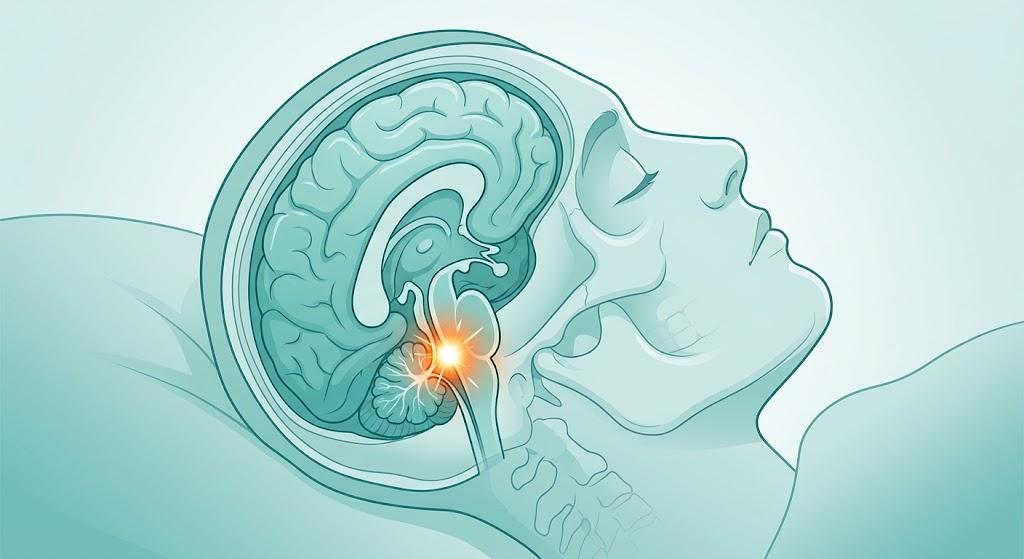
Exploding head syndrome (EHS) is classified as a parasomnia — a family of sleep disorders that also includes sleepwalking and sleep terrors. The official diagnostic criteria in the International Classification of Sleep Disorders, Third Edition (ICSD-3) describe it this way:

A sudden perception of a loud noise or sense of an explosion in the head, occurring either at the transition from wakefulness to sleep or upon waking during the night — followed by abrupt arousal, often with a sense of fright. Critically, the experience is not associated with significant pain.
Every element of that definition matters:
- Sudden loud noise or explosion — sufferers describe it as a gunshot, a door slam, thunder, cymbals, a lightning crack, or an actual bomb going off, all from a standing start: silence to maximum volume in under a second.
- At sleep transitions — it strikes as you’re falling asleep or, less often, as you wake in the night. It does not happen in the middle of a busy afternoon.
- No significant pain — this is the single most important clue about what’s going on, and it’s a required criterion. Real head pain at night is a different story entirely (more on that soon).
Neurologist Silas Weir Mitchell first documented the phenomenon in 1876, calling the episodes “sensory shocks.” The syndrome wasn’t formally recognized as a sleep disorder until 2005 — and some researchers now campaign for a more accurate name: episodic cranial sensory shock. Few people use it. “Exploding head syndrome” is too memorable to replace.
Some episodes come with company: a flash of light as if a camera went off, a muscle jerk, a burst of sweat, a racing heart, or a spike of fear strong enough to feel like the room itself is dangerous. Occasionally the “sound” is perceived more as a feeling — a bright flash of painless electricity inside the head.

What EHS is not: it is not a headache disorder, it is not a psychiatric condition, it is not a seizure, and it is not a sign of stroke, aneurysm, or a tumor. Large clinical reviews find no damage of any kind associated with it. The name promises catastrophe; the biology delivers a harmless — if rude — neural hiccup.
The Numbers: How Common Is It Really?
For something that sounds like a rare curiosity, exploding head syndrome is remarkably common.
The best prevalence data comes from sleep researcher Brian Sharpless, who surveyed more than 200 university students and found that nearly one in five — 18% — had experienced at least one EHS episode in their lives. More than a third of those affected had it disrupt their sleep, and many also reported isolated sleep paralysis — a finding we’ll come back to, because it’s a clue.
The largest survey ever conducted, published in Sleep Medicine in 2020, analyzed questionnaire responses from 6,240 people — 3,286 with lifetime EHS episodes and 2,954 without — recruited online through BBC Science Focus. The survey found:
- Most sufferers report only a handful of episodes across their whole lives.
- But a persistent minority has it several times a week or more.
- 44.4% reported clinically significant fear during attacks, 25.0% clinically significant distress, and 10.1% actual daytime interference.
- People with EHS slept for shorter durations, took longer to fall asleep, and rated their sleep quality and efficiency lower — no surprise when your brain keeps setting off fireworks at the finish line.
- Women endorsed EHS slightly more often than men, and sufferers identified five prevention strategies that more than half of them found effective — the same practical steps you’ll read below.
Researchers suspect the real worldwide numbers are far higher than clinics record, because most people are too embarrassed to mention it — or too convinced they’re the only one. If it has happened to you, the statistics carry a simple message: you are not broken, and you are very much not alone.
Hypnagogic Transition: Normal Sleep Onset vs. EHS Sensory Burst
Smooth Reticular Shutdown (Typical)
Primary Function: Synchronous Gating: Reticular activating system dims cortical alertness while suppressing auditory/visual networks.
Neural Substrate: Thalamocortical gating down-regulates primary auditory cortex as motor atonia engages smoothly.
Paroxysmal Auditory Burst (EHS Episode)
Primary Function: Gating Delay Glitch: Motor shutoff occurs on time, but auditory neurons experience an abrupt disinhibition spike.
Neural Substrate: Sudden synchronous neuronal discharge in brainstem auditory pathways mimicking an external blast.
The Machinery: What Your Brain Is Doing in Those Minutes
To understand the bang, you need to understand the transition it interrupts.

Falling asleep is not a dimmer switch. It is a choreographed shutdown sequence in which different brain systems power down at different speeds — like departments in an office building going dark floor by floor. Motor control relaxes first. Then attention drifts. Sensory systems run their own independent wind-down, with the auditory thalamus (your brain’s sound relay station) gradually gating the outside world out of consciousness. (If you have ever noticed your brain generating phantom sounds in a quiet room, you have already met this system mid-handover.)
During this handover, researchers observe a curious electrical signature: alpha and theta waves firing at the same time — a pattern called “alpha coactivation,” traced to deep structures including the thalamic pulvinar and the posterior cingulate cortex and documented in clinical reviews of the syndrome. It appears in people at sleep onset and is not seen in fully awake controls. Think of it as two radio stations broadcasting over each other while the tuner decides which one to keep.
Exploding head syndrome is best understood as a glitch in this handover. The leading theory: instead of the auditory system powering down smoothly, a burst of neurons fires all at once — and the sleeping brain, which normally interprets such bursts as meaningless static, is caught halfway between modes and processes the burst as sound. Not faint sound. Maximum-volume sound. Because there’s no gradual ramp — the noise arrives the way an alarm arrives: already at full volume.
That also explains the flash of light some people see (the same burst reaching the visual system) and the jolt of fear (the amygdala — your brain’s alarm bell — is one of the last structures to stand down at night). The amygdala hears “explosion,” sounds its own alarm, and you wake with your heart hammering before you’re consciously aware of anything at all.
Why does the burst happen at all? Several overlapping hypotheses exist: a transient calcium channel dysfunction in brainstem neurons during the transition; momentary glitches in the brainstem’s inhibitory circuits; even minor dysfunction of the middle ear or Eustachian tube in some cases. What researchers agree on is smaller and more interesting: the glitch lives in the transition machinery itself — the specific circuitry that gates consciousness — which is why the syndrome strikes only at the doorway of sleep and never in the middle of the day.
Why It Strikes at Night: The Sleep-Transition Neighborhood
EHS does not travel alone. It clusters at the same transitional crossroads as several other strange night phenomena — and the shared address is the strongest clue we have about its mechanism.
Sleep paralysis — waking while your muscles are still temporarily “locked” in dream-sleep atonia — co-occurs with EHS at strikingly high rates. In the student survey, more than a third of EHS sufferers also experienced sleep paralysis — the glitch that happens when waking and dreaming collide. Both events happen at consciousness boundaries; both involve the brain’s threat-detection system firing while the body’s sleep systems are still mid-transition. Some researchers now group them as neighbors on a spectrum of transition glitches.
Hypnic jerks — the full-body lurch many people feel as they fall asleep — sit at the same crossroads, as do hypnagogic hallucinations, the vivid half-dreams that can feel completely real. These phenomena are the brain’s version of a car that backfires, stalls, or lurches while shifting gears: each one is a different misfire in the same transmission.
And there’s a reason the night amplifies all of this. In darkness and quiet, your auditory system turns up its internal gain to compensate for the missing stimulation — which is why small sounds seem louder in the dark, and why a neural burst that would be a whisper in a noisy afternoon becomes a cannon shot in a silent bedroom.
Exploding Head Syndrome vs. Headaches vs. Everything Else
The name causes panic; the details reassure. Here’s how EHS separates from conditions that genuinely need attention.
| Feature | Exploding Head Syndrome | Thunderclap Headache | Nightmare / Night Terror |
|---|---|---|---|
| What happens | Painless imagined BANG at sleep onset or on night waking | Real, severe head pain peaking in under a minute | Frightening dream experience, usually later in the night |
| Actual pain | None (required criterion) | Severe — often “the worst headache of my life” | Emotional fear, no head pain |
| Duration | Under 1 second; aftermath fades in minutes | Hours unless treated | Minutes to longer |
| Position | Only at sleep-wake transitions | Any time, any state | During sleep, REM-heavy phases |
| Physical danger | None documented | Medical emergency — possible bleeding | None (distressing but harmless) |
One genuine red flag is worth knowing: if a “bang in the head” comes with real pain — especially sudden, severe pain — that’s not EHS and needs immediate medical care. EHS, by definition, is noise without damage.
Myth vs. Fact
Myth: If you hear explosions in your head, something in your brain is about to burst.
Fact: Clinical reviews of EHS spanning more than three decades — from the first case series in 1989 to the largest 2020 survey — have found zero associated brain damage, zero strokes, and zero structural disease. The explosions are generated by your own sleep-transition circuitry and leave no trace.
Myth: Exploding head syndrome only happens to people with mental illness.
Fact: It is classified as a sensory parasomnia, not a psychiatric condition, and it occurs in otherwise healthy people — including roughly one in five university students in the best prevalence study to date.
Myth: The bang is caused by a real noise outside your head.
Fact: No external sound is involved — partners, pets, and microphones record nothing. The burst originates inside your own auditory pathway during the handover between wakefulness and sleep.
Myth: EHS is a rare disorder almost nobody has.
Fact: Prevalence studies suggest it is far more common than clinics record — most sufferers simply never report it, assuming the sound was real or feeling too embarrassed to mention it.
Myth: A painful bang in the head at night can be treated like EHS.
Fact: A sudden, severe, painful headache — with or without a bang — is not EHS and needs immediate medical attention. Pain is the dividing line between the harmless and the urgent.
The Numbers Game: Who Gets It Most?
EHS doesn’t pick randomly. The data points to several clear patterns.
- Age: It can begin at any age, but cases cluster in adolescence and young adulthood, with many sufferers reporting first episodes in their teens — and many reporting that episodes fade over the years.
- Sex: Unlike most sleep disorders, no strong skew has been established — women report it slightly more often in some samples, but the gap is small and inconsistent.
- Sleep position: Episodes appear more often when sleeping on the back (supine) — one of the few reproducible physical risk factors.
- Stress and fatigue: High stress, poor sleep, and irregular schedules consistently show up as triggers. In the BBC survey, “stress” was the most common suspected cause cited by sufferers — and they weren’t far wrong.
- Related conditions: Higher rates appear in people with insomnia, anxiety, depression, and fatigue — likely because all of these destabilize the sleep transition itself.
There’s also a short list of secondary triggers worth knowing — cases where EHS-like episodes arise from something treatable: sudden withdrawal from certain antidepressants or benzodiazepines, migraine with brainstem aura, and rare cases tied to medication effects or metabolic issues. This is why a doctor should evaluate frequent episodes even though the syndrome itself is benign: the job isn’t just to confirm the noise is harmless, but to check nothing treatable is hiding behind it.
How to Stop It (or at Least Turn Down the Volume)
There is no pill for exploding head syndrome — and, importantly, no pill is needed for most people. The evidence-based approach is a ladder, and most people never need to climb past the first step.
Step 1: Reassurance — the single most effective “treatment.” The largest clinical reviews say it plainly: most patients need nothing more than an accurate explanation. Learning that the bang is harmless removes the fear, and removing the fear removes the insomnia that the fear was causing. In published case series, many patients describe the episodes stopping entirely after diagnosis — not because the biology changed, but because the anxiety loop broke.
Step 2: Fix the fuel. Since stress and sleep deprivation are the most consistent triggers, the treatment is boring and effective: regular sleep schedule, adequate sleep, and wind-down time before bed. (And if you sleep a full night yet still wake up drained, the culprit may be one of the hidden causes of tiredness after 8 hours of sleep — micro-arousals among them.) Caffeine after mid-afternoon and evening alcohol both destabilize the sleep transition — cutting them reduces episode frequency in many self-reports. (The survey found some sufferers drink alcohol before bed specifically to prevent attacks; it sedates you, but it worsens sleep quality and usually backfires.)
Step 3: Change the sleeping position. Because back-sleeping shows up as a consistent amplifier, simply switching to your side is the easiest experiment worth trying — low cost, zero risk, and it works for some people.
Step 4: Treat the stress, not the head. Relaxation training, meditation, and structured wind-downs reduce the hyper-arousal that feeds the transition glitch. When anxiety or insomnia is significant, cognitive behavioral therapy aimed at sleep (CBT-I) addresses the loop directly.
Step 5: Medication — only for the stubborn minority. For the small group with frequent, sleep-destroying attacks, clinicians have reported success with low-dose clomipramine (a tricyclic antidepressant), and there are reports of benefit from other medications including nifedipine (a calcium channel blocker — which neatly supports the calcium-channel hypothesis). This is specialist territory: the medications are well-studied, but EHS itself is not what they were designed for.
And one final strategy, reported by sufferers and clinicians alike: expectation management. The next episode, when it comes, will last less than a second and cost you nothing. People who internalize this stop bracing for the bang — and, ironically, bracing less seems to mean hearing it less.
Frequently Asked Questions About Exploding Head Syndrome
Is exploding head syndrome dangerous?
No. It is classified as a benign parasomnia, and decades of clinical follow-up have documented no brain damage, no stroke risk, and no structural disease associated with it. The main harm is fear and interrupted sleep — both treatable with education and good sleep habits.
Why do I hear loud bangs when falling asleep?
Because your auditory system is caught mid-handover between wakefulness and sleep. A brief burst of neural activity fires while the brain’s sound-processing circuits are still partially “on,” and the half-awake brain interprets that burst as a sudden, maximal-volume sound — with no warning ramp.
Is exploding head syndrome a sign of a tumor or stroke?
No association has been found between EHS and tumors, strokes, aneurysms, or any structural brain disease. That said, sudden painful headaches at night are a different matter entirely and deserve immediate medical evaluation — pain is the key word that separates the dangerous from the merely dramatic.
How common is exploding head syndrome?
Roughly one in five university students reported at least one lifetime episode in the best prevalence study to date, and researchers believe the true population rate is higher because most people never report it. For most sufferers it’s an occasional event — a few episodes a year or a few in a lifetime.
Can exploding head syndrome be cured?
For most people it doesn’t need a cure — it needs explanation and stress management. Episodes often fade with better sleep and lower stress, and many sufferers report long remissions. For frequent, severe cases, sleep specialists sometimes prescribe low-dose clomipramine or nifedipine with reported success.
Why do I also see a flash of light with the bang?
The same neural burst can reach both the auditory and visual systems during the transition. When it does, you get a silent flash of light along with the bang — the sensory equivalent of a camera flash going off inside your head. It’s the same harmless glitch wearing a different costume.
Does exploding head syndrome happen to children?
Yes — episodes have been reported in children and teenagers, and first episodes often begin in adolescence. It is just as benign in younger sufferers as in adults, and the same reassurance-first approach applies.
What’s the difference between exploding head syndrome and nightmares?
Nightmares are dreams — elaborate, story-like experiences from REM sleep, usually in the early morning hours. EHS is a single instantaneous sensory event with no story attached, striking precisely at the moment of falling asleep or waking. People with EHS wake immediately and know exactly what woke them; nightmare sufferers often can’t say what woke them at all.
The Bottom Line: A Loud Name for a Quiet Truth
Exploding head syndrome sits in a strange corner of medicine: a condition whose name sounds fatal but whose biology is harmless — a misfire of the exact circuitry your brain uses to fall asleep gracefully.
That transition is one of the most complex things you do all day. Every night, billions of neurons change state in a choreographed sequence — and like any complex maneuver, it occasionally glitches. When the glitch lands in your auditory relay at the exact moment consciousness is letting go, you get one second of borrowed thunder.
Loud? Extremely. Dangerous? No. And now that you know what it is — and that nearly one in five people experience the same thing — the next bang you hear in the dark can be what it always should have been: noise without meaning, gone before your heart rate even finishes spiking.
References and Sources
- Mars, J. A., et al. (2025). “Exploding Head Syndrome.” StatPearls, NCBI Bookshelf. NBK560817 — verified; source of the ICSD-3 diagnostic criteria, the parasomnia classification, the alpha-coactivation sleep-onset EEG pattern, the transient calcium channel dysfunction hypothesis, the middle-ear contribution, and the clomipramine and nifedipine treatment reports.
- Pearce, J. M. S. (1989). “Clinical features of the exploding head syndrome.” Journal of Neurology, Neurosurgery & Psychiatry, 50(7), 868–870. PMC1031943 — verified; the landmark first case series (source of the 1989 date and the benign outcome documented in the recorded cases).
- Sharpless, B. A. (2015). “Exploding head syndrome is common in college students.” Journal of Sleep Research, 24(4), 447–449. PubMed (PMID: 25773787) — verified; source of the 18% lifetime prevalence among 211 undergraduates, the isolation reported by more than a third of affected students, and the isolated sleep paralysis comorbidity.
- Sharpless, B. A., Denis, D., Perach, R., French, C. C., & Gregory, A. M. (2020). “Exploding head syndrome: Clinical features, theories about etiology, and prevention strategies in a large international sample.” Sleep Medicine, 75, 251–255. doi:10.1016/j.sleep.2020.05.043 — verified; source of the 6,240-person sample (3,286 with EHS), the 44.4% / 25.0% / 10.1% fear–distress–interference figures, the sleep-quality findings, and the five prevention strategies.
- American Academy of Sleep Medicine. International Classification of Sleep Disorders, 3rd edition (ICSD-3) — verified via StatPearls; source of the official diagnostic criteria quoted above.
- Goldsmiths, University of London. Research coverage: “Exploding head syndrome.” gold.ac.uk — verified; source of the “episodic cranial sensory shock” renaming proposal.
Disclaimer
By Aly ElDeeb — Science Writer & Literature Researcher | 📚 Fact-Checked & Sourced from Peer-Reviewed Studies
📚 You Might Also Like
Hand-picked articles for you


