


One spoonful of ice cream, taken a little too fast, and it happens: a sudden, stabbing pain right behind your forehead. For a few seconds the world shrinks to that one sharp ache — then it fades, and you go right back to the bowl.
Everyone calls it brain freeze. It sounds like a joke, and most people treat it like one.
But here is the surprising part: it is a real neurological event. It has an entry in the International Classification of Headache Disorders, it can be measured with brain-blood-flow instruments in a laboratory, and the way it works tells you something remarkable about how your brain locates pain in the first place.
So the real question is not whether ice cream headaches exist.
The real question is: why would cold in your mouth explode into pain in your head?

The answer is a fast chain of reflexes that begins on the roof of your mouth, runs through one of the most important nerves in your face, and ends with your brain misreading a temperature signal as pain. Let’s break it down, step by step.
What Brain Freeze Actually Is: It Has an Official Medical Name
Neurologists don’t use the words “brain freeze.” The official term is cold-stimulus headache — or, when it comes specifically from food, the ice cream headache. In the International Classification of Headache Disorders (ICHD-3), the diagnostic section 4.5.2 describes it as:
“A short-lasting frontal or temporal pain, which may be intense, induced in susceptible people by passage of cold material (solid, liquid, or gaseous) over the palate and/or posterior pharyngeal wall.”
Every word of that definition matters. (We will keep saying “brain freeze” here too — but now you know the official paperwork.)

Short-lasting: the pain usually peaks within 30 to 60 seconds and fades within seconds to minutes after the cold stimulus is gone. The diagnostic criteria require resolution within 10 minutes at most.
Frontal or temporal: the pain lands in the forehead or temples — not in the mouth where the cold actually is. We’ll come back to this, because it is the most fascinating part.
In susceptible people: not everyone gets brain freeze, and we now know exactly which groups get it most.
Some medical writing also uses the tongue-twister sphenopalatine ganglioneuralgia — “pain related to the sphenopalatine ganglion” — a name built on the hypothesis that a specific nerve cluster behind the nose is part of the reflex. You do not need the long name; you need the mechanism behind it.
And one more thing before we continue: nothing in your head actually freezes. The brain itself has no pain receptors at all, and a scoop of ice cream cannot cool it to any dangerous temperature. The name is vivid — the biology is stranger.
The Trigger: What Ice Cream Does to the Roof of Your Mouth
The story starts at the palate — specifically the back part of the roof of your mouth, and the posterior pharyngeal wall just behind it.

This area is packed with cold-sensing receptors, and it sits right next to major blood vessels and nerve pathways. When a large, very cold mass slides across it quickly — an ice cream spoonful, a big gulp of slushie, an ice cube held against the roof of the mouth — the tissue there is cooled rapidly and deeply.
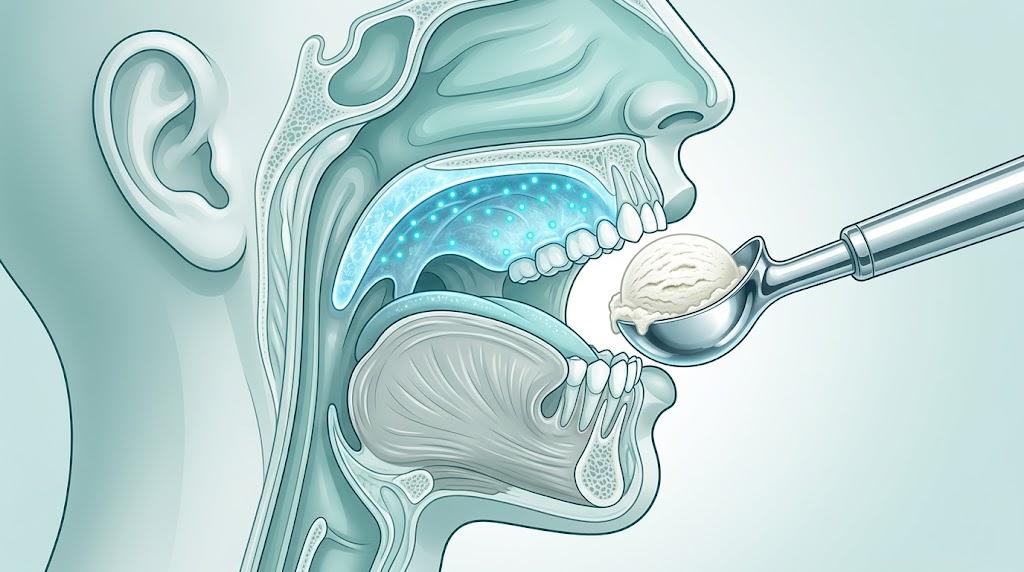
Two details decide whether you get an ice cream headache or not:
- Contact with the palate. Cold passing over the tongue alone is much less likely to trigger it. The cold has to reach the roof of the mouth or the back of the throat.
- Speed. A slow, careful spoonful may barely cool the tissue. A fast one drops its temperature sharply within seconds.
That second point is not a guess — it was tested in a randomized trial, which we’ll look at in a moment. It is also the reason the same ice cream eaten slowly can be painless, while the same ice cream eaten greedily feels like an attack.
Cold is not inherently painful, either. Your skin touches cold things all day without alarm. The problem is the rate of change: an abrupt, intense temperature swing in a small, nerve-rich zone is exactly the kind of signal your nervous system treats as an emergency. If you have ever wondered why the same cold can feel so different depending on how it arrives, that principle — temperature perception depends on material and context, not just degrees — is the same one behind why metal feels colder than wood at the same temperature.
What Happens Inside Your Head: The 60-Second Reflex
Once the palate is suddenly chilled, your body runs a reflex sequence that looks something like this:
Step 1: Sudden vasoconstriction
The blood vessels in the palate and nearby tissues clamp down — vasoconstriction — to limit heat loss. Blood flow through the cooled area drops sharply.
Step 2: The rebound — rapid vasodilation
Your body does not like cold tissue, so it immediately counterattacks: the vessels re-open aggressively to flood the area with warm blood. This rebound vasodilation is rapid and forceful, because the tissue near your brain’s blood supply is a priority for temperature defense.
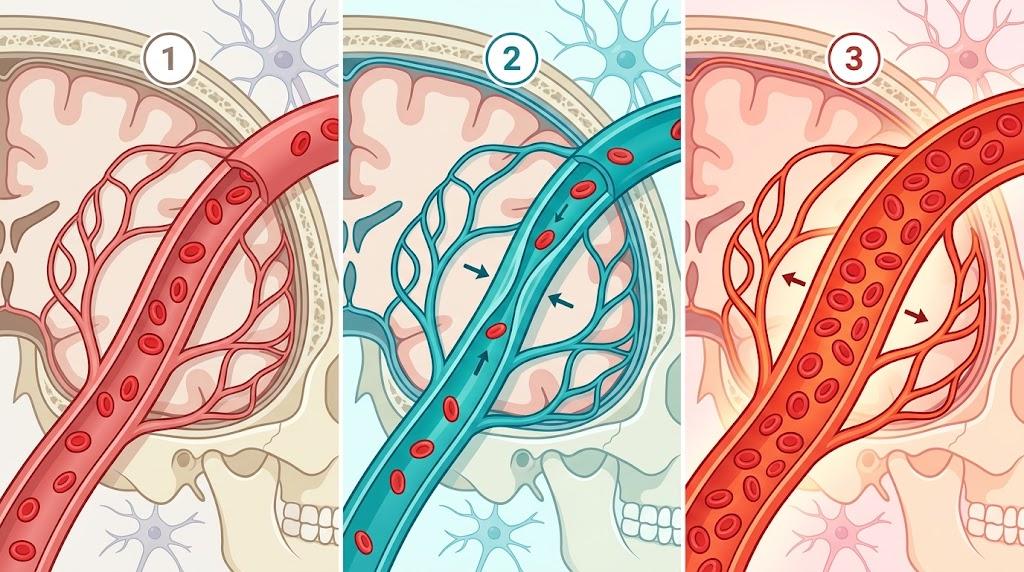
Step 3: The trigeminal-parasympathetic reflex fires
The rebound is mediated through a wiring loop between the trigeminal nerve — the great sensory nerve of the face — and parasympathetic fibers connected to the sphenopalatine ganglion behind the nose. The same reflex loop explains the side effects some people notice with an ice cream headache: a brief watery eye or a runny nose.
The laboratory evidence
This is not just a tidy story. In a 2019 study from Martin Luther University in Halle, Germany, researchers continuously measured blood flow velocity in the middle cerebral arteries of 77 healthy volunteers while they drank 200 ml of ice water as fast as possible.
The results, published in Frontiers in Neurology, were consistent: ice water caused blood flow velocity in the arteries to rise and cerebrovascular resistance to drop — the signature of vasodilation. And the volunteers who actually developed a cold-stimulus headache showed a significantly larger velocity increase than those who didn’t. In the people whose headache came with watery eyes, the increase was larger still. The authors concluded the pattern points to involvement of the trigeminal-parasympathetic vasodilator reflex — exactly the loop described above.
So the pain you feel is not the cold itself. It is the rewarming overshoot: vessels dilating fast, nerve fibers around them being stretched and activated, and pain signals racing up a nerve that normally reports sensation from the whole face.
The 30-Second Brain-Freeze Emergency Reset
The next time cold ice cream or an iced beverage triggers a piercing headache, immediately press the flat warm underside of your tongue firmly against the roof of your mouth.
Did rapid conductive rewarming of your posterior hard palate instantly halt the trigeminal pain signal behind your eyes?
Referred Pain: Why Your Forehead Hurts When Your Palate Is Cold
Here is the puzzle that makes this headache scientifically interesting: the cold is in your mouth, but the pain arrives in your forehead or temples. Why?
The answer is referred pain — the nervous system occasionally filing a signal under the wrong address.
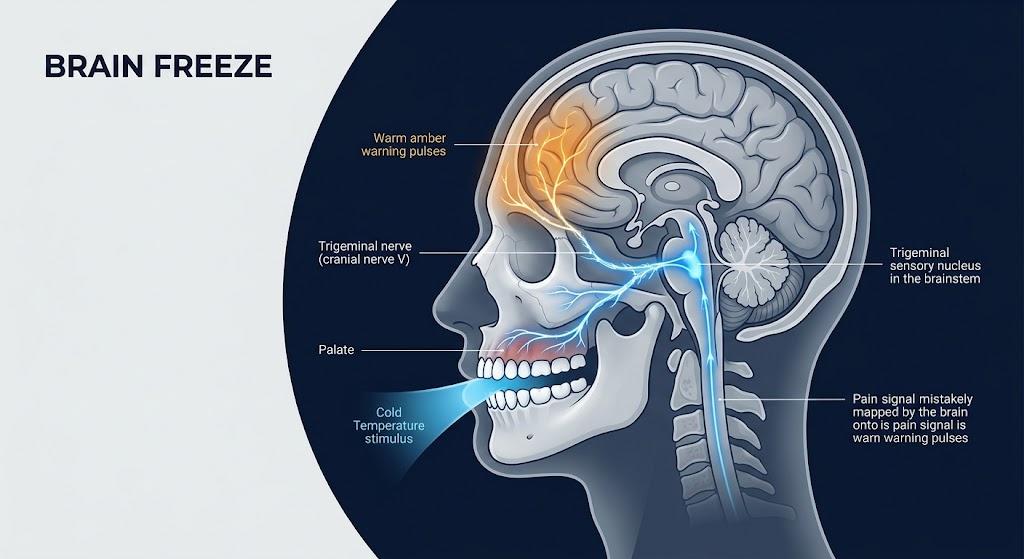
The pain fibers that serve the palate and the fibers that serve the forehead and temples all feed into the trigeminal nerve (the fifth cranial nerve), and ultimately converge on the same processing hub in the brainstem — the trigeminal nucleus. When a strong, unusual signal comes screaming in from the palate, the brain interprets it through that shared circuitry and projects the sensation onto the familiar facial territory served by the nerve: the forehead and temple.
In other words, your brain is making its best guess about where the trouble is — and it guesses wrong. This is the same failure mode behind more serious examples of referred pain, like heart attacks being felt in the left arm or jaw. The signal is real; the location is a reconstruction.
It is, honestly, one of the friendliest demonstrations of this glitch available. It is a controlled, harmless experiment you can run on yourself with a spoon: perception and reality briefly disagree, and you feel pain in a place nothing is happening. That disconnect — the brain confidently reporting sensations that do not match the world — shows up all over neuroscience, from the small lies your brain tells you every day to the way your brain can hear silence as a phantom sound.
Who Gets Brain Freeze? The Numbers (and the Migraine Connection)
It is common — but “common” varies a lot by group, and the pattern is revealing.
The best-verified figures from published research:
- University students: about 62% report having experienced an ice cream headache, according to a 2016 German survey study.
- Adults in general: roughly 22–36% — prevalence drops with age.
- A general-population cohort of 618 people aged 17–63 found a cold-stimulus headache prevalence of 51.3%, with no difference between men and women.
- In the famous 2002 ICE-H study published in the BMJ, 79% of 145 middle-school students reported lifetime ice cream headache.
- A 2023 systematic review confirmed that children and adolescents get cold-stimulus headache more often than adults, with a notable family history and significant comorbidity with migraine.
So the younger you are, the more likely you have felt it. But the most striking correlate is something else entirely:
People with migraine get brain freeze far more often than everyone else.
In experimental cold-stimulation studies, headache was provoked in about 17% of healthy adults, but in 23–32% of people with tension-type headache and a remarkable 48–74% of people with migraine. That gradient — healthy, tension-type, migraine — tells researchers something important: the trigeminal-vascular system that produces brain freeze is the same system involved in migraine, and in people with migraine it is hyperexcitable. A small cold trigger produces a big pain response.
This is why neurologists find the phenomenon genuinely interesting. It is a fast, safe, repeatable model of how the trigeminal-vascular reflex behaves — a tiny window into one of the most studied pain systems in the human body.
Does Hot Weather Matter? Science Tested It — in Winter
A popular belief says ice cream headaches only happen on scorching days. There is even an old suggestion in the literature that they can be induced “only in hot weather.”
In 2002, a paper published in the BMJ — the ICE-H study, designed and run by a father-and-daughter pair (the first author was a grade-8 student) — put that belief to a proper test. All 145 students at one Canadian middle school were randomized into two ice-cream-eating regimens, and the entire experiment was deliberately conducted in the middle of winter.
Two results matter here:
- Weather: 79% of the students reported lifetime ice cream headache, and headaches occurred fine in the cold season. Brain freeze is not a hot-weather phenomenon — what matters is the cold stimulus hitting the palate, not the air temperature around you.
- Speed: students assigned to the accelerated regimen (eating a scoped quarter of the ice cup in under 5 seconds, repeatedly) developed more ice cream headaches within the study window than those on the cautious regimen (half-spoonfuls over more than 30 seconds). Eating fast genuinely raises your risk.
The lesson is delightfully simple: mum was right. Slow down.
Is Brain Freeze Dangerous?
No. This is the clearest answer in this entire article.
This headache is classified as a primary headache — a headache that is itself the event, not a symptom of disease. It is self-limited, typically resolving within seconds to a couple of minutes, and it leaves no damage. Your brain cannot freeze from ice cream: it sits inside a warm, insulated skull, constantly perfused with blood at a regulated temperature, and the brief cooling of your palate does not reach it. The discomfort is a reflex misfire, not an injury.
There is one genuinely useful medical angle, and it points in the opposite direction of worry: because it is fast, reproducible, and harmless, it can teach you what a benign headache feels like — sudden, intense, and gone quickly, with no other symptoms. What deserves attention is different: headaches that are severe without any cold trigger, that keep recurring, that change pattern, or that come with neurological symptoms (vision changes, weakness, confusion, fever, neck stiffness). Those are not brain freeze and should be discussed with a clinician.
A quick comparison to keep the boundaries clear:
| Feature | Brain freeze | Migraine | Tension-type headache |
|---|---|---|---|
| Trigger | Cold food/drink on the palate | Multiple (stress, sleep, hormones, foods) | Stress, posture, fatigue |
| Onset | Seconds after the cold stimulus | Gradual over minutes–hours | Gradual |
| Duration | Seconds to minutes (resolves within 10 min) | 4–72 hours if untreated | 30 minutes to days |
| Other symptoms | Occasionally watery eye/runny nose | Nausea, light/sound sensitivity, aura possible | Mild scalp/neck tenderness |
| Danger | None | Disabling but not dangerous by itself | None |
How to Stop Brain Freeze Fast (and Prevent It Next Time)
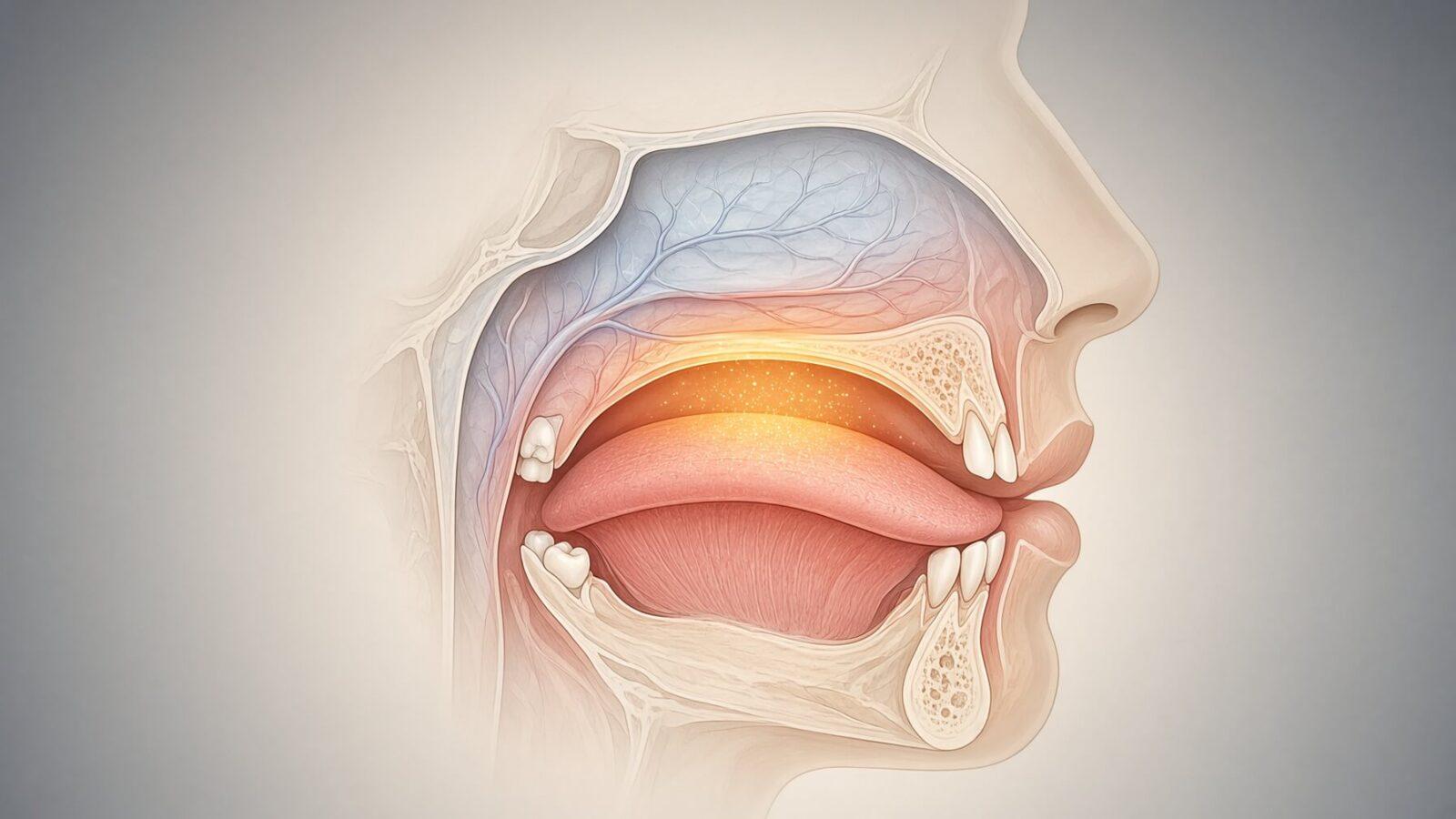
The reflex depends on the palate staying cold. Warm it, and the loop breaks. That single principle drives every effective remedy:
In the moment — to end it faster
- Press your tongue against the roof of your mouth. The tongue is warm; holding it against the palate transfers heat back into the tissue and shuts down the reflex’s trigger.
- Sip a warm (not hot) drink — water, tea — to rewarm the palate from the inside.
- Breathe warm air in through your mouth, cupping your hands in front of it in cold surroundings. Same logic: reheat the tissue.
And honestly: doing nothing also works. The pain is short by definition, because the reflex dies out as the palate warms on its own. The tricks above mainly buy back the seconds.
Prevention — so it doesn’t happen again
- Eat slowly and in small bites. The ICE-H trial showed the accelerated regimen provokes more headaches.
- Keep large cold masses away from the roof of your mouth. Guide ice cream and very cold drinks toward the tongue and cheeks, especially the first few bites when the cold is most intense.
- Let cold food warm slightly for a few seconds in your mouth before swallowing. The difference between 0°C slush and 5°C slush is the difference between a reflex and no reflex.
- Be extra careful with icy drinks through a straw — a straw shoots cold liquid straight at the posterior palate and throat, the exact zone the ICHD definition names.
Your body runs many of these odd little reflex programs all the time. It belongs to the same family of quirks as the hypnic jerk that shakes you awake and the yawn that cools your brain — ancient reflex loops that mostly work quietly in the background, and only become visible when something odd sets them off.
Myth vs. Fact
⚡ Myth vs. Fact
Myth: Your brain literally freezes.
Fact: The brain cannot freeze from ice cream. The pain is a vascular and nerve reflex triggered by rapid cooling of the palate — the brain’s temperature barely changes.
Myth: Brain freeze only happens in hot weather.
Fact: The BMJ ICE-H study deliberately ran in winter and still provoked headaches in students. Only the cold stimulus on the palate matters.
Myth: Brain freeze damages your brain.
Fact: It is a primary, self-limited headache. It resolves within seconds to minutes and causes no harm.
Myth: Everyone gets brain freeze.
Fact: Prevalence varies widely — from about a third of adults to nearly 80% of adolescents in some studies. Some people simply never get it.
Myth: Recurrent brain freeze is a sign of a brain disease.
Fact: Frequent brain freeze with a clear cold trigger is not dangerous. What deserves medical attention is severe, recurrent, or unusual headache without a cold trigger, or headache with neurological symptoms.
Myth: Pressing your thumb to your forehead cures it.
Fact: There is no solid evidence for the thumb trick. What works is rewarming the palate — tongue pressure, warm drinks, warm air.
Frequently Asked Questions About Brain Freeze
What is the scientific name for brain freeze?
The official classification calls it cold-stimulus headache (ICHD-3, section 4.5.2), sometimes written as “headache attributed to ingestion or inhalation of a cold stimulus” (HICS). Colloquially: ice cream headache. The technical nickname sphenopalatine ganglioneuralgia refers to the hypothesis that the sphenopalatine ganglion participates in the reflex.
How long does brain freeze last?
Usually 20–60 seconds, with the pain peaking quickly and fading within seconds to a few minutes after the cold stimulus is removed. By definition, it resolves within 10 minutes at most.
Why does brain freeze hurt in the forehead and not the mouth?
Because of referred pain. The palate and the forehead share wiring in the trigeminal system, so the brain projects the palate’s strong cold signal onto the forehead and temple regions served by that nerve.
Can brain freeze be dangerous or kill you?
No. It is a harmless, self-limited primary headache with no tissue damage. Severe headaches without a cold trigger, or with symptoms like vision changes, weakness, fever, or confusion, are a different matter and warrant medical evaluation.
Why do people with migraine get brain freeze more often?
Experimental studies provoke cold-stimulus headache in roughly 48–74% of migraine patients versus about 17% of healthy adults. Both phenomena involve the trigeminal-vascular system, which appears to be hyperexcitable in migraine.
Do children get brain freeze more than adults?
Yes. Prevalence is higher in children and adolescents than in adults — up to 79% lifetime in school samples — and decreases with age. In children there is no clear gender difference.
Can dogs get brain freeze?
Veterinary sources assume it is possible, since dogs have similar palatal cold receptors and trigeminal wiring, and anecdotal reports exist. But it has never been formally studied, so there is no verified answer — and no good reason to test it on your pet.
What is the fastest way to stop brain freeze?
Warm the palate: press your tongue against the roof of your mouth, or sip a warm drink, or breathe warm air through your mouth. The reflex ends when the cooled tissue is rewarmed.
When should I see a doctor about headaches?
Seek evaluation for headaches that are severe without any trigger, become frequent or change pattern, occur with neurological symptoms (vision changes, weakness, numbness, confusion, fever, stiff neck), or follow an injury. A headache that only ever appears with cold food and vanishes quickly does not fit any warning pattern.
Conclusion
So, why does ice cream hurt your head?
Because a spoonful taken too fast chills a nerve-rich patch at the roof of your mouth, your body answers with a rapid warming reflex that dilates blood vessels, and the pain signal travels up the trigeminal nerve — which reports to your brain from the forehead and temples, not the palate. Your brain, doing its best with a noisy line, files the pain in the wrong place.
Nothing freezes. Nothing is damaged. The whole episode is a sixty-second reflex — common in the young, commoner still in people with migraine, provable in winter, and stoppable with a warm tongue against the roof of your mouth.
And that is the quiet beauty of this strange little headache: it is one of the few moments when the machinery behind pain, temperature, and perception normally hidden from you becomes visible — with a spoon, a hot summer afternoon, and thirty seconds of staring into space, waiting for it to pass.
The next time it happens, you can enjoy a rare privilege: knowing exactly what your nervous system is doing, down to the artery, while everyone else just winces.
References and Sources
- Hensel, O., Burow, P., Mages, S., Wienke, A., Kraya, T., & Zierz, S. (2019). “Increased Blood Flow Velocity in Middle Cerebral Artery and Headache Upon Ingestion of Ice Water.” Frontiers in Neurology, 10:677. PubMed (PMID: 31316454) — verified; source of the MCA flow-velocity findings, the trigeminal-parasympathetic vasodilator reflex interpretation, the 77-volunteer protocol, and the cited prevalence figures.
- Headache Classification Committee of the International Headache Society (IHS). International Classification of Headache Disorders, 3rd edition (ICHD-3), section 4.5.2 “Headache attributed to ingestion or inhalation of a cold stimulus.” — verified; source of the official definition and diagnostic criteria.
- Kaczorowski, M., & Kaczorowski, J. (2002). “Ice cream evoked headaches (ICE-H) study: randomised trial of accelerated versus cautious ice cream eating regimen.” BMJ, 325(7378), 1445–1446. PubMed (PMID: 12493658) — verified; source of the 79% lifetime prevalence in 145 students and the winter/accelerated-eating findings.
- Bonemazzi, I., Pelizza, M. F., Berti, G., Ancona, C., Nosadini, M., Sartori, S., & Toldo, I. (2023). “Cold-Stimulus Headache in Children and Adolescents.” Life, 13(4), 973. PubMed (PMID: 37109502) — verified; systematic review, source of the higher pediatric prevalence, family history, and migraine comorbidity.
- Kraya, T., et al. (2020). “Prevalence and characteristics of headache attributed to ingestion or inhalation of a cold stimulus (HICS).” PubMed (PMID: 31645112) — verified; source of the 51.3% prevalence in a 618-person cohort with no gender difference.
- Zierz, A. M., et al. (2016). “Ice cream headache in students and family history of headache.” PubMed (PMID: 27039390) — verified; source of the 62% student prevalence and 36% (female) / 22% (male) adult figures.
- Selekler, H. M., et al. (2004). “Prevalence and clinical characteristics of an experimental ice cream headache.” PubMed (PMID: 15030539) — verified; experimental cold-stimulation study comparing migraine and tension-type headache patients.
- Bird, N., et al. (1992). “Ice cream headache — site, duration, and relationship to migraine.” PubMed (PMID: 1555929) — verified; source of the frontal/temporal site and short-duration characterization.
- Cleveland Clinic (2021). “Brain Freeze: What It Is, Symptoms, Treatment.” my.clevelandclinic.org — verified.
Disclaimer
By Aly ElDeeb — Science Writer & Literature Researcher | 📚 Fact-Checked & Sourced from Peer-Reviewed Studies
📚 You Might Also Like
Hand-picked articles for you


