


Fact-checked by Aly ElDeeb — Science writer & literature researcher, last verified September 2026. Sources: Alfonsi et al. (2019), Bjorvatn et al. (2010), AASM (ICSD-3).
There are few things stranger than hearing someone speak when they are clearly asleep.
Maybe it is a partner muttering a sentence that makes no sense. Maybe a child suddenly answers a question no one asked. Maybe someone says a perfectly ordinary phrase, laughs, whispers a name, or delivers what sounds like an entire speech — only to wake the next morning with absolutely no idea that any of it happened.
Then comes the inevitable question:
Why do people talk in their sleep?

The phenomenon is called somniloquy, or sleep talking, and it is much more common than the nighttime mystery surrounding it might suggest. In one large population survey, 66.8% of respondents reported having talked in their sleep at some point in their lives, while 17.7% reported sleep talking within the previous three months.
Most of the time, sleep talking is not a sign that something is wrong. It is a form of sleep-related vocalization that can occur during different stages of sleep and may happen with or without remembered dreams.
Yet the details matter.

A person who occasionally mumbles while sleeping is very different from someone who suddenly begins shouting, punching, kicking, or repeatedly acting out vivid dreams. Sleep talking can sometimes occur alongside other parasomnias or sleep disorders, and recognizing that distinction is more useful than trying to interpret the words themselves.
So what is actually happening inside the sleeping brain?
The answer begins with an important misconception: being asleep does not mean that every part of the brain switches off at once.
The Sleeping Brain Is Not Simply “Off”
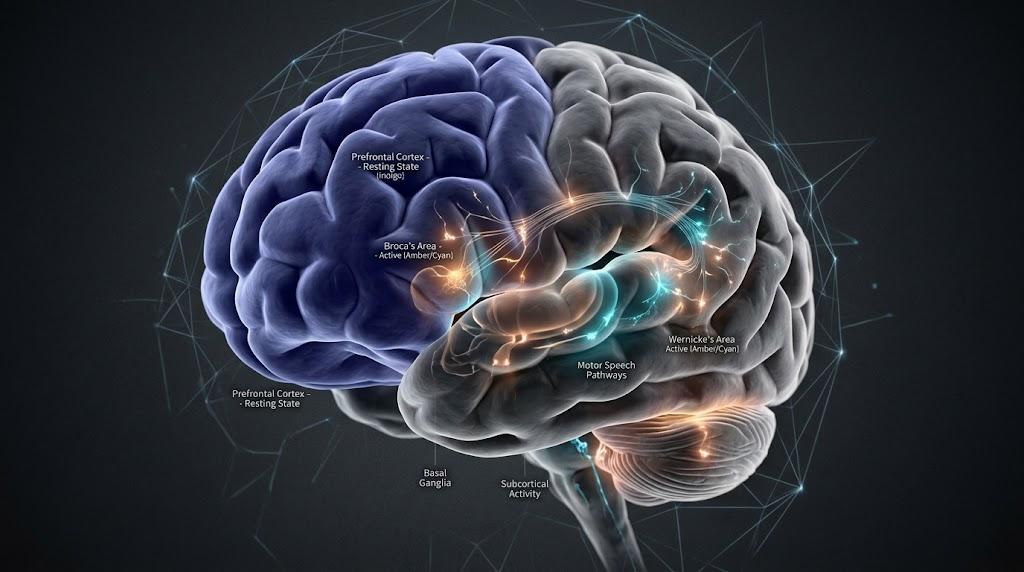
Sleep is an active biological state with its own patterns of brain activity.
Throughout the night, the brain moves through non-rapid eye movement (NREM) sleep and rapid eye movement (REM) sleep. NREM sleep includes three stages, ranging from relatively light sleep to the deepest stage. REM sleep is associated with high levels of brain activity and is the stage most strongly associated with vivid dreaming.
These stages are not isolated blocks. They occur in repeating cycles, with the balance between them changing as the night progresses.

That matters because sleep talking can occur during more than one stage of sleep.
A person does not need to be having a vivid REM dream in order to speak.
Some vocalizations occur during NREM sleep, while others happen during REM sleep or alongside other sleep behaviors. The American Academy of Sleep Medicine’s classification materials describe sleep talking as highly prevalent and note that it may occur following partial arousals from sleep.
This helps explain why two people can both talk in their sleep but sound completely different.
One might mumble a few indistinct words during a brief transition between sleep and wakefulness. Another might shout during a vivid dream. Someone else may produce sounds that seem emotionally charged but have no obvious connection to anything they remember dreaming about.
The underlying phenomenon is related, but the sleep state surrounding it can be quite different.
“People who talk in their sleep are involuntarily blurting out their deepest subconscious secrets and hidden truths.”
Polysomnography and linguistics research (Alfonsi et al., 2017) proves somniloquy consists of transient motor disinhibition during sleep-stage shifts—speech reflects automatic syntax and momentary dream-defense fragments, not verified wakeful truth.
So, Why Do People Talk in Their Sleep?
There is no single explanation that accounts for every episode.
Sleep talking appears to emerge from the interaction between sleep stage, partial arousal, brain activity, dreams, individual susceptibility, and factors that disrupt normal sleep.
That is why the most accurate answer to why do people talk in their sleep is not simply “because they are dreaming.”
Dreaming may be involved in some cases, but it does not explain all sleep talking.
A 2019 clinical review described sleep talking as an unaware production of vocalizations during sleep and emphasized that the relationship between spoken material and mental activity during sleep is still not completely understood.
Researchers have proposed several overlapping mechanisms.
1. Partial Activation During Sleep
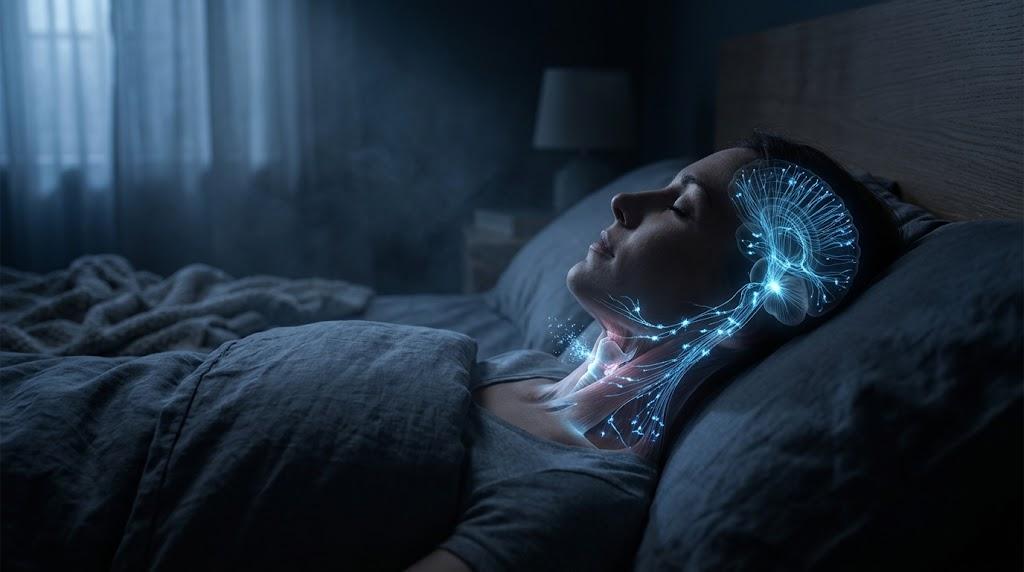
The brain does not necessarily transition between wakefulness and sleep like a light switch.
Some systems become less active while others remain capable of producing relatively organized activity. During partial arousals, aspects of speech production may become active without the person reaching full consciousness.
That can produce:
- mumbling
- whispered words
- short phrases
- responses to imagined situations
- laughter
- shouting
- apparently meaningless sounds
- surprisingly coherent sentences
The person may have no conscious awareness of the event.
This is one reason sleep talking can sound so bizarre. The machinery needed to produce speech can become active without the complete set of cognitive systems associated with deliberate waking conversation.
Sleep Talking and Dreams: Connected, but Not Identical
This is where popular explanations often go too far.
It is tempting to hear someone say something in their sleep and assume that the words are a direct transcript of their dream.
That conclusion is not justified.
Research suggests that some sleep talking can reflect ongoing dream or sleep mentation, but the relationship is inconsistent. The American Academy of Sleep Medicine notes that the content of sleep talking has not been shown to reliably reflect a person’s actual waking behavior or memories.
A person might therefore talk about something related to a dream — but the words should not automatically be treated as a literal window into their private thoughts.
What We Know
Sleep talking can sometimes coincide with dream activity.
Verbal material may preserve elements of the mental experience occurring during sleep, and researchers have investigated whether analyzing sleep speech can provide clues about how language and cognition operate during dreaming.
What We Don’t Know
We cannot reliably reconstruct an entire dream from a few spoken sentences.
We also cannot assume that every phrase has a hidden psychological meaning.
And there is no scientific basis for treating sleep talking as a reliable method of discovering someone’s secrets, desires, or memories.
That last point is important because the mythology surrounding sleep talking is much stronger than the evidence.
Can Sleep Talking Reveal Your Secrets?
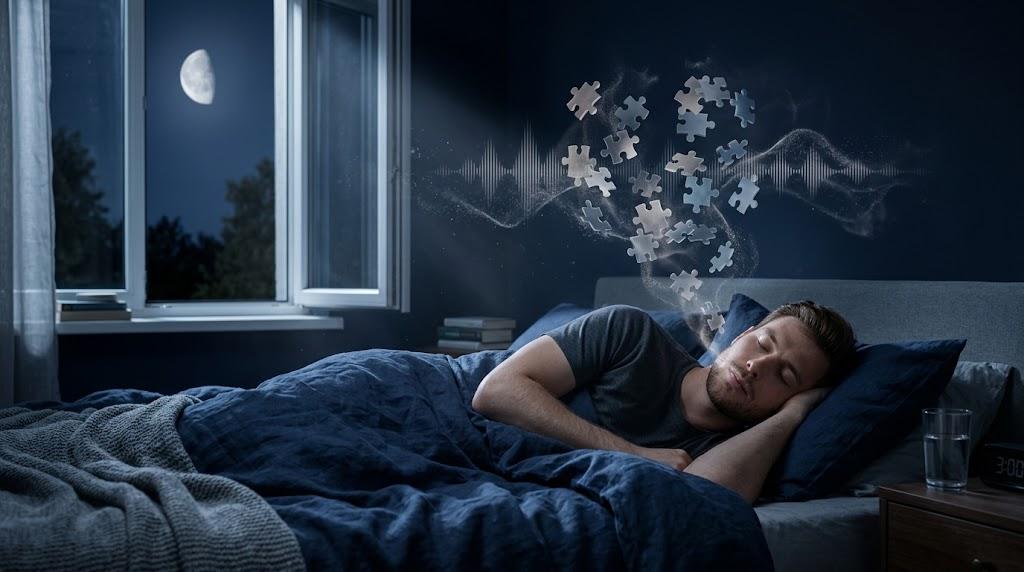
Not reliably.
The idea that sleeping people are incapable of lying — or that sleep talking exposes their deepest secrets — is a cultural myth, not an established scientific principle.
Sleep speech can be grammatically structured and can sometimes resemble ordinary conversation. But that does not mean the speaker has consciously decided what to say.
The AASM classification specifically notes that sleep-talking content has not been demonstrated to represent actual prior waking behavior or memories.
A sentence spoken during sleep might therefore be:
- connected to a dream,
- generated during a partial arousal,
- fragmented,
- emotionally influenced,
- completely unrelated to anything obvious,
- or impossible to interpret without additional context.
A strange sentence should remain a strange sentence — not become evidence in an argument the next morning.
What Does Sleep Talking Actually Sound Like?
There is a surprisingly wide range.
Imagine four people sleeping in the same house.
Person A quietly mumbles a few syllables and stops.
Person B whispers something that sounds like a response to a conversation.
Person C speaks a complete sentence at normal volume.
Person D suddenly shouts and moves their arms.
All four may appear to be “talking in their sleep,” but the clinical significance is not necessarily the same.
Sleep talking can involve whispers, ordinary speech, shouting, full sentences, unintelligible sounds, grunts, laughter, and other vocalizations.
The content is often less important than the pattern surrounding the behavior.
A rare, quiet mumble is generally very different from a new pattern of loud vocalizations accompanied by violent movements.
Is Sleep Talking Normal?
For most people, occasional sleep talking is generally considered harmless.
Sleep talking itself is classified as a parasomnia — a sleep-related behavior or experience occurring during sleep or around transitions between sleep and wakefulness.
The fact that something is classified as a parasomnia does not automatically mean it is dangerous or requires treatment.
Many parasomnias occur in otherwise healthy people.
The practical problem may simply be that one person’s nighttime vocalizations wake somebody else.
A partner might lose sleep. A roommate might be startled. A parent might worry after hearing a child shout. Someone sharing a room may become convinced that the speaker was awake when they were not.
In most cases, the issue is disruption rather than danger.
Why Does Sleep Talking Sometimes Get Worse?
Sleep is sensitive to disruption.
A person who normally sleeps quietly may notice more unusual nighttime behavior during periods of poor or fragmented sleep.
Potential contributors include:
- sleep deprivation
- irregular sleep schedules
- jet lag
- psychological stress
- anxiety
- alcohol
- certain medications or substances
- obstructive sleep apnea
- other sleep disorders
Clinical guidance from Cleveland Clinic identifies sleep disruption, sleep deprivation, stress and anxiety, jet lag, sleep apnea, and alcohol or substance misuse among factors that may contribute to sleep talking.
MedlinePlus similarly notes that sleep problems can be influenced by factors such as irregular schedules, caffeine or alcohol use, medications, mental health conditions, other medical conditions, and genetics, depending on the particular sleep disorder.
This does not mean that every episode has a single identifiable trigger.
Sometimes a person talks in their sleep simply because they are susceptible to doing so.
Stress May Matter — but Don’t Oversimplify It
You may have noticed that sleep behaviors seem different during stressful periods.
That observation is plausible, but it should not be turned into a simplistic rule that “stress causes sleep talking.”
Stress can affect sleep quality and sleep continuity. If sleep becomes fragmented or irregular, certain parasomnias may become more likely in susceptible people.
That is different from saying that every sleep-talking episode is a direct expression of anxiety.
There is no need to psychoanalyze every nighttime sentence.
A person who says “I forgot the meeting” while asleep has not necessarily revealed a profound unconscious fear about work.
Sometimes the sleeping brain produces speech because the sleeping brain is capable of producing speech.
Children and Sleep Talking
Sleep talking is especially common during childhood.
Children also experience a range of parasomnias, including sleepwalking and sleep terrors, and these behaviors often become less frequent as they mature.
For parents, the experience can still be unsettling.
A child may suddenly sit up, speak, cry, laugh, or appear partially awake while remaining asleep. They may have little or no memory of the event the next morning.
The important distinction is between an isolated, benign behavior and a recurring pattern involving significant distress, injury, breathing problems, or other unusual symptoms.
If a child’s nighttime behavior is frequent, dangerous, or accompanied by significant daytime sleepiness, discussing it with a pediatrician or sleep specialist can help determine whether further evaluation is appropriate.
A Quick Comparison: Ordinary Sleep Talking vs. Something More Concerning
| Pattern | More consistent with ordinary sleep talking | Worth discussing with a clinician |
|---|---|---|
| Frequency | Occasional or intermittent | Suddenly frequent or progressively worsening |
| Speech | Mumbling, phrases, short conversations | Loud screaming or repeated unusual vocalizations |
| Movement | Little or no movement | Punching, kicking, running or complex movements |
| Awareness | Usually absent | May wake fully and recall episodes depending on condition |
| Injury | None | Falls, bruises, injuries to self or partner |
| Breathing | Normal | Loud snoring, gasping or witnessed breathing pauses |
| Daytime effects | Usually minimal | Significant daytime sleepiness or impaired functioning |
| Onset | Longstanding pattern | New onset in adulthood, especially with other symptoms |
This table is not a diagnostic tool. It is a way to recognize why the surrounding context matters more than the mere presence of speech.
When Sleep Talking May Be Linked to Another Sleep Disorder
Sleep talking can occur by itself, but it can also accompany other parasomnias or sleep disorders.
That is where the subject becomes more clinically interesting.
Sleepwalking
Sleepwalking is a non-REM parasomnia in which a person can perform behaviors while remaining asleep.
Talking may occur during sleepwalking episodes, and the speech can be difficult to understand or disconnected from normal conversation.
The primary concern with sleepwalking is not usually the speech itself. It is the possibility of injury.
A person who walks around while asleep may encounter stairs, doors, windows, sharp objects, or other hazards.
Night Terrors
Sleep terrors can involve sudden intense fear, screaming, agitation, and autonomic arousal.
The person may look awake but remain difficult to console and may have little memory of the event later.
Vocalization during a sleep terror is therefore quite different from quietly mumbling during sleep.
REM Sleep Behavior Disorder
This is a particularly important distinction.
In REM sleep behavior disorder (RBD), the normal muscle paralysis associated with REM sleep is reduced or absent, allowing a person to physically act out dream-related behaviors.
Someone with RBD may shout, talk, punch, kick, or make other purposeful-looking movements during sleep.
That is not the same thing as ordinary sleep talking.
RBD is diagnosed using clinical history together with polysomnography demonstrating REM sleep without normal muscle atonia.
Because RBD can be associated with neurological disorders, particularly in older adults, repeated dream-enactment behavior deserves medical attention.
The distinction is not “talking versus not talking.”
It is talking alone versus talking as part of a broader pattern of dream enactment or abnormal nighttime behavior.
What About Sleep Apnea?
Obstructive sleep apnea repeatedly disrupts breathing during sleep.
Those disruptions can fragment sleep architecture and may coexist with parasomnias or other unusual nighttime behaviors. Clinical sleep resources identify sleep apnea as one possible factor associated with sleep talking.
If someone talks in their sleep and also:
- snores loudly,
- gasps or chokes during sleep,
- has witnessed breathing pauses,
- wakes with headaches,
- feels unusually sleepy during the day,
- or frequently wakes unrefreshed,
the breathing symptoms may deserve more attention than the speech itself.
Sleep talking does not diagnose sleep apnea.
It can simply be one clue that the person’s sleep is not as continuous as it should be. Fragmented sleep from any cause — including the hidden factors behind feeling tired after a full night’s sleep — is worth taking seriously.
Why Some Sleep Speech Sounds Completely Meaningless
This may be one of the strangest parts of the phenomenon.
A sleeping person can produce speech-like sounds that seem to have no logical structure at all.
That does not necessarily mean the brain is producing random noise.
Language is a complex system involving multiple processes: vocabulary, grammar, motor planning, memory, auditory processing, attention and executive control.
During sleep, these systems do not necessarily operate in exactly the same configuration as they do during wakefulness.
A person may therefore produce fragments of language without the normal monitoring and self-correction that accompany conscious conversation.
The result can sound like a sentence that starts normally and then dissolves into nonsense.
Research on sleep talking has considered the possibility that spoken material may reflect aspects of ongoing sleep mentation and the activation of psycholinguistic processes during sleep. But the researchers emphasize that our understanding remains incomplete.
That uncertainty is scientifically important.
We know that speech can emerge during sleep.
We do not yet have a complete explanation for every type of nighttime utterance.
Can You Understand What Someone Is Dreaming About From Their Speech?
Sometimes you may get a clue.
You cannot reliably reconstruct the dream.
Suppose someone dreams about missing a train and says, “Wait — don’t close the door!”
It would be reasonable to wonder whether the phrase relates to the dream.
But suppose they mumble, “Blue… tomorrow… no, that’s not it.”
There may be no useful interpretation at all.
Dream content and sleep speech can overlap, but the relationship is not sufficiently reliable to treat sleep speech as a direct transcript of dreams. The scientific literature describes the connection as promising for research while emphasizing that the evidence remains incomplete.
This is one reason sleep researchers remain interested in the phenomenon.
Sleep talking may offer researchers a rare opportunity to observe fragments of verbal cognition while a person remains asleep.
It is intriguing precisely because we do not yet understand all of it.
Myth vs. Fact
⚡ Myth vs. Fact
Myth: Sleep talkers reveal their deepest secrets.
Fact: There is no reliable scientific basis for treating sleep speech as a truth serum. Sleep-talking content does not reliably reflect waking memories or behavior.
Myth: Sleep talking only happens during dreams.
Fact: Sleep talking can occur during both REM and non-REM sleep.
Myth: Every sleep-talking episode means something psychologically important.
Fact: Many episodes are ordinary sleep-related vocalizations without a known deeper meaning.
Myth: Sleep talking always indicates poor mental health.
Fact: Sleep talking is common and can occur in otherwise healthy people.
Myth: If someone talks loudly during sleep, they definitely have REM sleep behavior disorder.
Fact: RBD is only one possible explanation, and formal diagnosis requires specific clinical and polysomnographic criteria.
Myth: You can diagnose someone by recording their voice overnight.
Fact: A recording can be useful information for a clinician, but it cannot by itself establish a diagnosis.
What Can You Actually Do About Sleep Talking?
For many people, nothing specific is required.
If sleep talking is occasional and causes no distress, the most sensible approach may simply be to leave it alone.
However, improving overall sleep quality is reasonable because sleep disruption can contribute to parasomnia-like behaviors.
A practical nighttime reset might look like this:
1. Keep a consistent sleep schedule.
Going to bed and waking up at approximately consistent times can support more stable sleep.
2. Give yourself enough time to sleep.
Adults generally need around seven to nine hours of sleep, although individual requirements vary.
3. Reduce avoidable sleep disruption.
A noisy bedroom, irregular schedule, excessive alcohol, or late-day stimulant use can interfere with sleep quality.
4. Pay attention to stress.
You do not need to eliminate stress completely. The goal is to avoid allowing persistent stress and arousal to repeatedly interfere with sleep.
5. Treat underlying sleep problems.
If you have symptoms suggesting sleep apnea or another sleep disorder, addressing that problem may be more useful than trying to suppress the speech itself.
6. Don’t turn nighttime conversations into interrogations.
The person may genuinely have no idea what they said.
That last point sounds humorous, but it is practical. Sleep speech is involuntary behavior.
Should You Wake Someone Who Is Talking in Their Sleep?
Usually, there is no medical need to wake someone simply because they are talking.
If the person is otherwise safe and the behavior is brief, allowing them to continue sleeping is generally reasonable.
The situation changes if there is a risk of injury.
Someone who is shouting while simultaneously punching, kicking, climbing out of bed, or moving around the room may need to be kept safe, and recurrent episodes should be evaluated.
The objective is not to “stop” every unusual sound.
It is to distinguish harmless sleep behavior from behavior that indicates a broader problem.
When Should You Talk to a Doctor?
A single episode of sleep talking usually does not justify a medical investigation.
A pattern is more important.
Consider speaking with a healthcare professional or sleep specialist if:
- sleep talking suddenly begins in adulthood;
- episodes become frequent or dramatically louder;
- there is screaming, intense fear or severe agitation;
- the person punches, kicks or otherwise acts out dreams;
- someone is being injured;
- there are repeated episodes of walking or other complex behavior;
- loud snoring or breathing pauses occur;
- significant daytime sleepiness develops;
- episodes interfere substantially with sleep quality;
- symptoms are associated with a new medication or substance;
- the behavior is causing substantial concern or disruption.
Cleveland Clinic specifically recommends considering evaluation when sleep talking appears suddenly in adulthood or involves intense fear, screaming, or violent actions.
A clinician may decide that no testing is necessary.
In other cases, an overnight sleep study may be appropriate.
What Happens During a Sleep Study?
A sleep study, or polysomnography, is designed to observe what happens to the brain and body during sleep.
Depending on the study, monitoring can include:
- brain-wave activity,
- eye movements,
- heart rate,
- breathing,
- blood oxygen,
- muscle activity,
- body movements,
- and video of nighttime behavior.
For suspected REM sleep behavior disorder, video polysomnography is particularly important because clinicians need to determine whether abnormal behavior occurs during REM sleep and whether normal REM muscle atonia is absent.
This illustrates an important principle in sleep medicine:
The same outward behavior can have different causes.
A microphone might tell you that someone shouted.
A complete sleep evaluation can potentially tell you what sleep stage they were in, what their muscles were doing, how their breathing was behaving, and whether another disorder was disrupting their sleep.
Does Sleep Talking Mean You Are Not Sleeping Deeply?
Not necessarily.
Sleep talking can occur during different stages of sleep, so its presence does not provide a simple measurement of sleep depth.
Someone can talk during lighter sleep, during a partial arousal, or during REM sleep.
Likewise, hearing someone speak does not automatically mean they are “almost awake.”
The sleeping brain can generate surprisingly sophisticated behavior without conscious awareness.
That is one of the reasons sleep remains such a fascinating area of neuroscience.
What Does Sleep Talking Mean?
If by “meaning” you mean a hidden psychological message, there is usually no reliable answer.
If you mean what does sleep talking tell us about the sleeping brain, the answer is much more interesting.
It demonstrates that aspects of language production can remain active during sleep.
It also shows that sleep is not a state of complete neurological silence. Different networks and processes can become active to different degrees, sometimes producing behavior that looks surprisingly similar to waking behavior.
Researchers have used sleep talking as one way of thinking about the relationship between language, memory, dreams and consciousness. A 2019 review suggested that systematic investigation of sleep speech could contribute to understanding mental processes during sleep, while emphasizing that much remains unknown.
In that sense, a strange sentence spoken at 3 a.m. is not necessarily a message waiting to be decoded.
It is evidence that the sleeping brain is doing something far more complicated than simply shutting down.
A Closer Look at the Neuroscience
During wakefulness, speech is supported by a network of interacting brain regions rather than one isolated “speech center.”
Producing a sentence involves conceptual processing, word retrieval, language formulation, motor planning, and coordination of the muscles used for speech.
Sleep changes the level and pattern of activity across these systems.
Some cognitive functions become markedly reduced. Others remain active in altered forms.
This creates the possibility of partial activation: enough neural activity to generate vocal output, but not enough coordinated waking cognition to produce a normal, intentional conversation.
The result can occupy an unusual middle ground.
The voice sounds purposeful.
The speaker is not consciously participating.
The sentence may be meaningful.
The overall episode may make no sense.
This is why the phenomenon is so easy to misunderstand.
From the outside, speech feels like proof of consciousness.
It isn’t.
Why You Usually Don’t Remember Talking in Your Sleep
Memory formation is not guaranteed simply because an event happened.
A person can produce sounds during sleep without forming a lasting waking memory of the episode.
This is particularly understandable when the event occurs during a sleep state or partial arousal without a complete transition into wakefulness — a boundary problem related to the same mechanisms explored in why we forget dreams instantly.
The result is a peculiar experience: someone else can describe a conversation you supposedly had overnight, while you have absolutely no subjective memory of it.
That mismatch is normal.
In fact, lack of awareness is characteristic of sleep talking. Most people learn about their nighttime speech from a partner, parent, roommate, or recording rather than from their own memory.
What About People Who Talk in Complete Conversations?
Complete sentences can sound more alarming than mumbling because they create the impression that the sleeper is consciously interacting with someone.
But organized speech does not necessarily mean organized consciousness.
Sleep speech can preserve aspects of syntax and semantic structure even when the person remains unaware. The AASM review notes that sleep-talking utterances can retain substantial syntactic and semantic structure resembling waking speech.
That is one of the most interesting features of somniloquy.
The sleeping brain can produce something that sounds linguistically coherent without the person deliberately planning the conversation.
The Difference Between Sleep Talking and Acting Out Dreams
These behaviors are often confused.
Sleep talking:
The primary feature is vocalization during sleep.
Dream enactment:
The person performs movements or behaviors that correspond to dream content.
A person with ordinary sleep talking may remain physically still while quietly speaking.
Someone experiencing dream enactment may shout while punching or kicking.
Dream enactment is particularly important when it is repetitive, vigorous, or associated with injury because it can occur in REM sleep behavior disorder and other conditions that require evaluation.
This is why the question “Why do people talk in their sleep?” cannot be answered solely by looking at the words.
Sleep medicine looks at the whole episode.
What We Know — and What Remains Uncertain
Established
- Sleep talking is common.
- It can occur during sleep without conscious awareness.
- It can occur during different sleep stages.
- It is generally harmless when it occurs in isolation.
- It can occur alongside other parasomnias.
- Sleep disruption and certain sleep disorders can be associated with unusual nighttime behaviors.
Plausible but still being investigated
- Some sleep speech may reflect ongoing dream mentation.
- Sleep speech may provide clues about language processing during sleep.
- Some utterances may relate to memory or recent experiences.
Research reviews have proposed these possibilities, but they should not be presented as established explanations for every episode.
Not supported as a reliable conclusion
- Sleep talking exposes hidden secrets.
- Every sentence has a psychological meaning.
- Every episode represents a dream.
- Talking in sleep automatically means someone has a sleep disorder.
The distinction between evidence and interpretation is especially important with a subject as easy to sensationalize as sleep behavior.
The Simplest Explanation May Be the Most Useful
Imagine the brain during sleep as a complex building rather than a house with one master power switch.
Some rooms are closed.
Some lights remain on.
Some systems are operating at reduced capacity.
Occasionally, a door opens between systems that normally operate more separately.
Speech can emerge.
Movement can emerge.
Dream imagery can become vivid.
A person may partially awaken and then fall back asleep.
The sleeping brain is not malfunctioning simply because it behaves differently from the waking brain.
That is the central idea behind understanding why do people talk in their sleep.
For most people, it is simply one of the many ways the boundary between sleep and wakefulness can become temporarily porous.
Practical Takeaway
If you or someone you live with talks in their sleep, start with the simplest interpretation.
Occasional mumbling or brief speech is usually not something to fear.
Look at the broader pattern instead.
Is the person sleeping reasonably well?
Are there breathing problems?
Is there sleepwalking?
Are they acting out dreams?
Are they hurting themselves or somebody else?
Did the behavior suddenly begin in adulthood?
Is there severe daytime sleepiness?
Those questions are far more informative than trying to decode a sentence spoken at 2 a.m.
And if the behavior is new, intense, dangerous, or associated with other sleep symptoms, professional evaluation is appropriate.
FAQ: Sleep Talking
Why do people talk in their sleep?
People talk in their sleep for several possible reasons, including normal variations in sleep-related brain activity, partial arousals, dreams, sleep disruption, stress, sleep deprivation, and other parasomnias. There is no single cause that explains every episode.
Is sleep talking normal?
Yes. Occasional sleep talking is common and is usually harmless when it occurs by itself. It becomes more important to evaluate when it is sudden, frequent, violent, highly disruptive, or accompanied by other unusual sleep behaviors.
What is sleep talking called medically?
The medical term is somniloquy. It refers to vocalization or speech produced during sleep without conscious awareness.
Does sleep talking mean you are dreaming?
Not necessarily. Sleep talking can happen during both REM and non-REM sleep. Some episodes may relate to dreams, but not all sleep speech can be explained by dream content.
Can sleep talking reveal someone’s secrets?
No reliable scientific evidence supports the idea that sleep talking reveals hidden secrets or guarantees truthful statements. Sleep speech is involuntary and may not accurately represent waking memories or intentions.
Why do people talk in their sleep more when stressed?
Stress can disrupt sleep and make sleep less stable, which may contribute to parasomnia-like behaviors in susceptible people. However, stress is not a universal explanation for sleep talking, and not every episode is caused by anxiety.
Can children grow out of sleep talking?
Sleep talking is particularly common in childhood and often becomes less frequent with age. Persistent, disruptive, dangerous, or unusual episodes may warrant discussion with a pediatrician or sleep specialist.
Is loud sleep talking dangerous?
Loud speech alone is usually not dangerous. However, loud vocalizations combined with punching, kicking, falling from bed, or other vigorous behaviors may indicate a different sleep disorder and should be evaluated.
Is sleep talking a sign of REM sleep behavior disorder?
Not by itself. REM sleep behavior disorder involves repeated dream-enactment behaviors and requires specific clinical and polysomnographic findings.
When should I see a doctor about sleep talking?
Consider professional evaluation if sleep talking begins suddenly in adulthood, becomes frequent or severe, involves screaming or violent movements, causes injuries, occurs alongside breathing problems, or produces significant daytime sleepiness.
Can you stop sleep talking?
There is no universal method that guarantees it will stop. Improving sleep regularity, reducing sleep deprivation, addressing stress and treating underlying sleep disorders may reduce episodes in some people. Severe cases require evaluation for the underlying cause rather than simply trying to suppress the speech.
Conclusion
So, why do people talk in their sleep?
Because sleep is not a state in which every part of the brain becomes inactive at the same time.
Speech can emerge from a sleeping brain during different stages of sleep, sometimes alongside dreams and sometimes during partial arousals that have little obvious connection to remembered dream content. For most people, the behavior is common, involuntary, and harmless.
The interesting part is not that someone can say a sentence while asleep.
It is that the sleeping brain can produce language at all while conscious awareness is largely absent.
That makes sleep talking more than a funny nighttime habit. It is a small glimpse into the complicated relationship between language, dreaming, memory, arousal and consciousness.
And if someone tells you what you said in your sleep last night?
You are allowed to ask for evidence.
Just don’t assume the evidence tells you what you were secretly thinking.
References and Sources
- Alfonsi, V., D’Atri, A., Scarpelli, S., Mangiaruga, A., & De Gennaro, L. (2019). “Sleep talking: A viable access to mental processes during sleep.” Sleep Medicine Reviews, 44, 12–22. PubMed (PMID: 30594004)
- Bjorvatn, B., Grønli, J., & Pallesen, S. (2010). “Prevalence of different parasomnias in the general population.” Sleep Medicine, 11(10), 1031–1034. PubMed (PMID: 21093361) — source of the 66.8% lifetime and 17.7% current prevalence figures.
- American Academy of Sleep Medicine. International Classification of Sleep Disorders, Third Edition (ICSD-3) — Parasomnias. Darien, IL.
- Cleveland Clinic (2024). “Why Do People Talk in Their Sleep?” health.clevelandclinic.org
- MedlinePlus. “Sleep Disorders.” U.S. National Library of Medicine / National Institutes of Health. medlineplus.gov
- Mayo Clinic. “REM Sleep Behavior Disorder — Symptoms and Causes.” mayoclinic.org
- Mayo Clinic. “REM Sleep Behavior Disorder — Diagnosis and Treatment.” mayoclinic.org
- Cleveland Clinic. “Sleep Basics: What It Is, Why It’s Important, Stages, REM & NREM.” my.clevelandclinic.org
Disclaimer
By Aly ElDeeb — Science Writer & Literature Researcher | 📚 Fact-Checked & Sourced from Peer-Reviewed Studies


