


Imagine you are on a first date. Instead of going to a quiet, boring coffee shop, your date takes you to a terrifying amusement park to ride the tallest, fastest rollercoaster in the city. As you plummet down the track, your heart is pounding, your palms are sweating, and your adrenaline is surging. When the ride is over, you look at your date and suddenly feel an intense, overwhelming romantic attraction to them. You might think you just found your soulmate, but what you are actually experiencing is the suspension bridge effect psychology. Your brain has just been hacked by your own fear.
For decades, scientists have studied the complex relationship between physical fear and romantic love. While they seem like complete opposites, the human brain actually processes both emotions using the exact same biological pathways. When you are in physical danger, your body reacts the exact same way it does when you are intensely physically attracted to someone. To understand the suspension bridge effect psychology fully, we are going to explore one of the most famous and controversial experiments in modern psychology, uncover how your brain misinterprets danger as desire, and explain why taking someone to a horror movie is the greatest first date strategy ever invented.
The 1974 Capilano Bridge Experiment

To truly understand this bizarre cognitive glitch, we must look at the groundbreaking study that gave the phenomenon its name. In 1974, psychologists Donald Dutton and Arthur Aron conducted an ingenious experiment in British Columbia, Canada. They chose two very different bridges to test the limits of the suspension bridge effect psychology.
The first bridge was the Capilano Suspension Bridge—a terrifying, wobbly, wooden bridge suspended 230 feet above a jagged river. It swayed violently in the wind. The second bridge was a solid, low, heavy cedar bridge built just 10 feet above a calm, shallow stream. It was completely safe and stable.
The psychologists hired a highly attractive female research assistant to stand in the middle of each bridge. As unaccompanied men walked across, she would approach them, ask them to fill out a brief, boring psychological questionnaire, and then offer them her phone number, saying, “If you want to know more about the results of this study, feel free to call me tonight.”

The Shocking Results
The men who crossed the safe, boring bridge acted normally. Only 12.5% of them actually called the female assistant later that night. Their heart rates were stable, and they were not particularly intrigued by the interaction.
However, the results from the terrifying suspension bridge were staggering. A massive 50% of the men who met the woman on the scary, wobbly bridge called her that night. Furthermore, when the researchers analyzed the stories the men wrote on their questionnaires, the men from the scary bridge wrote highly romantic and sexualized narratives, while the men on the safe bridge wrote dull, mundane stories.
Why did this happen? The men on the suspension bridge were experiencing extreme physical fear. Their hearts were racing, their breathing was shallow, and their adrenaline was spiking. When they suddenly saw an attractive woman, their brains became confused. Instead of saying, “My heart is pounding because I am terrified of falling off this bridge,” the brain concluded, “My heart is pounding because I am intensely attracted to this beautiful woman.” This biological confusion is the ultimate proof of the suspension bridge effect psychology.

Whether experienced on a high wooden footbridge or an unpredictable turbulent flight, the core dynamics of the suspended bridge effect demonstrate how easily physical instability transforms into emotional vulnerability.
The Biology of Fear and Love
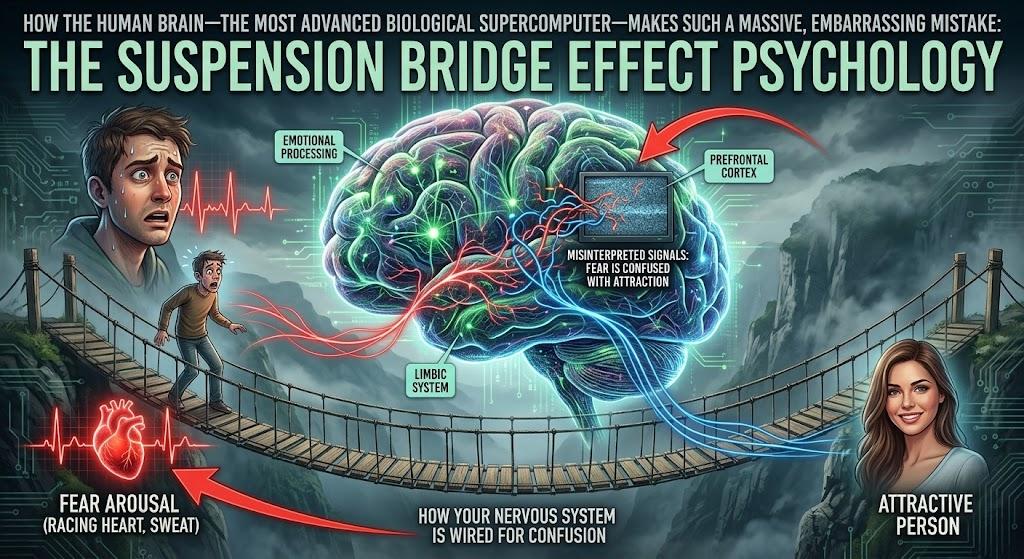
How can the human brain—the most advanced biological supercomputer on the planet—make such a massive, embarrassing mistake? It all comes down to how your nervous system is wired. This wiring is what makes the suspension bridge effect psychology so incredibly potent in our daily lives.
This evolutionary blind spot ranks among the most disturbing facts about the human brain: our conscious mind does not always have direct access to why it feels what it feels, leaving it vulnerable to fabricating stories to match internal sensations.
When you encounter a terrifying situation (like looking down from a 230-foot bridge), your sympathetic nervous system activates the “fight or flight” response. Your adrenal glands flood your bloodstream with adrenaline and cortisol. Your heart beats faster to pump oxygen to your muscles, your pupils dilate, and your hands begin to sweat. This is purely a survival mechanism.
However, what are the physical symptoms of falling deeply in love or experiencing intense physical attraction? Your heart beats faster, your pupils dilate, and your palms sweat. The physiological symptoms of mortal terror and romantic love are absolutely identical. The brain only has one physical “alarm system” for intense arousal, regardless of whether that arousal is positive (lust) or negative (fear).
Therefore, when you are in a state of high physical arousal due to fear, your prefrontal cortex has to guess the cause of the arousal based on your surroundings. If there is a dangerous bear, it guesses fear. If there is an attractive person standing next to you, it incorrectly guesses love. In this way, every subtle environmental cue in your immediate vicinity serves as an external trigger that guides your subconscious appraisal. This cognitive bias is a prime example of how easily our logical mind can be hijacked by our own hormones.

In Dutton and Aron's famous 1974 suspension bridge experiment, why did men crossing a shaky 230-foot chasm call the female interviewer far more often?
Horror Movies and First Dates: Weaponizing the Effect

Once you understand the suspension bridge effect psychology, you will realize why certain cliches in dating and pop culture actually have a deep scientific basis. For decades, teenagers have intuitively known that taking a date to a terrifying horror movie is a great way to spark a romance.
When a jump scare happens on screen, your date’s heart rate spikes. The adrenaline floods their system. When the movie ends and the lights come on, their brain is still swimming in adrenaline. They look over at you, and their brain automatically misattributes that residual physiological arousal to you. They suddenly find you significantly more attractive, charming, and exciting than they did before the movie started.
This is why extreme sports, haunted houses, rollercoasters, and even heated arguments can be massive catalysts for romantic attraction. The context of the situation creates the physical arousal, but the brain assigns the credit to the person you are with.

The “Toxic Relationship” Phenomenon
While taking a date on a rollercoaster is harmless and fun, there is a very dark and dangerous side to the misattribution of arousal. Because of the suspension bridge effect psychology, many people become trapped in toxic, chaotic, or highly dramatic relationships.
In a healthy, stable relationship, there is very little fear or anxiety. The heart rate is normal. For some people, this normal state feels “boring.” In a toxic relationship, however, there is constant screaming, fighting, jealousy, and fear of abandonment. These intense, negative emotions cause massive spikes in adrenaline and cortisol.
When the couple finally makes up after a terrifying fight, their brains are highly aroused. They mistake the relief of ending the fight for intense, passionate love (often resulting in what is colloquially known as “makeup sex”). They become addicted to the cycle of fear and relief, falsely believing that the intense anxiety they feel is actually just “fiery passion.” They are living on a permanent emotional suspension bridge, unable to tell the difference between anxiety and affection.
How to Tell if It Is Real Love
If your brain is so easily tricked by its own heartbeat, how can you ever know if your feelings for someone are genuine, or if you are simply experiencing the illusion of the suspension bridge effect psychologyHere are a few ways to bypass the illusion:
1. Change the Context
If you met someone during a highly intense, scary, or adrenaline-fueled situation (like a wild party, a protest, or a terrifying flight), you cannot trust your initial feelings. You must see them in a highly boring, mundane context. Go grocery shopping with them, or sit in silence at a library. If your heart is still fluttering when there is zero external stimuli, the attraction is likely genuine.
2. Wait for the Adrenaline to Fade
Adrenaline has a relatively short half-life in the human body. Do not make any major romantic declarations or commitments while you are in a state of high arousal. Sleep on it. Once your nervous system returns to baseline the next day, evaluate your feelings using logic rather than emotion.
Decoupling Adrenaline from Genuine Emotional Connection
We like to believe that love is a magical, mystical force that connects two souls. However, science proves that romance is often just a highly complex chemical equation happening inside our nervous system. The suspension bridge effect psychology is a humbling reminder that we are not always the rational masters of our own minds.
Our brains are constantly trying to make sense of the chaotic signals sent by our bodies, and sometimes, they get the translation completely wrong. The next time you find your heart racing in the presence of a stranger, take a step back and ask yourself: Are you actually falling in love, or are you just standing on a wobbly bridge?
Frequently Asked Questions (FAQ)
1. What is the suspension bridge effect psychology in simple terms?
It is a psychological phenomenon where people mistake the physical symptoms of fear (like a racing heart and sweating palms) for intense romantic or sexual attraction toward whoever happens to be with them at the time.
2. What is the scientific term for this effect?
In academic psychology, this phenomenon is officially known as the “Misattribution of Arousal.”
3. Who conducted the original Suspension Bridge Experiment?
The landmark study was conducted in 1974 by psychologists Donald Dutton and Arthur Aron at the Capilano Suspension Bridge in British Columbia, Canada.
4. Why do scary movies make good dates?
Scary movies induce physical fear and adrenaline. Because the symptoms of fear and lust are biologically identical, your date’s brain will often misinterpret the fear caused by the movie as romantic attraction toward you.
5. Can this effect ruin relationships?
Yes. Many people confuse the intense anxiety and fear of a toxic, dramatic relationship with “passion.” They become addicted to the adrenaline spikes caused by fighting, falsely believing it is a sign of deep love.
Related reading you might find interesting:
- disturbing facts about the human brain
- how small environmental cues influence behavior without you noticing
- how false memories form
- your brain lies
References
- Dutton, D.G. & Aron, A.P. (1974). Some evidence for heightened sexual attraction under conditions of high anxiety. Journal of Personality and Social Psychology, 33(4), 510-517. DOI: 10.1037/h0036256
- Schachter, S. & Singer, J. (1962). Cognitive, social, and physiological determinants of emotional state. Psychological Review, 69(5), 379-399. DOI: 10.1037/h0046234
Scientific References & Studies
- Dutton, D. G., & Aron, A. P. (1974). Some evidence for heightened sexual attraction under conditions of high anxiety. Journal of Personality and Social Psychology, 30(4), 510-517. PubMed PMID: 4436577.
- Schachter, S., & Singer, J. (1962). Cognitive, social, and physiological determinants of emotional state. Psychological Review, 69(5), 379-399. PubMed PMID: 14497895.
- Meston, C. M., & Frohlich, P. F. (2003). Love at first fright: Partner salience moderates physiological arousal and sexual attraction. Archives of Sexual Behavior. PubMed PMID: 14700445.
📚 You Might Also Like
Hand-picked articles for you


