


One of the most terrifying creepy facts about the human brain is that it lacks pain receptors entirely. The brain can process sensory agony from the rest of the body, but brain tissue itself cannot feel physical pain. Furthermore, your nervous system constantly edits your visual reality in real-time, frequently inventing false memories and deleting objects from your vision to conserve metabolic energy.
Most of us operate under the comforting assumption that we are the conscious masters of our own minds. We trust our sensory perceptions, we believe our vivid memories are accurate recordings of history, and we assume our thoughts represent rational deliberation. However, modern cognitive neuroscience reveals a far stranger, deeply unsettling reality. Exploring these creepy facts about the human brain exposes that the three-pound organ inside your skull is not a flawless logical computer—it is an ancient, paranoid biological survival engine operating in total darkness.
Your nervous system does not prioritize objective truth; it prioritizes evolutionary survival and metabolic efficiency. To keep you alive in a hostile environment, your brain routinely alters your sensory perceptions, invents fictional people during sleep, rewrites historical facts in your memory, and conceals massive blind spots from your conscious awareness. Once you understand the deeper biological mechanisms at play, learning these creepy facts about the human brain permanently changes how you perceive your conscious identity and everyday reality.
Before examining each neurological phenomenon in detail, it helps to understand why researching creepy facts about the human brain feels so intuitively shocking. We are accustomed to treating our conscious ego as an independent driver controlling a biological vehicle. In truth, neuroscience demonstrates that the conscious mind is more like a passenger sitting in the back seat, observing decisions that unconscious neural networks have already finalized.
12 Creepy Facts About the Human Brain Explained by Neuroscience

1. It Generates Fictional Human Beings While You Sleep
Have you ever awakened from an intense, vivid dream remembering the face of a complete stranger? You might assume your imagination created that person from scratch, but neuroscience indicates that the brain cannot spontaneously fabricate a biologically accurate human face. Instead, your fusiform face area (FFA)—the specialized neural cluster responsible for facial recognition—harvests fragments of faces you have unconsciously glanced at throughout your lifetime.
Every unfamiliar face in your nocturnal dreams is a composite Frankenstein creation. Your brain stores thousands of micro-impressions from passersby on crowded streets, grocery store cashiers, and background actors in television shows. During REM sleep, the hippocampus and neocortex stitch these stored facial geometries together, presenting you with a completely fictional human being that feels eerily familiar and alive. This is one of the most intriguing creepy facts about the human brain and its nocturnal generative power.

2. You Are Permanently Living 80 Milliseconds in the Past
You believe you are experiencing the present moment in real time, but physical reality and neural processing operate at different speeds. Visual signals take approximately 50 milliseconds to travel from retinal photoreceptors through the lateral geniculate nucleus to the primary visual cortex. Auditory signals require around 10 to 15 milliseconds, while tactile signals from your feet take significantly longer to travel up the spinal cord.
Because different sensory modalities travel at different transmission velocities, your brain cannot broadcast incoming data immediately without causing sensory chaos. To solve this, the brain enforces a biological buffer known as temporal binding, delaying your conscious perception by roughly 80 milliseconds. You are permanently living in the past, observing a synchronized, post-produced broadcast of reality that has already occurred.
3. It Hallucinates Textures Over Your Visual Blind Spot
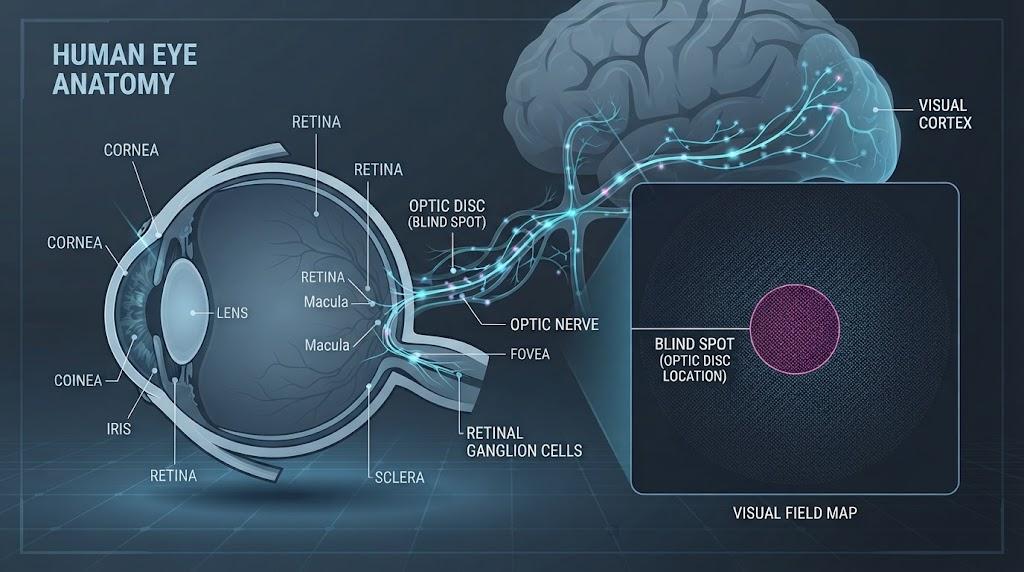
In each of your eyes, there is an anatomical area on the retina completely devoid of photoreceptor cells (rods and cones). This is the optic disc, where the bundle of optic nerve fibers exits the eyeball to reach the brain. Despite this permanent hole in your visual field, you never perceive two gaping black voids in your daily vision.
More Read

This seamless visual field is an active illusion generated by your primary visual cortex (V1) through a process called perceptual filling-in. When incoming sensory data is absent, your brain examines surrounding colors, lighting, and geometric patterns, instantly fabricating synthetic visual information to paint over the hole. Understanding these creepy facts about the human brain confirms that you are constantly looking at neurological guesswork rather than objective sensory data.
4. It Can Implant False Memories That Feel 100% Real
Human memory does not function like a digital video recorder; it is a reconstructive, malleable neural process. Pioneering research led by cognitive psychologist Dr. Elizabeth Loftus has demonstrated that subtle verbal suggestion and repetitive visualization can easily implant completely fabricated autobiographical memories into healthy individuals.
In landmark clinical experiments, researchers successfully convinced adult participants that they had gotten lost in a shopping mall as a young child, suffered an attack by a wild animal, or committed a minor crime in their teenage years. Within a few guided interviews, participants not only believed the fictional events occurred but also provided rich, emotional sensory details—proving that the emotional intensity of a memory has zero correlation with its factual truth.
5. Intrusive Thoughts: It Thinks Without Your Permission
Almost everyone has experienced a sudden, horrifying thought: a sudden urge to jerk the steering wheel into oncoming traffic, jump from a high balcony, or drop a fragile object. In psychology, these alarming flashes are called egodystonic intrusive thoughts, and they highlight a chilling reality: you do not deliberately generate your thoughts.
The brain’s Default Mode Network (DMN) acts as a constant, autonomous scenario generator, continuously producing thousands of hypothetical permutations per hour. These disturbing thoughts are essentially evolutionary safety simulations—your subconscious mind tests boundary conditions and models catastrophe so you remain alert. You are not the author of your thoughts; you are merely the conscious observer witnessing whatever neural cascades emerge from the subconscious basement. This explains why discovering these creepy facts about the human brain can be so deeply humbling.
6. The Hyperactive Threat System Prefers Paranoia Over Safety
If you have ever felt a sudden chill of terror while sitting alone in a dark room—convinced someone was standing silently behind you—you have experienced the Hyperactive Agency Detection Device (HADD). From an evolutionary perspective, our ancestors lived in environments populated by stealthy predators and hostile competitors.

In evolutionary biology, making a “Type I error” (believing a rustling bush is a tiger when it is just the wind) costs a small amount of metabolic energy. Making a “Type II error” (believing a tiger is just the wind) results in death. Consequently, natural selection engineered the human amygdala to be perpetually paranoid, deliberately generating false feelings of being watched rather than risking a single undetected threat. This survival mechanism is closely connected to why the brain replays embarrassing moments at night when sensory distractions vanish.
7. It Cannot Tell the Difference Between Physical Threat and Pure Imagination
When you are being chased by a predator, your sympathetic nervous system initiates the fight-or-flight response: your adrenal glands flood your bloodstream with cortisol and epinephrine, your heart rate accelerates, bronchial tubes dilate, and non-essential functions like digestion halt immediately.
Chillingly, the neurochemical axis cannot distinguish between a physical life-or-death crisis and an imagined catastrophe. When you lay in bed ruminating about financial disaster, social embarrassment, or health anxieties, your brain activates the exact same physiological cascade. Over time, chronic activation of this stress response damages arterial walls, weakens hippocampal neurons, and suppresses the immune system purely based on thoughts that have never materialized. This physiological hijack connects directly to why you feel tired after 8 hours of sleep due to nocturnal cortisol spikes.
8. It Creates Real Physical Pain Where No Body Exists
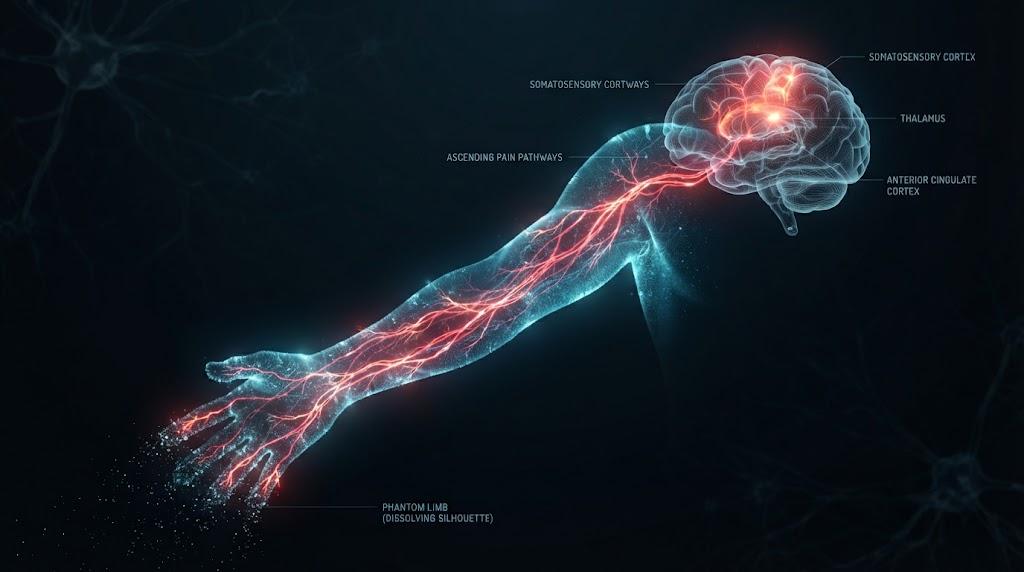
One of the most foundational principles of neurology is that pain does not exist within bodily tissues; pain is a neural construct generated by the neuromatrix in the brain. If you cut your finger, nociceptive nerves send electrical signals to the spinal cord, but the agony itself is computed in the somatosensory cortex, anterior cingulate cortex, and insula.
This biological separation is vividly illustrated by phantom limb pain. Up to 80% of individuals who undergo surgical limb amputations experience burning, crushing, or twisting pain in a body part that no longer exists physically. Because the cortical representation of the limb remains etched in the brain’s sensory map, the mind continues to feel real, agonizing pain in empty air. This phenomenon is another reminder of how these creepy facts about the human brain challenge our basic assumptions about the physical body.
9. It Rewrites and Corrupts Your Past Every Time You Remember It
We intuitively imagine our memories stored safely in neural filing cabinets, remaining pristine until we choose to recall them. However, molecular neuroscience demonstrates that memory operates through a volatile cycle known as memory reconsolidation.
Every time you retrieve a long-term memory from hippocampal storage, the underlying neural synapses become biochemically fragile and editable. While the memory is active in conscious working memory, your current emotional state, recent conversations, and new beliefs are permanently rewritten into the original trace. By the time you “save” the memory back into long-term storage, it is an altered copy. Your oldest childhood memories are not direct recordings; they are copies of copies of copies, heavily distorted by time. Unraveling such creepy facts about the human brain shows that our personal autobiographies are living fiction.
10. It Actively Deletes 99% of Your Conscious Reality
At any given moment, your sensory organs are bombarded by an estimated 11 million bits of information per second through sight, sound, touch, smell, and internal proprioception. Conscious human working memory, however, can only process roughly 40 to 60 bits per second.
To keep you from experiencing fatal cognitive overload, the thalamus acts as an aggressive sensory filter, deleting over 99.9% of incoming data before it ever reaches conscious awareness. You do not feel the continuous pressure of your clothes against your skin, you do not consciously see your own nose despite it resting in your field of view, and you tune out background frequencies. Your brain creates a highly sanitized, drastically reduced version of the universe to keep you functional, proving once again how creepy facts about the human brain govern our everyday reality.
11. Your Identity and Moral Compass Are Biologically Fragile
Philosophers have long debated the nature of the human soul and moral character, but clinical neurology demonstrates that your fundamental personality, ethical boundaries, and emotional empathy are tethered to fragile physical neural circuits. The famous historical case of Phineas Gage in 1848 showed how a localized iron rod injury to the ventromedial prefrontal cortex transformed a polite, dependable foreman into an erratic, profane stranger.
Similarly, subtle neurodegenerative conditions, localized ischemic strokes, or microscopic shifts in neurotransmitter balance can instantly transform a loving parent into an aggressive sociopath, eliminate moral inhibitions, or erase lifelong passions. Who you consider “yourself” is entirely dependent on the physical integrity of thin synaptic connections that can be altered in an instant. This physiological fragility is also seen in subtle nervous misfires, such as why your eye twitches randomly under stress.
12. It Will Fiercely Defend Delusions to Protect Social Belonging
Perhaps the most disturbing of all creepy facts about the human brain is its profound aversion to objective truth. Evolutionary psychology shows that for early hunter-gatherers, social ostracization from the tribe meant certain death, whereas holding factual misconceptions about the cosmos rarely killed anyone. As a result, the human brain evolved to prioritize social conformity and psychological comfort over empirical reality.
When presented with indisputable mathematical or factual evidence that contradicts an identity-defining belief, your brain does not calmly update its knowledge. Instead, functional MRI scans reveal that the amygdala treats ideological contradictions as physical threats, activating defensive cognitive biases (such as the backfire effect and motivated reasoning) to rationalize falsehoods and protect the ego. This bias illustrates how environmental cues influence behavior without our conscious awareness.
Which terrifying neurological fact about your brain is completely true and verified by medical science?
Neuroscience vs. Perception: The Brain’s Hidden Mechanics
To understand why these cognitive phenomena occur, examining the underlying neuroanatomical architecture reveals how biological survival mechanisms distort daily conscious experience. Studying these creepy facts about the human brain helps demystify why our perception feels continuous while operating on fractured biological hardware:
| Brain Mechanism | What Your Brain Does | The Illusion You Experience |
|---|---|---|
| Temporal Binding Buffer | Holds and synchronizes sensory signals for ~80ms. | You feel like you live in the instant “Now.” |
| Perceptual Filling-In | Paints fabricated visual patterns over the optic disc. | You see a continuous, complete visual field. |
| Synaptic Reconsolidation | Modifies synaptic weights upon memory retrieval. | You believe your past memories are 100% accurate. |
| Thalamic Sensory Gating | Discards 99.9% of incoming environmental sensory signals. | You experience a calm, manageable sensory reality. |
| Neuromatrix Pain Synthesis | Generates pain sensations internally via central circuits. | Pain feels located directly within physical limbs. |
Why Evolution Built a Deceptive Mind
When confronted with these creepy facts about the human brain, it is tempting to view the human nervous system as broken, deceptive, or poorly engineered. However, evolutionary biologists emphasize that none of these phenomena are design flaws. Every single shortcut, hallucination, and bias was forged across hundreds of thousands of years of brutal selective pressure.
An organism that paused to consciously verify the mathematical validity of every rustling leaf was quickly eaten. An organism that remembered every mundane detail collapsed under metabolic exhaustion. Similar physiological misinterpretations are observed in the suspension bridge effect, where autonomic arousal is mistaken for romantic attraction. By understanding these creepy facts about the human brain, you gain psychological liberation: you no longer have to blindly believe every intrusive thought, fearful prediction, or subjective certainty that emerges into your conscious awareness.
Ultimately, learning about these creepy facts about the human brain reminds us that human consciousness is an ongoing biological negotiation. Your brain balances sensory inputs, predictive models, and metabolic budgets to keep you functional, even if it has to fabricate small illusions along the way.
The Resilient Architecture Behind Everyday Brain Quirks
- Learning creepy facts about the human brain reveals that conscious awareness operates on an 80-millisecond delay, synchronizing sensory modalities after events occur.
- The visual system actively fabricates imagery over the physiological blind spot, presenting a predictive simulation rather than raw reality.
- Human memories are rewritten during every retrieval cycle via synaptic reconsolidation, altering your personal history over time.
- Intrusive thoughts and paranoid sensations are ancient evolutionary alert simulations designed to prevent fatal survival errors.
- Pain is synthesized in the brain rather than in physical tissues, enabling phantom limb sensations without physical stimuli.
- The brain prioritizes social survival and metabolic efficiency over empirical, objective truth.
Frequently Asked Questions
Can the brain actually feel physical pain?
No. While exploring creepy facts about the human brain, one of the most surprising findings is that brain tissue itself has zero nociceptors (pain receptors). Neurosurgeons routinely perform complex craniotomies and open-brain surgeries on patients who remain fully conscious, speaking, and pain-free once local anesthesia numbs the scalp and skull lining.
Why does the brain generate terrifying intrusive thoughts?
Intrusive thoughts are generated primarily by the Default Mode Network testing safety parameters. By presenting your conscious mind with a sudden worst-case scenario (such as dropping a baby or swerving into traffic), your brain triggers an immediate aversion response, reinforcing your behavioral inhibition and ensuring you remain hyper-vigilant against potential danger. This is among the most commonly experienced creepy facts about the human brain.
Is it true that humans only use 10% of their brain capacity?
No, the 10% brain myth is entirely false. Functional neuroimaging (fMRI) and positron emission tomography (PET) scans prove that virtually 100% of the brain is active and metabolically demanding. Even during non-REM deep sleep, complex neural networks across all lobes remain engaged in cellular repair, memory consolidation, and waste clearance.
Why do old memories feel so clear if they are inaccurate?
The perceived vividness of a memory is driven by amygdala activation and emotional significance, whereas factual accuracy depends on hippocampal synaptic fidelity. During recall, the brain reconstructs the narrative and fills gaps with current knowledge, creating a cohesive, emotionally intense memory that feels undeniably real despite significant factual divergence.
How does the brain filter out background sensory noise?
Sensory filtering is managed primarily by the reticular activating system (RAS) and the thalamus. These neural gatekeepers suppress repetitive, non-threatening background stimuli (such as the hum of air conditioning or the weight of a watch) through neural habituation, reserving conscious attention for novel or biologically relevant signals, illustrating another dimension of these creepy facts about the human brain.
Academic References
- Loftus, E. F. (2005). Planting misinformation in the human mind: A 30-year investigation of the malleability of memory. Learning & Memory, 12(4), 361-366. DOI: 10.1101/lm.94705
- Eagleman, D. M., & Sejnowski, T. J. (2000). Motion integration and postdiction in visual awareness. Science, 287(5460), 2036-2038. DOI: 10.1126/science.287.5460.2036
- Ramachandran, V. S., & Hirstein, W. (1998). The perception of phantom limbs: The D. O. Hebb lecture. Brain, 121(9), 1603-1630. DOI: 10.1093/brain/121.9.1603
- Nader, K., Schafe, G. E., & Le Doux, J. E. (2000). Fear memories require protein synthesis in the amygdala for reconsolidation after retrieval. Nature, 406(6797), 722-726. DOI: 10.1038/35021052
- Bargh, J. A., & Morsella, E. (2008). The unconscious mind. Perspectives on Psychological Science, 3(1), 73-79. DOI: 10.1111/j.1745-6916.2008.00064.x


