


When you lie down in a dark, quiet room, external sensory input drops substantially. In this low-demand state, the brain’s Default Mode Network (DMN) shifts into higher activity, facilitating spontaneous self-referential thought and autobiographical memory retrieval. Interacting with the human negativity bias, this internal processing often brings unresolved social interactions into conscious focus just as you attempt to sleep.
If you have ever found yourself staring at the ceiling at 2:00 AM because you are suddenly remembering embarrassing moments at night, you are not alone. You are finally relaxed, the lights are off, and you are just about to drift into sleep. Without warning, your brain decides to replay a hyper-realistic, high-definition memory of that time you waved back at a stranger who was actually waving to the person standing directly behind you five years ago.
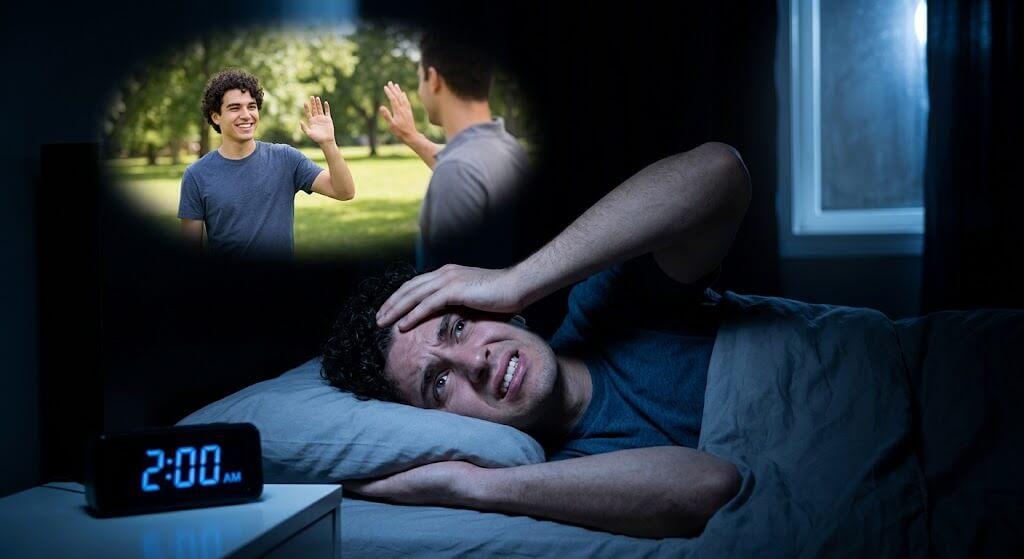
You physically cringe in the dark. Your heart rate spikes, your face flushes with heat, and sleep becomes completely impossible. Why does your brain choose the exact moment you need to rest to torture you with your past social failures? Is it a sign of an anxiety disorder? Is it a broken memory system? Or is your brain just fundamentally wired to torment you?
In cognitive neuroscience, the phenomenon of remembering embarrassing moments at night reflects spontaneous resting-state cognition. It emerges from the interplay between the Default Mode Network (DMN), autobiographical memory consolidation, and evolutionary mechanisms attuned to social belonging. Let us explore the science of the “midnight cringe,” examine how the brain processes social feedback, and look at practical cognitive strategies to calm the nervous system for sleep.
The primary scientific reason you find yourself remembering embarrassing moments at night is the activation of the Default Mode Network. Discovered by neuroscientist Marcus Raichle in 2001, the DMN is a network of interacting brain regions that is active when a person is not focused on the outside world. During the day, your brain is occupied with sensory input (work, talking, scrolling on your phone). When you lie down to sleep in the dark, sensory input drops to zero. In the absence of external distractions, your brain switches into its “Default Mode,” which is highly active and responsible for self-reflection, daydreaming, and retrieving autobiographical memories.
The Neuroscience of the Midnight Cringe
To understand this frustrating nighttime habit, we must first look at how the brain prioritizes and stores memories. The human brain is not a neutral hard drive that records all events equally. It is a highly biased, survival-oriented machine that categorizes memories based on their emotional intensity and their perceived threat level.
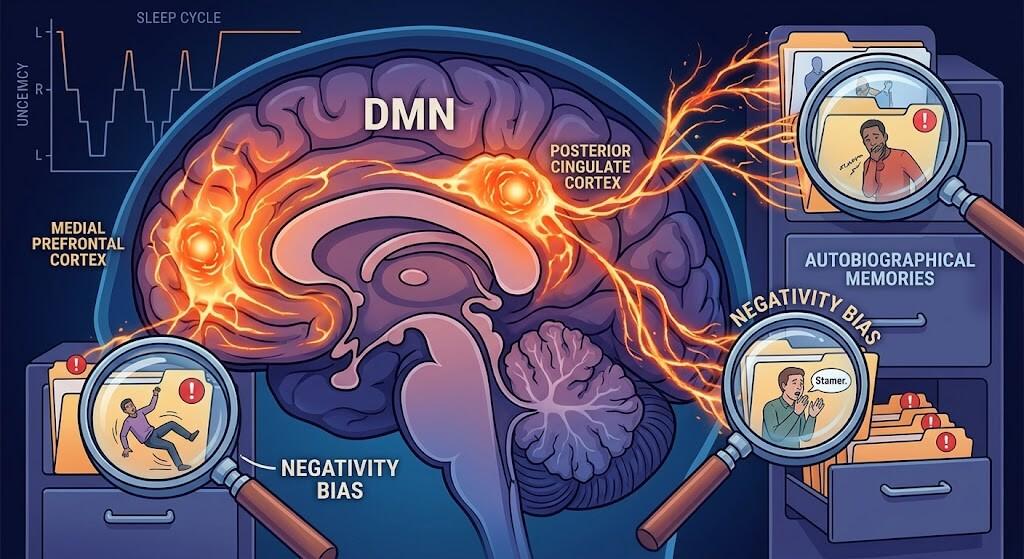
When you are in the quiet of the night, the Default Mode Network begins scanning your mental archives to consolidate memories. Because the human brain has a natural “Negativity Bias,” it heavily favors reviewing negative, threatening, or emotionally painful memories over happy ones. This is an evolutionary survival mechanism designed to help you learn from past mistakes so you do not repeat them in the future.

This cognitive asymmetry helps explain why self-critical or awkward memories often surface more vividly than neutral or positive ones. Because social cohesion was vital for human ancestral survival, negative social feedback is prioritized for retrospective evaluation, prompting the mind to mentally review past interactions to recalibrate social behavior.
Evolutionary Biology: Why Social Pain Equals Physical Pain

You might wonder why a minor social faux pas from a decade ago can trigger such an intense, visceral reaction when you are perfectly safe in your bed. Why does it physically hurt to remember?
To early humans living in hunter-gatherer tribes, social rejection was literally a death sentence. If you did something deeply embarrassing or offensive and were ostracized from your tribe, you would not survive alone in the wilderness. Therefore, the brain evolved to process social pain (like embarrassment, shame, and rejection) in the exact same neurological pathways as physical pain.
More Read

In a fascinating study on social pain, neuroscientists discovered that the brain’s anterior cingulate cortex lights up during moments of social embarrassment, just as it does when you stub your toe. Remarkably, studies have even shown that taking an over-the-counter physical painkiller like Acetaminophen (Tylenol) can actually reduce the emotional sting of social rejection.
When autobiographical retrieval re-activates an awkward experience, salience networks and the amygdala can register the associated emotional distress, triggering mild autonomic arousal. This momentary sympathetic response produces the familiar bodily sensations of embarrassment—facial warmth, accelerated pulse, and muscle tension—even though no immediate environmental danger exists.
The Physiology of Cringe: Why You Sweat and Blush
The midnight cringe is not just a mental phenomenon; it is a full-body physiological response. When that embarrassing memory hits your conscious mind, it triggers the sympathetic nervous system.
Your brain immediately dumps a micro-dose of adrenaline into your bloodstream. This causes your heart rate to accelerate, preparing you to either fight or flee from the “threat” (even though the threat happened five years ago). Simultaneously, you experience vasodilation—the blood vessels in your face and neck expand rapidly, rushing warm blood to the surface of your skin, causing you to blush in the pitch dark.
You might even find yourself physically groaning, shaking your head, or whispering a random word out loud (like “Stop” or “No”) to physically break the mental loop. This is your body desperately trying to pull you out of the internal memory and back into external reality.
The 7-Year-Old Awkward Memory Paradox
At 1:00 AM, your brain violently serves up a memory of you stuttering or dropping something embarrassing in front of peers 7 years ago. How many of those witnesses actually remember it today?
The Spotlight Effect: A Grand Cognitive Illusion
One of the main reasons these memories carry so much emotional weight is a cognitive bias known as the Spotlight Effect. This is the psychological phenomenon where people tend to believe they are being noticed more than they really are.

Because we are the center of our own universe, we assume everyone else is paying close attention to our actions. When you tripped in the cafeteria in high school, you felt like a spotlight was shining directly on you, and you assume everyone who witnessed it remembers it vividly to this day.
In reality, human beings are incredibly self-absorbed. The people who witnessed your embarrassing moment likely forgot about it ten minutes later because they were too busy worrying about how they looked. Reminding yourself of the Spotlight Effect is a powerful tool to neutralize the shame associated with remembering embarrassing moments at night. No one is thinking about your awkward wave. They are all lying awake thinking about their own awkward waves.
The Role of Sensory Deprivation and Rumination
Why does this almost exclusively happen at night? During the day, your prefrontal cortex is busy processing visual, auditory, and physical information. If an embarrassing thought pops up, you can easily push it away by focusing on your computer screen, talking to a coworker, or listening to music.
At night, in a dark, quiet room, you enter a state of mild sensory deprivation. Without external data to process, the brain turns its processing power completely inward. The thoughts get louder because there is no background noise to drown them out. This quiet environment is the perfect breeding ground for rumination—the repetitive, obsessive thinking about negative past events.
Rumination is dangerous because it reinforces the neural pathways associated with the painful memory, making it even more likely to pop up the next night.
How to Stop the Midnight Cringe and Finally Sleep
If you are tired of losing sleep because your brain insists on remembering embarrassing moments at night, you cannot simply use willpower to stop thinking about it. (Try telling someone “Don’t think of a pink elephant” and see what happens). Instead, you must use cognitive and physiological hacks to bypass the system.
1. The Cognitive Shuffle
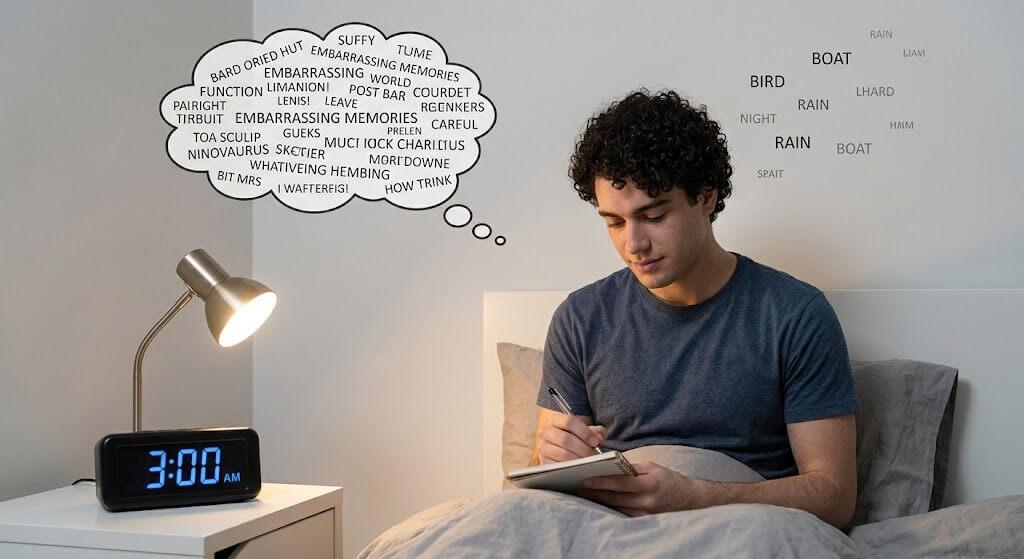
Because the brain cannot process a vivid, emotional memory and random, logical data at the same time, you can force the Default Mode Network to shut down by playing a mental game called the Cognitive Shuffle. Think of a random, emotionally neutral word (like “BIRD”). Now, visualize as many objects as you can that start with B (Ball, Banana, Boat). Then move to I (Ice, Igloo). This forces the brain to use its logical processing centers, actively suppressing the emotional memory centers and mimicking the random thought patterns that precede sleep.
2. Externalize the Memory (Journaling)
Your brain keeps bringing the memory up because it believes the “threat” is unresolved. Keep a small notebook by your bed. When the awkward memory strikes, write it down in one sentence. By externalizing the thought onto physical paper, you signal to your amygdala that the information has been safely recorded, categorized, and does not need to be actively monitored while you sleep.
3. Somatic Processing (Body Awareness)
When the cringe hits, your instinct is to fight the feeling. Instead, lean into the physical sensation. Notice where you feel the heat in your face, or the tightness in your chest. By focusing entirely on the physical sensations rather than the mental story, you activate the parasympathetic nervous system, which calms the body down. The physical feeling of embarrassment usually dissipates within 90 seconds if you do not feed it with more thoughts.
Scientific Distinction: What the Evidence Supports vs. Current Hypotheses
- Resting-State DMN Activation: Marcus Raichle’s seminal fMRI findings demonstrate that when external tasks cease, the Default Mode Network coordinates internal autobiographical reflection and self-referential thought.
- Neural Overlap of Social and Physical Pain: Neuroimaging studies (Eisenberger et al., 2003) show that social exclusion and acute embarrassment recruit dorsal anterior cingulate cortex (dACC) and anterior insula regions shared with physical pain processing.
- The Spotlight Effect: Empirical social psychology (Gilovich et al., 2000) consistently proves that individuals substantially overestimate how prominently others notice and remember their social mistakes.
- Evolutionary “Social Threat Calibration”: While evolutionary models suggest nocturnal replay evolved to calibrate future social safety, empirical cognitive research notes that severe nocturnal rumination is largely unconstructive and impairs sleep architecture.
- Tylenol / Acetaminophen Effects: While small clinical studies reported slight reductions in social distress following acetaminophen administration, meta-analyses caution that emotional blunting effects vary widely across individuals and do not constitute a clinical intervention for rumination.
The Bottom Line on the Midnight Cringe
The midnight cringe is not a sign of an anxiety disorder, and it is certainly not a punishment. It is a sign of a perfectly functioning, highly evolved human brain trying desperately to protect you from social isolation, using ancient software in a modern world.
The next time you find yourself remembering embarrassing moments at night, do not fight the thought, and do not judge yourself. Acknowledge the memory, thank your ancient brain for trying to keep you socially safe, and then gently redirect your focus using the Cognitive Shuffle. The memory cannot hurt you, the people involved have completely forgotten it, and tomorrow is a brand new day.
References
- Raichle, M. E., MacLeod, A. M., Snyder, A. Z., Powers, W. J., Gusnard, D. A., & Shulman, G. L. (2001). A default mode of brain function. Proceedings of the National Academy of Sciences, 98(2), 676-682. DOI: 10.1073/pnas.98.2.676
- Eisenberger, N. I., Lieberman, M. D., & Williams, K. D. (2003). Does rejection hurt? An fMRI study of social exclusion. Science, 302(5643), 290-292. DOI: 10.1126/science.1089134
- DeWall, C. N., Macdonald, G., Webster, G. D., et al. (2010). Acetaminophen reduces social pain: Behavioral and neural evidence. Psychological Science, 21(7), 931-937. DOI: 10.1177/0956797610374741
- Gilovich, T., Medvec, V. H., & Savitsky, K. (2000). The spotlight effect in social judgment: An egocentric bias in estimates of the salience of one’s own actions and appearance. Journal of Personality and Social Psychology, 78(2), 211-222. DOI: 10.1037/0022-3514.78.2.211


