



You are standing on the balcony of a tall building, enjoying the view. Suddenly, an intense, terrifying thought flashes through your mind: “What if I just jumped?” Your heart skips a beat. You quickly step back from the railing, gripping it tightly, horrified by your own mind. Are you secretly depressed? Do you have a hidden death wish? This chilling experience is the call of the void — and it is far more common than you might imagine.
Not necessarily. What you are describing is a common and often misunderstood experience that researchers call the **high place phenomenon (HPP)**, and that most people know as **the call of the void**. On its own, it is not proof that you want to die.
This article explains what researchers have found about the call of the void, what is still unknown, and when the experience is worth discussing with a professional.
1. What Is The High Place Phenomenon Behind The Call of the Void?
For centuries, humans have documented the eerie sensation of wanting to leap into dangerous heights. The French coined the term L’appel du vide — which translates directly to “the call of the void” — to capture the poetic terror of this psychological mystery. The phrase first appeared in French literature in the 19th century, describing the experience of standing at the edge of a cliff and feeling an inexplicable pull toward the abyss below.
In 2012, Jennifer Hames and colleagues at Florida State University published the landmark empirical study on the subject in the Journal of Affective Disorders, formally investigating the High Place Phenomenon (HPP). Surveying 431 college students, the researchers found that approximately 50% of participants who had never experienced suicidal ideation still reported feeling a sudden, inexplicable urge to jump when standing in high places. Among participants with a history of suicidal ideation, approximately 75% reported experiencing it.

Subsequent clinical research, including a 2020 study in BMC Psychiatry across two German samples, confirmed that while HPP is reported more frequently by individuals with elevated anxiety sensitivity and depressive symptoms, it is remarkably widespread among mentally healthy individuals with zero suicidal intent. Crucially, clinicians emphasize that an isolated call of the void is not evidence of a hidden death wish; rather, it reflects a misattributed survival signal that occurs across both clinical and non-clinical populations.
Similar sudden urges are sometimes reported in other situations. These are usually described as intrusive thoughts rather than the high place phenomenon in the strict sense:

- On the Highway: A sudden intrusive thought urging you to swerve your vehicle into oncoming traffic.
- At the Train Station: A fleeting impulse to step off the platform as a high-speed train approaches.
- Domestic Environments: A sudden thought telling you to crush a fragile glass in your bare hand or touch a glowing heating element.
Sudden, unwanted thoughts like these are called intrusive thoughts, and they are extremely common. In an international study of 777 university students in 13 countries, 93.6% reported at least one unwanted intrusive thought, image, or impulse in the previous three months (Radomsky et al., 2014). One of the study’s authors noted that the thoughts themselves are not the problem; what matters is what people make of them.

“The Call of the Void (l urge to jump from a high ledge) means you secretly harbor unconscious suicidal desires.”
Clinical psychology proves the exact opposite: it is an affirming survival signal! Your amygdala detects danger milliseconds before your conscious mind, causing a rapid motor recoil that your brain misinterprets!
2. A Leading Hypothesis: A Misread Safety Signal
To understand why the call of the void produces this bizarre cognitive glitch, we must examine how the brain’s dual processing systems communicate under acute environmental stress.
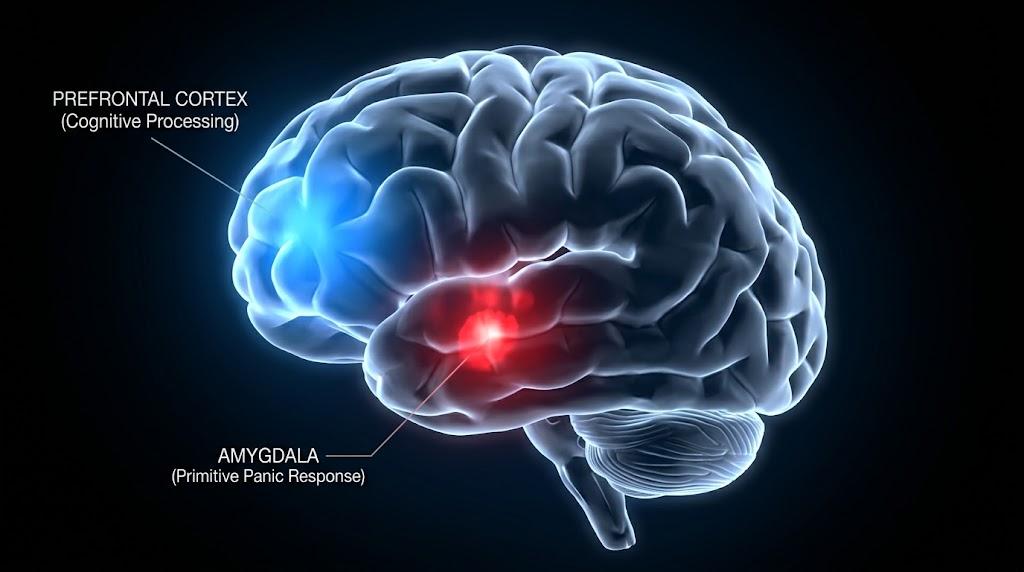
The human brain relies on two distinct threat-assessment engines:
- The Subconscious Alarm System (The Amygdala): Operates at blistering speed. When you stand near an edge, your amygdala calculates the drop instantly, identifies lethal peril, and triggers a physical reflex (stepping backward) before your conscious mind even realizes what is happening.
- The Executive Control Network (The Prefrontal Cortex): Operates at a slower, more deliberate processing speed. It analyzes context, assesses actual risk levels, and constructs logical narratives about what just happened.
The eerie illusion occurs during the microsecond gap between these two systems. Your primitive amygdala forces your body to step back from the railing in fear. A fraction of a second later, your logical prefrontal cortex evaluates the situation and realizes you were in complete control all along — you were standing behind a secure barrier and were never actually falling.
Your logical brain experiences a narrative error. It tries to explain why your physical body just panicked and stepped back. It draws an erroneous conclusion: “I just panicked and retreated. Therefore, I must have been entertaining the thought of jumping. My body was saving me from my own hidden urge.”
In short, the scary thought triggered by the call of the void is not a desire to die; it is your logical brain’s clumsy attempt to make sense of its own automated survival reflex.
Neuroscientists describe this as a predictive processing failure. Your prefrontal cortex is constantly generating predictions about your body’s behavior. When the amygdala hijacks your motor system and forces an involuntary retreat, the prefrontal cortex must retroactively construct an explanation for the movement. Since it did not initiate the action, it fabricates a plausible narrative — and the most logically coherent explanation for “I just recoiled from a cliff edge” is “I must have been considering jumping.” This is the same neural machinery that causes you to confabulate reasons for decisions you made unconsciously — your conscious mind is not the author of your behavior; it is merely the press secretary, spinning explanations after the fact.

3. Anxiety Sensitivity and Threat Detection
Why do some people experience the call of the void regularly while others never feel it at all? Studies have found that the high place phenomenon is associated with “anxiety sensitivity.”
Anxiety sensitivity refers to how acutely an individual perceives and interprets their own internal physiological signals. People with elevated anxiety sensitivity are hyper-aware of subtle bodily changes — such as a sudden spike in heart rate, muscle tension, or a transient feeling of dizziness. They interpret these physical sensations as more dangerous than they actually are, which amplifies the emotional response that follows.
One proposed way this could work for a person with high anxiety sensitivity standing on a high ledge:
– Their body may react to the height with a stronger alarm response.
– They may notice that reaction and search for an explanation.
– The explanation they land on may feel more alarming than it would to someone with lower anxiety sensitivity.
If you experience the call of the void frequently, it does not signify psychological instability. Instead, it indicates that you possess a hyper-vigilant threat-detection apparatus. This heightened state of environmental awareness is closely related to the psychological cost of constant mental stimulation, where an overstimulated brain becomes hyper-reactive to perceived environmental hazards.
Research in clinical psychology has further distinguished between two subtypes of HPP that produce the call of the void. The active subtype involves a fleeting sense of temptation — “I could jump if I wanted to” — which correlates with higher impulsivity scores and novelty-seeking behavior. The passive subtype involves a sudden fear of losing control — “What if my legs give out and I fall?” — which correlates more strongly with generalized anxiety and OCD-spectrum traits. Both subtypes produce the same visceral terror, but they originate from slightly different neural pathways. The active subtype is driven by reward-circuit miscalibration in the ventral striatum, while the passive subtype stems from excessive error-monitoring in the anterior cingulate cortex. Understanding which variant of the call of the void you experience can help you contextualize the sensation more accurately.
4. Intrusive Thoughts: Common, Unwelcome, and Often Misread
Cognitive behavioral therapy (CBT) places the call of the void within the broader framework of intrusive thoughts. Why would human evolution allow the brain to project terrifying, unwanted images of self-harm or catastrophe?
Evolutionary psychologists theorize that dark intrusive thoughts function as extreme biological simulations. By abruptly flashing a horrific mental image — such as dropping a child, driving off a bridge, or leaping into an abyss — your brain forces you into immediate hyper-vigilance.
It acts as a terrifying software alert. The mental image of disaster shocks your nervous system, instantly increasing your grip on the steering wheel, causing you to step further back from the ledge, or forcing you to hold precious items more tightly.
The intense discomfort and sudden fear you feel upon experiencing the thought reflect a natural protective alarm. In individuals without suicidal intent, the brain quickly rejects the intrusive scenario, treating it as an acute environmental hazard rather than an actual intention.
This evolutionary framework also explains why intrusive thoughts tend to target precisely the scenarios where the consequences would be most catastrophic. Your brain does not randomly generate images of mildly inconvenient outcomes — it fixates on the worst possible result. This negativity bias in intrusive thought content is not a design flaw; it is a feature. The more terrifying the simulation, the more effectively it commands your attention and motivates protective behavior. Studies in decision-making under stress show that the brain allocates disproportionate processing power to high-stakes scenarios, which is exactly why the call of the void feels so vivid and real compared to ordinary passing thoughts.
5. Survival Signal vs. Suicidal Intent: What the Brain Is Really Doing
The central paradox of the call of the void is that experiencing it is one of the strongest indicators of a powerful survival instinct.
True suicidal ideation is characterized by chronic emotional despair, feelings of helplessness, and a desire to escape consciousness. It is rarely marked by the sudden, terrifying physiological shock that accompanies HPP. In clinical assessments, suicidal ideation presents as a persistent, often quiet voice suggesting that death would be a relief. The call of the void is the polar opposite — it is sudden, violent, shocking, and immediately rejected by the conscious mind.
When the subconscious survival engine detects a fatal hazard, it overreacts to guarantee your safety. The momentary thought of jumping is merely cognitive exhaust generated by a hyper-active self-preservation mechanism. Think of it as your brain’s smoke detector going off when you burn toast — the alarm is deafening, the experience is alarming, but there is no actual fire.
The next time you stand on a high balcony and experience this alarming sensation, do not panic. Recognize it for what it truly is: a slightly dramatic, split-second miscommunication between your ancient survival reflexes and your modern analytical brain. The void calls, but the fact that you recoil in horror is the clearest possible evidence that you have absolutely no intention of answering. Your survival system is not broken — it is simply so vigilant that it sometimes sounds the alarm when there is no actual danger, which is precisely the kind of false positive that has kept our species alive for hundreds of thousands of years.
Reframing the Sudden Ledge Urge: Core Insights
- The call of the void (L’appel du vide) is not a suicidal urge — it is the High Place Phenomenon (HPP), a misinterpretation of your brain’s own survival signal
- HPP occurs when the amygdala’s fast survival reflex fires before the prefrontal cortex can provide context, causing the conscious brain to fabricate a false narrative about wanting to jump
- The phenomenon is more common in people with high anxiety sensitivity and higher impulsivity, but it is not associated with depression or suicidal intent
- Intrusive thoughts about danger function as evolutionary survival simulations — the more horrified you feel, the stronger your will to live actually is
- Experiencing HPP is proof that your threat-detection system is working overtime to keep you alive
Frequently Asked Questions
Is this phenomenon considered a mental disorder?
No. Psychologists classify the High Place Phenomenon as a benign cognitive anomaly. It is experienced by millions of mentally healthy individuals and is not listed as a disorder in any diagnostic manual. The DSM-5 does not include HPP among anxiety disorders, mood disorders, or any other psychiatric classification.
What is the biological cause of the call of the void?
The leading cognitive hypothesis suggests the call of the void arises from a dual-processing timing difference. The brain’s rapid threat-detection circuitry (involving the amygdala and motor reflex pathways) triggers an automatic physical recoil from danger before the slower, deliberative prefrontal cortex fully assesses the context. When your conscious mind registers that you have suddenly pulled back from a secure ledge, it mistakenly rationalizes the automated physical retreat as evidence of a near-urge to leap.
Does experiencing the call of the void mean a person is secretly suicidal?
Absolutely not. Studies show HPP occurs frequently in people with zero history of depression or suicidal ideation. The strong fear response and physical retreat triggered by the call of the void demonstrate a robust, active survival drive. If anything, the intensity of your horrified reaction is proportional to how strongly your brain rejects the idea of self-harm.
Why does the call of the void happen more often in some people than others?
Individual variation in how often the call of the void occurs is linked to anxiety sensitivity, trait impulsivity, and novelty-seeking personality dimensions. People who are naturally more attuned to their internal bodily signals — and who tend to interpret physiological arousal as threatening — experience the call of the void more often. Cultural background and prior exposure to high-altitude environments also play minor roles.
Can I reduce how often I experience the call of the void?
While you cannot eliminate the amygdala’s automatic threat response, you can reduce the anxiety that follows the call of the void by understanding the phenomenon. Simply knowing that HPP is a harmless processing glitch — rather than a genuine desire — significantly reduces the distress associated with the experience. Mindfulness practices and cognitive reappraisal techniques can also dampen the escalation from initial intrusive thought to full panic response.
Curious about other strange brain phenomena? Read our articles on how false memories form and the feeling of being watched to learn more.
References
- Hames, J. L., Ribeiro, J. D., Smith, A. R., & Joiner, T. E. (2012). An urge to jump affirms the urge to live: An empirical examination of the high place phenomenon. Journal of Affective Disorders, 136(3), 1114–1120. DOI: 10.1016/j.jad.2011.10.035
- Teismann, T., Brailovskaia, J., & Margraf, J. (2020). High place phenomenon: Beckoning to the void or a plea for life? BMC Psychiatry, 20(1), 325. DOI: 10.1186/s12888-020-02737-3
- Radomsky, A. S., et al. (2014). Part 1—You can run but you can’t hide: Intrusive thoughts on six continents. Journal of Obsessive-Compulsive and Related Disorders, 3(3), 269–279. DOI: 10.1016/j.jocrd.2013.09.002
📚 You Might Also Like
Hand-picked articles for you


