


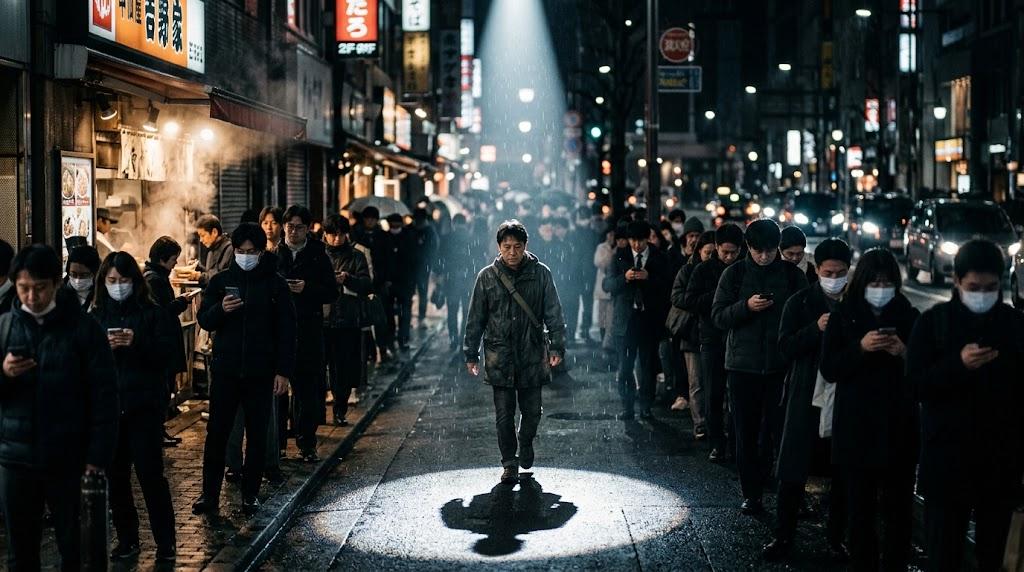
You spill coffee on your shirt before a meeting. Your brain instantly sounds an alarm: Everyone noticed. Everyone is judging you. You are humiliated.
But is anyone actually watching? Research says no — and the gap between what you believe and reality is enormous.
The spotlight effect is a psychological illusion that tricks you into believing an invisible audience is monitoring your every move. It causes crippling self-consciousness, social anxiety, and avoidance behavior in millions of people every day.
This embarrassing cognitive bias secretly destroys your confidence, limits your career potential, and prevents you from forming genuine connections with others. Understanding the neuroscience behind it can help you reclaim your social freedom.
1. The Spotlight Effect: Why Your Brain Exaggerates Your Flaws
The human mind operates on a deeply egocentric cognitive bias. Because you spend 100% of your waking hours inside your own head, every mistake, stain, or slip of the tongue carries immediate emotional weight for you.

The spotlight effect occurs because your brain erroneously projects its internal emotional intensity onto the minds of everyone around you. Your pain feels enormous to you, so you assume it must be visible to others.
Cognitive neuroscience reveals a completely different social reality. Every individual you interact with is trapped inside their own egocentric bubble. People are far too consumed by their own insecurities to pay detailed attention to yours.
In a landmark experiment conducted by Dr. Thomas Gilovich at Cornell University, researchers required students to wear an intentionally embarrassing t-shirt into a crowded room. The participants predicted that at least 50% of people would notice the shirt.

The results were striking: less than 20% of observers ever noticed. Your prefrontal cortex dramatically inflates the degree of attention you command in social settings.
The spotlight effect has been demonstrated across multiple cultures and age groups. Teenagers and young adults experience the strongest version, which correlates with the developmental stage where social evaluation is most critical for identity formation.
Interestingly, the effect diminishes with age. Older adults typically develop a more realistic understanding of how little attention others actually pay to them, which contributes to the emotional resilience many older people report.

The Barry Manilow T-Shirt Dilemma
You are forced to walk into a crowded university lecture hall wearing an embarrassing, bright yellow Barry Manilow T-shirt. How many peers do you think noticed and judged your shirt?
2. The Ancient Tribal Instinct Behind Perceived Judgment
Why does the human brain react so intensely to minor social missteps? The answer lies deep within human evolutionary history.
For ancestral humans living in hunter-gatherer tribes, social standing was literally a matter of life or death. Being perceived as incompetent or socially disruptive risked rejection by the tribe.
Social exclusion meant isolation, which almost guaranteed death in hostile wilderness environments. There was no Uber Eats, no apartment to retreat to, no online community to join. You either belonged to the group or you died.

Consequently, the human nervous system evolved to treat social mistakes as immediate physical threats. The same neural pathways that activate when you encounter a predator activate when you trip in public.
When you make a minor mistake in public, your amygdala triggers a fight-or-flight response. Cortisol and adrenaline flood your bloodstream, creating the sensation that you are in genuine danger — even though you are simply standing in a coffee shop with a stained shirt.
This physiological surge is closely tied to why you experience the feeling of being watched, as your brain constantly scans the environment for potential social threats.
The irony is that this ancient survival mechanism, which once protected you from genuine tribal rejection, now fires in response to trivial situations that pose no real danger to your survival. Your brain has not updated its threat assessment software for the modern world.

3. How the Spotlight Effect Drives Chronic Social Anxiety
When left unmanaged, the spotlight effect rapidly snowballs into debilitating social anxiety. If you operate under the constant belief that an invisible audience is evaluating your every move, your nervous system remains trapped in perpetual high alert.
You begin to over-analyze your physical posture, tone of voice, eye contact, and hand placement. This continuous self-monitoring consumes massive amounts of working memory and executive mental bandwidth that could be used for actual performance.
Instead of participating naturally in social interactions, you begin treating every conversation as a high-stakes performance where mistakes must be avoided at all costs. The pressure becomes suffocating and exhausting.
The spotlight effect is closely related to the “false consensus effect” — the tendency to assume that others share your thoughts, values, and experiences. Together, these biases create a distorted mental model where you are simultaneously the center of attention and fundamentally similar to everyone around you.
Dr. Thomas Gilovich found that the effect is strongest when the event is negative or embarrassing. When people wear something flattering, they actually underestimate how much others notice it. This asymmetry reveals that the spotlight effect is driven by self-critical monitoring, not genuine social attention.
A 2018 study published in the Journal of Experimental Psychology found that people with social anxiety overestimate others’ attention by approximately 50% compared to people without anxiety. The spotlight effect is not just a quirk — it is a measurable distortion of social perception.
4. The Illusion of Transparency: Your Panic Is Invisible
Another cognitive bias that feeds directly into social vulnerability is known as the “Illusion of Transparency.” This is the mistaken belief that your internal emotional states are vividly apparent to external observers.
If you feel nervous during a presentation, your prefrontal cortex assumes everyone can see your heart racing, your hands shaking, or your mind scrambling. You feel as though your panic is broadcast on a giant billboard for the entire room to see.
In reality, human observers are remarkably poor at detecting subtle internal physiological changes in others. Studies show that even trained psychologists cannot reliably distinguish genuine anxiety from calm composure in most social situations.
Research by Gilovich and colleagues found that speakers who believed their nervousness was transparent were rated as significantly less nervous by their actual audience. The gap between perceived and actual visibility of anxiety is enormous.
To external observers, you simply appear calm and focused. Your internal storm is completely invisible to everyone except you. Recognizing that your emotional state is entirely private is one of the fastest ways to deactivate social panic and break the cycle of the spotlight effect.
5. Decision Fatigue and the Loss of Authentic Choice
When your daily choices are dictated by an imagined audience, your logical decision-making breaks down. Rather than selecting options based on your authentic desires, you begin selecting choices designed purely to avoid imagined judgment.
You might avoid wearing clothes you love, remain silent in meetings despite having valuable insights, or alter your career choices to satisfy non-existent critics. The spotlight effect transforms every decision into a performance evaluation.
This continuous habit of filtering decisions through imagined public opinion accelerates severe decision fatigue that drains your mental energy. Each social micro-decision — what to say, how to sit, whether to laugh — depletes the same cognitive resources you need for meaningful work.
Living for an audience that is not actually paying attention is not only mentally exhausting; it actively prevents you from pursuing meaningful personal goals. The spotlight effect becomes a cage of your own making.
Research on decision-making under social evaluation shows that people make worse choices when they believe they are being observed, even when the observation is entirely hypothetical. The mere belief in an audience degrades performance across creative tasks, problem-solving, and interpersonal communication.
6. Why Social Regret Peaks Late at Night
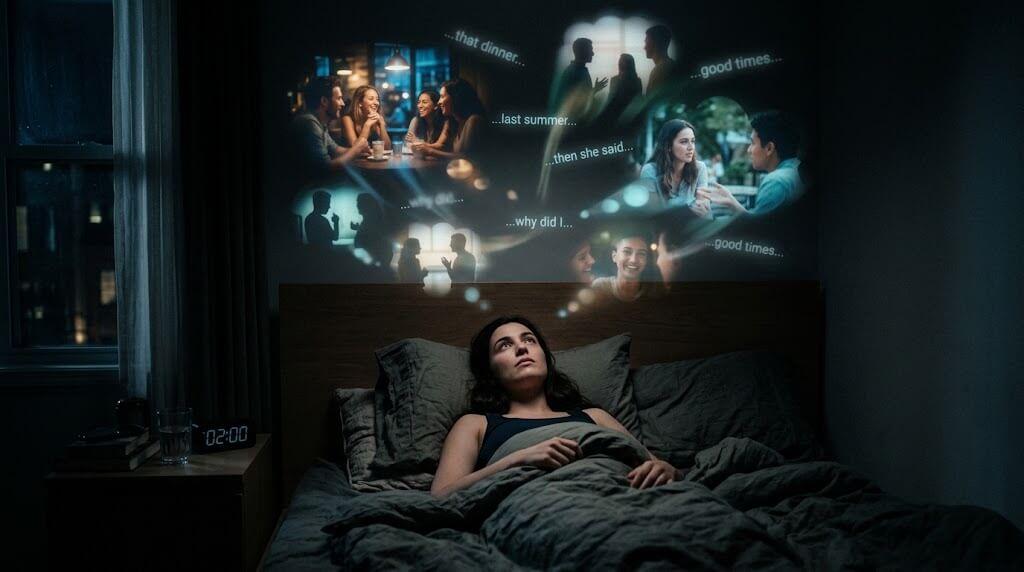
Many people experience intense spikes of social regret right as they try to fall asleep. Without daytime work distractions, your brain enters the default mode network (DMN).
During quiet evening hours, your brain actively reviews unclosed cognitive loops and unresolved social experiences. It drags up embarrassing memories from years ago and replays them in vivid detail, convincing you that others involved still remember those events with the same intensity.
This late-night replay mechanism is a primary reason why your brain overthinks at night. The DMN has no audience to compete with, so the spotlight effect intensifies — you become both the performer and the only audience member, trapped in a loop of self-judgment.
In reality, the people involved in those past memories have completely forgotten them. They are busy lying in bed worrying about their own embarrassing moments, entirely unaware that you still replay yours.
Studies on autobiographical memory confirm that people overestimate how long others remember their social mistakes by a factor of three. That thing you said at a party five years ago? The other person probably forgot it within hours.
7. Neuroscience-Backed Hacks to Reclaim Social Freedom
You can systematically retrain your nervous system to dismantle the spotlight effect using practical cognitive techniques grounded in neuroscience research. These strategies work by redirecting the same attention circuits that fuel the bias.
Practice External Focusing
The moment you feel self-conscious, force your attention outward. Count three blue objects in the room, listen closely to ambient sounds, or focus intensely on the exact words someone is speaking. External attention breaks the egocentric loop that fuels the spotlight effect.
Deploy the “So What?” Frame
If you make a social mistake, ask yourself, “So what?” Human social memory for minor external events degrades within minutes. Research shows that people remember your mistakes for approximately 25% as long as you think they do. The discomfort you feel is temporary, but the spotlight effect makes it feel permanent.
Embrace Your Role as an Extra
Remind yourself that everyone is the main character of their own story. You are merely a background extra in theirs, granting you complete freedom to make mistakes without consequence. This reframe is surprisingly powerful.
Test the Illusion Directly
Ask a trusted friend if they noticed something embarrassing about you recently. Their answer will almost always be “No.” Each time you receive this confirmation, your brain updates its model of social reality, gradually weakening the spotlight effect over time.
Exposure Therapy Through Deliberate Mistakes
Intentionally make small social “mistakes” — wear mismatched socks, pour water on yourself at a restaurant, or say something intentionally awkward. Notice that the consequences are always far milder than your brain predicted. This directly retrains the amygdala’s threat response.
Summary and Frequently Asked Questions About the Spotlight Effect
The spotlight effect is a harmless byproduct of an egocentric human brain. By recognizing that the invisible audience does not exist, you can reclaim your social confidence and make decisions for yourself rather than for imagined critics.
What is the primary cause of the spotlight effect?
It is caused by egocentric bias — the brain’s natural tendency to overestimate how much others notice our appearance and behavior because we are hyper-focused on ourselves.
How can I stop feeling like everyone is looking at me?
Shift your attention externally to your environment, remind yourself of the Illusion of Transparency, and remember that others are focused on their own insecurities. Practice these techniques consistently and the bias will weaken over time.
Does the spotlight effect get worse with age?
No. Research shows the opposite. Teenagers and young adults experience the strongest spotlight effect. The effect naturally diminishes with age as people develop a more realistic understanding of how little others notice them.
Is the spotlight effect related to social anxiety disorder?
Yes. The spotlight effect is a core cognitive mechanism that fuels social anxiety. People with clinical social anxiety often experience an amplified version of this bias, which can be effectively addressed through cognitive behavioral therapy.
References
- Gilovich, T. et al. (2000). The spotlight effect in social judgment: An egocentric bias in estimates of the salience of one’s own actions and appearance. Journal of Personality and Social Psychology, 78(2), 211-222. DOI: 10.1037/0022-3514.78.2.211
- Savitsky, K. et al. (2001). Spotlight effect: The spotlight effect may involve egocentric predictions of others’ attention. Journal of Experimental Social Psychology, 37(5), 386-395.
- Fejfar, M.C. & Hoyle, R.H. (2000). Effect of self-monitoring on the spotlight effect. Psychological Reports, 87(1), 171-178.
📚 You Might Also Like
Hand-picked articles for you


