


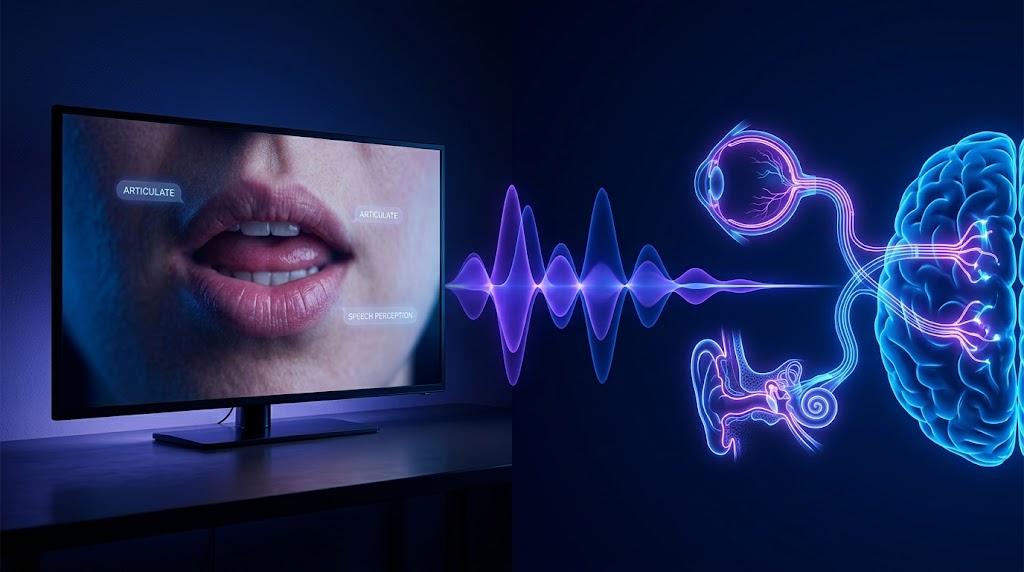
Have you ever tried listening to a video with your eyes closed, only to realize the spoken words sound completely different when you open them? This strange cognitive phenomenon lies at the heart of the mcgurk effect.
In a classic laboratory demonstration, a participant listens to a clear audio recording of a person pronouncing the syllable “Ba-Ba.” As long as the participant’s eyes remain closed, the audio input is perceived with total clarity. There is no ambiguity. The sound is unmistakable.
However, the moment the participant opens their eyes to watch a video clip where the speaker’s lips physically articulate the syllable “Ga-Ga,” their perception instantly shifts. The sound in their ears has not changed at all — but what they hear has.
Instead of hearing “Ba-Ba” or “Ga-Ga,” the brain fuses the conflicting visual and acoustic data into an entirely new sound: “Da-Da.”
Close your eyes again, and the sound immediately reverts back to “Ba-Ba.” Open them, and “Da-Da” returns. You can toggle this illusion on and off simply by blinking.

This multisensory phenomenon reveals that human speech perception is not an isolated auditory event. Your brain actively merges sight and sound into a synthesized perceptual reality — and it does so without your conscious permission every single time you watch someone speak.
Play any video with speech. Close your eyes. Notice how the audio feels different — clearer, more direct, more “raw.” Now open your eyes. The character of the sound changes instantly. That is the mcgurk effect in action.
1. The Lip-Reading Experiment That Broke Cognitive Science
The mcgurk effect was discovered by accident in 1976 by researchers Harry McGurk and John MacDonald at the University of Surrey. While studying how infants perceive language at different developmental stages, they instructed a technician to dub an audio track of one spoken syllable onto a video recording of a different syllable.
The technician made a mistake — or what everyone assumed was a mistake. The audio said “ba” but the video showed lips saying “ga.” When the researchers played the composite tape back, both were startled to hear a third, unrecorded syllable: “da.”

They ran the tape again. Same result. They asked colleagues to watch. Same result. Nobody could unhear the illusion once they experienced it. Their ears heard one thing. Their eyes saw another. Their brain invented a third option that existed in neither signal.
This discovery, published in the journal Nature, sent shockwaves through cognitive science. It proved that the brain does not passively receive sensory information — it actively constructs reality by blending inputs from multiple senses into a single coherent experience.
Clinical trials confirmed several remarkable characteristics of the mcgurk effect:
- Automatic Fusion: Sensory fusion occurs within milliseconds inside the brainstem, before conscious awareness can intervene. You cannot choose to resist it.
- Resistance to Awareness: Knowing how the illusion works does not stop your brain from hearing the altered sound when your eyes are open. Even researchers who have studied the effect for decades still experience it.
- Universal Mechanism: The effect occurs across diverse languages and age groups, proving that multisensory speech integration is hardwired into human neuro-architecture.
Dr. Tracy Beale and colleagues at the University of Western Ontario have shown that the mcgurk effect is strongest in infants and young children, suggesting that multisensory integration is a fundamental, hard-wired feature of the developing brain rather than a learned response.
The effect persists even when participants are explicitly told what is happening and asked to focus exclusively on the audio. This indicates that the neural mechanisms responsible for multisensory integration operate below the level of conscious control — you cannot override them with knowledge, willpower, or attention.
In the famous McGurk experiment, if you watch video of lips mouthing 'GA-GA' while the audio track plays 'BA-BA', what does your brain actually hear?
2. Inside the Brain’s Multi-Sensory Processing Hub
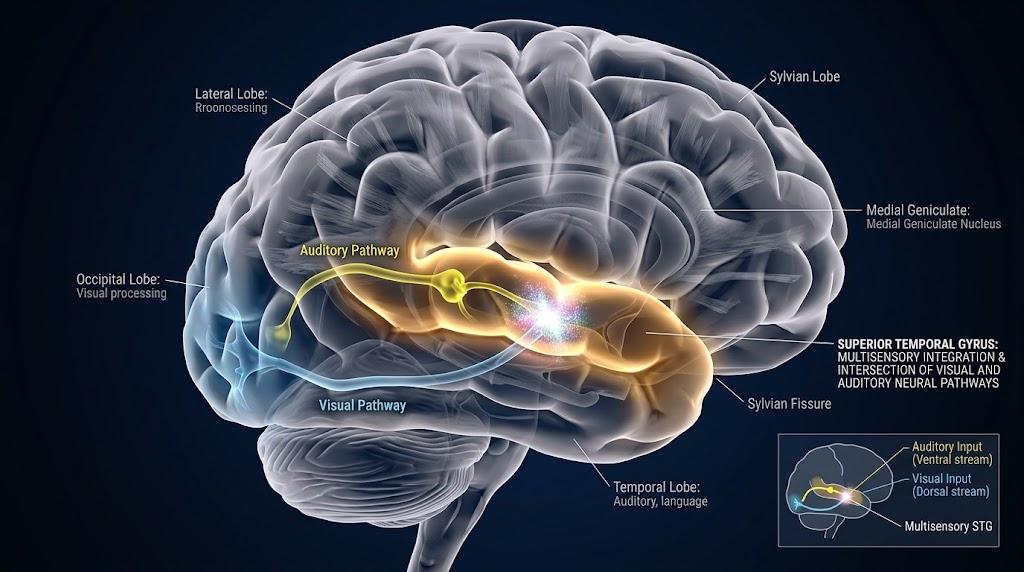
Neuroimaging studies using functional magnetic resonance imaging (fMRI) show that the mcgurk effect is orchestrated within the Superior Temporal Gyrus (STG) — the primary brain region responsible for integrating auditory and visual information. This area sits at the intersection of the brain’s hearing and seeing networks, making it the perfect meeting point for cross-sensory fusion.

When you observe someone speaking in person, a fascinating race begins between your senses. Visual signals detailing lip movement reach your visual cortex approximately 30 to 50 milliseconds faster than auditory soundwaves reach your auditory cortex. This timing difference is small but neurologically significant.
The visual cortex exploits this head start by projecting a predictive motion template directly to the STG. The STG then pre-filters incoming auditory signals to match the visual lip movement. In other words, your brain uses what it sees to decide what it hears — often before the sound has even finished arriving.
Because ancestral human survival depended heavily on visual awareness — spotting predators, reading facial expressions, interpreting gestures — the brain treats visual cues as high-priority data when resolving sensory ambiguity. When sight and sound conflict, vision usually wins. The mcgurk effect is the clearest demonstration of this visual dominance in everyday perception.
The McGurk effect demonstrates something profound about how the brain constructs reality: perception is not a passive recording of the external world but an active, constructive process. Your brain takes incomplete, sometimes contradictory sensory data and creates the most plausible interpretation available.
This principle extends beyond auditory illusions. Visual illusions like the checker shadow illusion, where two squares of identical color appear different due to surrounding context, operate on the same fundamental principle of active construction. Your brain is an artist, not a camera.
This predictive filtering is closely connected to how subtle visual mismatches trigger revulsion under the uncanny valley effect. Both phenomena reveal the same truth: your brain prioritizes internal consistency over objective accuracy.
3. Why Your Brain Trusts Visual Light Over Soundwaves
Why did natural selection link sight and sound so tightly? The answer lies in the challenges of communication in natural environments, where speech rarely occurs in perfect silence.
Ancestral humans did not have quiet offices or recording studios. They communicated near running water, during hunts, in windy open savannas, and within crowded tribal gatherings. Pure audio processing was unreliable, so evolution built a backup system — lip-reading.
Automatic lip-reading provided key evolutionary benefits that made survival more likely:
- Noisy Environments: Visual mouth tracking allows humans to decipher conversation in windy conditions, near running water, or within noisy crowds where pure audio processing fails. Even today, you instinctively watch a bartender’s lips in a loud bar to understand your order.
- Clarity Boost: Seeing a speaker’s mouth provides an acoustic boost equivalent to increasing speech volume by up to 15 decibels. This is the difference between hearing a whisper and hearing a normal conversation — entirely from visual input alone.
- Childhood Learning: Infants spend critical early months observing adult lip movements to master native phonemes. Children who cannot see faces during language acquisition show measurable delays in speech development, confirming that vision is integral to learning language.
The practical implications of the mcgurk effect extend directly to hearing aids, cochlear implants, and speech therapy. Understanding how visual information complements auditory perception can significantly improve outcomes for patients with hearing difficulties. Many speech therapists now train patients to read lips precisely because visual input compensates for degraded auditory signals.
This subconscious reliance on visual context helps explain how the brain reconstructs missing sensory details during memory formation. The same blending mechanism that creates the mcgurk effect also fills in gaps in your memories with information that was never actually there.

“Speech perception is not a passive acoustic recording. It is an active, multisensory construction generated continuously by the human visual cortex.”
4. The Reverse Illusion: When Sound Tricks Your Eyes
While the mcgurk effect proves that vision alters hearing, cognitive scientists have discovered that the sensory bridge works in reverse as well. In a famous experiment known as the Sound-Induced Flash Illusion, soundwaves actively trick your visual cortex into seeing things that do not exist.
In this experiment, a participant stares at a computer screen where a single dot of light flashes once. Simultaneously, the speakers emit two rapid audio beeps. Instead of seeing a single flash, the participant’s brain forces them to visually perceive two distinct flashes of light — even though only one occurred.
The illusion is so powerful that participants report absolute certainty that they saw two flashes. They are not guessing or uncertain. They genuinely experienced a visual event that never happened, entirely because their ears told them it should have.
This reverse cross-modal illusion demonstrates that sensory processing is a two-way street. Your auditory cortex can force your visual cortex to hallucinate extra visual events to match incoming acoustic rhythms. The brain’s commitment to multisensory coherence is so strong that it will fabricate entire perceptual experiences just to maintain a unified model of reality.
The mcgurk effect is not an isolated trick. It is one manifestation of a brain that constantly overrides raw sensory data to create a coherent narrative. Sometimes that narrative matches the physical world. Sometimes it does not. And you have no way of telling the difference from the inside.
5. How Sound Designers and Foley Artists Exploit Sensory Fusion
Hollywood sound designers, Foley artists, and video game engineers have quietly exploited the neurobiology of the mcgurk effect for decades to create convincing artificial environments. They understand that the brain does not evaluate sight and sound independently — it fuses them into a single experience.
Consider the ventriloquist effect in movie theaters. All physical audio comes from speakers placed on the side walls. Yet, because your eyes focus on the actors’ lips on screen, your brain perceives the voice as coming directly from the actor’s mouth. The sound has not moved. Your brain relocated it based on visual input.
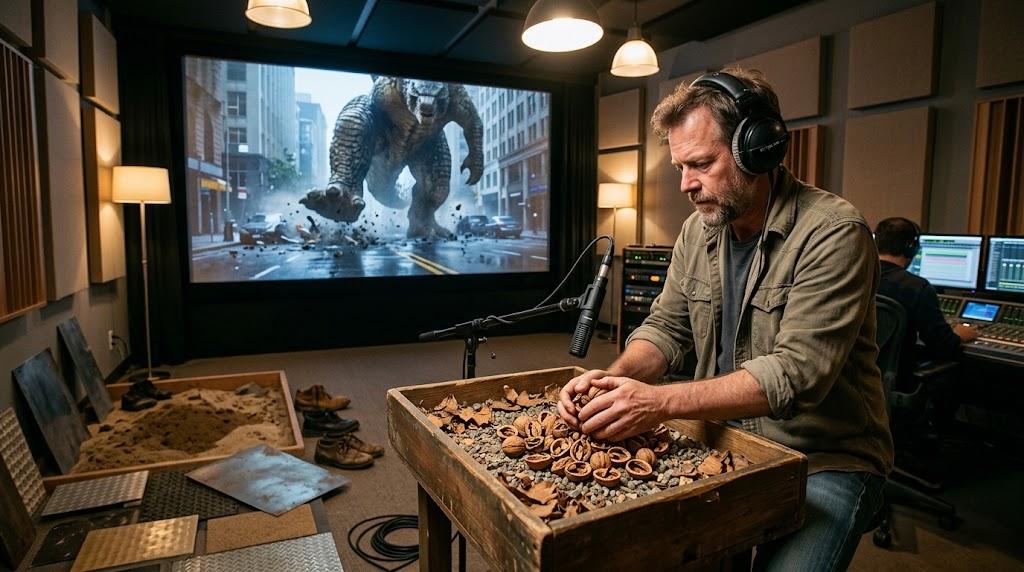
Foley artists layer animal sounds — such as a tiger roar mixed with a pig squeal — over a CGI monster’s opening jaws. Because the mouth movement matches the acoustic timing, your brain accepts the synthetic creature as real. The visual synchronization overrides the fact that no such animal exists in nature.
Walking sounds in video games are frequently recorded using crushed walnut shells or wet leather. Because your eyes see boots walking on gravel, your brain interprets the audio as authentic footsteps. The texture of the sound becomes irrelevant — visual context determines perceived authenticity.
These techniques work because the brain prioritizes temporal synchrony between sight and sound above all else. If the timing matches, the brain fuses the signals regardless of their actual source. The mcgurk effect is at work every time you watch a movie, play a video game, or listen to a podcast with accompanying video.
6. Modern Screen Fatigue: Dubbing, Zoom Calls, and Masked Speech
Understanding the mcgurk effect sheds light on several everyday communication challenges in modern digital life. The same neural mechanisms that create the laboratory illusion also operate during your daily conversations, often causing fatigue you cannot explain.
Dubbed Films: Watching foreign films dubbed into English causes subtle cognitive strain because visual lip movements contradict the spoken soundtrack. Your brain constantly attempts to fuse mismatched signals, creating low-level mental fatigue that accumulates over a two-hour film. This is why many film enthusiasts prefer subtitles over dubbing — subtitles eliminate the visual conflict entirely.
Video Conference Lag: Minor audio-video delays during remote meetings disrupt cross-modal timing. When lips move slightly out of sync with the audio, the mcgurk effect generates tiny perceptual conflicts that compound over a one-hour meeting. This contributes significantly to the exhaustion people report after back-to-back Zoom calls — your brain is fighting itself to maintain coherent perception.
Face Coverings: During the pandemic, many adults suddenly realized how heavily they rely on visual cues for routine conversation. With mouth movements obscured, speech comprehension dropped measurably in noisy environments. The mcgurk effect explains why — without visual input, the brain loses a critical channel for resolving ambiguous sounds.
A 2021 study at the University of Manchester found that participants wearing face masks scored 20% lower on speech comprehension tests in noisy conditions compared to unmasked conditions. The visual input was not available to supplement the degraded audio signal.
This cognitive strain is deeply connected to how digital context switching contributes to daily brain fog causes.
Studies show that Western listeners focus heavily on a speaker’s mouth during conversation, triggering strong McGurk fusion. East Asian listeners focus more on eye cues, resulting in subtle but measurable variations in how the effect manifests across cultures.
As high-frequency hearing naturally declines with age, the brain automatically increases reliance on visual lip cues. This makes older adults up to 30% more susceptible to visual speech illusions, which also helps explain why older adults struggle more with phone calls than face-to-face conversation.
Summary and Frequently Asked Questions About the McGurk Effect
The mcgurk effect highlights the sophisticated nature of human perception, demonstrating that our experience of the world is a unified construction created by multiple sensory systems working in constant collaboration. Your eyes and ears do not operate independently — they are partners in building your reality.
The next time you watch someone speak, remember that what you hear is not purely acoustic. It is a collaboration between your eyes and ears, edited in real time by a brain that values coherence over accuracy.
Can someone overcome the mcgurk effect with practice?
No. Because multisensory integration occurs automatically in early neural processing pathways, conscious effort cannot prevent the sensory fusion from occurring. Even trained phoneticians and audio engineers who study speech for a living experience the illusion just as strongly as anyone else.
Does the illusion work across all spoken languages?
Yes. While structural susceptibility varies slightly due to language-specific lip dynamics, the underlying neural integration mechanism exists in all human populations studied to date. Languages with more visually distinct consonants may produce slightly stronger fusion, but the effect is universal.
Why does the mcgurk effect matter in daily life?
The effect explains why dubbed films feel unnatural, why Zoom calls cause fatigue, why face masks reduced comprehension, and why hearing aids benefit from visual speech training. It is not just a laboratory curiosity — it shapes every conversation you have.
Can the mcgurk effect help people with hearing loss?
Yes. Speech therapists and audiologists use the principles behind the mcgurk effect to train hearing-impaired patients to leverage visual lip cues. By consciously directing attention to a speaker’s mouth, patients can compensate for degraded auditory signals and improve comprehension in challenging environments.
References
- McGurk, H. & MacDonald, J. (1976). Hearing lips and seeing voices. Nature, 264(5586), 746-748. DOI: 10.1038/264746a0
- Bruns, P. & Liebig, J. et al. (2014). Multisensory integration for perceptual learning. Frontiers in Psychology, 5, 893. DOI: 10.3389/fpsyg.2014.00893
- Bristow, D. et al. (2009). Audiovisual speech perception is customized to the environment. Current Biology, 19(11), 979-983. DOI: 10.1016/j.cub.2009.04.038
📚 You Might Also Like
Hand-picked articles for you


