

You graduated at the top of your class. Your manager just praised your work in front of the entire team. Your inbox is full of congratulatory messages. By every measurable standard, you are succeeding.
And yet, somewhere in the back of your mind, a quiet voice is saying: “They haven’t figured me out yet.”
This is imposter syndrome — one of the most widespread and least understood psychological experiences in modern life. It does not target the unskilled or the underprepared. It targets the ambitious, the driven, and the perfectionist. It targets you precisely because you care enough to worry.
A landmark study published in the Journal of Behavioral Science found that approximately 70% of people experience imposter syndrome at some point in their careers. Among graduate students, the figure climbs even higher — some researchers estimate that up to 84% of high-achieving students report persistent feelings of fraudulence despite objective evidence of their competence.
The Perceptual Trap
Your internal narrative: “I barely know what I’m doing. Everyone else seems so confident and capable.”
The statistical reality: 70% of people experience imposter feelings at some point. The “confident” colleagues you admire are likely hiding the exact same doubt behind their composure.

Five Faces of the Same Fear
In 1978, clinical psychologists Pauline Clance and Suzanne Imes first documented imposter syndrome while working with high-achieving women in academia. Despite earning top grades and professional recognition, these women consistently insisted their success was luck, timing, or charm — never skill. They lived in constant terror that one day, someone would pull back the curtain and expose them as the fraud they believed themselves to be.

What made their case particularly puzzling was the total disconnect between external achievement and internal perception. These were not people failing upward. They were objectively brilliant professionals who could not internalize their own competence. The term “imposter phenomenon” was born — and decades of research have since revealed it is far more common and far more complex than Clance and Imes initially imagined.
Research by Dr. Valerie Young, who has spent over 30 years studying these patterns, has identified five distinct personality profiles that experience this phenomenon differently. Each represents a unique cognitive distortion — a different way the brain maintains the fiction that you are secretly incompetent:
- The Perfectionist — anything less than flawless equals total failure. They obsess over the one mistake in an otherwise brilliant presentation. A 98% test score feels like a disaster because they cannot stop fixating on the missing 2%. They set impossibly high standards and then punish themselves for falling short of perfection.
- The Expert — must know every answer before speaking. They will delay contributing to a meeting for weeks rather than risk revealing a knowledge gap. They feel a surge of panic when asked a question they cannot answer perfectly, interpreting the gap as proof that they do not truly belong.
- The Natural Genius — if it requires effort, it must not be real ability. They feel like a fraud the moment something stops coming easily. If a task takes them longer than expected, they conclude they were never truly talented to begin with.
- The Soloist — asking for help is proof of incompetence. They will struggle in silence for hours rather than admit they need guidance. Collaboration feels dangerous because it exposes their perceived weaknesses to others.
- The Superhuman — measures worth by how many roles they can juggle simultaneously. They overwork themselves into exhaustion, spread across work, family, and social obligations, desperately trying to prove they deserve their position through sheer volume of output.
Identifying your subtype is not just an academic exercise. It reveals the specific cognitive distortion your brain uses to maintain the fraud narrative. Cognitive behavioral therapy (CBT) has shown remarkable effectiveness here — studies in the Journal of Behavioral Science found that structured CBT interventions reduce imposter symptoms by up to 50% within eight weeks, particularly when therapy targets the subtype-specific thought patterns.

Why Smart People Doubt Themselves More
Here is the cruel paradox at the heart of imposter syndrome: the more you actually know, the more inadequate you feel. This is not a bug in human cognition — it is a direct consequence of how expertise develops.
Neuroscientists explain this through the Dunning-Kruger Effect — but seen from the expert’s side rather than the beginner’s. When you are a novice, you lack the knowledge to recognize how much you don’t know. Confidence comes easily because ignorance is invisible. You don’t know what you don’t know, so you assume you know enough.
But as your expertise deepens, your awareness expands to reveal an ever-growing horizon of things you have yet to master. A junior developer feels brilliant after building their first website. A senior architect feels like a fraud because they cannot name every cloud computing pattern off the top of their head — despite having built systems that serve millions of users.
This intellectual humility — the very quality that makes someone a genuine expert — gets hijacked by the brain’s threat-detection system and reframed as evidence of inadequacy. The skill that makes you competent is the same skill that makes you doubt. You know enough to see how much you don’t know, and that gap becomes the evidence your inner prosecutor uses against you.
The deeper your expertise, the wider the gap between what you know and what remains unknown — and the louder the imposter voice becomes. This paradox is closely related to how the brain constantly reconciles conflicting sensory input under the McGurk effect — both demonstrate the brain’s tendency to question its own reliable outputs and arrive at conclusions that feel true but are factually wrong.

The Brain’s Fraud Detection System
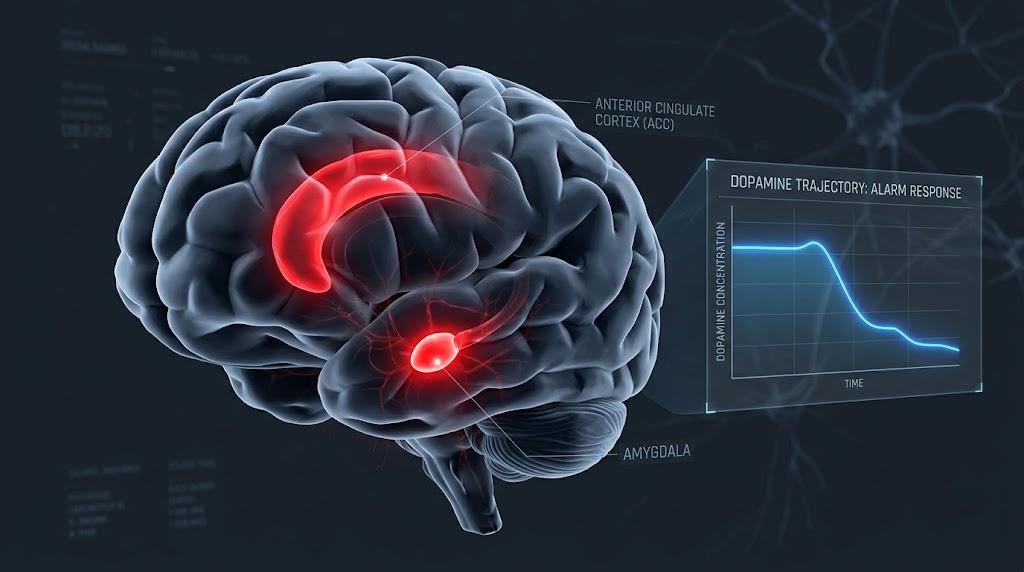
Functional neuroimaging reveals exactly what happens inside your skull during an imposter episode. The experience is not abstract — it has a measurable neurological signature that researchers can observe in real time.

Three brain structures collaborate to create the experience:
- Anterior Cingulate Cortex (ACC) — the brain’s internal auditor. In high achievers, this region is perpetually hyper-vigilant, scanning for discrepancies between your actual performance and your impossibly high standards. It fires warning signals for every minor imperfection, no matter how trivial. A single typo in an email triggers the same alarm as a critical error in a presentation.
- Amygdala — when the ACC flags a perceived flaw, the amygdala interprets it as a survival threat. It floods your bloodstream with cortisol and adrenaline, triggering the same physiological response you would experience facing a physical predator. Your heart races, your palms sweat, and your thinking narrows — all because your brain is treating a slightly imperfect report the same way it treats a charging lion.
- Dopamine crash — after achieving a long-sought goal, baseline dopamine plummets. The absence of the “chase” chemicals creates an emotional void that your brain fills with doubt: “If this felt empty, maybe I didn’t really earn it.” The celebration is fleeting, and the anxiety rushes back before the champagne goes flat.
This explains the baffling pattern where imposter feelings peak immediately after success — the moment you should feel most confident. The pursuit chemicals vanish, the achievement feels anticlimactic, and the brain invents a narrative to explain the emptiness. This dopamine mechanism connects directly to how dopamine baseline crashes trigger loss of motivation.
Do You Attribute Your Success to Luck Rather Than Skill?
When you achieve a major milestone or receive public praise, do you feel an internal panic that you merely tricked everyone and will soon be unmasked as a fraud?
The Childhood Programming You Forgot About
Developmental psychologists have traced the roots of adult imposter syndrome back to a surprisingly specific source: the type of praise you received as a child. The words your parents and teachers used to describe your achievements literally shaped how your brain processes success and failure for the rest of your life.
Two approaches to praising a child’s performance create radically different adult outcomes:
- Person praise — “You’re so smart” — teaches the brain that ability is a fixed trait. Every future challenge becomes a potential exposure event where the “truth” about your intelligence will be revealed. Difficulty means you were never really smart to begin with. Children raised on person praise develop a permanent fear of being unmasked whenever they encounter something difficult.
- Process praise — “You worked really hard on that” — teaches the brain that ability is built through effort and strategy. Failure becomes information rather than identity. When these children struggle, they interpret it as a signal to adjust their approach, not as evidence of fundamental inadequacy.
Adults who received predominantly person praise carry a permanent anxiety that their intelligence is a performance rather than a fact. They interpret every struggle as evidence that the “smart” label was a mistake. This childhood programming runs silently in the background — an example of how subconscious brain control shapes your reality without your awareness.
The cruelest aspect of this developmental pattern is that it is self-reinforcing. The more you achieve, the higher the stakes feel, and the more devastating the imagined exposure becomes. Each success raises the platform from which you fear falling.
You vs. Everyone Else: The Comparison Trap
A core engine of imposter syndrome is a brutally unfair comparison you make every single day without realizing it.
You compare your entire internal experience — every uncertain thought, every moment of confusion, every draft you deleted, every time you googled something basic before a meeting — against your colleagues’ external presentation — their polished slides, their confident voice, their final output.
You see your behind-the-scenes footage and compare it to their highlight reel. The comparison is rigged from the start because you have access to your own unedited thought process but only to other people’s curated performance.
“Imposter feelings are not proof that you lack talent. They are proof that you are pushing yourself into new, high-stakes territory that demands growth.”
This distorted self-perception mirrors how curated digital environments distort self-perception under the dead internet theory — both create false realities by showing you a selectively edited version of other people’s experiences. Social media amplifies this mismatch further by presenting everyone else’s achievements as effortless while your own journey feels like a struggle.
The Silence That Keeps Everyone Stuck
In organizations, imposter syndrome compounds through a phenomenon psychologists call pluralistic ignorance — a collective hallucination where everyone assumes they are the only one struggling.
The mechanism works like this:
- Multiple team members privately doubt their competence.
- Each person assumes the silence of others means confidence.
- No one speaks up, reinforcing the illusion that doubt is a personal failing rather than a shared experience.
- The silence itself becomes the “evidence” that confirms the fear — “nobody else seems worried, so I must be the only one who doesn’t belong here.”
The result is an entire team of competent professionals who all believe they are the only fraud in the room. Research published in Psychological Science found that pluralistic ignorance is one of the primary reasons imposter syndrome persists in high-performing teams — the silence itself becomes the evidence that confirms the fear.
Breaking this cycle requires one person to go first. When someone admits they feel like a fraud, the entire illusion collapses — and the team discovers that everyone was hiding the same fear. This pattern is identical to why your brain replays embarrassing moments in isolation — both thrive in darkness and dissolve under shared light.

How to Reclaim Your Reality
You do not need to eliminate self-doubt to function. You need to stop letting self-doubt make your decisions. The goal is not confidence without doubt — it is competence that persists despite doubt.
Four strategies backed by clinical research:
- The Evidence Log: Keep a running document of every compliment, successful project, and earned achievement. Write down specific metrics, client feedback, and concrete results. When imposter feelings surface, force your rational brain to review the facts instead of trusting the emotional narrative. Your feelings will say “luck” — the data will say “skill.”
- Normalize the Struggle: Ask any successful person you admire if they have ever felt like a fraud. The answer is almost always yes. Difficulty is not evidence of inadequacy — it is evidence of growth. The moment things feel hard is usually the moment you are learning the most.
- Separate Feeling from Fact: “I feel like a fraud” is an emotional statement. “I am a fraud” is a factual claim. The first is valid and human. The second is almost always false. Recognizing that your brain reshapes emotions based on predictions, not reality helps you treat imposter feelings as noise rather than signal.
- Find Your Mirror: Share your doubt with a mentor or trusted peer. Almost universally, they will reveal they experienced the same thing — which instantly dismantles the isolation that keeps imposter syndrome alive. The act of speaking the fear out loud strips it of its power.
The Evidence Log
Keep a running document of every verified accomplishment, positive feedback, and milestone reached. When doubt strikes, open the log. Objective evidence is the most powerful antidote to subjective fear.
?️ The Mirror Conversation
Tell one trusted person exactly what you’re afraid of. The act of speaking the fear out loud strips it of its power — and their response will almost certainly prove that you are not alone in this experience.
Questions People Also Ask
Is imposter syndrome a real condition or just insecurity?
It is a well-documented psychological phenomenon, not a clinical diagnosis. Research across dozens of studies confirms it is distinct from general anxiety or low self-esteem — it specifically affects high achievers who objectively succeed but subjectively feel like frauds. It is not weakness; it is a cognitive distortion that happens to target the most capable people.
Why does imposter syndrome get worse after success?
Achieving a goal triggers a dopamine crash. The sudden absence of pursuit chemicals creates an emotional void that the brain interprets as emptiness rather than fulfillment, reinforcing the narrative that the success wasn’t “real.” The bigger the achievement, the more dramatic the crash — which is why Nobel laureates and CEOs report some of the strongest imposter feelings.
Can imposter syndrome be cured?
For most people, it does not disappear entirely — but it becomes manageable. CBT reduces symptoms by up to 50% in eight weeks. Over time, accumulated evidence of your competence teaches your brain to trust objective data over emotional narrative. The episodes become shorter, less frequent, and easier to recognize as cognitive distortion rather than truth.
Why are women more affected by imposter syndrome?
The original research by Clance and Imes focused on women because societal pressures create additional layers of self-doubt. However, subsequent research shows it affects all genders — the difference is that women are more likely to report it openly. Men often experience the same feelings but mask them with overwork or avoidance behaviors.
At what age does imposter syndrome typically start?
While it can appear at any age, research shows it often begins during transitions — starting university, beginning a new job, or receiving a promotion. These moments of increased responsibility and visibility trigger the brain’s threat-detection system, creating fertile ground for imposter feelings to take root.
Where can I learn more?
Read the Clance & Imes (1978) – The Imposter Phenomenon in High Achieving Individuals and explore clinical research from the American Psychological Association.
References
- Clance, P.R. & Imes, S.A. (1978). The imposter phenomenon in high achieving women: Dynamics and therapeutic intervention. Psychotherapy: Theory, Research & Practice, 15(3), 241-247. DOI: 10.1037/h0086006
- Clance, P.R. (1985). The Impostor Phenomenon: Overcoming the Fear That Haunts Your Success. Peachtree Publishers.
- Parkman, A. (2016). The imposter phenomenon among astrophysics graduate students. Psychological Reports, 119(1), 142-162. DOI: 10.1177/0033294116653264
- Cokley, K. et al. (2017). Impostor feelings as a moderator and mediator of the relationship between perceived discrimination and mental health. Journal of Counseling Psychology, 64(2), 148-157. DOI: 10.1037/cou0000198
📚 You Might Also Like
Hand-picked articles for you


