


Three hours of sitting perfectly still should be restful. Instead, a single morning of video meetings can leave you more depleted than a full day of standing in physical boardrooms — shoulders knotted, eyes burning, voice flattened, and a headache assembling behind the forehead. This inversion now has a formal name: zoom fatigue. Stanford’s Jeremy Bailenson, founding director of the Virtual Human Interaction Lab, gave the phenomenon its first theoretical skeleton in 2021, defining it as the nonverbal overload produced by videoconferencing platforms [Bailenson, 2021].

The paradox is the point. A medium that leaves the body motionless drives the brain’s stress machinery as if the body were under siege, and that contradiction is not a software bug — it is an evolutionary trap. Video conferencing simulates intense intimacy and inescapable surveillance while stripping away nearly every somatic cue the human brain used to calibrate social contact across 200,000 years: shared air, peripheral vision, footsteps, the lean of a torso.
What remains is a narrowed, artificial signal stream that the prefrontal cortex must constantly patch — the same executive depletion documented in why decision fatigue ruins your night. Zoom fatigue is what that patching feels like from the inside: the tax levied by four distinct, measurable mismatches, each with its own neurology.
The Biological Mismatch Behind Zoom Fatigue
Human social cognition assumes a body in a room. Over evolutionary time, the brain tuned itself to interactants who breathe, blink, shift weight, and occupy a stable three-dimensional distance from the eyes — roughly arm’s length for intimate conversation, meters for public address. Video conferencing violates every one of those calibration constants simultaneously. It compresses several people into a glowing rectangle, fixes them at distances no physical gathering ever sustained, deletes the spatial audio that lets the brain separate one voice from a crowd, and replaces organic timing with network arithmetic.
The result is a medium the sensory system treats as plausible yet wrong — close enough to trigger full social processing, distorted enough to require continuous correction. Cognitive load theory calls this extraneous load: mental effort spent on the medium itself rather than the message [Sweller, 2011]. Zoom fatigue is that load, billed by the hour, and its components are now measurable one by one.

Hyper-Gaze and the Synthetic Looming Reflex
Stand two feet from another human face and only two physical contexts exist: romantic intimacy or confrontation. That proximity rule is wired deep. Zoom fatigue begins here, in optics the social brain never evolved to discount. A face filling a large fraction of the visual field means the other person is inside personal space, and the brain responds accordingly — pupil adjustments, heightened arousal, recruitment of the amygdala-centered circuitry that adjudicates approach versus defense. On a video call, every participant’s face is optically enlarged to exactly that intimate scale, and several of them loom at once, motionless, for hours.
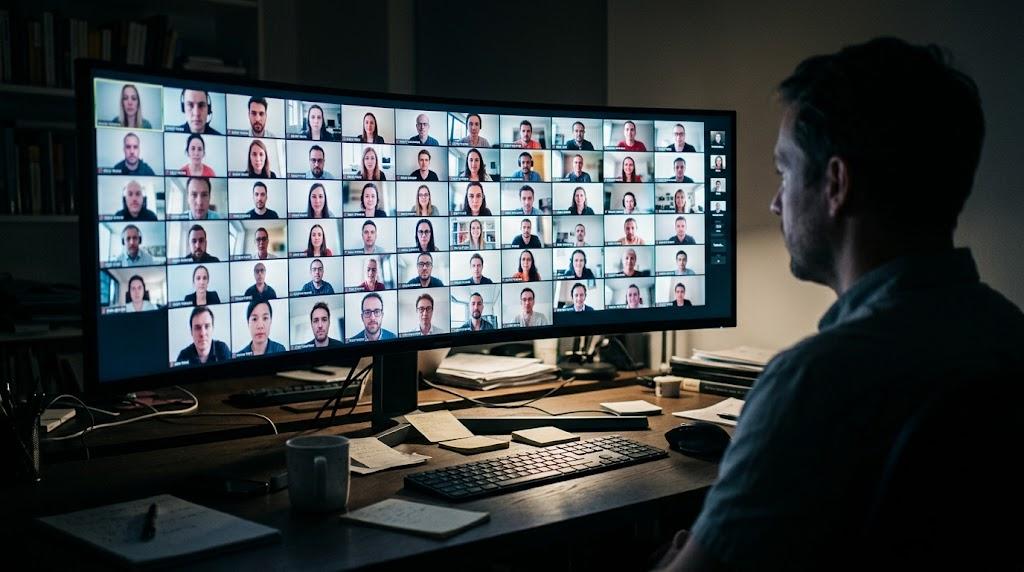
The gaze compounds the problem. Direct mutual eye contact on a call is total and continuous: every grid cell stares at you, and you at it, in a configuration physical life almost never produces. The brain’s gaze-detection machinery — a subcortical network specialized for noticing being watched — cannot distinguish the camera’s lens from genuine observation, which is why the sensation maps directly onto the psychology of feeling watched. Bailenson’s analysis is blunt: sustained close-up mutual gaze at this intensity is something terrestrial social life simply never asks of the nervous system [Bailenson, 2021]. It is the single most reliable amplifier of zoom fatigue the platform produces.
The physiological consequence is subtle but cumulative — not panic, but a low sympathetic hum: vigilance without resolution. This is the first engine of zoom fatigue, and it runs silently beneath every grid view. Participants report it as an unexplained tension at the end of a call-heavy day, a body that never received the all-clear signal. The synthetic looming reflex converts ordinary colleagues into a wall of oversized faces at conversational gun range.

Synthetic Gaze & Video Exhaustion Index
Evaluate how severely artificial video latency and constant self-view drain your neural bandwidth.
When speaking on a video call, how frequently do you glance at your own video thumbnail?
The Mirror Effect — Self-View and the Self-Monitoring Brain
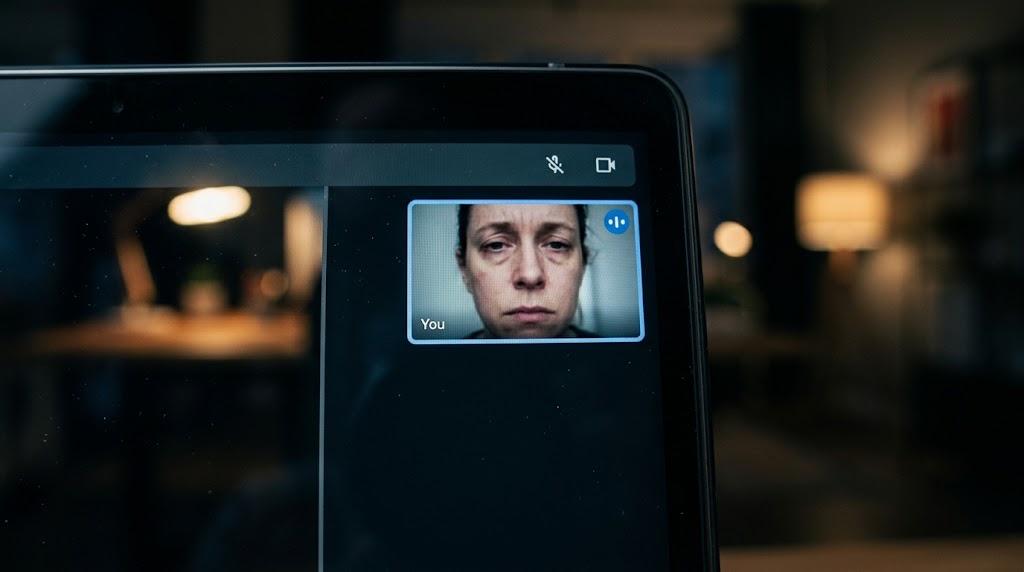
Most video platforms default to a small mirror in the corner of the call: your own face, live, always visible — the second engine of zoom fatigue. No physical environment does this. Offices contain mirrors in bathrooms, not boardrooms, and nobody spends eight hours studying their own reflection mid-conversation. The self-view tile hands the brain a continuous self-evaluation task it is neurologically built to find expensive.
Psychologists call the underlying mechanism objective self-awareness — the shift into watching yourself as an object of evaluation, which reliably triggers self-critical comparison. Neuroimaging work on self-referential and social-evaluative processing implicates the dorsal anterior cingulate cortex and the insula, regions that register conflict, error, and bodily distress. Staring at a real-time self-image keeps that evaluative loop running: micro-adjustments of expression, posture checks, the silent question do I look engaged? — repeated hundreds of times per meeting.
That loop is a direct contributor to zoom fatigue, and the evidence is no longer theoretical. A within-person field experiment tracking employees across two weeks found that camera use during virtual meetings measurably increased fatigue during the meetings themselves, with the effect strongest in people who felt pressured to keep cameras on [Shockley et al., 2021].
The repair is almost comically simple — hide the self-view — which makes its omission more revealing. Platforms defaulted to self-display because it feels useful, not because interaction requires it. Meanwhile the mirror keeps charging its neurological rent: attention diverted from the actual conversation toward a performance of oneself, and the dACC’s conflict circuit idling at a low boil. Turning the mirror off does not merely reduce distraction; it deletes an entire self-monitoring workload the brain was never designed to sustain.
The 200-Millisecond Latency Trap
Face-to-face conversation runs on micro-timing so precise it operates below awareness. When one person finishes a turn, the next begins after a gap of roughly a fifth of a second — a universal human rhythm so tight that conversationalists perceive gaps of a second or more as meaningful: hesitation, reluctance, bad news. Turn-taking is therefore a prediction task. The listening brain forecasts when the speaker will stop and prepares its own launch, compressing what looks like effortless dialogue into milliseconds of choreography. Break that rhythm and zoom fatigue follows within the hour.
Video platforms corrupt the clock. Compression, buffering, and network routing insert delays — often hundreds of milliseconds — between lips and sound, and among participants. Each asynchronous micro-gap forces the listener to re-decide whether the silence is a turn boundary or a pause. The social cognition networks interpret the stretched gaps the only way they can: as cognitive hesitation or interpersonal coldness. Speakers compensate by talking longer to avoid interruptions — a defensive style that deepens zoom fatigue — and the conversation degrades into negotiated transmission rather than rhythmic exchange. This is the third engine of zoom fatigue: a meeting conducted in a currency the brain’s timing circuits keep converting at a loss.

The costs extend beyond fatigue into judgment. Latency distorts the impression one forms of other minds — colleagues read as disengaged, candidates as unsure, silence as dissent — and the listener’s temporal lobe spends the entire meeting double-checking those readings. A medium that reliably decouples voice from mouth and turn from reply does not merely slow communication; it quietly manufactures distrust at 200-millisecond intervals.
High-Effort Nonverbal Overhead and the Paralyzed Body
In physical interaction, the brain decodes posture, gesture, and prosody automatically — parallel, effortless, mostly subcortical. Video strips the signal to a flat 2D crop and then taxes the conscious mind to decode what used to be free. Gestures must be oversized to register inside the frame; nods and leans, the tiny attunements that carry agreement and interest, vanish below the resolution of the codec. Early video-collaboration research already documented this premium: video communication carries measurable cognitive and interpersonal costs that audio alone does not [Hinds, 1999]. Every added second of manual decoding compounds the day’s zoom fatigue bill.
Audio adds its own friction — compressed, clipped, time-shifted voices that the auditory system must continuously reassemble, the acoustic cousin of why misophonia makes chewing sounds furious: real sounds, wrong signal statistics.
Then comes the body’s own rebellion. To stay inside the frame, users suppress the head, neck, and torso movement that physical conversation uses as punctuation. That stillness is not neutral. Human cognition is embodied — movement feeds back into thinking — and prolonged motor restraint suppresses the release of brain-derived neurotrophic factor and dampens catecholamine turnover, the very chemistry that keeps attention and mood elastic. Meetings become cognitive inertia: a brain requested to perform socially while its motor system is anchored to a chair. Videoconferencing’s four vectors — looming gaze, the mirror, broken timing, manual nonverbal decoding — converge with this paralysis into the full syndrome of zoom fatigue [Riedl, 2022].
Zoom Fatigue vs. the Meeting Room: The Communication Cognitive Friction Matrix
The matrix condenses the argument and shows why zoom fatigue is structural rather than personal. Each row pairs a biological parameter of human communication with its video-conference distortion, the neurological burden incurred, and the ergonomic remedy that restores the parameter.
| Parameter | Natural Human Baseline (In-Person) | Video Conference Distortion | Neurological Burden / Brain Region | Neuro-Ergonomic Remedy |
|---|---|---|---|---|
| Gaze Mechanics & Pupil Dilation | Intermittent mutual gaze at 3–6 feet, broken naturally | Continuous close-up stares at simulated 1–2 feet, from every tile | Amygdala-driven threat/intimacy arbitration; sustained sympathetic arousal | Shrink the window; use speaker view; sit farther from the screen |
| Spatial Audio & Directionality | Binaural localization; one voice per direction; natural room acoustics | Mono playback; clipped, compressed voices from a single speaker point | Auditory cortex effort on stream separation; attentional drain | Headphones; mute discipline; audio-only blocks for listening tasks |
| Latency & Micro-Timing | Turn-taking gaps near 200 milliseconds; predictive choreography | 200+ millisecond asynchronous gaps between lips, sound, and replies | Temporal and social-cognition networks re-deciding every silence | Explicit turn norms; hand-raise tools; fewer multi-party calls |
| Motor Freedom & Dopaminergic Pacing | Locomotion, gesture, postural shifts feeding back into cognition | Head-in-frame stillness; gesture suppression for camera discipline | Reduced BDNF release and dopamine turnover; cognitive inertia | Camera-off walking meetings; standing or pacing options |
| Mirror Self-Evaluation | Self-image occluded during interaction; evaluation episodic | Persistent self-view tile; continuous real-time self-monitoring | Dorsal anterior cingulate and insula self-evaluative load | Hide self-view by default; cameras optional on internal calls |
No row is exotic. Each names a parameter physical meetings satisfied for free, and each distortion is a standing invitation to zoom fatigue that no amount of willpower cancels.
The Stanford Neuro-Ergonomic Protocol
Zoom fatigue responds to design changes faster than to discipline. The interventions below are drawn from the Stanford analysis and the empirical literature that followed it; each one removes a specific vector rather than promising endurance.
1. Disable Self-View
Hide the mirror. Removing the self-image suppresses the continuous objective self-awareness loop that keeps dorsal anterior cingulate and insular circuits idling, and it returns attention to the other participants — the only people whose faces the conversation actually needs. The camera can stay on; only the self-display must go. This is the cheapest single intervention against zoom fatigue available in the settings menu.
2. The 5-Foot Virtual Buffer
Shrink the call window and step back until faces recede to the size they would hold across a real table. A laptop at arm’s length-plus — the five-foot buffer — converts synthetic looming back into plausible conversational distance, relaxing the pupil-and-amygdala calibration that grid view violates. An external keyboard makes the distance workable.
3. Audio-Only Sensory Offloading
For calls where faces are optional, turn the camera off and let the auditory system carry the exchange. Audio-only mode deletes the looming, the mirror, and the decoding burden in one switch, and the research on camera-related fatigue suggests the body notices within a single meeting [Shockley et al., 2021]. Periodic audio-only meetings are the highest-yield, lowest-cost intervention in the entire protocol.
4. The 25/50 Meeting Schedule
Default to 25- and 50-minute meetings instead of 30 and 60. The recovered minutes function as sympathetic reset windows: stand, walk, look at a far wall, let the gaze-detection circuitry discharge. The breaks also interrupt the rapid task-switching between windows and documents that fragments attention mid-call — the same boundary effect that erases context when walking through a doorway makes you forget. Organizations that normalize camera-optional norms and shorter defaults report lower end-of-day exhaustion, consistent with survey data showing that zoom fatigue scales with daily video exposure [Nesher Shoshan & Wehrt, 2022].
Reclaiming Neural Bandwidth in a Screen-First World
Zoom fatigue is not weakness, and it is not a metaphor. It is the predictable physiological invoice for a medium that forces the brain’s social hardware to run at intimate distance, under total gaze, with a live mirror, against a broken clock, inside a paralyzed body. Bailenson’s four vectors name the charges; the friction matrix shows what natural interaction provided for free. Pay the invoice down structurally — hide the self-view, shrink the faces, drop the camera when possible, shorten the defaults — and the exhaustion that seemed like a personal failing turns out to be classic zoom fatigue: an engineering problem with known fixes.
Frequently Asked Questions
What exactly causes zoom fatigue?
Research attributes it to four interacting mechanisms that together define zoom fatigue: excessive close-up mutual gaze that triggers sustained amygdala vigilance, continuous self-view that drives exhausting self-evaluation through dorsal anterior cingulate recruitment, audio-visual latency that disrupts the ~200-millisecond rhythm of human turn-taking, and the conscious effort of producing and decoding nonverbal signals within a restrictive camera frame [Bailenson, 2021].
Who experiences zoom fatigue the most?
Scale-based research using the Zoom Exhaustion & Fatigue Scale found higher reported zoom fatigue among women and younger users, with longer and larger-grid meetings predicting more exhaustion [Fauville et al., 2021]. Field evidence adds that employees required to keep cameras on fatigue faster within meetings than those with camera choice [Shockley et al., 2021].
How do I reduce zoom fatigue today?
Hide the self-view tile, shrink the meeting window so faces sit at plausible conversational distance, switch to audio-only for calls that do not need faces, and move your schedule to 25- and 50-minute meetings with standing breaks between blocks. Each step removes a distinct neurological burden rather than asking you to endure it.
This article is for educational purposes only and does not constitute medical or psychological advice. If video meetings are accompanied by persistent anxiety, low mood, or burnout symptoms, consult a licensed mental health professional.
References
- Bailenson, J.N. (2021). Nonverbal overload: A theoretical argument for the causes of Zoom fatigue. Technology, Mind, and Behavior, 2(1), 1-6. DOI: 10.1037/tmb0000030
- Fauville, G., Luo, M., Queiroz, A.C.M., Bailenson, J.N. & Hancock, J. (2021). Zoom Exhaustion & Fatigue Scale. Computers in Human Behavior Reports, 4, 100119. DOI: 10.1016/j.chbr.2021.100119
- Riedl, R. (2022). On the stress potential of videoconferencing: Definition and root causes of Zoom fatigue. Electronic Markets, 32(1), 153-177. DOI: 10.1007/s12525-021-00501-3
- Shockley, K.M., Gabriel, A.S., Rosen, C.C., Chawla, N., Ganster, M.L. & Shoss, M.K. (2021). The fatiguing effects of camera use in virtual meetings: A within-person field experiment. Journal of Applied Psychology, 106(8), 1137-1155. PMID: 34423999
- Nesher Shoshan, H. & Wehrt, W. (2022). Understanding “Zoom fatigue”: A mixed-method approach. Applied Psychology, 71(3), 827-852. DOI: 10.1111/apps.12360
- Hinds, P.J. (1999). The cognitive and interpersonal costs of video. Media Psychology, 1(4), 283-311. DOI: 10.1207/s1532785xmep0104_1
- Sweller, J. (2011). Cognitive load theory. Psychology of Learning and Motivation, 55, 37-76. DOI: 10.1016/B978-0-12-387691-1.00002-8


