


Imagine filling two identical containers with water: one with near-boiling hot water at 90°C (194°F), and the other with cool tap water at 20°C (68°F). You place both containers side by side inside the exact same freezer, under identical ambient conditions.
Basic common sense and schoolbook thermodynamics tell you what should happen. The hot water must first cool down to 20°C before it can even begin the freezing process, giving the cold water a massive head start. Yet, under specific laboratory conditions, an astounding physical anomaly occurs: the hot water forms ice first. You are left staring into the freezer asking why hot water freezes faster than cold water against all intuitive logic.
This counterintuitive physical phenomenon is known in physics as the Mpemba Effect. While it sounds like an urban legend, it is one of the most fiercely debated anomalies in thermal physics — historically noted by thinkers like Aristotle, Francis Bacon, and René Descartes, yet still actively contested in modern laboratory research. Understanding this bizarre paradox requires diving into quantum-level hydrogen bonding, evaporative mass loss, convection currents, and dissolved gas dynamics.
1. The Mpemba Effect: History of a Physics Paradox
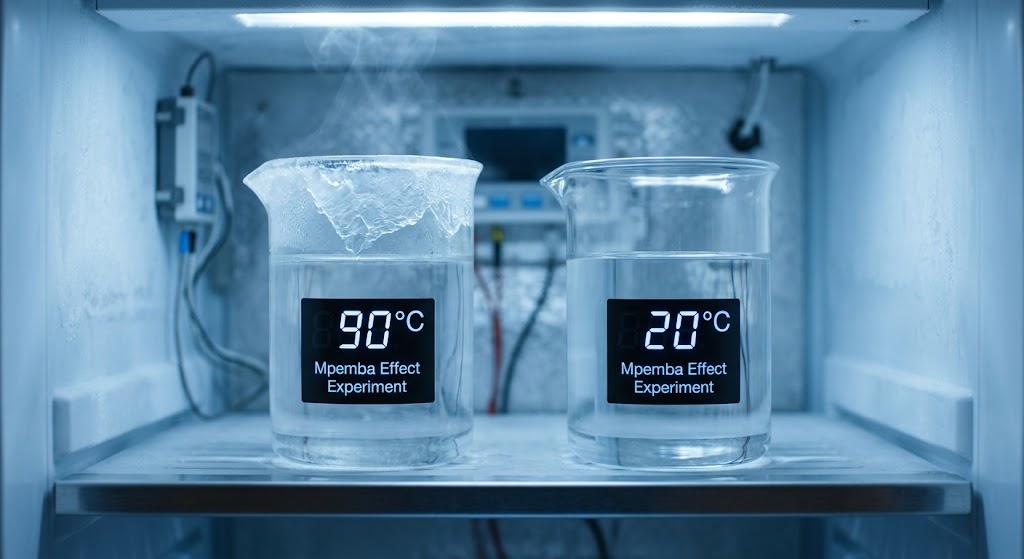
Although ancient scholars documented instances of hot liquids freezing rapidly, the phenomenon received its modern scientific name from a Tanzanian high school student named Erasto Mpemba in 1963.
While making ice cream in his home economics class, Mpemba noticed that his warm ice cream mixture froze significantly faster than his classmates’ cooled mixtures. When he questioned his physics teacher about why warm liquid froze faster, he was initially mocked. However, Mpemba persisted, eventually convincing physics professor Dr. Denis Osborne to conduct controlled experiments. In 1969, they published their findings, formally introducing the world to the Mpemba Effect.

Since then, physicists around the globe have attempted to replicate and explain why hot water freezes faster than cold water. The mystery persists because water is not a simple fluid; H₂O is one of the most anomalous chemical compounds in the universe, exhibiting over 70 unique physical properties that defy standard liquid dynamics.
“It is scientifically impossible for boiled hot water to freeze faster than cold water; it violates thermodynamics.”
The Mpemba Effect is genuine biophysical reality! Rapid evaporation reduces total mass, convection currents accelerate thermal loss, and hydrogen bonds relax faster under specific supercooling conditions!
2. Hydrogen Bond Anomalies: Quantum Energy Relaxation
The most groundbreaking modern explanation for this physical anomaly comes from quantum chemistry research into the molecular structure of water.
A single water molecule consists of one oxygen atom covalently bonded to two hydrogen atoms. However, individual H₂O molecules are also linked to neighboring water molecules by weaker hydrogen bonds. In cool water, these hydrogen bonds pull water molecules close together, which naturally exerts a pulling force that stretches the internal covalent (O-H) bonds inside each molecule.

A theoretical molecular hypothesis proposed by some chemical physicists suggests that hydrogen bond dynamics could play a role. As water warms, weaker intermolecular hydrogen bonds stretch, theoretically allowing the stronger internal covalent (O-H) bonds within each water molecule to contract and store elastic energy like a compressed spring.
Some theoretical physicists propose that heating alters hydrogen bond geometry, suggesting that when hot water is suddenly chilled, subtle molecular relaxation could accelerate initial energy release. However, this “molecular spring” mechanism remains a minority hypothesis under active debate; many researchers argue that macroscopic factors — such as convection currents and experimental setup — are far more influential than subatomic bond shifts.
3. Evaporative Mass Loss: Less Water to Freeze
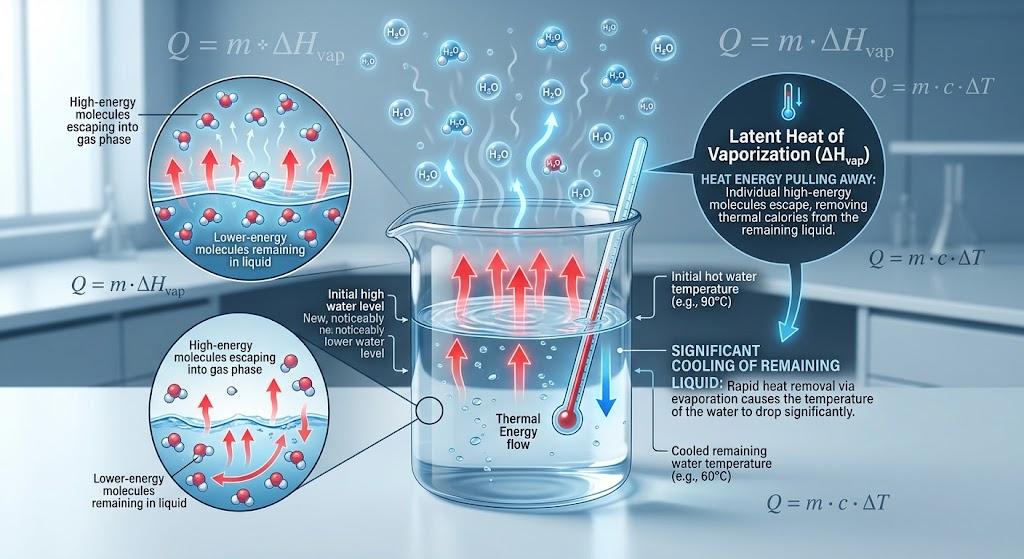
While quantum mechanics explains the molecular energy release, classical thermodynamics provides a very practical macro-level factor: Evaporation.
Hot water has a significantly higher vapor pressure and kinetic energy than cold water. When hot water is placed in an open container inside a freezer, it undergoes rapid, aggressive evaporation. This process affects cooling in two major ways:
- Latent Heat of Vaporization: Evaporation requires a massive amount of thermal energy. As water molecules evaporate off the top surface, they carry away enormous amounts of heat, dramatically cooling the remaining liquid below.
- Mass Reduction: By the time the hot water cools down to freezing temperatures, a notable percentage of its total volume has evaporated into steam.
Because there is physically less water left in the hot container compared to the cold container, the remaining reduced volume requires less total heat extraction to freeze solid. This evaporative advantage is a major practical reason for this rapid freezing in open environments.
This rapid shift in physical state demonstrates how complex systems can produce non-intuitive outcomes when multiple variables operate simultaneously.

4. Rayleigh-Bénard Convection: The Thermal Engine
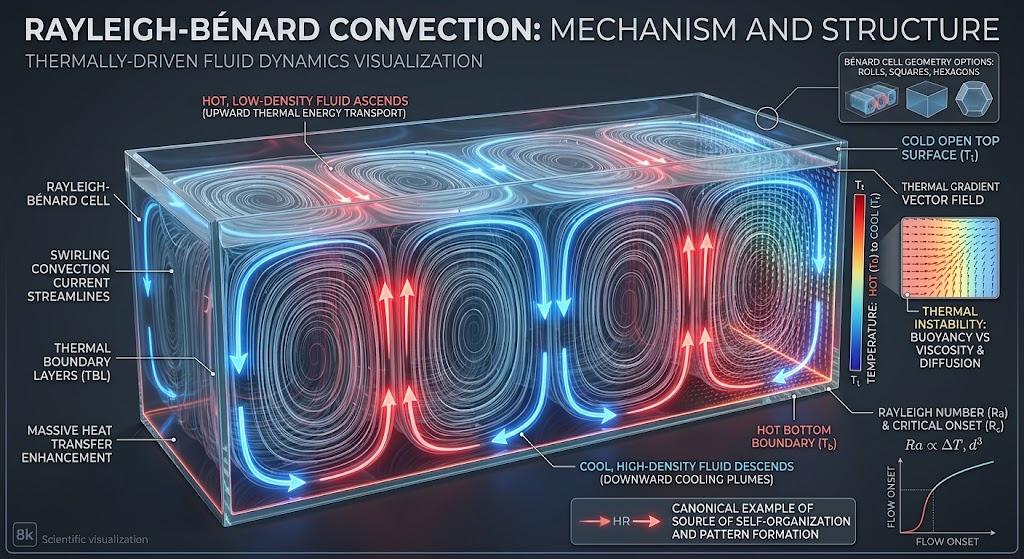
Another major thermodynamic factor explaining this thermal engine is the creation of powerful Convection Currents.
When hot water is placed in a freezing room, an extreme temperature gradient is established between the hot bottom/center of the container and the cold top surface. This steep gradient drives rapid Rayleigh-Bénard convection currents—warm water rapidly rises to the surface, loses its heat to the cold air, and plunges back down.
Cold water, having a much smaller temperature gradient, develops very weak convection currents. It cools stagnant layer by stagnant layer. In hot water, the powerful convection currents act like an internal mechanical pump, rapidly circulating heat out of the core of the liquid. This accelerated heat transfer mechanism explains why hot water freezes faster than cold water before stagnant cold water can complete ice nucleation.
5. Dissolved Gas Depletion and Supercooling Susceptibility
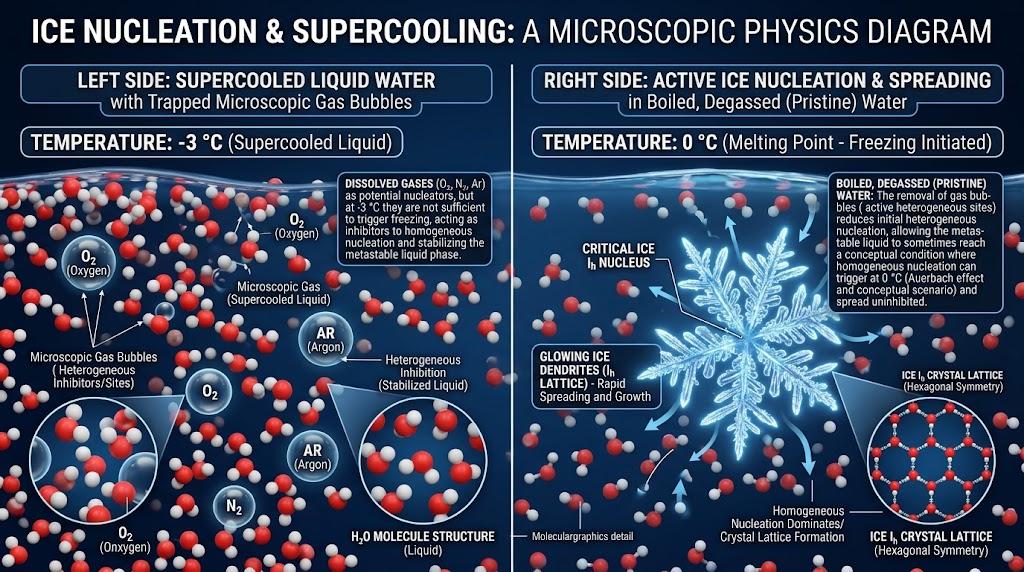
The chemical composition of tap water also plays a surprising role in thermal dynamics, specifically regarding Dissolved Gases.
Cold water holds a high concentration of dissolved atmospheric gases (oxygen, nitrogen, and carbon dioxide). As water is heated to high temperatures, these dissolved gases are forced out of solution (which is why you see tiny bubbles forming on the bottom of a pot before it boils).
Gas-depleted hot water differs from gas-rich cold water in two critical ways:
- Thermal Conductivity: Dissolved gas bubbles act as microscopic insulators. Degassed hot water has higher thermal conductivity, allowing heat to escape more efficiently.
- Supercooling Point: Cold water rich in dissolved gases frequently undergoes significant “supercooling”—remaining liquid below 0°C (32°F) before spontaneous ice nucleation begins. Degassed, previously heated water can nucleate at slightly higher temperatures under certain conditions, bypassing an extended supercooling delay.
Controlled thermodynamic experiments demonstrate that dissolved gas concentrations alter nucleation thresholds and convection currents, representing one of several coupled variables influencing cooling trajectories.
6. Freezer Frost Melt: The Environmental Substrate Hack
In home freezer experiments, a very simple physical interaction frequently causes the Mpemba Effect to occur by accident.
Most home freezer shelves accumulate a thin layer of frost or ice. When a container of cold water is placed on the shelf, the frost acts as an insulating barrier, preventing efficient heat transfer from the bottom of the container to the freezing metal shelf.
However, when a container of hot water is placed on the shelf, its high thermal energy immediately melts the frost beneath it. The container sinks down, establishing direct, metal-to-container thermal contact. This direct conductive contact transfers heat away exponentially faster than sitting on top of insulating frost. This environmental interaction frequently explains the outcome in everyday home experiments.
This environmental shift reflects how subtle environmental factors alter outcomes without conscious awareness.
7. Does Hot Water Always Freeze Faster?
Despite the real physics behind the Mpemba Effect, it is vital to answer this question accurately: Does hot water always freeze faster than cold water?
The answer is no. Under standard, everyday conditions, cold water freezes before hot water the overwhelming majority of the time, obeying standard thermal conduction principles.
The Mpemba Effect is an anomalous non-equilibrium phenomenon that requires very specific, sensitive initial parameters to appear: open containers that facilitate significant evaporation, pronounced convective circulation, and specific cooling environments. If containers are hermetically sealed to eliminate evaporative mass loss and thermal gradients are suppressed, colder water consistently freezes first. The Mpemba effect does not violate fundamental thermodynamics; rather, it highlights how multi-variable non-equilibrium systems can yield unexpected cooling trajectories.
The Bottom Line on the Mpemba Effect
The fact that hot water can, under the right conditions, overtake cold water on its journey to becoming ice is one of the most delightful paradoxes in natural science.
It reminds us that even the most common substance on Earth—pure water—still holds profound physical mysteries. Understanding why hot water freezes faster than cold water requires appreciating hydrogen bond energy relaxation, evaporative mass loss, convective currents, and gas depletion working in perfect physical harmony.
Thermodynamics in Action: The Surprising Physics Summary
- The phenomenon where hot water freezes before cold water is called the Mpemba Effect, named after Tanzanian student Erasto Mpemba in 1963.
- Proposed explanations range from macroscopic drivers (rapid evaporative mass loss, steep convection currents, and gas depletion) to debated microscopic hypotheses regarding hydrogen bond relaxation.
- Rapid evaporation reduces the total mass of hot water, leaving less volume to freeze while carrying away immense latent heat.
- Steep thermal gradients create powerful Rayleigh-Bénard convection currents that act like a pump, rapidly transferring heat out of hot water.
- Boiling forces out dissolved gases, increasing thermal conductivity and altering ice nucleation thresholds to prevent extended supercooling.
- The Mpemba Effect is conditional; it does not happen every time, but occurs under specific geometries, open surfaces, and thermal parameters.
Frequently Asked Questions
Is the Mpemba Effect real, or is it a myth?
The Mpemba Effect is a genuine, condition-dependent scientific phenomenon, but it is not a universal rule. While historical observations and certain modern experiments have demonstrated that warmer water can sometimes freeze before colder water, large-scale replications (such as Burridge & Linden, 2016) found that standard water often behaves normally. Recent breakthroughs in non-equilibrium thermodynamics (Nature Reviews Physics, 2021) suggest the effect is real in specific physical systems, but highly sensitive to container geometry, dissolved gases, and cooling protocols.
Who discovered that hot water can freeze faster than cold water?
While historical figures like Aristotle, Francis Bacon, and René Descartes observed the phenomenon centuries ago, it was formally brought to modern science by Tanzanian high school student Erasto Mpemba in 1963, who noticed warm ice cream mix froze faster than cold mix.
Should I use hot water to make ice cubes faster at home?
Generally, no. In a standard home freezer, using tap water from the cold faucet is more energy-efficient and reliable. Hot water can also raise the internal temperature of your home freezer, causing your appliance to work harder. The Mpemba Effect requires precise conditions that are not always present in a home freezer tray.
How does evaporation help hot water freeze faster?
Hot water evaporates rapidly into steam. As water molecules evaporate, they carry away significant latent heat, rapidly cooling the remaining liquid. Furthermore, evaporation reduces the total mass of the water, leaving a smaller volume that takes less time and energy to freeze solid.
Does hydrogen bonding explain the Mpemba effect?
Hydrogen bond energy relaxation is one theoretical hypothesis proposed to explain the effect at the molecular scale, suggesting that heated water stores and rapidly releases covalent bond energy. However, this remains an unproven minority model under active debate. Most physicists consider macroscopic factors—especially evaporation and convection—far more influential in experimental setups.
References
- Mpemba EB, Osborne DG. Cool? Phys Educ. 1969;4(3):172-175. doi:10.1088/0031-9120/4/3/312
- Burridge HC, Linden PF. Questioning the Mpemba effect: hot water does not cool more quickly than cold. Sci Rep. 2016;6:37665. doi:10.1038/srep37665
- Lu Z, Raz O. Nonequilibrium thermodynamics of the Markovian Mpemba effect and its inverse. Proc Natl Acad Sci USA (PNAS). 2017;114(20):5083-5088. doi:10.1073/pnas.1701264114
- Bechhoefer J, Kumar A, Chétrite R. A fresh understanding of the Mpemba effect. Nat Rev Phys. 2021;3:534-535. doi:10.1038/s42254-021-00349-8


