


You walk into a kitchen. On the counter sits a clear bowl filled with bright apples. Without thinking, you reach for one. On another day, the same counter holds a cookie jar. Your hand drifts differently.
The room didn’t change much. But the small signals did — and those signals shaped your behavior without a single conscious decision.
This is how environmental cues influence behavior: quietly, automatically, and constantly. Understanding this mechanism is one of the most practically useful insights in modern behavioral science. Once you see it, you can begin designing your surroundings to support the life you actually want — no extra willpower required.
What Are Environmental Cues?
Environmental cues meaning: In psychology and behavioral neuroscience, environmental cues are sensory signals from your physical surroundings—such as room lighting, object placement, ambient scents, or background sounds—that unconsciously trigger specific automated behaviors, habits, or decisions without your active cognitive awareness.
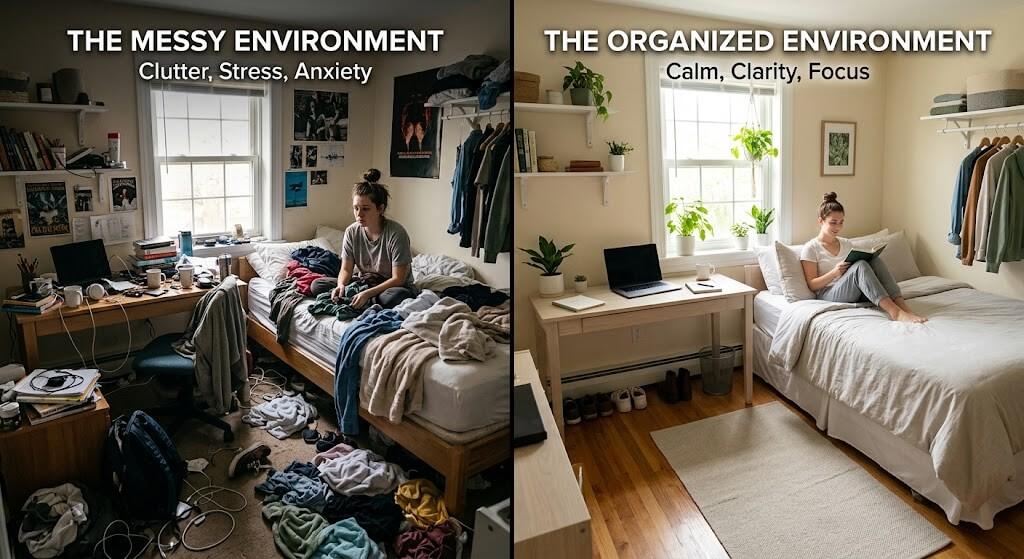
An environmental cue is any feature of your surroundings that suggests or prompts a particular behavior. It is a signal, not a command — but it’s a remarkably powerful signal.

When you see a chair, you think “sit.” When you see a door handle, you think “pull.” When you see a notification badge on your phone, you think “check.” These associations are learned, automatic, and processed below the level of conscious thought. By the time you “decide” to act, the cue has already nudged you in a direction.
Some cues are obvious: a stop sign, a sale banner, a “buy now” button. Others are subtle: the way a grocery store places milk at the back so you walk past other products, the way a website uses red for urgent actions, the way your phone’s home screen determines which apps you use most.
You are being nudged all day, by stores, apps, offices, and your own home — most of it happening without your awareness.
More Read

The Science: How Surroundings Shape Choices
The scientific study of how environmental cues influence behavior spans environmental psychology, behavioral economics, and neuroscience. One of the most significant contributions came from Nobel laureate Richard Thaler, whose work on choice architecture demonstrated that small changes in how options are presented produce large, predictable changes in behavior.
A classic demonstration came from a school cafeteria study. When fruit was placed at eye level and dessert was positioned less conveniently, students chose fruit significantly more often. When the arrangement was reversed, dessert consumption rose. The food didn’t change. The students didn’t change. Only the environmental design changed — and behavior followed automatically.
Another famous example: the Schiphol Airport urinal. Researchers etched a small image of a fly near the drain of each urinal. Men instinctively aimed at the fly. Cleaning costs from spillage dropped by approximately 80%. No signs. No rules. No enforcement. Just a tiny visual cue that triggered an automatic behavioral response.
A meta-analysis of 42 studies found that making healthy foods more visible or convenient increased their selection by an average of 27%, while making unhealthy options less visible decreased their selection by 22%. No one was told what to eat. The environment made the decision.
This automatic responsiveness to surroundings connects directly to how expectations shape perception — environmental cues create expectations that pre-load behavior before conscious deliberation begins.
Choice Architecture: Who Designed Your Decisions?

Choice architecture refers to how the presentation and arrangement of options affects what people choose. Every environment is designed by someone. The question is whether they designed it to help you — or to extract something from you.

Supermarkets are masterful choice architects:
- Essential items like milk and eggs are placed at the back, requiring you to walk through more aisles
- Candy and impulse purchases are positioned at checkout, when decision fatigue is highest
- The most profitable items sit at eye level; cheaper alternatives are above or below
- Larger cart sizes increase average purchase quantity — you fill what you’re given
Online platforms operate identically. Infinite scroll removes natural stopping points. Autoplay eliminates the moment of deliberate choice to continue. Notification defaults are set to maximum. Social validation metrics (likes, view counts) are placed prominently to trigger social comparison.
The good news: you can become your own choice architect. You can arrange your home, desk, and digital environment so that the easy choice is also the one you actually want to make.
The Cafeteria Eye-Level Salad Dilemma
A university cafeteria moves fresh fruit and crisp salads to eye-level at the entrance, while moving french fries and desserts 4 steps further back behind a low counter. What happens to student eating habits?
The Default Effect: Why “Standard Options” Always Win
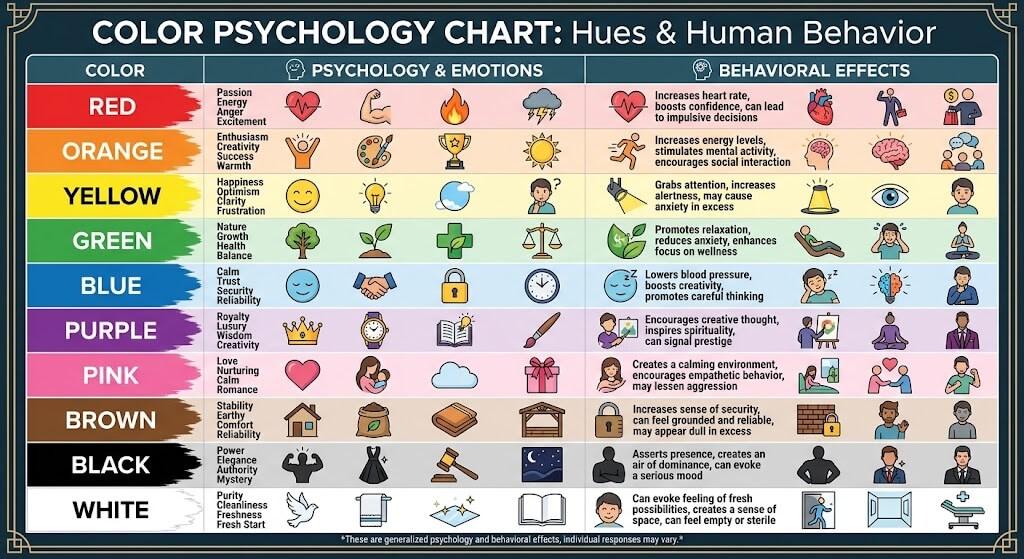
One of the most powerful forms of environmental influence is the default option — the choice you get if you do nothing. And the consistent finding across hundreds of studies is that most people do nothing. They keep the default, accept the pre-checked box, and take the path of least resistance.
The consequences at scale are striking:
- In countries where organ donation is the default (you must actively opt out), donation rates consistently exceed 90%
- In countries where donation requires active opt-in, rates typically fall below 20%
- The same people, the same attitudes, the same values — different default, dramatically different outcomes
The same principle applies to retirement savings, insurance coverage, energy plans, and software privacy settings. Whoever sets the default shapes the behavior of the majority.
In your personal life, you can exploit defaults deliberately. Set your default lunch to something nutritious. Place a book on your nightstand as the default pre-sleep activity. Set your phone’s default mode to Do Not Disturb during work hours. When the default is good, you benefit every time you fail to override it — which is most of the time. This directly addresses why more choices lead to worse decisions — reducing the number of active decisions through intelligent defaults preserves cognitive resources for genuinely important choices.
Proximity and Effort: The Laziness Principle
The human brain is, neurologically, effort-averse. This isn’t laziness — it’s energy conservation. Your brain evolved to minimize unnecessary expenditure, reserving resources for genuine emergencies. When two options are available, you will consistently choose the one requiring less physical or cognitive effort.
Behavioral scientists have documented what’s sometimes called the “two-foot rule”: moving an object just two feet farther away measurably reduces how often people reach for it. Distance creates friction. Friction changes behavior.
Practical implications:
- If healthy snacks are on the counter and cookies are in a cabinet, you’ll eat more fruit — and vice versa
- If your running shoes are by the door, you’re more likely to exercise than if they’re in a closet
- If your phone requires a passcode every time (friction) versus Face ID (frictionless), usage patterns differ significantly
- If your medication is next to your toothbrush, you’ll take it more consistently than if it’s in a bathroom cabinet
To use proximity deliberately: make desired behaviors physically easier and undesired behaviors physically harder. You don’t need to change your motivation — you need to change the distance.
Visual Cues: What Your Eyes Decide Before You Do
Your visual system automatically prioritizes certain features: bright colors, movement, faces, high contrast, and objects that stand out from their surroundings. This automatic prioritization happens before conscious attention — your eyes have already “decided” what matters before you’re aware of choosing.
Research from Princeton University found that visual clutter genuinely competes for neural attention. Every object in your visual field sends low-level signals to the brain, consuming a portion of limited attentional resources. A clear environment isn’t just aesthetically pleasant — it’s cognitively quieter.
- A water bottle on your desk is a constant visual cue to hydrate
- A visible fruit bowl cues healthier snacking without any reminder
- A phone face-down reduces the pull of its notifications
- A single task on your desk surface reduces the visual competition for attention
The key insight: out of sight genuinely means out of mind. The brain cannot be nudged toward something it isn’t seeing. This is why focus is so fragile in visually complex environments — every visible object is a potential cue competing for the same limited attentional resources.
Social Cues: Other People as Environmental Signals
Other people are among the most powerful environmental cues you encounter. When you see someone else doing something, your brain automatically treats that as a signal about appropriate behavior. This mechanism — called social proof — operates below conscious awareness.
- If everyone in a meeting is checking their phones, you’ll check yours
- If everyone is listening quietly, you’ll listen too
- Hotel towel reuse programs increased compliance by 26% when signs said “75% of guests in this room reused their towels” versus generic environmental appeals
- Neighborhoods where recycling is visibly common show higher recycling rates among new residents regardless of prior attitudes
You can use social cues deliberately: join groups where your desired behavior is normal and expected. Spend time with people who already have the habits you want. The behavior that surrounds you becomes the behavior that feels natural — because your brain uses others as constant calibration for what’s appropriate.
This mechanism also explains why familiar habits are so hard to change — social environments reinforce existing patterns just as strongly as physical ones, making behavior change in isolation significantly harder than behavior change within a supportive social context.
How to Design Your Environment Intentionally
The practical application of behavioral science isn’t about controlling every corner of your life. It’s about making small, strategic adjustments that shift the balance in your favor.
1. Audit Before You Change
Spend one week simply noticing. Where does your hand go first in the kitchen? What does your eye land on when you sit at your desk? What makes your intended habits hard to start? This observation is data, not judgment. Environmental cues are most visible right before they trigger behavior — catch them in that moment.
2. Make Good Cues Visible and Proximate
Put your gym bag by the front door. Place your water bottle on your desk. Keep healthy food at eye level in the refrigerator. Set your book on your pillow each morning so it’s waiting when you get into bed. The goal: make your preferred behavior the obvious, easy, visible option.
3. Create Friction for Unwanted Behaviors
Move the cookie jar to a high cabinet. Log out of social media so you must actively log in each time. Put your TV remote in a drawer. Delete apps from your phone’s home screen (or the phone entirely). Increasing effort by even small amounts significantly reduces frequency — the brain’s effort-aversion works in your favor here.
4. Set Better Defaults Once
Automatic transfers to savings. Do Not Disturb enabled during sleep hours. Healthy items ordered as the default grocery delivery. Notifications turned off except for essential apps. Each of these requires one decision — and then benefits you automatically every time you don’t override it.
5. Change One Thing at a Time
Environmental redesign works best when it’s specific and sustainable. Move one object. Remove one distraction. Add one helpful cue. Let the behavior change settle before adding the next adjustment. Wholesale environment overhauls are harder to maintain than incremental improvements.
Understanding why you feel the urge to reorganize when avoiding tasks reveals an interesting intersection — sometimes environmental redesign is genuinely productive, and sometimes it’s avoidance dressed as productivity. The distinction is whether you’re creating conditions for future work or delaying current work.
Designing Physical Spaces for Unconscious Focus
- Environmental cues shape behavior automatically and below conscious awareness — you respond to your surroundings before you decide to
- Choice architecture (how options are arranged) is more powerful than motivation for determining what people actually do
- The default effect means that whoever sets the standard option controls the behavior of most people most of the time
- Proximity and effort determine behavior more than preference — make desired actions easy and undesired actions hard
- Social cues are among the strongest environmental influences — the behavior of people around you becomes the template for your own
- You can become your own choice architect with small, strategic changes that don’t require willpower — just intentional design
Frequently Asked Questions
What are environmental cues in psychology?
In psychology, environmental cues are features of your physical or social surroundings that trigger or suggest specific behaviors. They work below conscious awareness — your brain processes them automatically and begins preparing behavioral responses before you consciously decide to act. Examples include the placement of food, the visibility of objects, notification sounds, the behavior of people around you, and the default settings of devices and platforms you use.
How do environmental cues influence behavior without us noticing?
Environmental cues operate through automatic neural processing. Your brain continuously scans your surroundings and pattern-matches against stored associations — a chair means “sit,” a ringing phone means “answer,” visible food means “eat.” These associations activate behavioral responses faster than conscious deliberation. By the time your conscious mind “decides” to act, the cue has already nudged the decision. Research shows that the majority of daily behaviors are initiated by environmental triggers rather than conscious intention.
What is choice architecture?
Choice architecture is the design of environments to make certain choices easier or more likely, without restricting freedom. It was developed by behavioral economist Richard Thaler (Nobel laureate) and legal scholar Cass Sunstein. Classic examples include placing healthy food at eye level in cafeterias, making organ donation the default (opt-out) rather than opt-in, and designing retirement plans so employees are automatically enrolled. Every environment has a choice architecture — the question is whether it’s designed intentionally or accidentally.
Can I use environmental design to build better habits?
Yes — and research suggests it’s more effective than willpower-based approaches for most people. The core strategy: make desired behaviors easier (more visible, closer, lower effort) and undesired behaviors harder (less visible, farther, higher friction). Specific tactics include placing gym clothes by the door, keeping healthy food at eye level, logging out of distracting apps, and setting better defaults for recurring decisions. Small environmental changes, sustained over time, produce larger behavioral changes than motivation alone.
Why do people often choose the default option even when better alternatives exist?
Default options benefit from several psychological biases simultaneously: loss aversion (changing from the default feels like losing something), status quo bias (the brain prefers existing states to change), and cognitive effort minimization (overriding a default requires an active decision, which consumes cognitive resources). Research consistently shows that default rates of 80-90% or higher are common across many domains — insurance, retirement savings, organ donation, and software settings — regardless of the quality of alternatives.
References
- Wansink, B. (2004). Environmental factors that increase the food intake and consumption volume of unknowing consumers. Annual Review of Nutrition, 24, 455-479. DOI: 10.1146/annurev.nutr.24.012002.132745
- Thaler, R.H. & Sunstein, C.R. (2008). Nudge: Improving Decisions About Health, Wealth, and Happiness. Yale University Press.
- Bargh, J.A. & Chartrand, T.L. (1999). The unbearable automaticity of being. American Psychologist, 54(7), 462-479. DOI: 10.1037/0003-066X.54.7.462


