


Step outside on a clear afternoon, gaze up at the vast expanse above you, and ask yourself a simple question: why the sky isn’t blue in true physical reality? To your eyes, the atmosphere appears to be a brilliant, uniform shade of azure blue. From childhood paintings to poetic descriptions, we accept the blue sky as an indisputable fact of nature.
While we perceive the daytime sky as a vibrant azure blue, the atmosphere itself contains no blue dye or pigment. Transparent nitrogen and oxygen gas molecules selectively scatter incoming sunlight according to Rayleigh’s scattering law. Furthermore, because wave physics dictates that shorter visible wavelengths scatter most intensely, pure optics predicts that violet light scatters even more than blue. The true scientific mystery is not why the sky appears bright during the day, but rather: why does the daytime sky appear blue to human eyes instead of violet?
Deconstructing this everyday miracle requires stepping inside an optical laboratory. Understanding why the sky isn’t blue involves examining Rayleigh light scattering, the 1/λ⁴ wavelength law, human retinal cone sensitivities, and comparing Earth’s sky to the alien horizons of Mars.
Light Wavelengths and Rayleigh Scattering Physics
To understand why the sky isn’t blue in physical space, we must first break down the nature of sunlight. The light streaming from the Sun appears white, but it is actually a continuous spectrum containing all the colors of the rainbow, each traveling at a distinct electromagnetic wavelength:
- Red / Orange Light: Long wavelengths (620–750 nanometers).
- Yellow / Green Light: Medium wavelengths (500–590 nanometers).
- Blue / Violet Light: Short, energetic wavelengths (380–495 nanometers).
When sunlight hits Earth’s atmosphere, it collides with billions of microscopic nitrogen (N₂) and oxygen (O₂) gas molecules. Because these gas molecules are much smaller than the wavelength of visible light, they trigger a physical process called Rayleigh Scattering, named after British physicist Lord Rayleigh in 1871.

Rayleigh’s formula dictates that light scattering intensity is inversely proportional to the fourth power of its wavelength (I ∝ 1/λ⁴). This power-law relationship means short wavelengths scatter dramatically more than long wavelengths. Red light glides straight through the gas molecules almost undisturbed, while shorter wavelengths are bounced around in every direction like microscopic ping-pong balls. This differential scattering is the fundamental physical starting point for why the sky isn’t blue by default, but rather a chaotic mixture of scattered short wavelengths.
Violet light has the shortest wavelength and scatters nearly 10 times more than red. Why does the daytime sky appear blue rather than purple?
Atmospheric Light Scattering Matrix
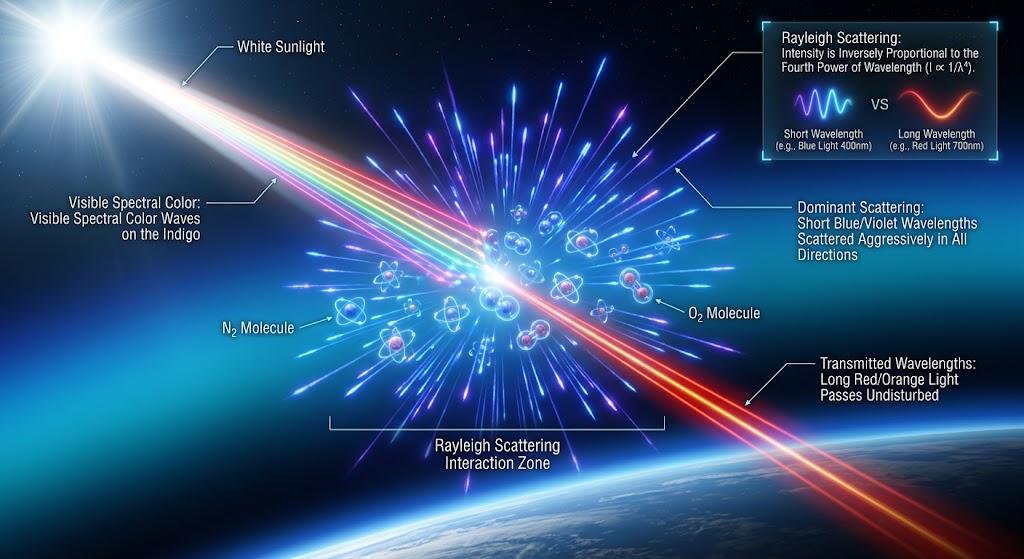
To visualize how different colors of sunlight behave when striking Earth’s gas particles, examine the physical breakdown below:
| Color Spectrum | Wavelength (nm) | Rayleigh Scattering Power (1/λ⁴) | Human Retinal Perception |
|---|---|---|---|
| Red Light | 700 nm | Lowest (1x baseline) | Passes straight through atmosphere without scattering. |
| Yellow Light | 580 nm | Moderate (2.1x baseline) | Direct sun beam remains yellowish-white. |
| Blue Light | 450 nm | High (5.8x baseline) | Scatters intensely; strongly triggers human S-Cones. |
| Violet Light | 400 nm | Extreme (9.4x baseline) | Scatters ~60% more per photon than blue at 400 nm (and nearly 2x at 380 nm), but human eyes are far less sensitive to violet. |
The Violet Paradox: Why Isn’t the Sky Violet?
This brings us to the ultimate physics mystery. If shorter wavelengths scatter more intensely, and violet light (400 nm) has a much shorter wavelength than blue light (450 nm), why is the sky blue instead of violet?

When calibrated spectrophotometers measure the daytime sky spectrum at ground level, they confirm that scattered blue and violet light arrive at roughly comparable intensities. While individual violet photons scatter with higher efficiency, two physical factors shape the spectrum we actually receive:
1. Solar Output Emission Spectrum
The Sun does not radiate all wavelengths in equal measure. The Sun’s surface (photosphere) emits light approximately as a 5,800 K blackbody radiator, with its energy output peaking in the green-blue spectrum. By the time sunlight reaches the upper atmosphere, there is substantially more blue light present in the incoming solar beam than violet light.
2. Human Ocular Biology and Trichromatic Vision
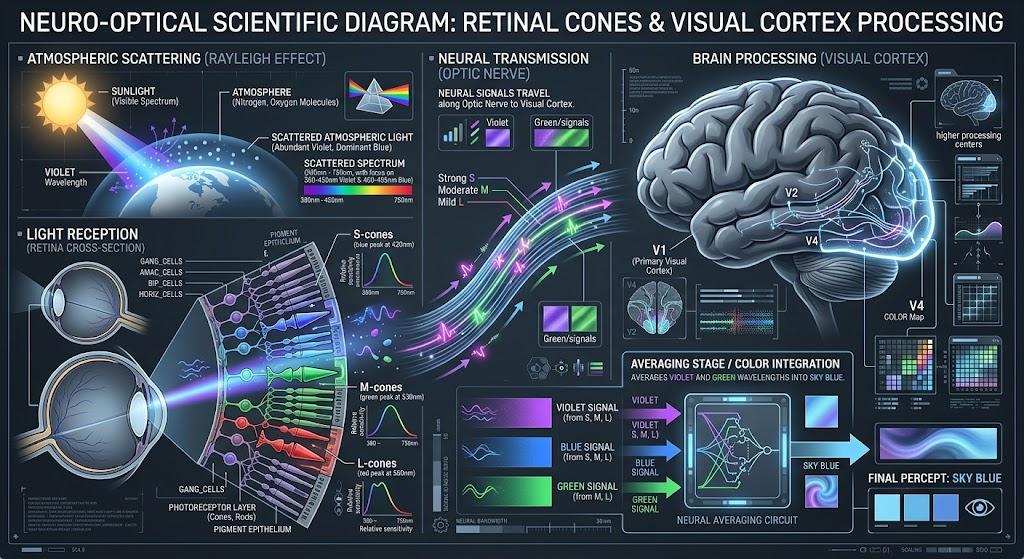
The ultimate filter is inside your own head. Human color vision relies on three types of photoreceptor cells (retinal cones):
- S-Cones (Short Wavelength): Peak sensitivity around 420–440 nm (blue spectrum). Crucially, anatomical research confirms that S-cones represent only about 5% to 10% of total retinal cones.
- M-Cones (Medium Wavelength): Peak sensitivity around 530–535 nm (green spectrum).
- L-Cones (Long Wavelength): Peak sensitivity around 560–565 nm (red spectrum).
According to landmark optical analyses published in the American Journal of Physics, the daylight spectrum reaching the ground stimulates all three cone types simultaneously. While violet light strongly activates S-cones, it also triggers a secondary response in L-cones, accompanied by scattered green-yellow light activating M-cones. Because our visual cortex interprets this tri-stimulus combination as a desaturated cerulean rather than a monochromatic violet, our brain perceives the sky as bright, luminous blue.
If humans possessed near-ultraviolet photoreceptors—such as bees, which have trichromatic vision sensitive to UV, blue, and green, or birds, which possess full tetrachromatic vision—the midday sky would appear dramatically shifted toward violet. The blue dome overhead is essentially an evolutionary compromise between solar irradiance and human retinal physiology.
This biological visual interpretation is another example of how the human nervous system constructs perceived reality from raw inputs.

It also highlights how the brain interprets data before conscious awareness takes hold.
Why Sunsets Turn Blood-Red: Atmospheric Path Length
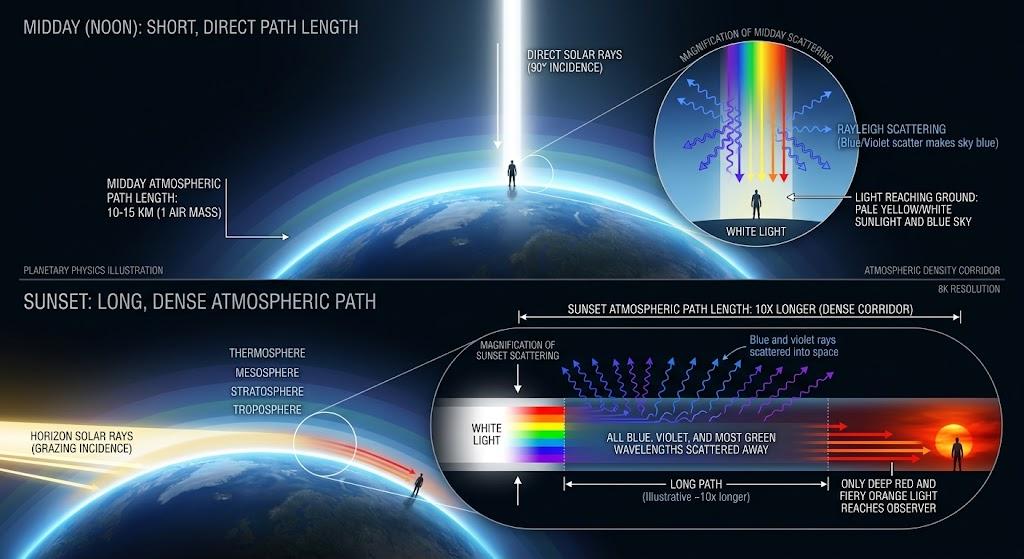
If Rayleigh scattering turns the daytime sky blue, how does the exact same atmosphere produce blazing orange and blood-red sunsets?
The secret lies in Atmospheric Path Length. At noon, the Sun is directly overhead, and sunlight travels through a relatively thin layer of atmosphere (about 10 to 15 kilometers of air) to reach your eyes.
However, as the Earth rotates and the Sun sinks toward the horizon, sunlight must travel at a low angle through up to 38 times more air mass (optical path length) before reaching your eyes. During this long journey through dense air, almost all short blue and violet wavelengths are scattered away into space or scattered out of your direct line of sight.
Only the longest, most resilient wavelengths—red, orange, and deep yellow—can survive the long trek through the thick atmospheric layer without being scattered away. When you watch a sunset, you are viewing the surviving light waves that made it through the atmospheric filter. This optical transformation clarifies why the sky isn’t blue at dusk, shifting into a dramatic spectrum of red.
This emotional reaction to natural beauty is deeply tied to why intense awe can trigger spontaneous emotional tears.
Earth vs. Mars: What Color Are Alien Skies?
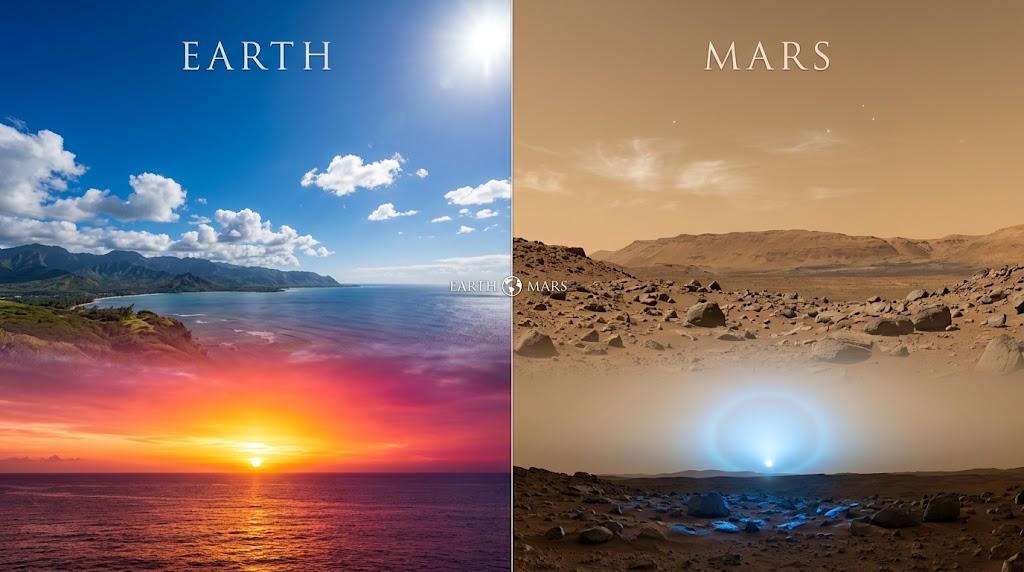
To truly appreciate Earth’s sky, we can look to planetary science. If you were standing on the surface of Mars, the sky would operate under completely different optical rules.
Atmospheric optical data documented by NASA Jet Propulsion Laboratory planetary science teams confirm that Martian sky coloration is governed strictly by suspended aerosol dust grain diameters and forward-scattering dynamics. Earth’s vivid blue sky is a direct consequence of a pure molecular atmosphere unclouded by heavy dust loading.
This sensory distortion connects to why the human brain experiences perceptual glitches during unfamiliar sensory processing.
It also highlights why sudden physical contrasts trigger autonomic goosebumps and chills.
Why Clouds and Fog Look White (Mie Scattering)
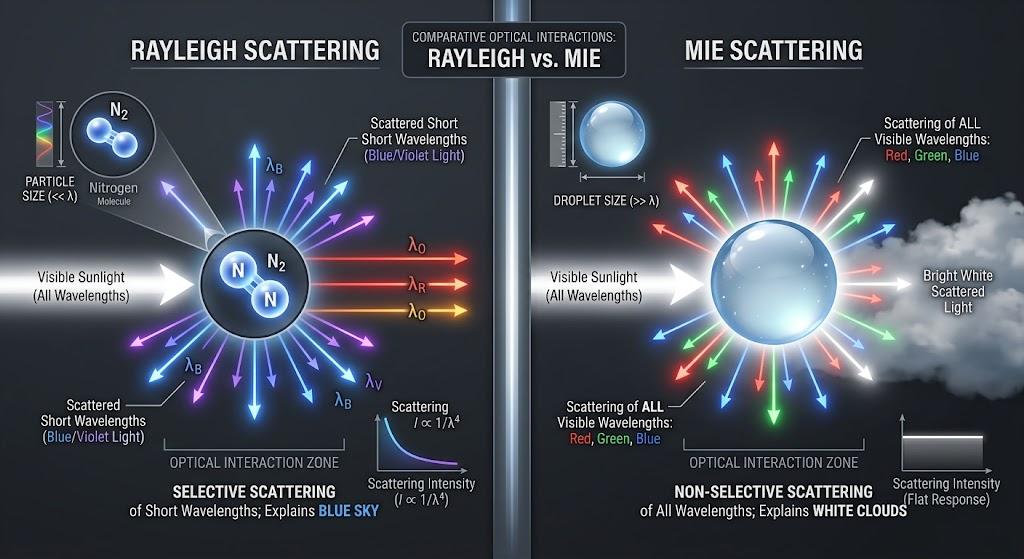
If gas molecules scatter blue light, why don’t clouds look blue as well?
Clouds are not made of microscopic gas molecules; they consist of relatively large water droplets and ice crystals. When sunlight hits water droplets that are larger than the wavelength of light, Rayleigh scattering no longer applies. Instead, the process shifts to Mie Scattering.
Mie scattering is largely non-wavelength-selective across the visible spectrum, meaning it does not favor blue over red. Instead, cloud water droplets scatter visible wavelengths (red, green, blue) predominantly in forward directions. Through multiple scattering events across the cloud droplet matrix, this balanced mixture of diffuse light reaches our eyes as brilliant white. This is why clouds, fog, and mist appear white while the clear atmosphere around them appears blue.
The Bottom Line on Sky Physics
The next time you look up at a clear afternoon sky, appreciate the magnificent multi-layered scientific illusion playing out above your head.
The sky has no inherent color. You are gazing through transparent gas molecules executing high-speed Rayleigh scattering, filtering solar radiation, and interacting with the unique trichromatic cone sensitivity of your human eyes. The blue sky is not a physical canopy—it is a breathtaking partnership between atmospheric physics and human evolution.
Optics and Human Perception: Core Principles
- The sky has no physical color; it appears blue due to Rayleigh Scattering of sunlight colliding with atmospheric gas molecules.
- According to Rayleigh’s inverse-fourth-power law (1/λ⁴), short wavelengths scatter dramatically more than long wavelengths (red/yellow).
- Physics dictates that violet light scatters almost twice as much as blue light, creating the Violet Light Paradox.
- The sky appears blue rather than violet because human retinal S-Cones are tuned to blue, and our brain averages the scattered green-violet spectrum into sky blue.
- Sunsets appear red because sunlight traverses up to 38 times greater atmospheric air mass at the horizon, scattering away all short blue waves and leaving long red waves.
- Clouds appear white because large water droplets trigger Mie Scattering, which scatters all light wavelengths equally.
Frequently Asked Questions
Why isn’t the sky blue in space?
In space, there is no atmosphere and no gas molecules to scatter sunlight. Sunlight travels in a straight line without bouncing around. As a result, astronauts in space see a pitch-black sky even when the Sun is shining brightly right next to them.
Why is violet light scattered more than blue light?
Violet light has a shorter wavelength (around 380–400 nanometers) than blue light (450 nanometers). Lord Rayleigh’s scattering equation proves that light scattering power increases dramatically as wavelength decreases (I ∝ 1/λ⁴). Because violet has a shorter wavelength than blue, individual violet photons scatter roughly 60% more intensely at 400 nm (and nearly double at 380 nm).
If the sky scatters violet light most, why do humans see blue?
Humans see blue because our eyes are equipped with three types of color cones (S, M, L). Our S-Cones are extremely sensitive to blue, while our M and L cones overlap in green and red. When scattered violet, blue, and green light enter our eyes, our brain’s visual cortex averages these signals together, interpreting the combination as a light sky blue.
Why are sunsets red and orange?
During sunset, the Sun sits low on the horizon, forcing its light to travel through a much thicker layer of Earth’s atmosphere. This long optical path scatters away almost all short blue and violet light into space before it can reach your eyes. The remaining long wavelengths—reds, oranges, and deep yellows—pass straight through to create vibrant sunsets.
Why do clouds look white instead of blue?
Clouds are made of water droplets that are much larger than light wavelengths. Large particles trigger Mie Scattering rather than Rayleigh Scattering. Mie scattering reflects all visible wavelengths of light (red, green, blue) equally. When all colors of light are scattered together equally, the human brain perceives the result as white.
References
- Rayleigh, Lord (1871). On the light from the sky, its polarization and colour. Philosophical Magazine, 41(271), 107–120. DOI: 10.1080/14786447108640452
- Smith, G. S. (2005). Human color vision and the unsaturated blue color of the daytime sky. American Journal of Physics, 73(7), 590–597. DOI: 10.1119/1.1858479
- Bohren, C. F., & Fraser, A. B. (1985). Colors of the sky. The Physics Teacher, 23(5), 267–272. DOI: 10.1119/1.2341808
- NASA Jet Propulsion Laboratory (2015). Martian Sunset: Why the Red Planet Has a Blue Sunset. NASA Science & JPL. NASA Science
- Curcio, C. A., et al. (1991). Distribution and morphology of human cone photoreceptors. Journal of Comparative Neurology, 312(4), 610–624. DOI: 10.1002/cne.903120411
- Lynch, D. K., & Livingston, W. (2001). Color and Light in Nature. Cambridge University Press.


