

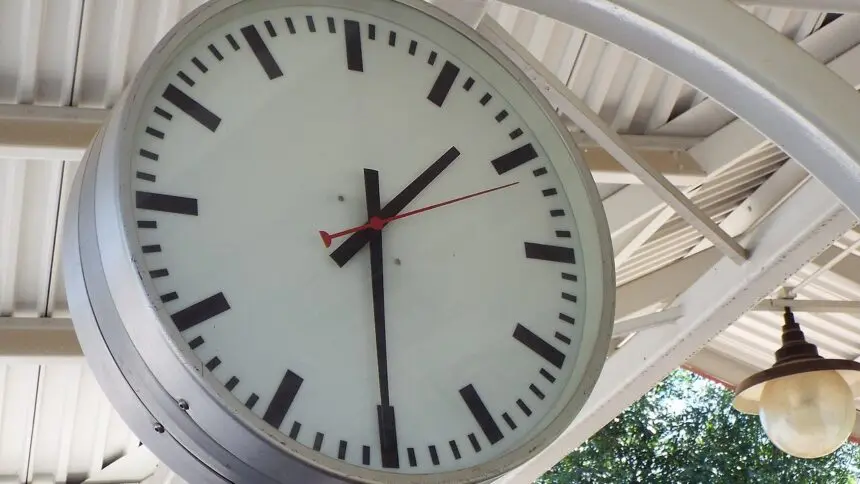
A commuter glances up at a railway station clock just as the second hand sweeps forward—and for an unnaturally long instant, the hand appears frozen mid-tick before snapping back into rhythm. Later that evening, glancing at a wall clock produces the exact same hesitation: always on the very first glance, and never on subsequent ticks. That uncanny experience is the stopped-clock illusion, scientifically known as chronostasis (from the Greek chronos for time and stasis for standing still). First rigorously quantified in a landmark Nature investigation (Yarrow et al., 2001), chronostasis describes an acute perceptual elongation of subjective time occurring immediately after a rapid eye movement.
- Motion Blur Deletion: Every rapid eye jump (saccade) blurs your retina for ~50 milliseconds, so the visual system edits that smear out of awareness.
- Backdating the Clock: Once your eyes land on the clock face, your brain fills the deleted gap backward with the new image of the second hand.
- The Result (Chronostasis): In experimental laboratory setups (Yarrow et al., 2001), saccadic temporal antedating adds an estimated 50–120 milliseconds to subjective duration depending on saccadic amplitude and visual conditions, rather than being an invariant physiological constant.
The illusion is remarkably picky about timing. Once the eyes already rest on the dial, every remaining tick reads true: the stall belongs exclusively to the instant after a glance. That narrow temporal window is where auditory and visual neuroscience conducted its search.
What empirical studies uncovered is stranger than the symptom itself. The stall is neither a mechanical fault in the clock nor a weakness in the retina; it is the brain’s internal record of when the glance began. Trans-saccadic temporal recalibration occurs during rapid gaze shifts, but conscious chronostasis is a specific perceptual phenomenon that manifests when gaze lands on an externally paced, periodic sensory stimulus (such as a ticking second hand, an oscillating visual counter, or a rhythmic auditory tone). In the absence of an immediate periodic reference, the trans-saccadic perceptual edit blends seamlessly into subjective duration without noticeable temporal dilation (Yarrow et al., 2001). The stopped clock illusion is therefore not an isolated sensory glitch; it is an observable psychophysical manifestation of active temporal binding mechanisms operating continuously across saccadic transitions.
Mechanistically, the visual system suppresses incoming retinal motion signals during rapid saccadic jumps (saccadic omission) to avoid motion blur, subsequently extending post-saccadic perceptual duration back to the onset of the eye movement (temporal antedating). The stopped clock illusion is simply a public clock catching that cognitive edit in the act.
The Blackout You Never Notice: Every Glance Is an Edited Cut
Your eyes do not glide smoothly across a room; they leap. These rapid, ballistic repositionings that carry your gaze to a clock face are called saccades. Launched several times each second while reading or scanning an environment, a short hop to a nearby dial is completed in a few tens of milliseconds.
During each saccade, the brain strongly damps its own visual sensitivity (a neurobiological phenomenon termed saccadic suppression) so the streaking motion across the retina never enters conscious awareness as motion blur. In a foundational review, Ross and colleagues (2001) surveyed the family of perceptual distortions crowding this narrow window: temporary visual suppression, spatial mislocalization, and coordinate warping, with underlying mechanisms remaining an active area of neuroimaging research.
One principle is no longer disputed: visual perception around every saccade is edited toward a single evolutionary priority: perceptual continuity. Saccades are commanded by specialized subcortical circuits including the superior colliculus, a layered midbrain structure that maps visual targets directly onto rapid eye movements. Visual chronostasis, saccadic suppression, and auditory chronostasis involve related processes of perceptual timing and continuity. Evidence for similar temporal distortions across sensory modalities does not establish that all three depend on identical neural circuits.

Backdating the Clock: How Vision Fills In the Blur While Your Eyes Jump
The Yarrow research team brought the stopped clock illusion into a controlled psychophysics laboratory. Volunteers executed calibrated saccades toward a digital counter and judged the duration of the first post-jump display. The data demonstrated a systematic, reproducible overestimation: participants consistently judged the initial target interval as approximately 100 to 130 milliseconds longer than subsequent intervals, precisely matching the duration of the saccade and its associated peri-saccadic suppression window (Yarrow et al., 2001).
The underlying neurobiological mechanism is more precise than simple attentional capture. The illusion occurs because the brain extends the percept of the first post-saccadic target backward in time to just before the eye movement began. This process, known as temporal antedating, stamps the newly arrived visual scene with an earlier timestamp to retroactively erase the blank gap caused by saccadic suppression (Yarrow et al., 2001). The clock hand is perceived as having been there from the exact moment you initiated the command to glance.
Two empirical nuances reveal how tightly regulated this system is. First, temporal antedating triggers with every saccade throughout the day, yet remains completely unnoticed until an external frequency reference (such as a ticking clock) reveals the distortion. Second, the illusion collapses if the visual target shifts position unpredictably during the eye jump, breaking the spatial continuity the brain relies on to execute the retrospective edit (Yarrow et al., 2001).
Maintaining seamless, blur-free vision requires continuous neural suppression and temporal reconstruction across every eye movement. The stopped-clock illusion provides a rare, direct perceptual window into this underlying neural integration.
When Time Squeezes Shut: The Compression Effect at Saccade Time
Not every temporal distortion during an eye jump involves expansion. In a landmark study published in Nature Neuroscience, Morrone, Ross, and Burr (2005) presented brief visual flashes right before and during saccades, asking observers to estimate the elapsed time between them. Brief visual intervals occurring immediately around the jump were severely underestimated, compressed toward a fraction of their real physical duration. Interestingly, brief auditory click pairs presented at the same time were perceived accurately: temporal compression was confined to the visual channel.
Even more striking was the discovery of perceptual reordering. In the critical window just prior to saccade onset, observers consistently perceived the second flash as occurring before the first (Morrone et al., 2005). The spatial and temporal profiles of this distortion aligned closely with anticipatory receptive field shifts, where visual neurons in parietal and frontal cortex shift their receptive fields to their future post-saccadic locations before the eye physically moves.
Building on these findings, Binda and colleagues (2009) mapped perisaccadic distortions with high temporal precision. Presenting a brief visual bar around an eye jump, they found that stimuli shown just before or during saccades were perceived as delayed by approximately 50 milliseconds, with a sharp reversal in temporal bias occurring in a narrow 50-to-70-millisecond pre-saccadic window (Binda et al., 2009). Perceived space and perceived time are warped simultaneously by the same underlying predictive circuits.
Chronostasis and perisaccadic compression represent opposite sides of the same cognitive ledger: a stretched arrival balanced against compressed intervals, both orchestrated to preserve subjective continuity over objective physical telemetry.
The Freeze Reaches Your Ears, Between Two Tones
If chronostasis were strictly an artifact of ocular motor commands, auditory perception would remain entirely immune. Auditory psychophysics experiments show it is not: chronostasis crosses sensory modalities. In an experiment conducted at Oxford, observers judged the duration of a brief silent gap between two tones delivered through stereo headphones. When both tones reached the same ear, duration judgments remained veridical: however, when observers shifted their listening concentration from one ear to the other, the silent gap was systematically overestimated, stamped backward exactly like the visual clock hand (Hodinott-Hill et al., 2002). A parallel effect occurs in daily life when turning toward a ringing telephone: the first ring appears to hold on longer than subsequent rings.
Cognitive neuroscientists Hodinott-Hill and colleagues (2002) interpreted this finding as evidence against purely ocular motor explanations. Because a deliberate shift of auditory attention alone is sufficient to induce the effect, chronostasis reflects a centralized, multimodal timing mechanism: an internal neural clock for duration estimation that is momentarily recalibrated whenever attention leaps across spatial coordinates (Hodinott-Hill et al., 2002). “Now” is stamped by central cognitive control, serving vision and audition alike.
Why the Brain Pays This Price Every Time You Look
None of these temporal distortions represent a sensory defect once understood in the context of predictive processing. Human perception is fundamentally constructive: the central nervous system constantly matches sensory inputs against an internal predictive model, an architecture explored in our analysis of how expectations shape perception. Editing time to eliminate sensory blackout is an evolutionary advantage. The alternative is an unedited visual stream: a disorienting gray-out occurring several times every second. Given the choice between a momentary smear and a coherent perceptual fiction, the brain chooses the coherent fiction (Yarrow et al., 2001).
These temporal adjustments fit into a broader spectrum of perceptual timing phenomena, including sensory order reversals and misalignments detailed in our examination of when the brain confuses time. Perceived duration is not a direct readout from a biological metronome; it is an actively generated cognitive construct.
Everyday cognitive consequences naturally follow. Anticipatory waiting makes time feel subjectively slower because attention is focused on monitoring intervals, a distinct phenomenon analyzed in why time feels slower when waiting. Conversely, chronostasis reveals the opposite mechanism: discrete time slices retroactively extended across perceptual transitions. These micro-edits aggregate throughout daily life, closely related to how environmental boundaries reset short-term working memory in the doorway effect.
The definitive takeaway of the stopped clock illusion is that your eyes are performing precisely as evolved. A high-bandwidth visual system incurs a modest, systematic editing cost on every single movement. Only when an external device changes state in close temporal proximity to an eye movement does this perceptual adjustment become apparent: the subjective visual stream is reconstructed continuously, and the temporal offset is revealed when indexed against an independent, rhythmic external timekeeper.
Two Quick Ways to Catch Saccadic Masking Yourself
First, test how eye-jump distance controls the length of the freeze: hold a ticking watch (or open a fullscreen stopwatch with a one-second blinking colon) at the far right edge of your desk. Stare at a pen on the far left edge, then snap your eyes across the desk onto the clock right after a tick. Compare that wide 40-degree glance against a tiny 5-degree hop from the rim of the watch face to its center: the wider your eyes have to travel, the longer the saccade lasts , and the longer that opening second appears to hang.
Second, walk up to a bathroom mirror and look swiftly from your left eye to your right eye and back again. No matter how fast you try, you will never catch your own eyeballs moving in the glass; you only ever see your eyes locked motionless on the left or locked motionless on the right. Now hold up your phone camera, record three seconds of video while doing the exact same left-right glance, and play it back: the video shows your eyes swinging plainly across the socket during the exact 50-millisecond window your visual system edited out.
Why That Extra Second Never Actually Happened
The stopped clock illusion is a real, measurable neurobiological phenomenon. The second hand appears frozen on your first glance because the brain suppresses vision during rapid eye saccades and retroactively backdates the first clear visual frame. This temporal antedating stretches the perceived duration of the initial post-jump interval by approximately 100 to 120 milliseconds (Yarrow et al., 2001). A matching temporal stretch occurs in audition following spatial shifts of attention (Hodinott-Hill et al., 2002), while neighboring perisaccadic intervals compress and reorder events (Morrone et al., 2005; Binda et al., 2009). The clock’s second hand never stalled; your brain simply edited the timeline to maintain an unbroken view of the world.
References
- Yarrow, K., Haggard, P., Heal, R., Brown, P., & Rothwell, J. C. (2001). Illusory perceptions of space and time preserve cross-saccadic perceptual continuity. Nature, 414(6861), 302–305. doi.org/10.1038/35104551 · PubMed (PMID: 11713528)
- Morrone, M. C., Ross, J., & Burr, D. (2005). Saccadic eye movements cause compression of time as well as space. Nature Neuroscience, 8(7), 950–954. doi.org/10.1038/nn1488 · PubMed (PMID: 15965472)
- Hodinott-Hill, I., Thilo, K. V., Cowey, A., & Walsh, V. (2002). Auditory chronostasis: Hanging on the telephone. Current Biology, 12(20), 1779–1781. doi.org/10.1016/s0960-9822(02)01219-8 · PubMed (PMID: 12401174)
- Binda, P., Cicchini, G. M., Burr, D. C., & Morrone, M. C. (2009). Spatiotemporal distortions of visual perception at the time of saccades. The Journal of Neuroscience, 29(42), 13147–13157. doi.org/10.1523/JNEUROSCI.3723-09.2009 · PubMed (PMID: 19846702)
- Ross, J., Morrone, M. C., Goldberg, M. E., & Burr, D. C. (2001). Changes in visual perception at the time of saccades. Trends in Neurosciences, 24(2), 113–121. doi.org/10.1016/s0166-2236(00)01685-4 · PubMed (PMID: 11164942)
Selective perceptual filtering works both across split-second visual saccades and across everyday life, explaining why newly noticed words suddenly seem ubiquitous in The Frequency Illusion (Baader-Meinhof Phenomenon).