

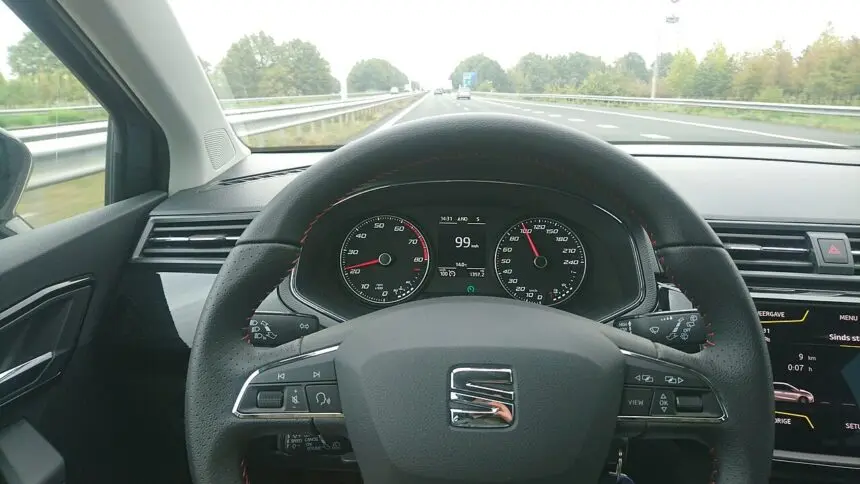
You are cruising down a straight, unlit stretch of interstate at eleven thirty at night. The tires hum against the asphalt in a steady, unbroken rhythm, and the white dashed lines flicker past your headlights with hypnotic regularity. Suddenly, you glance up at a green reflective overhead sign for an approaching exit and a cold shock of adrenaline hits your chest: you have zero conscious recollection of passing the last two towns or driving the last fifteen miles. Yet your hands remained steady on the wheel, your speed stayed locked within the limit, and your car remained centered inside the lane.
- Not Sleep, But Split Attention: During highway hypnosis, procedural steering and lane-keeping stay online while conscious episodic memory stops recording routine scenery.
- The Monotony Trap: Unchanging road geometry and predictable optic flow reduce visual prediction errors, encouraging the brain’s mind-wandering network to take over.
- Why Novelty Wakes It Up: A sudden brake light, rumble strip, or exit change breaks the prediction loop and snaps conscious focus back to the wheel.
That disorienting lapse is known as highway hypnosis (often termed Driving Without Attention Mode or DWAM in traffic psychology)—a descriptive cognitive and attentional phenomenon rather than a formal psychiatric diagnosis or clinical medical condition. In traffic ergonomics and cognitive science, researchers study this phenomenon as driving without awareness (DWA), a cognitive condition characterized by the subjective absence of conscious recall for recent driving segments even while basic vehicle guidance appeared to continue. Rather than indicating an extraordinary or safe autopilot, this state reflects a cognitive vulnerability where conscious attention decouples from the external driving environment while overlearned procedural routines maintain basic lane tracking.

How Routine Driving Can Continue While Attention Declines
To understand how routine vehicle control can continue while conscious attention declines, cognitive psychologists point to procedural automaticity, the brain’s ability to carry out complex, overlearned behavioral sequences without active supervisory oversight. When you first sat behind the steering wheel as a novice, driving demanded every scrap of your conscious attention. Your prefrontal cortex, the executive brain region responsible for deliberate decision-making, working memory, and focused mental effort, was firing continuously to modulate pedal pressure, calculate braking distance, and keep the vehicle within lane markings.
After extensive driving practice, routine vehicle control sequences rely increasingly on procedural motor automaticity supported by distributed corticostriatal and cerebello-thalamo-cortical networks. Interconnected structures within the basal ganglia and cerebellum coordinate overlearned motor habits, helping maintain steady throttle pressure and routine steering corrections with reduced supervisory involvement from the prefrontal cortex. However, cognitive scientists emphasize that this automaticity does not mean subcortical structures operate as an independent driving brain; rather, it reflects a shift where distributed motor networks sustain overlearned actions while conscious attentional resources drift toward internal mental content.
In a landmark driving simulator investigation, cognitive psychologists Samuel Charlton and Nicola Starkey (2011) evaluated drivers across repeated trials on identical simulated routes over several weeks. They observed that as familiarity and route predictability increased, drivers developed progressive procedural automaticity: speed variability and lane position variance decreased significantly, and on-task target detection became more efficient. Crucially, however, drivers in this state of driving without awareness showed significantly reduced visual inspection and retrospective recall of roadside changes, demonstrating that while procedural practice stabilizes basic vehicle trajectory, it diminishes conscious situational monitoring.
This offloading demonstrates that the nervous system prioritizes efficiency over exhaustive recording. Your brain conserves scarce cognitive resources by operating on pre-compiled sensory predictions, an adaptive principle explored in our foundation guide on how prior expectations shape perception.
Highway Hypnosis vs. Drowsy Driving vs. Automaticity: The Crucial Distinctions
In traffic psychology and road safety research, distinguishing between highway hypnosis, drowsy driving, and normal motor automaticity is essential for driver safety.
To understand the empirical and behavioral boundaries between these states, cognitive researchers contrast three distinct elements:
- Highway Hypnosis (Driving Without Awareness): An attentional state where active conscious tracking decouples from vehicle operation. While overlearned subcortical procedural loops maintain routine lane tracking and steady throttle, the driver’s attention is absorbed by internal thought streams. Contrary to early popular misconceptions, this is not a superior or reliable “autopilot”; driver hazard reaction times are significantly degraded.
- Drowsy Driving (Driver Fatigue): A physiological state of central nervous system exhaustion driven by homeostatic sleep pressure and circadian down-regulation. Drivers battle drooping eyelids (ptosis), prolonged blink intervals, and involuntary microsleeps (brief intrusions of sleep-related electroencephalographic patterns typically defined between 1 to 15 seconds depending on operational research criteria (such as the Bern criteria)), which substantially elevate the risk of unintended lane departures and delayed braking reactions.
- Procedural Motor Automaticity: The underlying neural mechanism (governed by the dorsal striatum and cerebellum) that enables repetitive, overlearned motor actions to execute without continuous prefrontal cognitive control. Automaticity operates continuously during skilled driving, but when paired with severe visual monotony, it permits the attentional disengagement characteristic of highway hypnosis.
| Physiological Parameter | Highway Hypnosis (DWA) | Drowsy Driving (Sleepiness) | Motor Automaticity |
|---|---|---|---|
| Neural Substrate | Attentional dissociation; hypothesized DMN engagement with procedural subcortical control | Homeostatic sleep debt; reticular activating system down-regulation | Dorsal striatum (basal ganglia) and cerebellar internal forward models |
| Arousal Level | Awake state with cognitive disengagement from the road; frequently overlaps with or transitions into drowsy driving | Depressed central nervous system arousal; imminent sleep intrusion | Variable; operates during intense focus, casual conversation, or daydreams |
| Oculomotor Patterns | Eyes open; visual scanning of peripheral road features, mirrors, and instruments is significantly reduced | Ptosis (drooping lids), prolonged blinks, slow rolling eye movements, microsleep closures | Normal, agile saccadic scanning calibrated to road demands |
| Vehicle Control & Risk | Basic lane tracking may appear preserved on straight roads, but reaction times to sudden hazards are significantly impaired | Erratic lane drifting, sudden steering jerks, catastrophic unbraked collisions | Precise, fluid speed and trajectory micro-corrections under predictable conditions |
| Immediate Safety Action | Exit the highway and pull over in a safe location; do not rely on automatic driving or sensory tricks. | Stop in a safe location immediately: 20-minute nap, caffeine, restorative sleep | Standard skilled human performance; not an impairment in itself |
Optic Flow and Wertheim’s Eye-Movement Trap
Long highway stretches create a specific sensory trap through optic flow, the continuous stream of visual motion that sweeps across an observer’s visual field as they move forward through space. On an open, divided motorway, optic flow is starkly uniform. The road ahead remains fixed at an artificial vanishing point, trees and telephone poles slide past in repetitive geometric intervals, and lateral lane markings pulse rhythmically across the peripheral retina.
In 1978, psychophysicist Alexander Wertheim formulated an influential explanation for highway hypnosis based on oculomotor dynamics (Wertheim, 1978). Wertheim argued that when a driver travels along a monotonous, straight road, the visual field provides little novel detail to trigger saccades—the rapid, voluntary eye movements that constantly reset visual processing. Instead, the eyes lock into a prolonged optokinetic pursuit, following repetitive lane markings or fixed horizon points.
When the oculomotor system ceases making active saccades, the brain receives a predictable, static influx of visual signals. Gemma Pastor Cerezuela and colleagues (2004) investigated driving without awareness by evaluating eye movements and attentional disengagement, confirming that monotonous motorway driving significantly restricts exploratory visual scanning while subjective awareness of the road diminishes. Electroencephalographic (EEG) recordings (Lal & Craig, 2002) demonstrate that this visual monotony is accompanied by elevated posterior alpha oscillations (8–12 Hz), reflecting relaxed, inwardly oriented cortical idling and reduced sensory throughput (Klimesch, 2012).
This explains the eerie subjective distortion of time that accompanies long highway journeys. When external sensory landmarks fail to puncture awareness, your internal clock loses its reference anchors, a mechanism closely tied to why time feels slower when waiting and how the visual system warps duration during the stopped-clock illusion.
Mind-Wandering and Attentional Decoupling: A Hypothesized Role for the Default Mode Network
When subcortical motor circuits handle routine steering and repetitive visual inputs settle sensory cortex into steady rhythms, where does conscious attention drift? While direct neuroimaging of drivers on real highways is technically constrained, cognitive neuroscientists draw on laboratory simulations of mind-wandering to understand this attentional disengagement. In these paradigms, when focus decouples from the primary task, researchers observe heightened activity across the Default Mode Network (DMN)—an interconnected anatomical system including the medial prefrontal cortex, posterior cingulate cortex, and angular gyrus that activates during spontaneous introspection and internal thought.
However, cognitive and traffic researchers emphasize a critical scientific distinction: the precise neural mechanisms of highway hypnosis remain incompletely understood. Involvement of the Default Mode Network represents a prominent neurocomputational hypothesis derived from broader mind-wandering literature (Christoff et al., 2009), rather than an invariant, universally demonstrated mechanism across every real-world driving episode. The confirmed behavioral reality is that attention is drawn inward, leaving substantially fewer cognitive resources available to detect unexpected changes in the road environment.
This dual-track division of labor explains why you forget the last twenty miles. Conscious recollection requires working memory, the temporary workspace that actively encodes incoming perceptual data and transfers salient details into long-term hippocampal storage. Because the repetitive highway presents no novel threats or unexpected disruptions, your prefrontal cortex determines that the sensory stream is redundant. Under monotonous driving conditions with minimal novel stimulation, sensory inputs are processed transiently for immediate steering adjustments and decay rapidly without undergoing semantic encoding or long-term consolidation, leaving minimal retrospective memory for the drive, similar to how changes in context reduce the accessibility of recent information in the doorway effect.
Hazard Detection and Attentional Re-engagement: Why Reorienting Is Delayed
When attention decouples from the driving environment, what happens when an unexpected hazard suddenly appears? Cognitive neuroscientists study how brain networks—particularly the salience network, involving the anterior insula and anterior cingulate cortex, detect salient environmental changes and help reorient executive attention back to external demands.
However, traffic safety research cautions against viewing attentional reorientation as an automatic, foolproof safety mechanism. When conscious focus has drifted inward during monotonous driving, detecting a sudden hazard, such as abrupt brake lights or a lane obstruction, requires reallocating cognitive resources back to the visual scene. This attentional switching is neither instantaneous nor guaranteed to prevent collisions.
In two driving-simulator experiments, Yanko and Spalek (2014, PubMed (PMID: 24689247)) found that participants who were mind-wandering responded significantly more slowly to sudden events, drove at higher speeds, and maintained shorter following distances than during on-task periods. While overlearned subcortical procedural loops can keep a vehicle within painted lane boundaries on an empty, predictable road, they cannot formulate adaptive decisions in sudden emergencies. The delay required to re-engage active conscious attention can add critical car lengths to total stopping distance.
Evidence-Based Safety Actions: Rest, Safe Stopping, and Managing Monotony
Drivers frequently attempt improvised tricks to fight off highway hypnosis and boredom, such as rolling down windows for cold air, blasting the radio, chewing snacks, or drinking ice water. However, road safety agencies, including the National Highway Traffic Safety Administration (NHTSA) and national transportation and occupational safety research agencies, caution that these tactics lack empirical support. They do not reliably restore cognitive vigilance or shorten impaired reaction times, and they can foster a dangerous false sense of security while attentional disengagement persists.
Evidence-based road safety recommendations prioritize genuine physiological rest and scheduled interruption of monotony:
- Pull Over in a Safe Location: If you recognize that your attention is fading, you are missing road signs, or you have no memory of recent miles, the only genuinely effective response is to exit the highway and stop in a designated rest area or safe parking location.
- Take a Short Restorative Nap (15 to 20 Minutes): When attentional lapses overlap with physical fatigue or sleep debt, a brief 15- to 20-minute nap can temporarily reduce homeostatic sleep pressure and help restore reaction times. However, sleep inertia (grogginess and temporary disorientation upon waking) can still occur, particularly in sleep-deprived drivers; drivers should wait several minutes until fully alert before resuming driving. Combining a brief nap with moderate caffeine is recognized by traffic safety bodies like the NHTSA as a temporary countermeasure, but it is not a guarantee of full alertness and does not replace adequate restorative sleep.
- Use Caffeine Judiciously as a Short-Term Bridge Only: Consuming moderate caffeine (approximately 100 to 200 mg) can temporarily enhance alertness, but it requires 20 to 30 minutes to enter circulation and cannot substitute for physiological sleep or restorative rest.
- Schedule Regular Driving Breaks: Proactively planning stops every two hours or 100 miles (European Road Safety Observatory, 2018) introduces perceptual variety and helps counter the cumulative effects of monotonous optic flow. Physical movement and cognitive disengagement from the road provide opportunities to re-engage active alertness.
- Do Not Rely on Motor Automaticity: Procedural memory can steer straight on an empty highway, but it cannot navigate emergencies. Whenever alertness wavers, stop driving rather than trusting your brain’s “autopilot.”
Scientific References & Foundational Studies
- Charlton, S. G., & Starkey, N. J. (2011). Driving without awareness: The effects of practice and automaticity on attention and driving. Transportation Research Part F: Traffic Psychology and Behaviour, 14(6), 456–471. DOI: 10.1016/j.trf.2011.04.010
- Christoff, K., Gordon, A. M., Smallwood, J., Smith, R., & Schooler, J. W. (2009). Experience sampling during fMRI reveals default network and executive system contributions to mind wandering. Proceedings of the National Academy of Sciences, 106(21), 8719–8724. DOI: 10.1073/pnas.0900234106 | PubMed (PMID: 19433790)
- Pastor Cerezuela, G., Tejero, P., Chóliz, M., Chisvert, M., & Monteagudo, M. J. (2004). Wertheim’s hypothesis on ‘highway hypnosis’: empirical evidence from a study on motorway and conventional road driving. Accident Analysis & Prevention, 36(6), 1045–1054. DOI: 10.1016/j.aap.2004.02.002 · PubMed (PMID: 15350881)
- Wertheim, A. H. (1978). Explaining highway hypnosis: Experimental evidence for the role of eye movements. Accident Analysis & Prevention, 10(2), 111–129. DOI: 10.1016/0001-4575(78)90019-2
- European Road Safety Observatory. (2018). Fatigue. European Commission, Directorate General for Transport. European Commission Transport Portal
- Klimesch, W. (2012). α-band oscillations, attention, and controlled access to stored information. Trends in Cognitive Sciences, 16(12), 606–617. DOI: 10.1016/j.tics.2012.10.007 | PubMed (PMID: 23141428)
- Yanko, M. R., & Spalek, T. M. (2014). Driving with the wandering mind: The effect that mind-wandering has on driving performance. Human Factors, 56(2), 260–269. DOI: 10.1177/0018720813495280 | PubMed: 24689247