


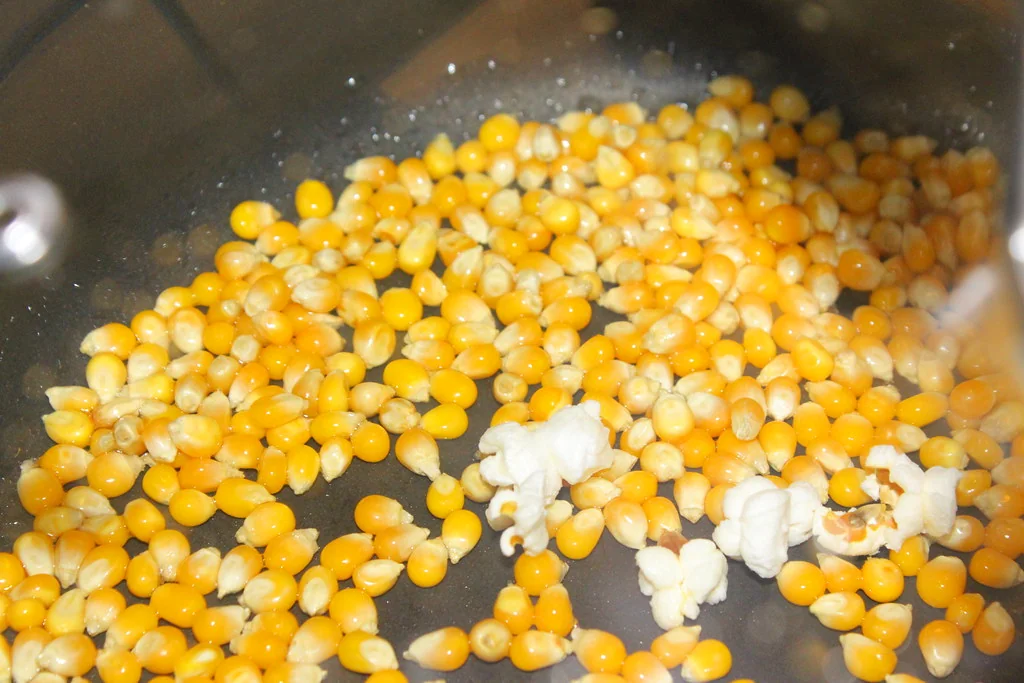
Drop a handful of ordinary dry field corn beside a handful of popping corn in the same hot skillet, turn the burner to medium-high, and wait ninety seconds. Long before anything bursts, water vapor begins misting the glass lid. One variety merely chars, cracks quietly along a seam, and stays flat against the metal; the other turns into a tiny sealed boiler that launches several centimeters upward, swaps places with its own core in hundredths of a second, and fires an unmistakable percussive pop.
On a botanical chart, both kernels belong to Zea mays. Yet only Zea mays everta turns a spoonful of hard amber grain into airy white foam thirty times its original size. Why popcorn kernels pop so violently while sweet corn and dent corn just split comes down to a narrow thermodynamic trap: a dense, moisture-locked starch core wrapped inside an unusually tough hull that holds superheated water liquid well past normal boiling until pressure tears the container open from within.
- A narrow water budget (13–15%): Commercial and experimental popcorn peaks near roughly
14%internal moisture. Too dry below 11–12% and steam pressure never clears hull strength; above 16% and the hull softens or tears prematurely. - Heat tightens the pericarp seal: Under heat and moisture, cellulose chains in the popcorn hull reorganize into tighter crystalline arrays while lignin reinforces the cell wall, slowing premature steam leakage.
- Boiling delayed to ~177–180°C: Trapped inside a closed pericarp, water stays liquid up to nearly 180°C (~9.2–10 atm / ~135 psi or ~10 bar) while surrounding starch melts into a hot, pressurized viscoelastic dough.
- Starch leaps, steam makes the pop: High-speed 2,900 fps cinematography synchronized with audio shows a compressed “leg” of starch propels the jump, whereas sudden water-vapor release creates the sound wave.
Why Ordinary Corn Splits While Popcorn Kernels Pop
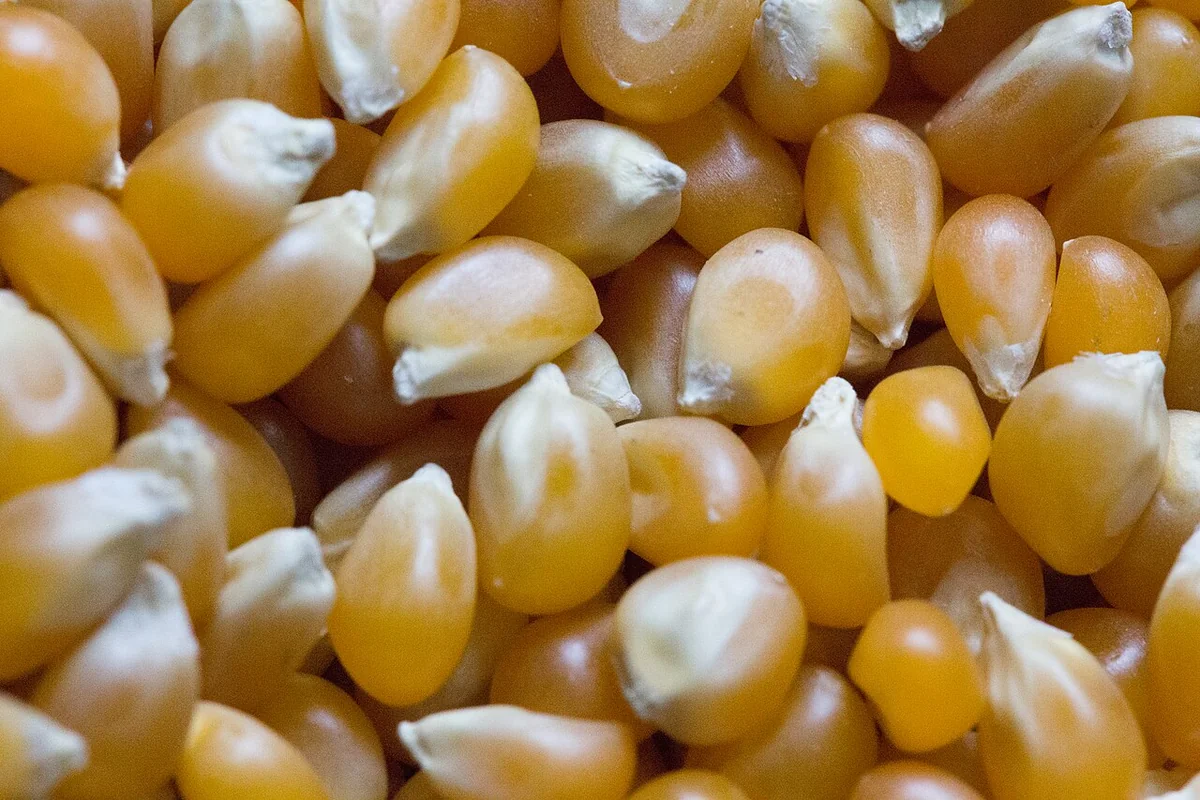
Crack open a dry field kernel and a dry popping kernel under a low-power magnifier and the structural contrast shows immediately. Every maize kernel stores food in two forms of starch: soft, floury opaque endosperm near the center and hard, tightly packed glassy endosperm toward the rim. Field dent corn holds a generous cap of soft floury starch and a thinner outer skin (the pericarp, or hull). When heated on a stovetop, water inside a dent kernel turns to vapor around 100°C, finds micro-fissures through the thin skin, and leaks away almost as fast as heat arrives.
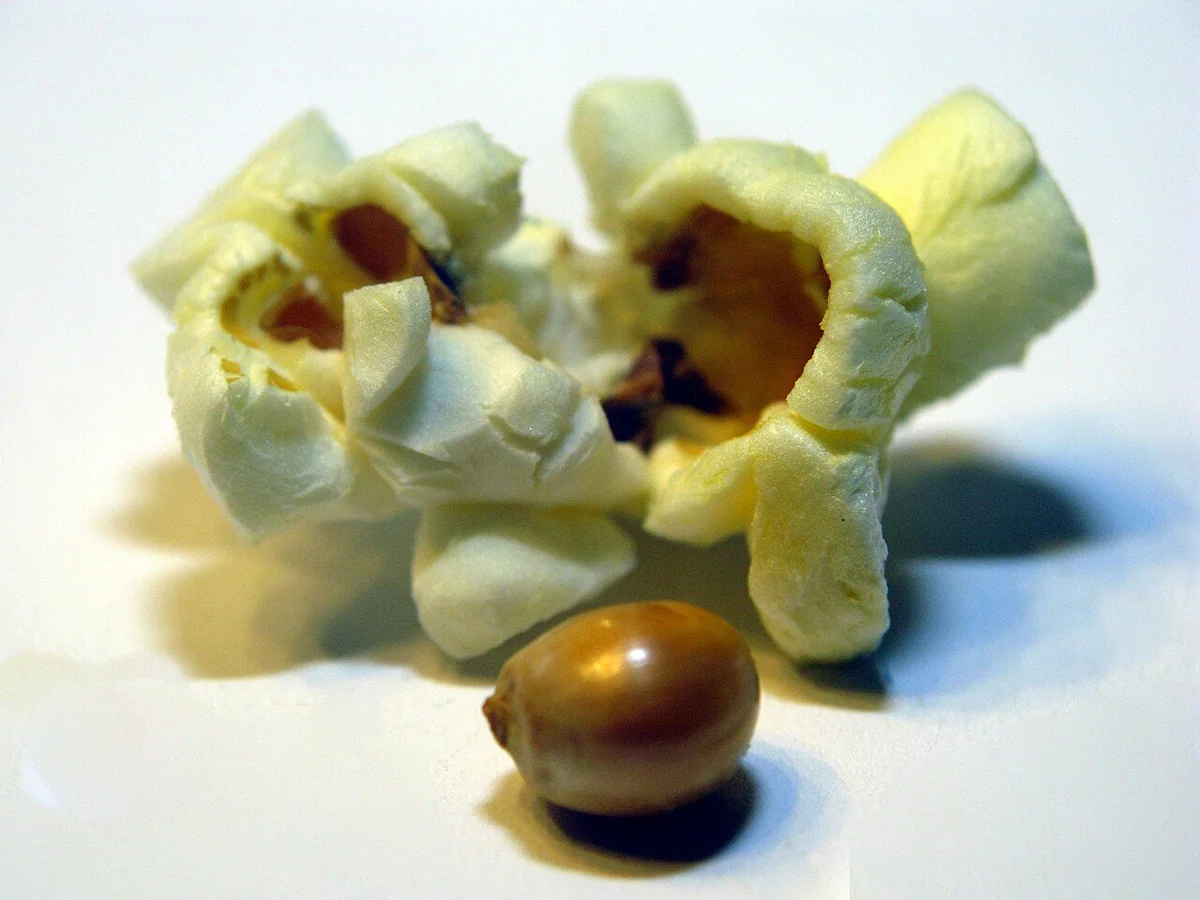
Popping cultivars flip that layout. In Zea mays everta, dense glassy endosperm surrounds a central starchy pocket containing microscopic moisture droplets, and the surrounding pericarp forms a thick, cohesive jacket anchored cleanly at the tip cap. Jess Sweley, Devin Rose, and David Jackson reviewed these cultivar mechanics in Food Reviews International (2013), noting how heavily popping expansion depends on combining a thick, intact, fracture-free pericarp with a tightly bounded 13–15% moisture window (with roughly 14% long recognized as ideal).
That dense glassy wall solves two engineering problems simultaneously. First, before heat ever crosses 150°C, the hard starch bed prevents tiny pockets of water from migrating freely toward weak seams. Second, heat conducts inward across the metal pan much faster than moisture can diffuse outward across the hull, setting up the same sudden thermal mismatch explored in our breakdown of thermal conductivity across a metal pan. A cracked hull behaves like a leaky boiler gasket; an intact everta hull behaves like a steel pressure cooker without a safety valve.
How Cellulose Crystals Lock Steam Past 100°C
Water inside an open pot boils at 100°C because atmospheric air pressing down on the surface offers only one atmosphere (~101 kPa) of resistance. Confine that water inside a sealed vessel and boiling halts. Vapor rising off the liquid surface packs into the tiny rigid headspace above it, driving pressure upward and forcing the remaining liquid molecules to stay condensed even as thermometer readings climb through 120°C, 150°C, and 170°C. Everyday heating holds counterintuitive phase-change behavior inside heating water, and nowhere is that pressure lock more visible than inside a dry maize hull.
In 2005, food biophysicist Bruce Hamaker and colleagues at Purdue University investigated why certain popping hybrids survive intense microwave heating without leaking dry first (Tandjung et al., 2005). Using differential scanning calorimetry and X-ray diffraction on isolated popcorn hulls, they uncovered a dynamic defense mechanism inside the wall itself. Popcorn pericarps consist primarily of tightly interwoven cellulose fibers and arabinoxylan hemicellulose. Rather than softening like wet paper when warmed with trace moisture, the cellulose matrix underwent heat- and water-driven structural reorganization into higher crystallinity.
Hybrids whose hulls produced higher thermal enthalpy transitions during heating retained more steam and left dramatically fewer unpopped kernels behind, yielding a tight statistical link (r = 0.826, p = 0.011). Years later, Clério Damasceno Junior and collaborators (2022) measured biochemical differences across inbred lines ranging from low expansion (P16 at 14 mL/g) to high expansion (GP12 above 40 mL/g) and found significantly higher pericarp cell-wall lignin in the highest-popping line (129.74 µg/mg or 12.97% vs. 113.52 µg/mg or 11.35%). Together, crystalline cellulose order and rigid lignin cross-links explain how a thin botanical coat holds back nine to ten atmospheres without tearing early, echoing how tight microscopic networks alter moisture flow through air pockets between cellulose fibers.
Vessel Integrity Comparison: Popping vs. Non-Popping Corn
Popcorn (Zea mays everta)
Built as a pressurized micro-boiler that stores heat past 175°C.
- Hull Architecture: Thick, crystalline cellulose and lignin-rich pericarp tightens its moisture barrier mid-heat (Tandjung et al., 2005; Damasceno Junior et al., 2022).
- Endosperm State: Translucent hard endosperm softens above 170°C into hot molten viscoelastic starch pressurized by ~9.2–10 atm steam.
- Failure Mode: Catastrophic brittle hull rupture flashes superheated liquid directly into dried spongy starch foam.
Field Dent or Sweet Corn
Vents moisture continuously before starch can reach molten gel temperature.
- Hull Architecture: Thinner pericarp lacks the moisture-barrier enthalpy peak required to contain high vapor pressure.
- Endosperm State: Large pockets of loose, porous floury starch allow water vapor to migrate freely toward surface cracks.
- Failure Mode: Steam seeps out gently near boiling, leaving a scorched, split, unexpanded kernel behind.
What 2,900-Frame-Per-Second Video Revealed at 180°C
In 1983, R. C. Hoseney, K. Zeleznak, and A. Abdelrahman published a foundational study in the Journal of Cereal Science mapping the exact tipping point inside heating kernels. Tracking internal pressure, temperature, and scanning electron micrographs of fractured starch walls, they established that popping clusters sharply around 177°C, where trapped steam reaches roughly 135 psi (~9.2 atmospheres). At that instant, dense surrounding starch is no longer solid crystal—heat and steam have gelatinized it into a bubbling thermoplastic fluid.
Once the outer pericarp splits along its weakest seam, confining pressure drops back to 1 atmosphere instantaneously. Liquid water superheated to 177–180°C cannot remain liquid at 1 atm, so it flashes explosively into steam inside the melted starch, inflating millions of tiny pockets until the water flashes out and the stretched starch chills within milliseconds into a rigid, dry white lattice.
| Thermal Stage | Measured Condition | Water & Starch Behavior | Pericarp Vessel Role |
|---|---|---|---|
| Stage 1: Warm-Up (<100°C) | Below normal boiling point | Core moisture (~13–15%) stays liquid inside starch granules | Intact hull keeps ambient room humidity balanced prior to heating |
| Stage 2: Pressurization (100–175°C) | Superheated liquid trapped under pressure | Steam pressure rises steadily while hard endosperm begins softening | Heat + moisture trigger crystalline cellulose alignment, cutting vapor escape |
| Stage 3: Critical Failure (~177–180°C) | ~135 psi (~9.2 atm) to ~10 bar equilibrium vapor pressure | Molten gelatinized starch sits primed at boiling failure boundary | Hull wall hits ultimate tensile stress and tears open in a sudden fracture |
| Stage 4: Flash Inversion (~0.02–0.05 s) | Instant drop back to 1 atm (101 kPa) | Superheated water flashes to vapor, flipping molten starch inside-out | Compressed starch leg kicks upward; cavity vapor pulse fires the pop sound |
For decades, however, two split-second details of that eruption remained guesswork: what makes the kernel vault upward off a flat griddle, and what physically makes the popping sound? In 2015, French physicists Emmanuel Virot and Alexandre Ponomarenko pointed cameras running at up to 2,900 frames per second alongside calibrated microphones at single heating kernels on a hot plate (Virot & Ponomarenko, 2015).
First, their measurements confirmed how strikingly narrow the failure temperature is: regardless of kernel shape or size, almost every kernel ruptured right near 180°C—consistent with a straightforward pressure-vessel limit where saturated steam reaches roughly 10 bar (~1000 kPa). Second, high-speed frames caught something unexpected beneath the leaping flake. The kernel was not blasted skyward by a downward rocket jet of steam. Instead, as the hull cracked and soft white foam extruded downward against the plate, a brief, dense starch “leg” bent, compressed like a spring, and kicked off the hot surface—putting popping popcorn mechanically halfway between explosive seed-dispersing plants and jumping animals.
Third, synchronizing audio tracks with the 2,900-fps frames overturned the textbook explanation for the bang itself. The hull crack actually arrives slightly ahead of peak sound without creating much noise, and flying flakes start whistling upward before bouncing back down. Instead, the crisp acoustic pop matched the sudden rush of escaping water vapor popping open internal acoustic cavities, acting far more like uncorking pressurized champagne gas than snapping brittle wood or tapping metal—an everyday acoustic sibling to temperature-driven shifts in kitchen sound waves.
Why Steaming Kettles Still Leave “Old Maids” Behind
Anyone who has lingered beside a heating pot knows popping does not happen simultaneously across every kernel, even at uniform stovetop temperatures. If you feel like you spend forever waiting beside a heating pot on the stove before the first pop lands, thermal kinetics shows why that pause occurs before the sudden rush. J. E. Byrd and M. J. Perona (2005) measured individual kernel popping lifetimes across six constant oil temperatures from 180°C to 250°C and inside a 202°C hot-air popper.
Rather than popping linearly from second one, every batch exhibited a clear thermal induction period while kernels absorbed heat across oil or convective air toward ~180°C, followed by a predictable first-order exponential decay in remaining unpopped kernels (yielding an apparent activation energy of 166.7 kJ/mol across the 180–210°C regime). Hot cooking oil speeds heat transfer into irregular kernel curves far more uniformly than dry air at lower settings, narrowing the gap between early bursts and late stragglers.
Yet even in steady 200°C oil, a stubborn few unpopped kernels—often nicknamed “old maids”—remain rattling on the bottom of the kettle. Sweley and colleagues (2013) cataloged the physical culprits behind failure, and every single one reduces to pressure-vessel economics:
- Depleted internal moisture (<11–12%): Months in a warm pantry or unsealed jar slowly dries a kernel out. Without enough trapped water left to flash past 9 atmospheres while turning starch viscous, pressure stalls below the hull’s yield point.
- Micro-cracks in the pericarp: Rapid mechanical harvesting or overly fast commercial grain drying creates microscopic stress fissures along the outer coat. Once warmed on the stove, steam simply whispers out through those pinholes instead of driving molten starch open.
- Excess moisture (>16%) or uneven scorching: Too much trapped water weakens the pericarp too early and lowers boiling containment before dense starch melts cleanly, yielding small, dense, tough nuggets instead of broad crisp flakes.
Common Questions About How Popcorn Kernels Pop
Does poking a pinhole in a kernel stop it from popping?
Yes. Experimental work cited by Hoseney et al. (1983) and Sweley et al. (2013) confirms that breaching the pericarp creates a pressure-relief vent. Water turns to steam around 100°C and escapes quietly through the pinhole, so internal pressure never climbs high enough to gelatinize the full starch core and burst the kernel outward.
Why does microwaving stale kernels sometimes fail even after soaking them in water?
Submerging old, desiccated kernels briefly in water mainly wets the outer coat rather than restoring uniform equilibrium (13–14%) deep inside the dense glassy endosperm. Excess surface water can also soften the outer hull prematurely, causing weak splits instead of high-pressure expansion unless moisture equilibrates evenly over days in a sealed container.
Why do “butterfly” flakes branch unevenly while “mushroom” popcorn pops round?
Cultivar shape, pericarp strength distribution, and starch-to-hull ratios govern where the brittle wall first gives way at ~180°C. Varieties bred for butterfly shapes rupture along irregular fissures into branched winged lobes, whereas denser ball-shaped mushroom cultivars expand more isotropically—though heating method and oil distribution also influence final flake form (Sweley et al., 2013).
Why does crisp popped corn turn tough within hours in humid air?
At the instant steam vents away, freshly puffed foam dries into a rigid glassy starch skeleton supported by ultra-thin solid walls. Humid air slowly diffuses water molecules back into those hydrophilic starch walls, plasticizing the rigid foam back toward a soft, rubbery polymer—even though no chemical spoilage has occurred.
One Pressure Limit Across Every Kernel
Everything separating a silent, scorched grain of dent corn from a billowing kettle of crisp white flakes happens in the narrow thermal zone between normal boiling and 180°C. Because crystalline cellulose and lignin seal a popcorn kernel tightly enough to delay boiling until water pressure approaches nine to ten atmospheres, liquid water and softened starch build potential energy together until the pericarp fails in a single fraction of a second. A brief starch leg throws the kernel airborne, escaping vapor fires the sharp acoustic pop, and superheated water rapidly freezes molten starch into dry airy foam the moment it meets open kitchen air.
Sources & References
- Virot, E., & Ponomarenko, A. (2015). Popcorn: critical temperature, jump and sound. Journal of The Royal Society Interface, 12(104), 20141247. DOI: 10.1098/rsif.2014.1247 · PMID: 25673298
- Hoseney, R. C., Zeleznak, K., & Abdelrahman, A. (1983). Mechanism of popcorn popping. Journal of Cereal Science, 1(1), 43–52. DOI: 10.1016/S0733-5210(83)80007-1
- Tandjung, A. S., Janaswamy, S., Chandrasekaran, R., Aboubacar, A., & Hamaker, B. R. (2005). Role of the pericarp cellulose matrix as a moisture barrier in microwaveable popcorn. Biomacromolecules, 6(3), 1654–1660. DOI: 10.1021/bm049220l · PMID: 15877391
- Byrd, J. E., & Perona, M. J. (2005). Kinetics of popping of popcorn. Cereal Chemistry, 82(1), 53–59. DOI: 10.1094/CC-82-0053
- Sweley, J. C., Rose, D. J., & Jackson, D. S. (2013). Quality traits and popping performance considerations for popcorn (Zea mays Everta). Food Reviews International, 29(2), 157–177. DOI: 10.1080/87559129.2012.714435
- Damasceno Junior, C. V., Godoy, S., Gonela, A., Scapim, C. A., Grandis, A., dos Santos, W. D., Mangolin, C. A., Buckeridge, M. S., & Machado, M. F. P. S. (2022). Biochemical composition of the pericarp cell wall of popcorn inbred lines with different popping expansion. Current Research in Food Science, 5, 102–106. DOI: 10.1016/j.crfs.2021.12.011 · PMID: 35024623