
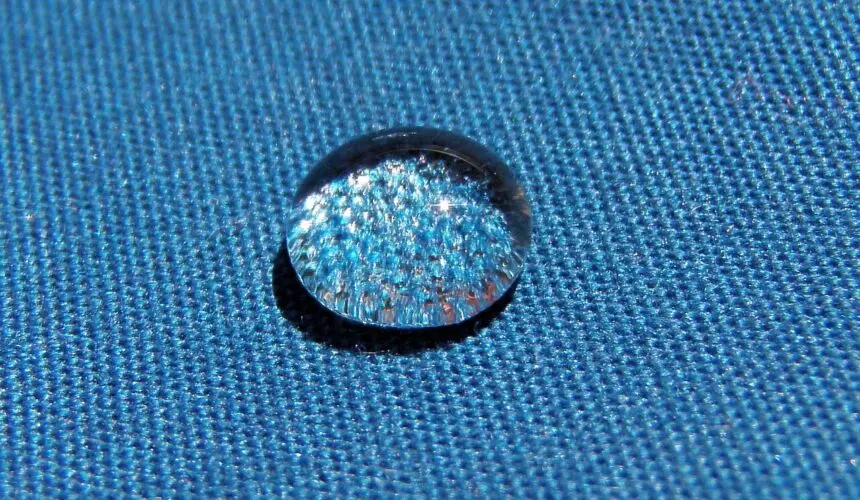
Lean your hip against a wet kitchen sink while rinsing a coffee mug, or let a single drop of condensation fall off an iced drink onto a gray cotton T-shirt. In less than half a second, a sharp charcoal blotch spreads across the knit. Hold the glass of tap water up to a window and the liquid is completely transparent, with no pigment, no soot, no dissolved minerals dark enough to stain anything. Yet on cotton, that clear drop looks almost like ink until twenty minutes of dry room air turns the patch right back into pale gray.
The reason wet clothes look darker has nothing to do with water changing the chemistry of fabric dye. Instead, water rearranges the microscopic path that room light takes through the yarn. Dry cloth owes much of its pale, soft brightness to millions of tiny air pockets wedged between tangled fibers, scattering white room light straight back toward your eyes before the dye ever gets a chance to touch it. Replace that air with a thin film of liquid water and two optical shifts kick in at the same instant: light plunges deeper into the dyed threads instead of bouncing off the surface fuzz, and the outer skin of water acts like a one-way mirror that traps nearly half of the returning rays inside the cloth.
- Dry fabric scatters white glare off air gaps: Cotton cellulose has a refractive index around
1.54compared with1.00for air. Every dry fiber-to-air boundary reflects roughly4.5%of straight-on light, sending uncolored white light back to your eyes before it reaches deep dye layers. - Water bridges the optical jump: Filling those gaps with water (
n = 1.333) cuts single-wall surface reflection down to roughly0.52%(nearly nine times weaker), so incoming photons travel forward through many more dyed fibers. - A 48.6-degree liquid light trap: Light trying to exit the wet cloth hits the outer water-to-air film. Any ray striking steeper than Snell’s
48.6°critical angle suffers total internal reflection and bounces right back into the yarn for another round of absorption. - Darker and richer at once: Silencing white surface haze leaves colored fabrics both darker in brightness and deeper in color saturation, whereas undyed white cotton turns translucent because there is no pigment inside to swallow the forward-moving light.
Dry Cotton Isn’t a Solid Sheet: It Is Mostly Trapped Air
Touch the sleeve of a dry cotton T-shirt or a pair of faded denim jeans and it feels like a continuous sheet of woven plant matter. Put that same sleeve under a magnifying loupe and the solid surface disappears. Each spun yarn is a loose rope of hundreds of individual cotton fibers, and every gap between neighboring fibers, plus the hollow central canal (the lumen) running down the middle of each mature cotton strand, is packed with ordinary room air.
In optics, what makes a rough material look bright or chalky is how abruptly light slows down each time it crosses from one medium into another. Physicists track that slowdown with the refractive index (n). Dry air sits at n = 1.0003 (essentially 1.00). Cotton cellulose, by contrast, is an optically dense carbohydrate polymer whose average refractive index sits near 1.54 (ranging from roughly 1.53 across the fiber width to 1.58 along its length).

Whenever a beam of room light crosses that 1.00-to-1.54 jump at a dry fiber wall, Augustin-Jean Fresnel’s reflection equation dictates how much light bounces off the boundary even at a straight perpendicular hit:
R = ((1.54 − 1.00) / (1.54 + 1.00))² ≈ 0.045 (4.5%)
Four and a half percent off a single microscopic wall sounds modest until you count how many walls sit stacked inside half a millimeter of spun cotton. A single strand of upland cotton is only 12 to 20 micrometers wide (thinner than a fine human hair) and twisted like a collapsed ribbon. Light entering the top of a dry shirt hits the front wall of one ribbon, exits its back wall into an air gap, strikes the curved flank of the next ribbon at a grazing angle (where Fresnel reflection climbs sharply), and scatters in a dozen directions before making it past the third or fourth fiber layer.
Notice what happens to the color: light that bounces straight off the outer skin of a dry fiber never travels through the dye molecules embedded inside the cellulose wall. It comes back to your eyes as plain, broadband white room light, for the exact same reason crushed clear window glass or finely ground table salt looks snow-white in a bowl even though a solid block of glass or rock salt is transparent. When your eyes look at a dry navy, burgundy, or olive shirt, you are never seeing the pure shade of the dye alone; you are seeing dyed light diluted with a steady veil of white surface scatter.
What Changes the Instant Water Floods the Fiber Maze
Cotton cellulose is covered in exposed hydroxyl (-OH) chemical groups that tug strongly on water molecules. When tap water touches a dry cotton knit, capillary pressure pulls the liquid sideways along the microscopic channels between fibers in milliseconds, pushing the trapped air pockets out ahead of it.
Liquid water has a refractive index of 1.333. It is completely colorless in a thin film (pure water absorbs less than one part in ten thousand of visible light across the thickness of a shirt), yet sliding n = 1.333 water into the spaces where n = 1.00 air used to sit transforms every optical boundary inside the yarn at once. Instead of leaping from 1.00 to 1.54, light now steps gently from 1.333 water into 1.54 cellulose. Plug those two numbers into the same Fresnel formula:
R = ((1.54 − 1.333) / (1.54 + 1.333))² ≈ 0.0052 (0.52%)
At a stroke, the reflective bounce at every single fiber surface drops from 4.5% down to half of one percent, nearly nine times weaker than when the shirt was dry.
In a landmark 1986 study published in Applied Optics, atmospheric physicists Sean Twomey, Craig Bohren, and John Mergenthaler worked out what happens inside any porous, multiple-scattering layer (whether woven cloth, soil, snow, or beach sand), when liquid narrows the refractive-index gap around each grain or fiber. When the relative refractive index drops from 1.54 (cellulose in air) to 1.155 (cellulose in water), individual scattering events stop throwing rays sharply sideways and backward. Instead, scattering becomes strongly forward-peaked: each fiber bends the passing beam by a much smaller angle, nudging photons deeper and deeper into the core of the thread.
Think of the difference between shining a flashlight into a thick fog bank versus clear rain. In dry cloth, photons make a tight U-turn near the top of the yarn after skimming only a handful of dyed fibers. In wet cloth, photons bore three or four times deeper into the yarn bundle before enough small deflections accumulate to turn them back toward the surface. Along that much longer detour, the light passes straight through dozens of extra dyed cellulose walls. Every pass strips away more of the wavelengths that the fabric dye absorbs, leaving a far smaller fraction of light to climb back out toward your eyes.
The Overhead Trap: Total Internal Reflection at 48.6 Degrees
Deeper forward scattering inside the yarn already darkens damp cloth noticeably, yet a second optical trap locks down the surface the moment enough water gathers to form a thin liquid skin over the threads. Swedish physicist and meteorologist Anders Ångström first modeled this mechanism in 1925 to explain why rain-soaked earth and vegetation drop sharply in solar reflectance (albedo), and physicists John Lekner and Michael Dorf refined the exact mathematics in their classic 1988 Applied Optics paper, “Why some things are darker when wet.”
Follow a photon that has survived its long trip through the dyed cotton yarn and is finally scattering back upward toward the open air. As long as the shirt was dry, any photon reaching the top fiber layer simply flew straight out into the room and into your eye. On a wet shirt, however, that escaping photon is traveling inside liquid water (n = 1.333) and must cross a smooth liquid-to-air ceiling to reach the air (n = 1.00).
Whenever light tries to cross from a slower, higher-index medium (water) into a faster, lower-index medium (air), Snell’s law bends the exiting ray away from the vertical. Once the outgoing ray strikes the underside of the water surface at an angle steeper than a strict geometric cutoff, the critical angle, the ray cannot exit into the air at all:
θ_c = arcsin(1.000 / 1.333) ≈ 48.6°
Any diffuse photon rising out of the cotton weave at 49 degrees, 60 degrees, or 75 degrees from vertical hits a 100 percent perfect mirror on the underside of the water film and ricochets straight back down into the dyed fibers. If you have ever dived to the bottom of a swimming pool, looked straight up, and seen a bright circular window overhead surrounded by a silvery mirror reflecting the pool floor, you have stared at that exact 48.6-degree cone from the inside.
Lekner and Dorf calculated just how punishing that cone is for diffuse light trying to leave a rough wet surface. Because rough fibers scatter returning rays into all upward directions, roughly 44 to 48 percent of the diffuse light reaching the underside of the water film fails to clear the escape cone and gets bounced back down into the cloth for another pass through the dye. A fraction of what survives that second pass gets trapped again for a third pass, and then a fourth. Between nine-fold weaker surface scatter inside the yarn and a nearly fifty-percent one-way mirror sitting on top, a medium-toned cotton shirt routinely loses half or more of its dry reflectance the moment water wets it through.
Why Wet Clothes Look Darker and Richer While White Shirts Turn See-Through
Look closely at a splashed royal-blue or forest-green cotton shirt and you will notice that the wet patch doesn’t look washed-out or muddy gray; it looks deeper and more saturated, almost as if someone brushed fresh paint over faded cloth. Now try the exact same splash on a plain white cotton undershirt and something completely different happens: instead of turning dark charcoal on its own, the wet patch turns translucent, showing the warm tone of your skin or the pattern of a chair cushion right through the weave.
Both effects come straight out of the same refractive-index bridge:
- On dyed fabric, water strips away chalky white glare: A dry red cotton shirt mixes deeply colored rays (which passed through red dye molecules) with uncolored white rays that bounced off the dry outer walls of top-layer fibers. Adding white light to any pure color lowers its saturation, turning crimson toward pastel pink and deep navy toward dusty slate, much like how broadband scattering washes out pure spectral colors in daylight. When water silences that white surface haze and forces rays through longer dye paths, brightness drops while chromatic purity jumps upward.
- Your visual cortex uses that exact pairing to spot wetness: In a 2017 study in the Journal of Vision, vision scientists Masataka Sawayama, Edward Adelson, and Shin’ya Nishida demonstrated that human observers judge whether an everyday texture is wet not just from shiny highlights, but from a specific shift in color statistics: darkened luminance paired with heightened color saturation. Even on a dry photograph of cloth or stone, mathematically skewing darker midtones and boosting chroma made test participants perceive the dry material as damp.
- On undyed white cotton, forward-scattered light keeps going out the back: Bleached white cotton contains virtually zero light-absorbing pigment. When dry, a white T-shirt is opaque only because thousands of
1.00-to-1.54air-fiber walls scatter light backward before it can cross the thickness of the knit. Flood those gaps with1.333water and forward scattering takes over, with no dye molecules waiting inside to absorb the photons. Light sails straight through to the back side of the fabric, hits your skin (which absorbs far more light than white cotton), and fails to return, making the wet spot look dark against your body while glowing bright white if you hold the wet hem up in front of a sunny window.
Why Grease Stains Never Dry Back, and Why Synthetics and Sand Behave Differently
Once you picture water as a temporary optical bridge between air (1.00) and fiber (1.54), half a dozen everyday laundry and outdoor puzzles click into place at once.
1. Why a Tiny Drop of Olive Oil Looks Darker Than Water and Never Fades on the Hanger
Drip tap water onto a khaki shirt and drip a pinpoint of olive oil or melted butter beside it. Ten minutes later, both spots look dark. Four hours later, the water mark has vanished completely while the oil mark looks as fresh and dark as the minute it landed. Cooking oils and triglycerides sit at a refractive index around n = 1.47, remarkably close to cotton cellulose’s 1.54. Plug 1.47 and 1.54 into Fresnel’s equation and single-wall reflection plunges to 0.05%, roughly ten times weaker than in water and eighty times weaker than in dry air. Oil turns cotton fibers nearly invisible to passing light, plunging photons straight to the bottom of the weave, and because vegetable oil has virtually zero vapor pressure at room temperature, that optical bridge stays locked between the fibers until detergent micelles physically pull the oil out in the wash.
2. Why Polyester Gym Shirts, Raincoats, and Coffee Mugs React So Differently
Spill water on a yellow vinyl slicker or a glazed blue ceramic mug and the color barely darkens at all. Non-porous solids have no internal network of air-filled micro-gaps waiting to be flooded; light already hits a single continuous surface whether dry or wet. Fabrics, paper towels, unsealed wood, cardboard, and suede darken dramatically specifically because they are porous, rough, multiple-scattering networks.
What about synthetic athletic shirts? Polyester (polyethylene terephthalate, n ≈ 1.57–1.64) is hydrophobic: solid extruded polyester filaments absorb less than 0.4% moisture by weight into their polymer core, whereas natural cotton fibers drink up 8 to 25% water into their cell walls and swell slightly. Even so, a sweaty polyester running shirt still turns noticeably darker while wet because liquid sweat fills the narrow capillary spaces between neighboring microfibers, creating the exact same index-matching bridge and 48.6-degree liquid-air trap. The difference shows up during drying: engineered wicking channels spread that water over a wide surface area without locking it inside swollen cellulose walls, so air re-enters the gaps in minutes instead of an hour, a reminder that how two materials handle moisture and heat flow comes down to microscopic structure rather than surface appearance alone.
3. Wet Beach Sand and Rain-Darkened Sidewalks
Walk along the water’s edge at the beach and watch a thin sheet of seawater slide across pale tan sand. Quartz sand grains consist of silicon dioxide with a refractive index near 1.54, virtually identical to cotton cellulose, which is why wet sand and wet clothes look darker under the exact same optical rules. When dry, tiny air gaps between rough quartz grains bounce sunlight right back out off the top millimeter, giving dry sand its washed-out, pale buff tone. The second a wave floods the pores between grains, forward scattering drives sunlight deeper into the sand bed while the thin water film on top reflects nearly half of the diffuse upward rays back down into the mineral grains. Seconds later, as the wave retreats and water drains below the top layer of grains, air rushes back into the pores and the sand flashes pale again right in front of your shoes.
1. The Table-vs-Window Flip (Proving Light Transmits Instead of Vanishing): Lay a dry white cotton handkerchief or a folded white paper towel flat on a dark wooden table and drop half a teaspoon of plain water in the center. Looking straight down, the wet circle looks distinctly gray and dark because light passes through to the dark table underneath. Now lift the cloth up between your eyes and a bright window or lamp: that exact same “dark” circle instantly flips into the brightest spot on the sheet, proving water replaced backward scattering with forward transmission rather than adding any darkness of its own.
2. Watch Air Reclaim the Fibers With a Warm Iron or Hair Dryer: Dab a drop of water onto a colored cotton T-shirt hem and hold a hair dryer (or press a warm dry iron) over one half of the dark spot. Instead of fading evenly, the outer rim snaps back to its dry chalky shade first as air pockets reopen in the outermost two or three fiber layers, turning the 4.5% Fresnel air-wall scatter right back on even while the deeper core of the seam still feels slightly cool and damp to your water-sensitive fingertips.
3. The Refractive-Index Ladder on a Scrap Napkin: On a colored paper napkin or an old cotton rag, place one drop of water (n = 1.333) next to a tiny dab of cooking oil (n = 1.47). Even while both spots are completely fresh, the oil spot looks noticeably darker and sharper-edged than the water spot because 1.47 sits much closer to cellulose’s 1.54 refractive index, eliminating almost every trace of internal fiber reflection.
Source Material & Studies
- Lekner, J., & Dorf, M. C. (1988). Why some things are darker when wet. Applied Optics, 27(7), 1278–1280. DOI: 10.1364/AO.27.001278 | PMID: 20531555
- Twomey, S. A., Bohren, C. F., & Mergenthaler, J. L. (1986). Reflectance and albedo differences between wet and dry surfaces. Applied Optics, 25(3), 431–437. DOI: 10.1364/AO.25.000431 | PMID: 18231197
- Ångström, A. (1925). The albedo of various surfaces of ground. Geografiska Annaler, 7(4), 323–342. DOI: 10.1080/20014422.1925.11881121
- Sawayama, M., Adelson, E. H., & Nishida, S. (2017). Visual wetness perception based on image color statistics. Journal of Vision, 17(5), 7, 1–24. DOI: 10.1167/17.5.7 | PMID: 28505669
- Morton, W. E., & Hearle, J. W. S. (2008). Optical properties of fibres (Refractive index and birefringence of cotton cellulose). In Physical Properties of Textile Fibres (4th ed., Chap. 23, pp. 649–668). Woodhead Publishing / The Textile Institute. DOI: 10.1533/9781845694425.649